AI Hair Color Changers: How They Work and Which Is Most Accurate
How AI hair color changers actually work, their real accuracy rates, and what they can't tell you. Honest comparison of generative AI vs AR filters.
Blendsor
Blendsor Team
“What would I look like with red hair?”
Millions of people search for exactly this every month. And thanks to AI, you can now see the answer on your own photo in seconds — no Photoshop skills required.
But here’s the real question: how accurate are these tools? Does what you see on screen match what you’d get at the salon?
Let’s be honest about what AI hair color changers can and can’t do.
How AI hair color changers work
An AI hair color changer analyzes your photo and generates a new image showing you with a different color. But not all tools work the same way — and the technology behind them makes a huge difference in quality.
Two types of technology
| Type | How it works | Result quality | Used by |
|---|---|---|---|
| AR filters (Augmented Reality) | Overlays color onto your existing hair pixels | Hair changes color but texture looks flat, “painted on” | Garnier, L’Oreal, Matrix |
| Generative AI | Creates an entirely new image with the color naturally integrated | Photorealistic result with natural texture and highlights | Blendsor (Gemini) |
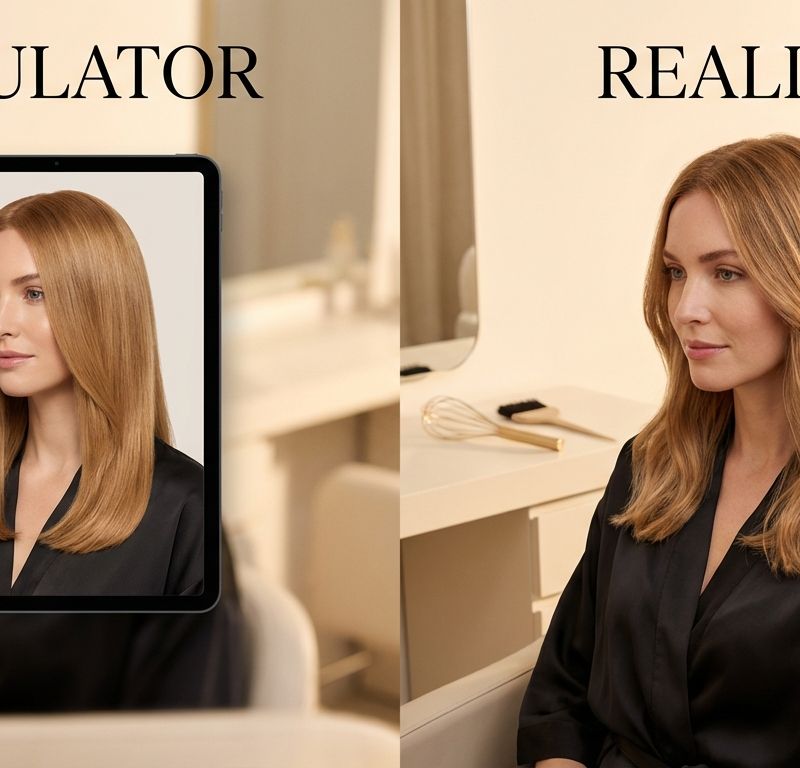
The difference is visible: an AR filter looks like an Instagram filter. Generative AI looks like a real photo.
What AI gets right (and what it doesn’t)
Based on analysis from The Right Hairstyles and data from Perfect Corp., here are the actual accuracy rates:
What works well
| Scenario | Accuracy | Why |
|---|---|---|
| Subtle changes (1-2 levels) | 89-92% | The final color is predictable when the change is small |
| Medium brown and dark blonde bases | 80-85% | Most intermediate bases respond well to simulation |
| Uniform techniques (all-over color) | 75-80% | Solid color is the easiest to simulate |
What doesn’t work as well
| Scenario | Accuracy | Why |
|---|---|---|
| Realism ceiling (best tools) | 70-80% | Even the best tools have a limit |
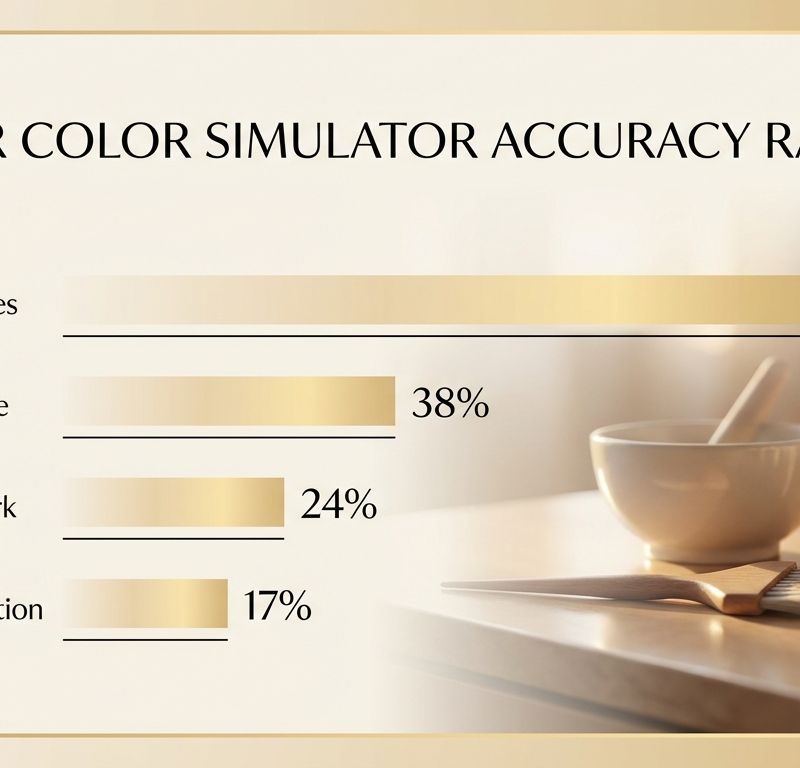
| Gray coverage | 38% | Gray hair absorbs color unpredictably — depends on texture and porosity |
| Pastels on dark bases | 24% | The simulator shows the “ideal” pastel, not the real result without bleaching |
| Brassiness prediction | 17% | Predicting how melanin reacts to lightening is nearly impossible |
| Lift prediction | 0% | No simulator calculates how much lightening you need |
The honest conclusion: AI color changers are excellent for giving you a general visual idea. They’re not a guarantee.
What the AI won’t tell you (but you should know)
1. How many sessions you’ll need
If you want to go from dark brown to platinum blonde, the AI shows you the end result — not the 3-5 intermediate steps to get there without destroying your hair.
2. Whether your hair can handle it
Chemical history matters. If you already have color, previous lightening, or straightening treatments, the real result can be very different from what the AI shows. The technology has no access to that information.
3. The real cost
A 1-2 level change might cost $80-150. Going from brunette to blonde could require $250-600 across multiple sessions. AI changers don’t include price estimates (but you can use the Blendsor service pricing calculator for guidance).
4. Ongoing maintenance
Copper needs touch-ups every 3-4 weeks. Ash blonde needs regular toning. Chocolate brown can last 8-10 weeks. The color you choose determines your maintenance routine.
How to use an AI color changer smartly
Think of it as an exploration tool, not an exact prediction. Here’s how to get the most out of it:
Do use it to:
- Rule out colors that clearly don’t flatter you
- Compare multiple shades and see which one you like best
- Bring a specific visual reference to your colorist
- Test trends that catch your eye before committing
Don’t use it to:
- Make a final decision without consulting a professional
- Assume the result will be identical in real life
- Evaluate whether your hair can handle the chemical change
Try it yourself
The Blendsor hair color simulator generates photorealistic results in seconds. Upload your photo, choose a color, and bring the image to your next salon appointment. Free, no sign-up required.
AI vs reality: 3 specific scenarios
Scenario 1: medium brown to honey blonde
- AI result: shows perfect result in 5 seconds
- Reality: requires 1-2 sessions of gentle lightening + toning. Result closely matches the simulation when done by an experienced professional
- Match rate: ~85%
Scenario 2: brunette to platinum
- AI result: shows clean, uniform platinum
- Reality: requires 3-5 sessions over 2-4 months. Intermediate steps include orange and yellow tones. The final result can match, but the journey is long
- Match rate: ~50-60% (improves with each session)
Scenario 3: copper on natural black hair
- AI result: shows vibrant copper
- Reality: without pre-lightening, copper will barely show on natural black hair. With lightening to level 6-7, the result approaches the simulation
- Match rate: ~40% without lightening, ~75% with lightening
Frequently asked questions
How can I see what I’d look like with a different hair color?
The fastest way is to use an AI color simulator. Upload your photo and see results in seconds. Simulators that use generative AI are more realistic than traditional AR filters.
How accurate are AI hair color changers?
For subtle changes (1-2 levels), accuracy is 85-92%. For dramatic changes (brunette to blonde), it drops to 50-60% because the AI doesn’t show intermediate steps or account for chemical variables. Always consult a professional for major changes.
Is there a free app to change hair color in photos?
Yes. The Blendsor simulator is free (3 simulations per day, no sign-up). Garnier and L’Oreal also offer free tools, though they’re limited to their own products. FaceApp and YouCam have limited free versions.
Does AI work the same on straight and curly hair?
Generative AI simulators respect natural hair texture (straight, wavy, curly). AR filters tend to work worse on curly hair because the overlay doesn’t adapt to the hair’s shape.
Is an AI simulator better than asking a colorist?
They’re complementary. The simulator helps you explore options and arrive at the salon with a clear visual reference. The colorist evaluates what the AI can’t: your hair’s actual condition, chemical history, and the technical feasibility of the change.
Can I trust AI results for gray hair?
With caution. Gray coverage has only 38% accuracy in the best simulators. Gray hair absorbs pigment differently based on its texture and porosity — something AI can’t predict.
Key takeaways
- AI color changers are useful but not perfect. 85-92% accuracy for subtle changes, much less for dramatic ones.
- Use them for exploration, not exact prediction. They’re the best way to rule out colors and find your favorite.
- AI + a professional = the best combination. Try colors in the Blendsor simulator and bring your favorites to your colorist.
See what you’d look like
Curious about how you’d look with a different color? The Blendsor color simulator generates photorealistic AI results — no filters, no sign-up, free.
Upload your photo and try it.
Related articles
Practice with our free tools
Calculators, neutralization wheel, AI consultation...
Master this technique with exact formulas
Blendsor generates the precise formula for each technique with your brand products. Try the mix calculator or download the app.
Download freeWritten by the Blendsor team
Professional hair colorimetry experts with experience in AI-assisted formulation. We combine color science, salon practice and technology to help colorists formulate with precision.