Professional Blonde Balayage: Formulas & Technique 2026
Professional blonde balayage formulas by type: natural, ash, platinum, and honey. Step-by-step technique, developers, timing, and mistakes to avoid.
Blendsor
Blendsor Team
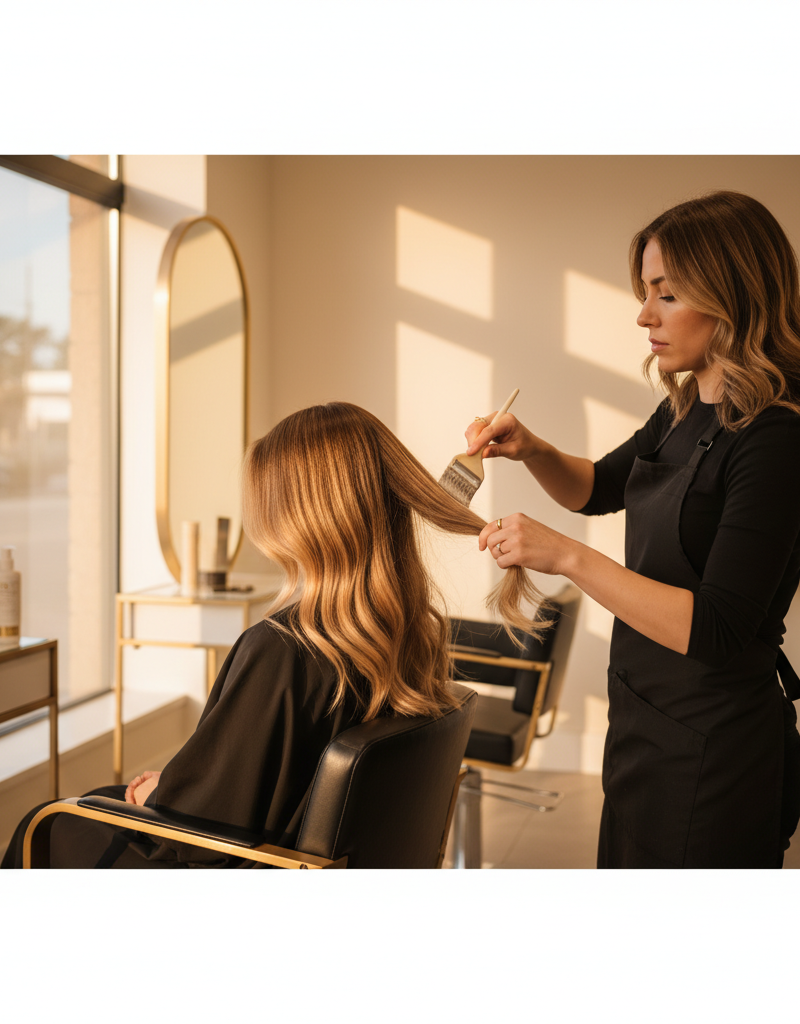
Does a client ask for a blonde balayage and five different formulas flash through your mind depending on their desired result?
If you’re a professional colorist, you know there’s no single “blonde balayage.” There are as many variations as there are shades of blonde: natural, ash, platinum, honey, dimensional. Each one requires its own formulation, developer volume, and processing time.
Blonde balayage remains the most requested technique in salons, but in 2026 it’s evolving toward softer, more lived-in, multidimensional finishes. This article is part of our complete guide to professional coloring techniques. Here you’ll find real formulas, step-by-step technique, and the mistakes that ruin results.
Types of blonde balayage and when to use each one
The first step before mixing is defining what type of blonde your client wants. According to the Professional Beauty Association, precise communication with the client about their desired outcome reduces touch-ups by 40%.
Each type has its own tone palette, target lightening level, and maintenance schedule.
| Type | Target level | Undertone | Maintenance | Best for |
|---|---|---|---|---|
| Natural | 7-8 | Warm golden | Low (every 10-12 weeks) | Clients wanting “sun-kissed” looks |
| Ash | 8-9 | Cool, violet | High (every 6-8 weeks) | Clients who hate warm reflects |
| Platinum | 9-10 | Ultra-cool | Very high (every 4-6 weeks) | Clients committed to maintenance |
| Honey | 7-8 | Warm golden-amber | Low-medium (every 8-10 weeks) | Warm skin tones, luminous effect |
| Dimensional | 6-9 (mix) | Cool/warm mix | Medium (every 8-10 weeks) | Clients seeking depth and movement |
Natural blonde balayage
The most requested and the most forgiving. You’re aiming for a gradual lightening effect that mimics what the sun would do: lighter on the ends and face-framing sections, with a natural root.
Works best on base levels 5-7. If starting from a level 3 or 4, consider foilyage first to achieve the lightening base.
Ash blonde balayage
The most technically demanding. You need to reach a clean underlying pigment (level 9 minimum) so the ash tone doesn’t turn greenish. If your client has residual orange undertones, check our guide to cool blondes without orange.
Platinum blonde balayage
Requires two-session lightening for dark base levels. Never attempt to lift more than 4-5 levels in a single session. Hair integrity is the priority.
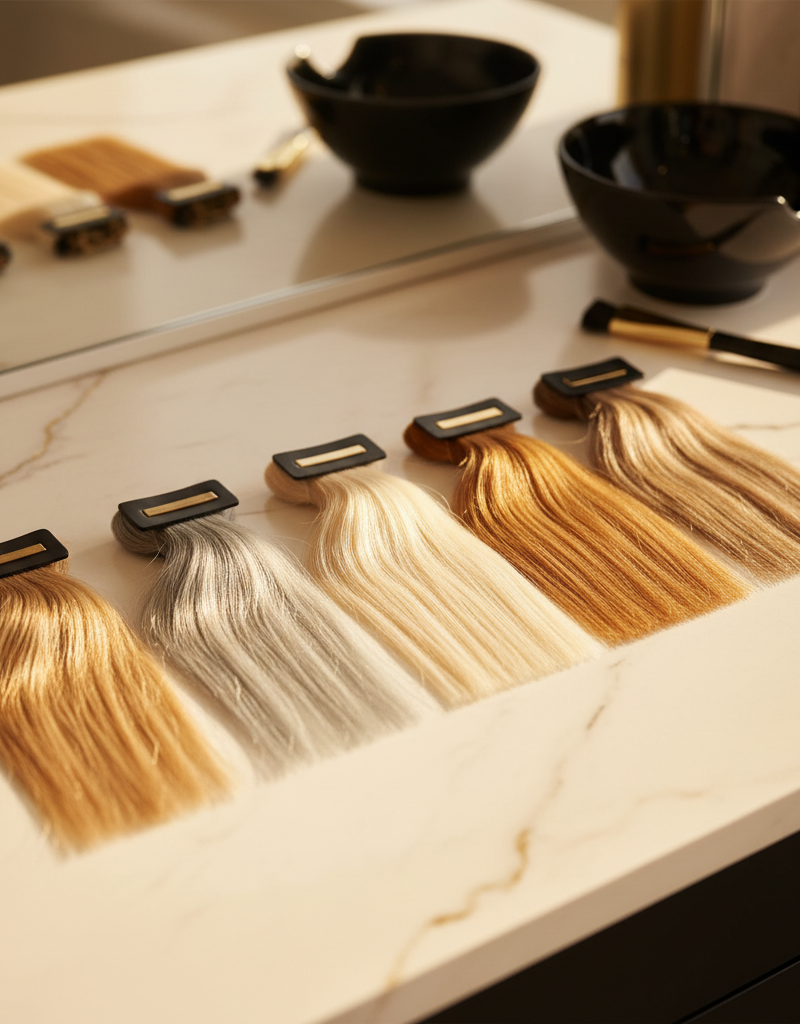
Professional formulation by blonde balayage type
This is where most articles about blonde balayage fall short. They don’t give you formulas. We do.
These formulas are guidelines that should be adapted to each client’s base level, porosity, and color history. What matters is understanding the logic behind each one.
Lightening formulas (first phase)
| Blonde type | Lightener | Developer | Ratio | Max time |
|---|---|---|---|---|
| Natural (level 5-7) | Clay-based lightener | 20 vol. | 1:2 | 35-40 min |
| Ash (level 5-7) | Blue powder lightener | 30 vol. | 1:2 | 40-45 min |
| Platinum (level 4-6) | Violet powder lightener | 30 vol. (1st session), 20 vol. (2nd) | 1:2 | 45 min max |
| Honey (level 5-7) | Clay-based lightener | 20 vol. | 1:2 | 30-35 min |
| Dimensional | Blue/clay lightener (by zone) | 20-30 vol. (by zone) | 1:2 | 35-40 min |
Pro tip: In balayage, the 1:2 ratio (lightener:developer) creates a creamier consistency that adheres better for freehand application. A 1:1 ratio makes the mix too thick and doesn’t blend well.
Toning formulas (second phase)
After lightening, toning is what defines the final result. Choose your formula based on the target tone:
| Blonde type | Toner/Color | Developer | Ratio | Time |
|---|---|---|---|---|
| Natural | 8.3 + 9.0 (50/50) | 10 vol. | 1:1.5 | 15-20 min |
| Ash | 9.1 + 10.1 (60/40) | 10 vol. | 1:1.5 | 15-20 min |
| Platinum | 10.1 + 10.21 (50/50) | 10 vol. | 1:1.5 | 10-15 min |
| Honey | 8.3 + 8.34 (70/30) | 10 vol. | 1:1.5 | 15-20 min |
| Dimensional | Root: 7.0 + 7.1 (50/50) / Ends: 9.0 + 9.3 (60/40) | 10 vol. | 1:1.5 | 15-20 min |
Choosing the right developer volume is critical in toning. Always use 10 vol. to deposit without lifting, since the hair is already compromised from lightening.
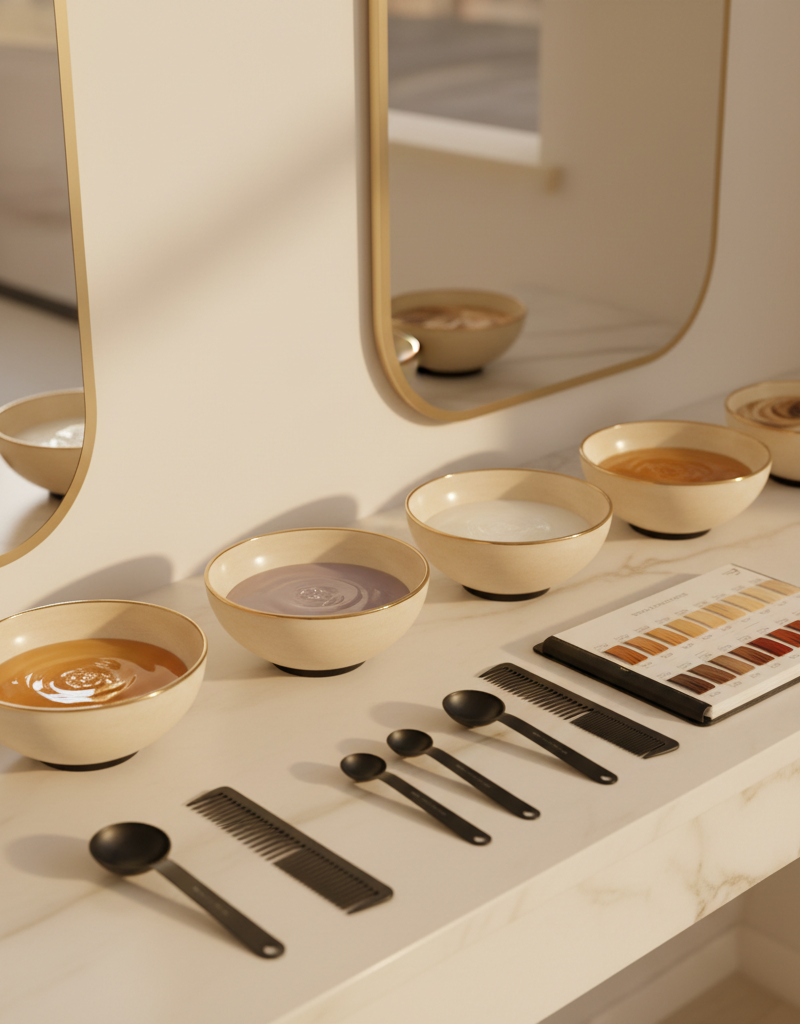
Step-by-step blonde balayage technique
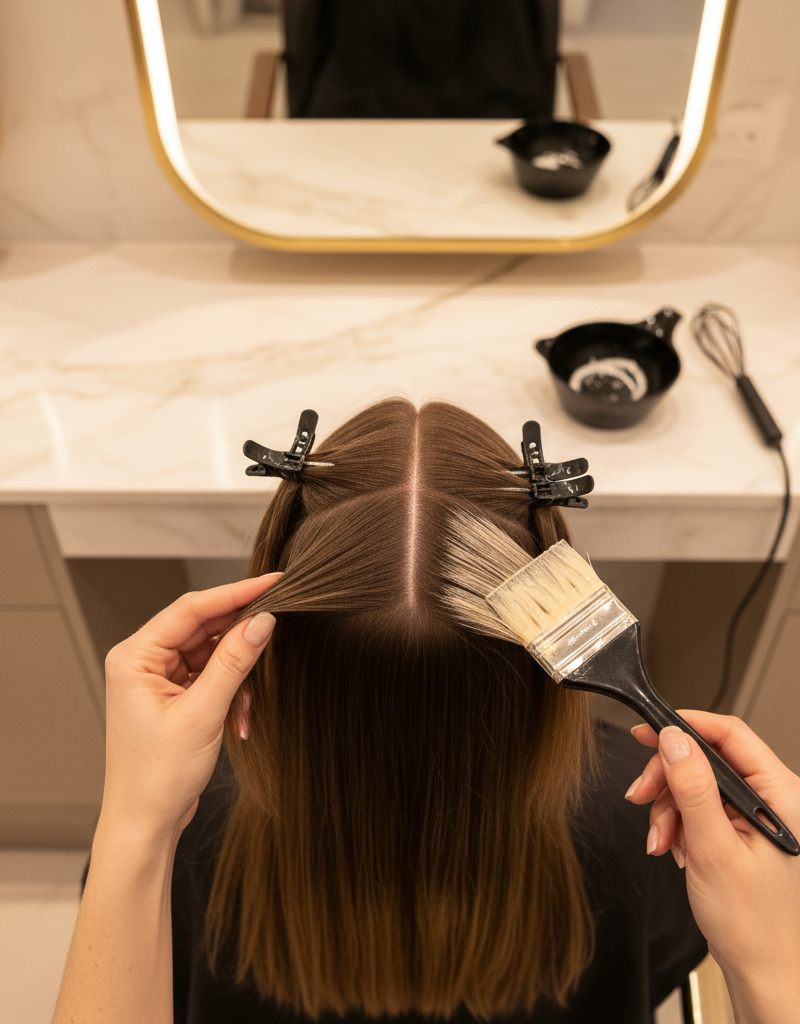
Balayage is a freehand technique. No foil is used (that would be foilyage or traditional highlights). The key lies in brush control and saturation.
Preparation
- Diagnose: Natural level, porosity, color history, hair condition
- Agree on the result: Show references and confirm tone, intensity, and placement
- Section: Divide into 4 quadrants (2 front, 2 back) then into subsections of 1-2 cm
Application
- Start at the nape: Lower back sections process slower due to lower body temperature
- Load the brush: Apply lightener to your hand palette and load the brush on both sides
- Paint with upward strokes: Start 4-6 cm below the root. More product on ends, less on mids. The blend comes from variable pressure
- Work upward: Front and face-framing sections get more lightening than back sections
- Saturate the ends: The last third should have maximum saturation for maximum contrast
Processing control
- Check every 10 minutes: Open a strand from each zone to verify the lift
- Don’t exceed max time: A second pass is better than damaged hair
- Rinse by zone if needed: If the ends have reached the target level but the mids haven’t, rinse the ends and reapply on mids only
Toning
- Wash with acid shampoo: Close the cuticle before toning
- Apply toner on damp hair: Porosity is more uniform
- Watch the development: Especially with ash tones, which can go from perfect to greenish in 5 minutes
Common blonde balayage mistakes that ruin results
After thousands of formulas generated with Blendsor, these are the errors we see most frequently:
- Horizontal banding: Happens when you apply the same amount of product throughout the strand. Solution: less product at the top of the stroke, more at the ends. The motion should be like painting a canvas, not spreading butter
- Yellow tones on ash blondes: The underlying pigment didn’t reach the necessary level. For ash you need a pale yellow base (level 9 minimum). If you see orange, don’t tone — keep lightening or schedule a second session
- Harsh root line: The blend failed. The transition between natural color and lightened hair should be invisible. Practice “teasing” (gentle backcombing) at the root of each section before applying
- Scalp exposure: Applying too close to the root. Always keep 2-3 cm minimum distance from the scalp on upper sections
Pro tip: If your balayages come out with bands, try alternating two section thicknesses: fine sections (0.5 cm) interleaved with thick ones (1.5 cm). This breaks up uniformity and creates the natural effect clients want.
Blonde balayage trends for 2026
Blonde balayage is evolving. These are the variations shaping 2026:
| Trend | Description | Key difference |
|---|---|---|
| Lived-in blonde | Darker root, very gradual transition | Less maintenance, beautiful “grown-out” effect |
| Color melting + balayage | Fusion of 2-3 tones with no visible lines | Combines balayage with color melting |
| Dimensional blonde | Mix of lights and depths | Uses dimensional technique |
| Face-framing blonde | Lightening focused on face contour | Only 15-20 pieces, maximum impact |
The “lived-in blonde” is the natural evolution of classic balayage. The client visits less often, the result looks beautiful even with 3 months of regrowth, and hair integrity is better preserved.
Blonde balayage vs traditional highlights: when to choose each
Not everything is balayage. Sometimes your client needs foil highlights:
| If the client wants… | Recommended technique |
|---|---|
| Natural effect, low maintenance | Balayage |
| Maximum uniform lightening | Foil highlights |
| Lightening on very dark hair (level 1-3) | Foilyage first, then balayage |
| Depth and dimension | Dimensional balayage |
| Defined contrast | Highlights + balayage combined |
Frequently asked questions
How long does a full blonde balayage take?
A full blonde balayage takes between 2 and 4 hours, depending on the base level and desired result. A touch-up can be done in 1.5-2 hours. If you need two-session lightening (platinum from dark levels), schedule 2 appointments 3-4 weeks apart.
What’s the difference between natural and ash blonde balayage?
Natural blonde balayage uses golden, warm tones (.3, .33 series) and allows more room for error because warm undertones disguise irregularities. Ash blonde balayage requires reaching a higher underlying pigment level (9+) and uses cool series (.1, .21). It’s technically more demanding and requires more maintenance.
Can you do blonde balayage on dark-dyed hair?
Yes, but with caution. Permanent dark dye creates an artificial base that lifts differently than natural color. You need to do a strand test first and use a color remover if there are accumulated layers of dye. Never attempt to lift more than 3 levels on previously colored hair.
How much does a blonde balayage cost at a salon?
Prices vary by city and salon level, but a professional full blonde balayage typically ranges from $150 to $400 in the US and £100 to £300 in the UK. The price depends on hair length, base level, and whether one or two sessions are needed.
How to maintain blonde balayage between sessions?
Use sulfate-free shampoo, a purple pigment mask once a week (for ash and platinum), protect from heat, and avoid prolonged chlorine exposure. A well-done natural blonde balayage can last 10-12 weeks without losing its effect.
Key takeaways
- Diagnose before formulating: The type of blonde balayage depends on the base level, porosity, and client expectations
- Toning defines the result: Lightening only prepares the canvas. The toner is what turns lift into ash, platinum, or honey blonde
- Less is more at the root: Natural blending comes from variable pressure and progressive separation, never from product at the root
Calculate professional formulas with AI
Want to generate custom blonde balayage formulas based on each client’s starting level?
Try Blendsor free - 5 formulas per month, no credit card required.
What type of blonde balayage do your clients request most?
Related articles
Practice with our free tools
Calculators, neutralization wheel, AI consultation...
Master this technique with exact formulas
Blendsor generates the precise formula for each technique with your brand products. Try the mix calculator or download the app.
Download freeWritten by the Blendsor team
Professional hair colorimetry experts with experience in AI-assisted formulation. We combine color science, salon practice and technology to help colorists formulate with precision.