Home Hair Dye vs Salon: When Is It Worth Going to a Professional?
Home hair dye vs salon coloring: cost comparison, risks, and when to DIY vs when you need a pro. Practical guide with real numbers.
Blendsor
Blendsor Team

You’re standing in the drugstore aisle, staring at a $12 box of hair dye. And you’re thinking: “Why would I spend $150 at a salon when I can do this myself?”
It’s a fair question. And the answer isn’t always “go to the salon.” There are changes you can do perfectly well at home and others where trying would be an expensive mistake.
This guide helps you decide when a professional is worth it and when you can handle it yourself.
Direct comparison: home vs salon
| Factor | Home dye | Professional salon |
|---|---|---|
| Cost per session | $8-20 (box dye) | $60-250 (depending on service) |
| Time | 45-90 minutes | 1-3 hours |
| Customization | Limited (standard box color) | Full (custom formula) |
| Error risk | Medium-high for big changes | Low (professional assessment) |
| Gray coverage | Good with permanent dye | Excellent (adapted technique) |
| Predictable result | Depends on your hair | Highly predictable |
| Correction if it goes wrong | Difficult and costly | Often included in service |
| Potential damage | Higher (no prior diagnosis) | Lower (controlled products and technique) |
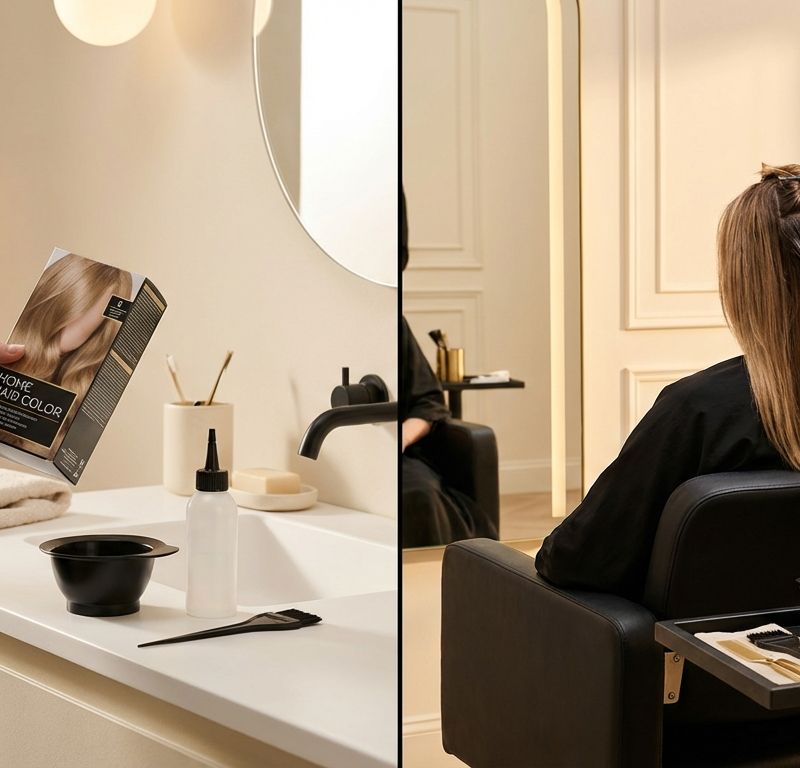
When you can dye at home (safely)
Going 1-2 shades darker
Blonde to light brown, or light brown to medium brown. The process is straightforward, the risk low. A quality box dye does an acceptable job.
Maintaining your current color
If you already have a color you love and just need root touch-ups or to refresh the tone, home dye is viable. Especially if you use the same brand and shade your colorist does.
Semi-permanent dyes or glosses
These products don’t open the cuticle and wash out gradually. If you want to try a copper reflection or a cooler tone, the risk is minimal: if you don’t like it, it disappears on its own.
Gray root coverage (between salon visits)
A root touch-up at home with permanent dye in the same shade is perfectly acceptable between salon appointments. Many colorists actually recommend it.
Before buying the dye: try the color on your photo with the Blendsor simulator. That way you can be sure it’s the shade you want before opening the box.
When you should NOT dye at home
Lightening more than 2 levels
Any significant lightening requires controlled bleaching. Box dyes labeled “light blonde” on dark hair don’t deliver what the box promises — they deliver orange.
Switching from warm to cool (or vice versa)
Going from golden blonde to ash blonde seems simple, but it requires neutralizing warm pigments. Without color theory knowledge, the result is often greenish or muddy.
Color correction
If your hair already has a color you don’t like (orange, green, patchiness), correcting it at home almost always makes it worse. Color correction is one of a colorist’s most complex skills.
Highlights, balayage, or babylights
These require selectively applying product to specific sections. Without training and proper tools, the result is uneven and unnatural.
Previously damaged hair
If your hair is already dry, porous, or fragile, adding box dye without a prior assessment can cause significant additional damage.
The real cost: home vs salon per year
Let’s do the math for a typical case (gray coverage + color maintenance every 6-8 weeks):
| Item | Home | Salon | Hybrid (salon + home touch-ups) |
|---|---|---|---|
| Dye/service | $10-15 x 8 = $80-120 | $100-180 x 8 = $800-1,440 | $120-180 x 4 + $12 x 4 = $528-768 |
| Care products | $60-120 | $60-120 | $60-120 |
| Corrections | $150-400 (if it goes wrong) | $0 (included) | $50-150 |
| Annual total | $290-640 | $860-1,560 | $638-1,038 |
The hybrid approach is usually smartest: salon every 3-4 months for the full service + root touch-ups at home in between. You save 35-45% compared to always going to the salon.
You can use the service pricing calculator to estimate costs for your specific situation.
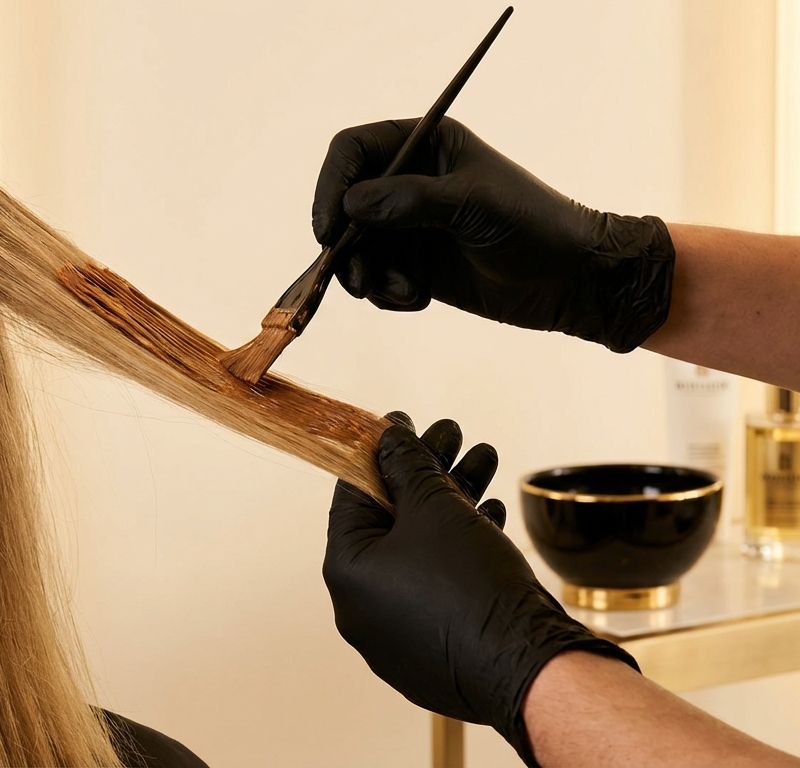
Common mistakes when dyeing at home
-
Choosing color by the box photo: the model on the box has a different starting color than you. The real result depends on YOUR current level and tone.
-
Skipping the allergy test: about 3% of people react to hair dye. A patch test 48 hours before can prevent a serious reaction.
-
Leaving dye on longer “for more color”: processing time is carefully calculated. More time doesn’t mean more color — it means more damage.
-
Applying to wet hair: permanent dye should be applied to dry hair. On wet hair, water dilutes the product and the result is uneven.
-
Mixing brands or dye types: every brand has its own formulation. Mixing products from different brands can produce unpredictable reactions.
A simple decision tree
What do you want to do?
- Go 1-2 shades darker → Home (fine)
- Touch up roots in the same color → Home (fine)
- Semi-permanent dye to experiment → Home (fine)
- Lighten more than 2 levels → Salon (always)
- Change tone (warm/cool switch) → Salon (recommended)
- Highlights, balayage, techniques → Salon (always)
- Color correction → Salon (always)
- First time coloring → Salon (recommended)
Frequently asked questions
Is it bad to dye your hair at home?
Not necessarily. For simple changes (going darker, root touch-ups, semi-permanent dyes), home coloring is viable and budget-friendly. Problems arise with complex changes: lightening, color correction, highlighting techniques. There, the error risk is high and fixing mistakes costs more than the salon visit would have.
How much does salon hair coloring cost?
In the US, a single-process permanent color typically ranges from $75-150. A full service with highlights or balayage can be $150-300 or more, depending on the salon, technique, and hair length.
Are box dyes worse than professional dyes?
Generally yes. Box dyes use standard formulations with a single developer (usually 20 vol.) that doesn’t adapt to each hair type. Professionals adjust the formula (dye type, developer volume, processing time) for each individual. The result is more precise and potentially less damaging.
Can I use box dye between salon appointments?
Yes, for root touch-ups in the same shade. Many colorists actually recommend it. The key: use the same dye number as your salon or one very similar. Don’t experiment with new colors between appointments.
How can I tell if a color would suit me before buying it?
Use the Blendsor color simulator. Upload your photo, try the color you’re interested in, and see the result in seconds. This way you avoid buying a dye that doesn’t flatter you.
How long does box dye last vs professional dye?
A permanent box dye lasts the same as a professional one (until it grows out). The difference is in color quality: professional dyes tend to give more natural, uniform tones with better shine. Box dyes can look flatter.
Key takeaways
- Home works for: going darker, root touch-ups, temporary dyes, maintenance between visits.
- Salon is needed for: lightening, tone changes, highlighting techniques, correction, damaged hair.
- Smartest approach: hybrid (salon every 3-4 months + home touch-ups). Saves 35-45%.
- Before deciding: try the color on the Blendsor simulator to be sure.
Not sure which color to choose?
Before heading to the salon or buying a box, try colors on your photo with the Blendsor simulator. Free, no sign-up, results in seconds.
Better informed, better decision.
Related articles



Manage your salon intelligently
Blendsor does more than formulas: organize client files, color history and keep your whole team in sync.
See BlendsorWritten by the Blendsor team
Professional hair colorimetry experts with experience in AI-assisted formulation. We combine color science, salon practice and technology to help colorists formulate with precision.