Bond Builder Dosage in Lightener: Exact Chart & Where It Goes
Bond builder dosage in lightener, per Olaplex: foil and balayage charts, when to add it to the bowl, and why not to bump your developer to compensate.
Blendsor
Blendsor Team
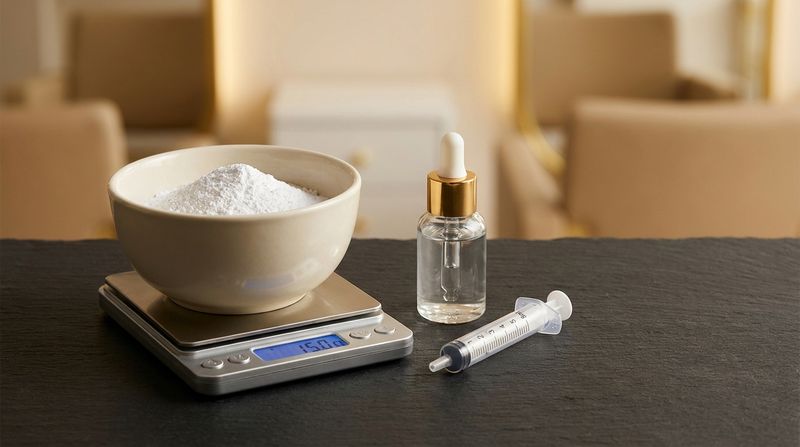
How many times have you added bond builder to the bowl by feel, assuming more is better?
There is a constant tension in daily salon work: you want to protect the hair, but the dose isn’t obvious from the bottle, and the person in your chair is waiting. You have to decide now.
The good news: the best-known brand does publish a number, by product weight and by application type. And understanding it changes how you lift.
Quick summary: Bond builder dosage in lightener is not guesswork. Olaplex publishes it for its No.1 by the grams of lightener (developer not included) and by how you apply it, with a separate row for hair color. At that dose, its instruction is plain: Do NOT bump developer. Below you’ll find the charts, when to add it, and where it makes sense and where it doesn’t.
What Does a Bond Builder Do Chemically?
When the oxidative process breaks a disulfide bond, each end is left as a loose sulfur (-SH). Olaplex explains in its manual that, without protection, that sulfur can end up bonded to three oxygen atoms and form cysteic acid, which “erodes the protein from the hair.”
What the brand says No.1 does is get there first: it pairs with that loose sulfur “faster than the three oxygen molecules can form” and builds “a permanent bridge between the two broken bonds.” In other words, it doesn’t claim to restore the original bond as it was; it builds its own bridge between the two broken ends. The manual doesn’t publish the reaction chemistry in more detail, and we won’t claim more than it says.
The practical takeaway: if the bond builder works while bonds are breaking, it has to be in the bowl from the start. Added later, it arrives too late.
Picture curly hair with previous color that you’re about to take through a full lightening service. Before you mix anything, that history calls for a strand test with the exact mix you’ll use, bond builder included: it tells you how far it lifts and what condition the hair comes out in. On that same lightened strand, run an elasticity test; if it stretches and doesn’t bounce back, rethink the service before you think about dosage. And if a toner with developer follows, do the allergy test 48 hours beforehand, as color manufacturers require in their instructions (Wella puts it this way in its Koleston Perfect leaflet: “Always perform an allergy test 48 hours before any color service.”). Step by step: the strand test, the hair elasticity test and scheduling the 48-hour allergy test. For what’s specific to curls, see bleaching curly hair.
For a deeper look at how oxidation affects the hair’s internal structure, see our professional bleaching guide.
The Exact Dose: Off-Scalp and On-Scalp Chart
This is the part that really matters, and where the most mistakes are made.
Olaplex publishes its No.1 doses on two pages of its professional manual, Lightener / Bleach in Foils and On Scalp Lightener, and brings them together in its Mixing Chart. The grams always refer to product without developer: “Measurements are based on color/bleach powder/clay/cream without developer.” Before you lock in your protocol, check that the Olaplex guide you’re working from is the current one.
Lightener in Foils (Off-Scalp)
| Lightener powder, clay or cream (no developer) | Olaplex No.1 dose |
|---|---|
| Less than 30 g | 1/16 oz (1.875 ml) |
| 30 to 60 g | 1/8 oz (3.75 ml) |
Balayage, Global and On-Scalp Application
Here each tier gets half the dose, measured in ounces. The Mixing Chart calls this table “Balayage & Global Lightening Application”; the manual page calls it “On Scalp Lightener.” Note where balayage sits: Olaplex puts it with this dose rather than the foil one, even though it’s worked away from the scalp and its developer is chosen as in point C below.
| Lightener powder, clay or cream (no developer) | Olaplex No.1 dose |
|---|---|
| Less than 30 g | 1/32 oz (1 ml) |
| 30 to 60 g | 1/16 oz (1.875 ml) |
Pro tip: Olaplex tells you to measure with the dispenser that comes with the bottle (“Use attached dosing dispenser to measure correct amount of OLAPLEX needed”). If you’d rather use a graduated syringe, pick one marked in milliliters, especially for the small doses in the second table. You weigh the lightener on a scale; you measure the bond builder. Never eyeball it.
The Exact Moment to Add It
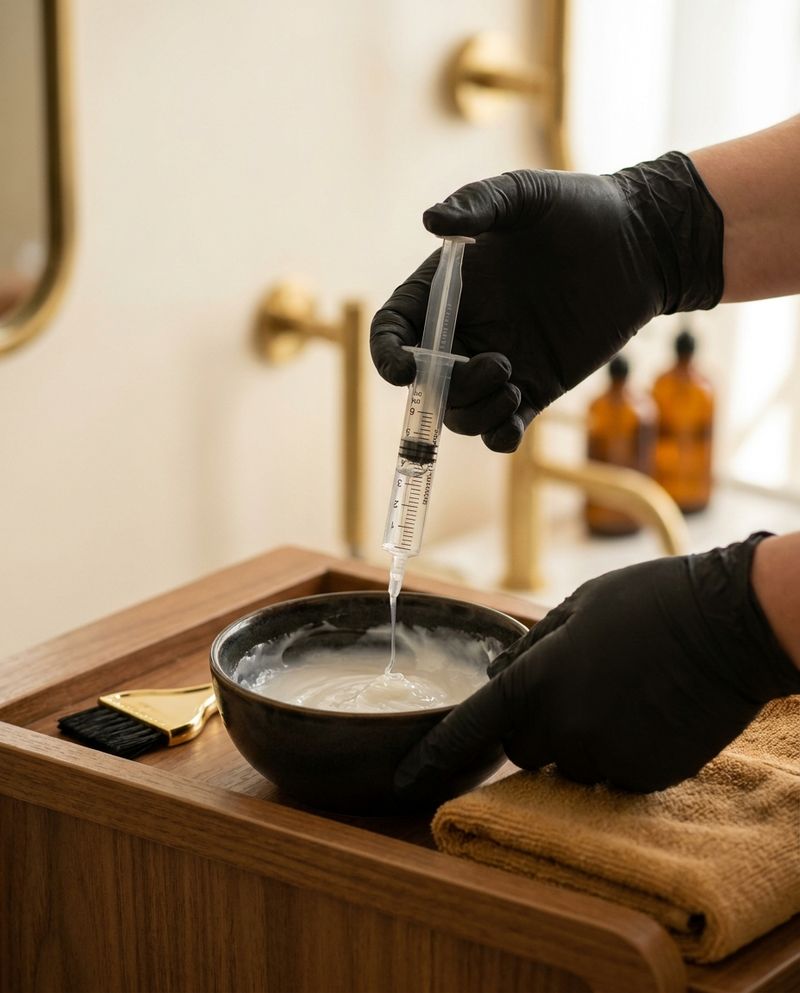
The bond builder goes into the already-mixed lightener and developer, not into the dry powder. That’s what Olaplex asks for: “Add OLAPLEX to your premixed Lightener and mix thoroughly.” The order is:
- Mix the lightening powder with the developer until you reach a uniform consistency.
- Add the bond builder at the dose the chart gives for that weight and that application.
- Blend with a brush or spatula until fully incorporated.
Where the Bond Builder Goes, and Where It Does Not
In the Lightener Bowl: Yes, Always
Oxidative lightening is the harshest step of the service, and it’s where Olaplex places the work of its No.1. Dose matters here, and here you stick to the chart.
In Hair Color: Yes, With Its Own Row
Plenty of colorists ask how pros mix bonders into their color formulas, not only their bleach. Olaplex’s Mixing Chart has a separate table, “All Hair Color,” built on the same gram logic: for 30-60 g of color, “1/16 oz. (1.875 mL)” of No.1; for less than 30 g, “1/32 oz. (1 mL).” Again, the grams are color without developer, and the brand describes its product as “compatible with all color lines.” If you work with a different bond builder, the dose for color comes from that brand’s guide; don’t carry Olaplex’s numbers over.
The Developer: What To Do and What Not To Do
Three things to keep clear:
(A) Do NOT bump developer to “recover” lift after adding the bond builder. Olaplex prints it next to every dose on both of its lightener pages: “Do NOT bump developer.” If the lift falls short, first check that you didn’t go over the chart, then review technique and processing time, always within what your lightener’s instructions allow. Bumping developer as a patch is exactly what the brand tells you not to do.
(B) On the scalp, your lightener sets the developer ceiling. Wella puts it in writing for its Blondor powders: for on-scalp application, developer “not exceeding 6%/20 Vol.”, and its UK manual specifies for root or full-head application “Welloxon Perfect 6% as a maximum.” Every lightener lists its own limit, and yours is the one that counts, with or without a bond builder.
(C) Off the scalp (foils, balayage, highlights), developer volume comes from your diagnosis and the lightener’s instructions. The same Blondor manual allows, for techniques away from the scalp, “Welloxon Perfect Pastel or Welloxon Perfect 6%, 9%, or 12%.” Choosing a higher volume because the base and the hair call for it is diagnosis; choosing it to cover up a dosing mistake is the error in point A.
In Toner or Gloss: Afterwards, Without Skimping on the Bowl
Olaplex includes the toner step too. On its lightener pages, after rinsing and shampooing, it says to mix the toner “with the recommended amount of OLAPLEX No.1.” What makes no sense is skimping in the lightener bowl and trying to make up for it in the toner: the harshest step is already behind you.
Some lines also come with a bond builder built in. Redken describes Shades EQ Bonder Inside as “an all-in-one toner and bonder,” formulated “with Citric Acid and Taurine.” Before adding an external bond builder to a product like that, read its technical data sheet.
What you use afterwards, outside the bowl, is a different family of products: treatments that say they repair bonds. We read the sheets of eight, Olaplex No.3PLUS and K18 among them, in what each one repairs.
Why the Ratio Changes Everything, and the Most Common Mistakes
Think of it this way: you can get the dose wrong in two opposite directions.
Under the chart: you use less product than the brand specifies for that weight of lightener. You’re no longer following its protocol, and there’s no reason to expect the protection it describes. If the hair feels weaker than expected a few days later, check how much went into the bowl first.
Over the chart: Olaplex doesn’t publish what happens if you go over. What you hear in salons, and it’s shop-floor reasoning, not brand data, is that a bowl with more liquid than planned lifts less or less evenly. Whatever the cause, the fix is to weigh and measure properly next time, and leave the developer alone.
The chart is the only reference the brand publishes, so use it as written.
What the chart doesn’t look at is each head of hair’s history. Very porous hair, hair with previous lightening or with layered treatments doesn’t change Olaplex’s dose, which goes by grams and application type, but it does change everything else: developer volume, processing time, and whether lightening today is a good idea at all. The strand test answers that.
To understand how porosity affects this calculation, we recommend reading our article on hair porosity and coloring.
Another frequent scenario: hair with metal buildup. Wella explains it in its Koleston Perfect technical guide, which covers a permanent color, not a lightener: metals come from water and from the body, they are “more concentrated in the porous hair ends,” and together with peroxide they generate radicals that “can attack and break the bonds, cause damage and disturb the colour formation.” The bond builder chart doesn’t account for that; it gets diagnosed before you lift. You will find more information in our article on metals in hair and bleaching.

Frequently Asked Questions
Can I use a bond builder with any lightener brand?
Olaplex says yes for its No.1: “OLAPLEX® is compatible with all lighteners including powder, cream, and oil-based.” What changes is lighteners that already have a bond builder inside: with those, read the technical data sheet before adding another.
Can I use 40 vol with a bond builder for highlights?
Olaplex doesn’t set any volume: its only instruction about developer is not to raise it because you added No.1. Whether 40 vol (12%) fits is up to your diagnosis (the base, the porosity, the lift you need) and your lightener’s instructions; Blondor’s, for example, allows up to 12% for techniques away from the scalp. What you must NOT do is reach for 40 vol to fix a short lift caused by too much bond builder.
What if I forget to add the bond builder before the lift and the product is already applied?
Olaplex asks for it in the mix before application and gives no directions for adding it once the product is on. If you forget, finish the service carefully, consider a reconstructive treatment in the salon after shampooing, and note it in the client’s history so you can adjust the protocol next time.
Does the dose change if I use a higher developer volume for an aggressive lift?
Not in Olaplex’s chart: it is organized by grams of lightener and by application type, not by developer volume, and every lightener row carries the same instruction, “Do NOT bump developer.” The developer volume itself stays within what your lightener’s instructions allow.
Does this work the same with other bond builders on the market, not just Olaplex?
The chart belongs to Olaplex and applies to its No.1. Other bond builders publish their own doses, and they don’t have to match. Follow the guide for whichever brand you’re mixing with.
In Summary
- According to Olaplex, No.1 pairs with the sulfur left loose by oxidation and builds its own bridge between the two broken ends; it doesn’t restore the original bond.
- It goes into the already-mixed lightener and developer, not into the dry powder.
- Olaplex doses by grams of lightener without developer: in foils, 1/16 oz (1.875 ml) for less than 30 g and 1/8 oz (3.75 ml) for 30-60 g; for balayage, global and on-scalp application, 1/32 oz (1 ml) and 1/16 oz (1.875 ml).
- In hair color, its “All Hair Color” table gives 1/32 oz (1 ml) for less than 30 g of color and 1/16 oz (1.875 ml) for 30-60 g. With another bond builder, follow its own guide.
- Don’t bump developer to compensate (“Do NOT bump developer”). On the scalp, your lightener’s instructions set the ceiling; off the scalp, your diagnosis decides within those instructions.
- You can add it to toner as well, but not at the expense of the lightener bowl.
- The dose doesn’t change with hair history; the rest of the service does, and the strand test tells you how.
Formulate with Blendsor and keep each client’s chemical history at hand before you lift.
What happens if you dose the bond builder wrong while bleaching?
In the app, we ask you a question like this one, but about your own client.
Up for this week’s case? → More on blondes and lightening →Related articles
Practice with our colorimetry tools
Calculators, neutralization wheel, AI consultation...
The Blendsor newsletter
Color techniques and trends for professionals. No spam.
A client in the chair right now?
The Blendsor advisor gives you the precise formula for this technique with your salon's brands — and saves it to your client's card.
Ask about your caseWritten by the Blendsor team
Professional hair colorimetry experts with experience in AI-assisted formulation. We combine color science, salon practice and technology to help colorists formulate with precision.