Dimensional Blonde: Avoid Flat Hair
Learn how to create multidimensional blondes that shimmer with light and depth. Techniques, formulas, and mistakes to avoid for vibrant blonde results.
Blendsor
Blendsor Team
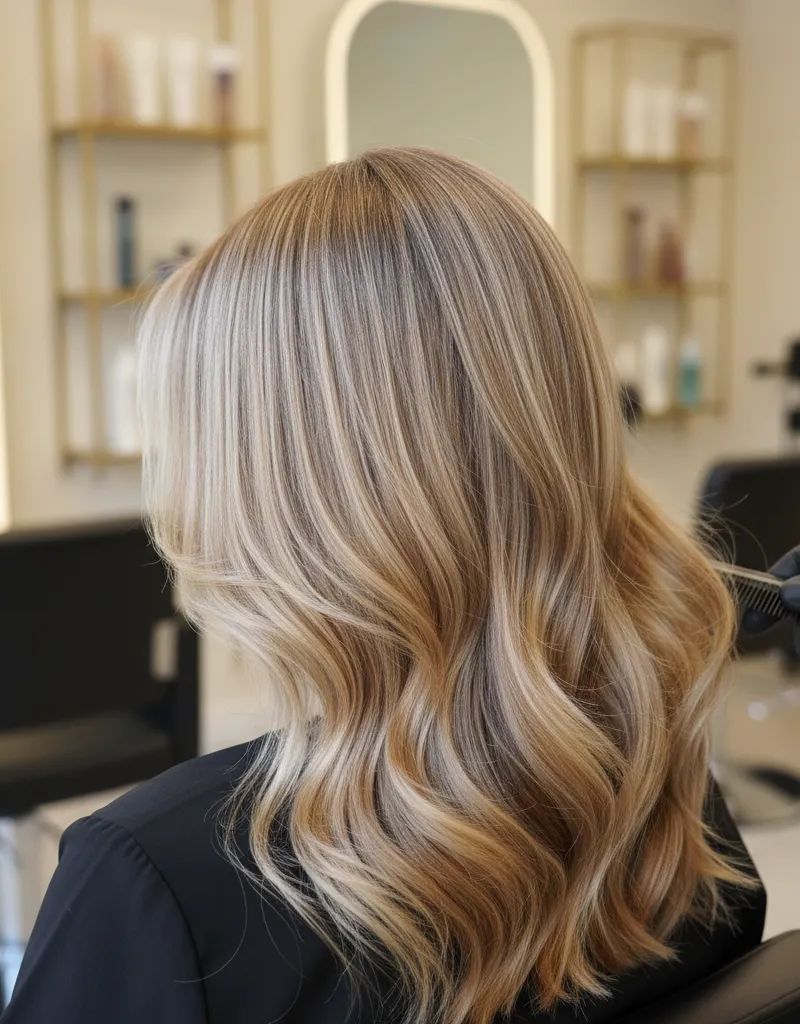
Does your client leave the salon with a gorgeous blonde only to text you two weeks later saying it looks “dull”? Or worse: she checks the mirror before leaving and you can already see the color looks like a single, flat block with no movement?
If you’re a professional colorist, you know exactly what I’m talking about. Dimensional blonde is the difference between a blonde that looks like a wig and one that looks lit from within. The good news? The technique isn’t complicated — it’s strategic.
In this article, you’ll learn what makes a blonde look flat, how to combine techniques for real dimension, and the formulas that actually work in the salon. This is part of our complete guide to professional coloring techniques.
Quick summary: Dimensional blonde combines at least 2-3 tones within the same palette, creating light and shadow contrasts that mimic natural hair movement. The three main methods are highlights+lowlights (3:1 ratio), babylights in 1-2 mm sections, and shadow root+balayage. A translucent toner is mandatory — an opaque gloss can flatten all the work in seconds.
What Is Dimensional Blonde and Why Does It Matter?
Dimensional blonde combines at least 2-3 different tones within the same palette to create plays of light and shadow that the eye perceives as natural movement. A flat blonde uses a single uniform tone; dimensional blonde integrates highlights 2-3 levels above the base and lowlights 1-2 levels below. According to Behind The Chair, it’s the most requested blonde technique among clients seeking sophisticated, low-maintenance color.
Dimensional blonde is a blonde that combines at least 2-3 different tones within the same palette, creating plays of light and shadow that mimic natural hair movement. According to Behind The Chair, it’s one of the most requested techniques by clients seeking sophisticated, low-maintenance blondes.
A flat blonde uses a single uniform tone. A dimensional blonde mixes:
- Highlights: the brightest zones, typically 2-3 levels above the base tone
- Lowlights: strategic shadows, 1-2 levels below
- Base tone: the canvas that ties everything together
The key is controlled contrast. It’s not about placing random highlights — it’s about creating a graduation that the eye perceives as natural depth.
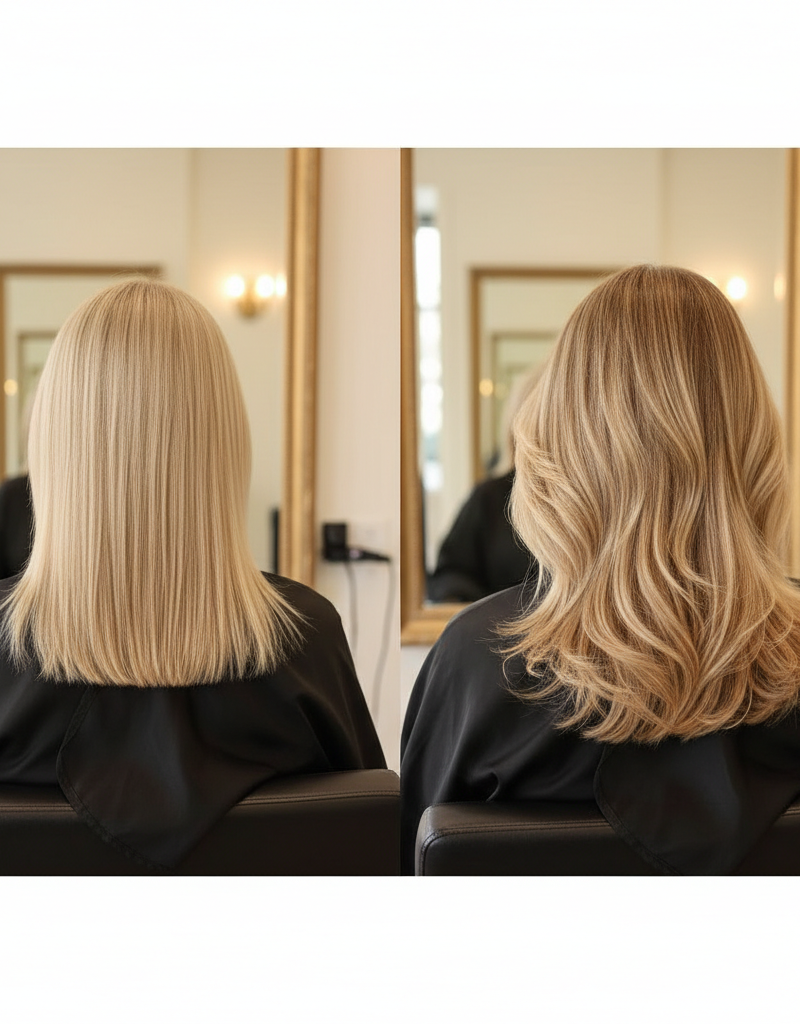
Why Blonde Goes Flat
Before talking solutions, understand the problem. Blonde loses dimension for these reasons:
- Uniform lightening: Applying the same volume and formula across the entire head kills contrast
- Overly opaque toner: A heavy gloss covers the nuances and flattens everything (find the right family with our toner selector)
- Session buildup: Each touch-up adds lightening on top of lightening, erasing natural shadows
- Washing and sun: Color oxidizes uniformly, blurring tonal differences
Pro tip: If your client comes in with flat blonde, before adding more highlights, think about adding depth. Sometimes the solution isn’t to lighten more but to darken strategically.
What Are the 3 Techniques to Create Dimensional Blondes?
The three techniques for dimensional blondes are: highlights + lowlights combined (the most versatile, with bright foils at the face frame and crown, dark foils at nape and interior), babylights in 1-2 mm sections (for dimension without obvious contrast), and shadow root + balayage (the lowest maintenance option, with a 2-4 cm blended dark root giving natural depth).
There’s no single way to achieve dimension. Depending on your client’s base and desired result, you can combine these three techniques.
1. Highlights + Lowlights Combined
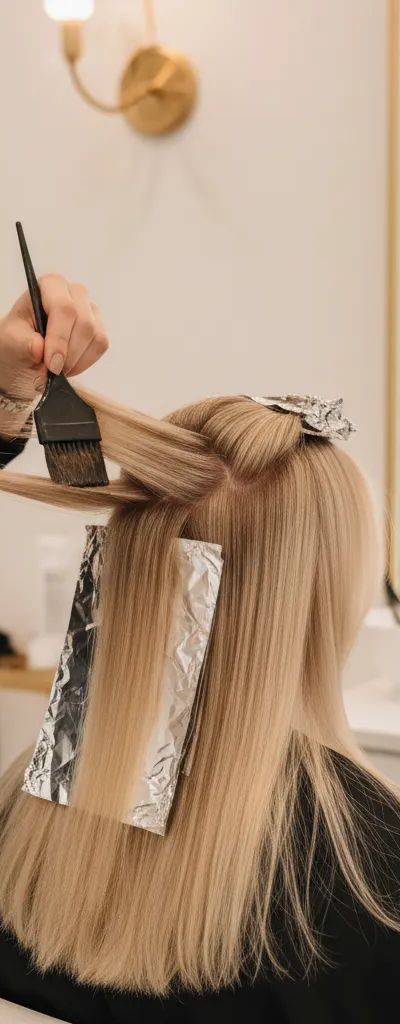
The classic and most versatile technique. Apply light foils where you want maximum luminosity (face frame, crown, ends) and dark foils where you need depth (nape, interior, root area).
Example formula (level 7 base):
| Zone | Technique | Formula | Volume |
|---|---|---|---|
| Face frame & crown | Highlights | Lightener + 30 vol | 30 min |
| Interior & nape | Lowlights | 6N + 7 vol | 20 min |
| Global toner | Gloss | 9V + 9P (1:1) + 7 vol | 10 min |
For a deeper understanding of how lowlights work, check out our guide on lowlights: dark highlights for depth and dimension.
2. Babylights for Natural Transition
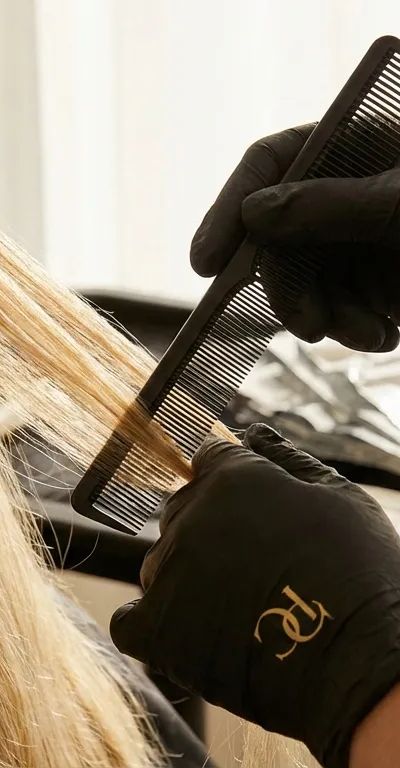
When your client wants dimension but without obvious contrast, babylights are your best tool. By taking ultra-fine sections (1-2 mm), you create a diffused effect that simulates how the sun naturally lightens hair.
The advantage of babylights for dimensional blondes is that you can alternate light and dark sections so fine that the eye can’t distinguish where one ends and the other begins. The result is a blonde that vibrates with light.
For the complete step-by-step technique, check our article on babylights: the technique for ultra-natural highlights.
3. Shadow Root + Balayage
This combination is perfect for clients who want low-maintenance blonde. The shadow root creates a blended dark root of 2-4 cm that provides natural depth, while balayage generates the lights from mids to ends.
Example formula (level 5 base):
| Zone | Technique | Formula |
|---|---|---|
| Root (2-4 cm) | Shadow root | 5N + 6 vol |
| Mids to ends | Balayage | Lightener + 20 vol |
| Ends toner | Gloss | 10V + 7 vol |
The difference from a simple balayage is that the root stays untouched by lightener. This creates a dark anchor that gives context to the lights and makes the entire look richer.
How Do You Formulate a Dimensional Blonde Step by Step?
Formulating a dimensional blonde follows 4 steps: diagnose current contrast (0-1 visible tones = needs full dimension work, 4+ = needs unifying), define a 3-tone palette within a maximum 4-level range, apply strategic zone distribution (face frame = lightest, nape = darkest), and select a translucent toner that preserves all the tonal nuances you just created.
Here’s the process I follow when a client asks for “a beautiful blonde with movement”:
Step 1: Diagnose Current Contrast
Before picking up a brush, analyze how many different tones you can see on your client’s head. If you only see one, you need to create at least 2-3 levels of difference.
- 0-1 visible tones = flat blonde, needs full dimension work
- 2-3 visible tones = has some dimension, reinforce it
- 4+ visible tones = may have too much contrast, unify
Step 2: Define Your Dimensional Palette
Choose 3 tones within a range of 4 levels maximum:
- Dark tone (shadow): your lowest reference
- Medium tone (base): the dominant tone that will be most visible
- Light tone (highlight): your highest point
Example for cool dimensional blonde:
| Role | Level | Reflect | Example |
|---|---|---|---|
| Shadow | 7 | Ash | 7.1 |
| Base | 8 | Natural-ash | 8.01 |
| Highlight | 10 | Violet | Lightener + toner 10V |
If you’re working with cool blondes, you’ll want to read how to achieve cool blonde without orange tones.
Step 3: Strategic Distribution
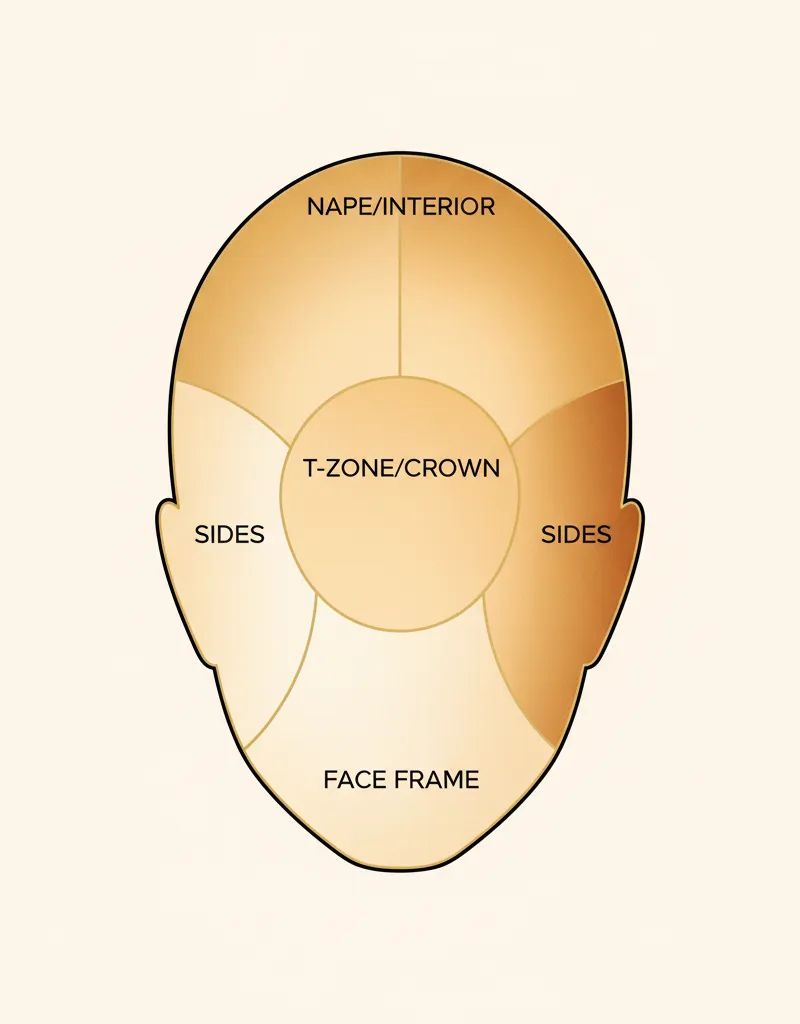
It’s not just about which tones you use, but where you place them:
- T-zone (forehead + part): lightest tone (maximum luminosity where it’s most visible)
- Crown: mix of light and medium
- Sides: medium tone predominates
- Nape & interior: dark tone (creates depth without being directly visible)
- Face frame: always the lightest (illuminates features)
Step 4: Toner Selection
The toner is where many colorists lose the dimension they just created. If you apply an opaque, uniform gloss across the entire head, you’ll flatten the work.
The rule: use a translucent toner (demi-permanent or gloss) and, if possible, apply slightly different tones to the light zones and shadow zones.
For a better understanding of the different highlighting techniques, check our article on highlights vs lowlights: differences and when to use each.
What Mistakes Flatten Blonde Hair and How Do You Avoid Them?
The four mistakes that flatten dimensional blonde are: using the same volume (30 vol) throughout the entire head (use 20 vol on ends, 30 vol on roots), skipping lowlights thinking that more highlights equals more dimension (minimum 3:1 ratio), applying a single opaque toner from root to tip (use a translucent gloss starting from mids), and lightening to the same underlying pigment across all zones (allow different zones to reach different bases for built-in dimension).
According to Wella Professionals, these are the most common mistakes when trying to create dimensional blondes:
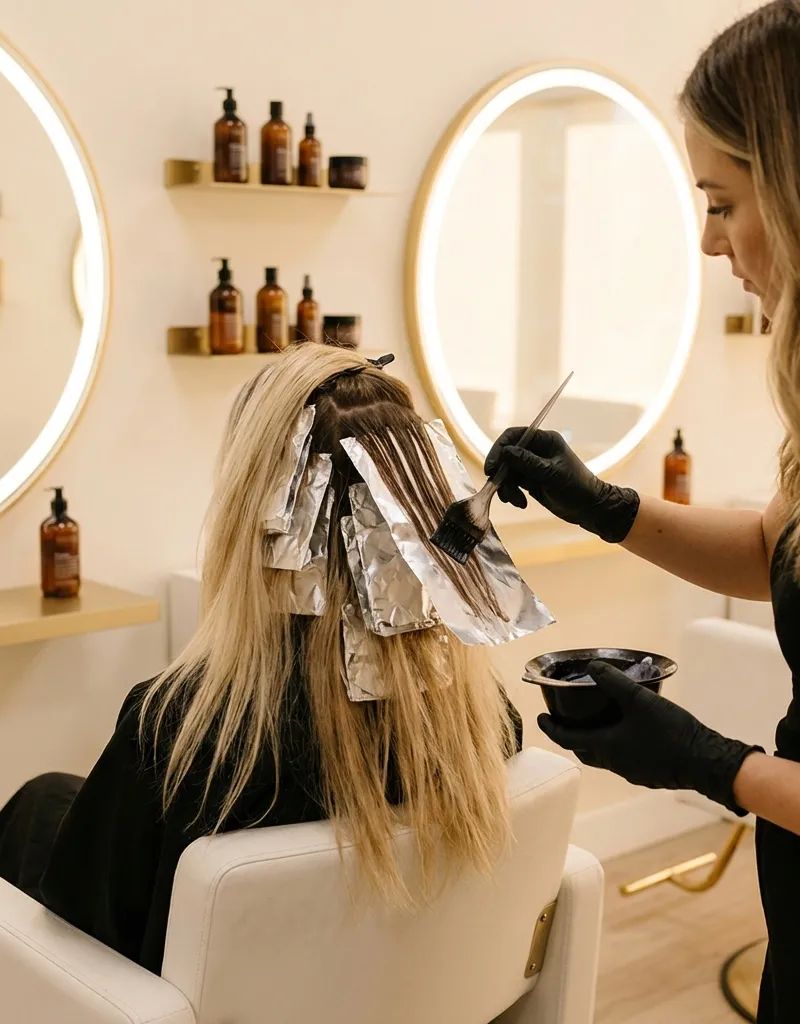
1. Same Developer Volume Everywhere
The mistake: using 30 volume from root to tip because “it lifts faster.”
The fix: adapt the volume by zone. Ends, which are already more porous, need less power. Use 20 vol on ends and 30 vol on roots for even lifting without over-processing.
2. Skipping the Lowlights
The mistake: thinking that dimension = more highlights. Without shadows, there are no lights.
The fix: for every 3 highlights, include at least 1 lowlight. The 3:1 ratio is a solid starting point.
3. Opaque Uniform Toner
The mistake: applying a single dense toner from root to tip that covers all the nuances.
The fix: use a translucent gloss and apply it first on mids and ends (where you want more color deposit), then emulsify toward the root (where you want less deposit).
4. Not Respecting Underlying Pigment
The mistake: lightening to the same underlying pigment across the entire head.
The fix: allow different zones to reach slightly different underlying tones. The nape can stay at a level 8 base (gold) while the crown reaches level 10 (pale yellow). That difference is dimension.
Frequently Asked Questions
How many levels of difference does a dimensional blonde need?
A minimum of 2-3 levels of difference between the darkest and lightest tone. Less than 2 levels reads as a single color. More than 4 levels can look like overly marked highlights.
Does dimensional blonde work on fine hair?
It works especially well. The tonal interplay creates an optical illusion of greater density and volume. On fine hair, prefer babylights over chunky highlights for smoother transitions.
How often does a dimensional blonde need touching up?
Between 8 and 12 weeks, depending on the technique. If you use shadow root, the grow-out blends better and you can stretch to 14 weeks. It’s one of the lowest-maintenance blondes.
Can you convert a flat blonde to dimensional in one session?
In most cases, yes. If the flat blonde is at levels 8-10, you can add lowlights and re-tone in a 2-3 hour session. If additional lightening is needed, two sessions may be necessary.
What maintenance products should you recommend?
Sulfate-free shampoo to preserve the toner, purple mask once a week for cool blondes, and heat protectant always. Proper maintenance is the difference between dimension lasting 4 weeks or 12.
Key Takeaways
- Dimensional blonde combines 2-3 strategic tones to create depth and movement
- The key techniques are highlights + lowlights, babylights, and shadow root + balayage
- Zone distribution matters as much as the formula
- Translucent toner preserves dimension; opaque toner kills it
- Recommended ratio: 3 highlights for every 1 lowlight
Want scientifically precise formulas calculated for each zone of the head? Try Blendsor free.
Related articles

Practice with our free tools
Calculators, neutralization wheel, AI consultation...
The Monday Briefing
Color techniques and trends for professionals. No spam.
Master this technique with exact formulas
Blendsor generates the precise formula for each technique with your brand products. Try the mix calculator or download the app.
Download freeWritten by the Blendsor team
Professional hair colorimetry experts with experience in AI-assisted formulation. We combine color science, salon practice and technology to help colorists formulate with precision.