Hair Color Processing Time: The Variable Most Colorists Ignore
Processing time is a chemical variable, not a rough guideline. The window for each process according to the brand's chart, and why going past it adds no color.
Blendsor
Blendsor Team
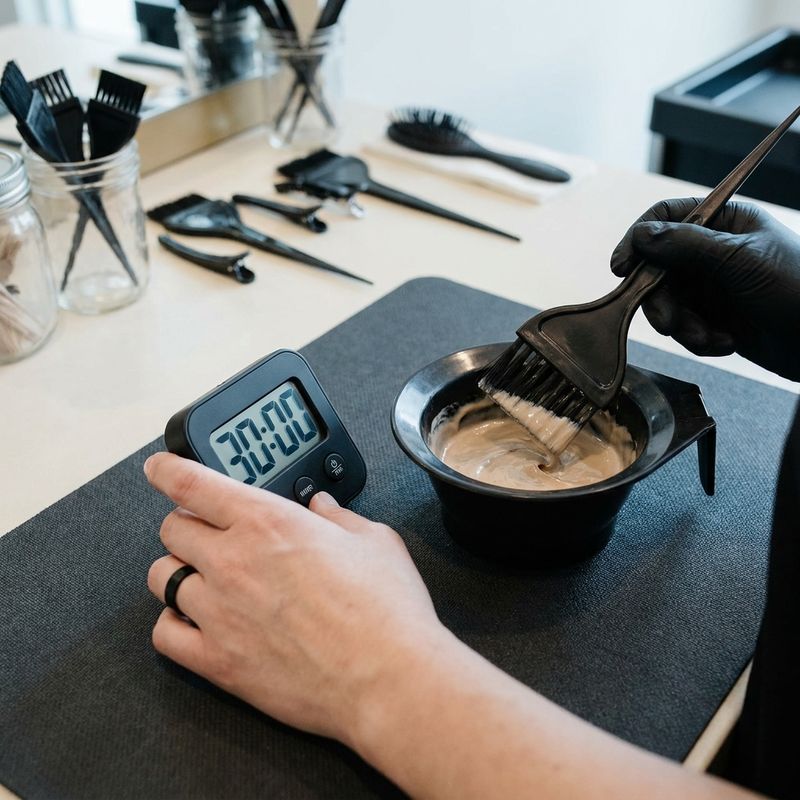

How many times have you left the color on “a little longer” because coverage didn’t look right?
If the answer is more than once, you are not alone. Processing time is the most frequently adjusted variable in the coloring process — and, paradoxically, the least understood. Most professionals treat it as a flexible margin. It isn’t.
Hair color processing time is a chemical variable with a defined start, a performance curve, and an endpoint governed by the kinetics of hydrogen peroxide. Understanding it means predicting results instead of improvising around them.
Quick summary: Hair color processing time is not approximate: it is the window during which hydrogen peroxide and dye precursors react inside the hair, and each line sets that window in its chart. Permanent color, with or without gray: your chart’s window (Koleston Perfect, for a regrowth application or same depth: 30-40 min without heat, 15-25 with Climazon). Demi-permanent: its chart’s window (Color Touch, per Wella US: 20 min without heat). Toner or gloss service: its chart’s window (IGORA VIBRANCE, per Schwarzkopf Professional US: up to 20 min). In permanent color, once the window closes no additional pigmentation occurs: only residual alkaline damage. In demi-permanents and glosses, going past it can darken or over-saturate.
Why Is Processing Time a Chemical Variable, Not an Estimate?
Processing time is the interval during which hydrogen peroxide (H₂O₂) performs two simultaneous functions: oxidizing the hair’s natural melanin and polymerizing dye precursors to form the final chromophore. Once that reaction completes its cycle, adding more time does not produce more color — it only increases the alkaline aggression on the fiber.
The hair dye chemistry review published in ACS Omega describes permanent color formation as a chain: the oxidant transforms the primary intermediate (such as p-phenylenediamine, PPD), which bonds with the couplers and keeps polymerizing until it forms the color molecule. How long that takes depends on pH, reaction time, temperature and how fast the components diffuse into the fiber. The review gives no minutes: each manufacturer sets those for its own formula.
That is why the number that counts is the one on your line’s chart. Once that window closes, what remains on the hair are alkaline residues that add no color but do cause dryness and fiber fragility.
To understand how the condition of the cuticle affects the speed of that process, read our guide on hair porosity and coloring.
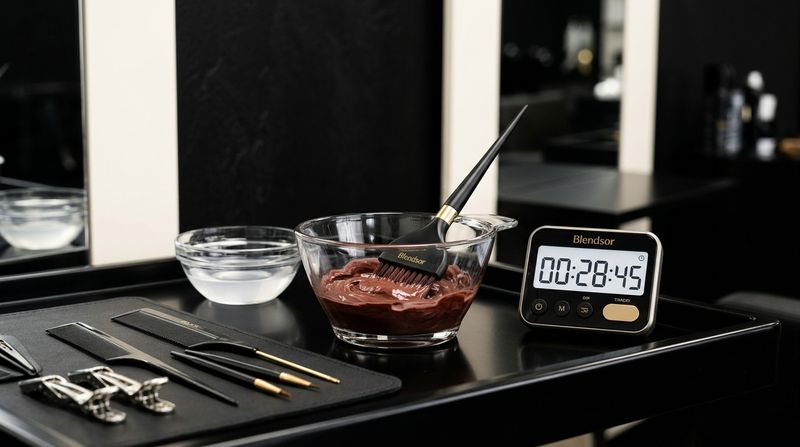
How Much Processing Time Does Each Service Require?
The correct answer is not the same for every service. It depends on the product type and the goal. Here is the window for each type of process, with an example from a brand’s chart and the underlying chemistry.
Two days before the timer, the allergy test: Wella’s global Koleston Perfect leaflet says to always perform an allergy test 48 hours before any color service, and the same leaflet says that if there is redness, burning or itching, or if the client has ever had an allergic reaction to hair color, you should not color. It is a skin test, not a hair test: if the hair arrives sensitized, also check its elasticity and do a strand test with your formula and your timing before applying to the whole head.
Permanent Color for Gray Coverage: The Full Window
Gray hair behaves like hair with functional low porosity: its cuticle is compact and there is no melanin left to add color, so the dye has to supply all of it. That demands the full reaction time so that dye precursors can penetrate, couple, and polymerize.
The full processing time is set by your line’s shade chart, and it is not the same across brands. For Koleston Perfect, Wella publishes a 30-40 minute window without heat (15-25 with Climazon) for a regrowth application, the same for gray coverage as for lightening. Other houses publish slightly longer windows. The number that counts is the one on the chart in your hand, not a general figure.
What happens if you rinse early? The pigment has not completed polymerization in the gray zone and coverage remains incomplete. What about leaving it longer? Past the ceiling your chart sets, the chemical reaction is done. What continues to act on the hair are alkaline residues that cause dryness, scalp irritation, and fiber fragility — without any additional color deposit.
Professional tip: with resistant gray, use the whole window on your chart (with Koleston Perfect, up to minute 40 without heat), but do not go past the ceiling. If it still has not covered by then, rinse anyway and note in the client file where it did not cover: what changes is the formula and the application at the next visit, not today’s minutes. The coverage boost your chart indicates, the product placed generously instead of stretched, and the developer your brand assigns to coverage. Heat, if your chart allows it, is decided before you start, with its own time, and is not added at the end. Pre-softening with developer alone or changing the mixing ratio: only if your chart says so.
Standard Permanent Color (Tone Change, No Gray Coverage): The Same Window
For level changes or pigment deposit on non-gray hair, the window is also set by your line’s chart. For Koleston Perfect, at same depth or darker, and in a regrowth application also for lightening, it is the same as with gray: 30-40 minutes without heat, or 15-25 with Climazon. The same leaflet gives Special Blonde and first-time lightening on virgin hair their own times: that service starts on lengths and ends and leaves the roots for last.
Leaving the color on longer does not add more saturation once the reaction has concluded. If the result is lighter than expected, check the developer volume and that the full window was used; adding minutes past the ceiling will not fix it.
Demi-Permanent and Semi-Permanent: Your Chart’s Window
Demi-permanent formulas are ammonia-free and are mixed with a low-strength emulsion. Without ammonia, which is what helps swell and open the cuticle, the pigment works closer to the surface and the window is usually shorter. A sourced example: in its Color Touch filling guide, Wella US gives 20 minutes without heat, or 15 with heat.
Going past that window can produce the opposite of the intended effect: the pigment may over-saturate the cuticle, leaving the result darker or flatter than planned.
Toners and Gloss Services: The Shortest Window
A toner or gloss is not meant to lift: it deposits color mainly in the outer layers of the fiber, and goes deeper the more porous the hair. Those that work at acid pH also contract the cuticle instead of opening it.
Processing time is short by design and depends on the product and the service. A sourced example: IGORA VIBRANCE, which Schwarzkopf Professional US presents as demi-permanent hair color, takes 5 to 20 minutes for a gloss service. Going past that window can cause over-deposit: a result darker or more saturated than planned, especially on high-porosity hair.
| Service | Time (chart example) | Chemical Basis |
|---|---|---|
| Permanent color, gray coverage | your chart’s window (Koleston Perfect: 30-40 min) | Full polymerization in compact cuticle without melanin |
| Permanent color, standard | your chart’s window (Koleston Perfect, same depth or regrowth: 30-40 min) | Developer and precursors form the color molecule inside the fiber |
| Demi-permanent / semi-permanent | its chart’s window (Color Touch, Wella US: 20 min without heat) | No ammonia: the cuticle opens less and pigment stays closer to the surface |
| Toner / gloss | its chart’s window (IGORA VIBRANCE, Schwarzkopf US: 5-20 min as a gloss) | Deposit without aiming to lift, mainly in the outer layers of the fiber |
| Bleaching | Check often, within the lightener’s chart limit (Blondor Multi Blonde: 50 min) | Variable by formula, base level and porosity: no fixed time |
Bleaching: The Exception Without a Fixed Time
Bleaching deserves its own section because it has no universal optimal time. The speed of lightening depends on the formula, developer volume, temperature, hair porosity, and starting level. No time chart can substitute for checking the strand often during processing.
What does have a ceiling is the time on the lightener’s chart: for Blondor Multi Blonde, Wella says do not exceed 50 minutes, and if the lightener goes on the scalp, the same fact sheet calls for a 6% developer or below. If the desired level has not been reached, stop, treat the hair, and plan a second session.
What Actually Happens When Hair Is Over-Processed?
Over-processing is not synonymous with “more color” — it is damage without benefit. When processing time exceeds the optimal reaction window, residual peroxide and alkaline ammonia residues continue acting on the fiber with no productive purpose. The result is three types of cumulative damage:
- Cuticle damage: Cuticle scales lift permanently, increasing porosity and accelerating color loss in subsequent washes.
- Cortex weakening: The keratin forming the hair’s internal structure degrades, reducing elasticity and increasing breakage.
- Uneven results: On hair with zones of varying porosity, over-processing amplifies the differences — the most damaged zones absorb and release pigment at different rates.
This is why going past the window is no safety margin: it is damage with no color in return. We review this and other mistakes in our guide to common color formulation mistakes.
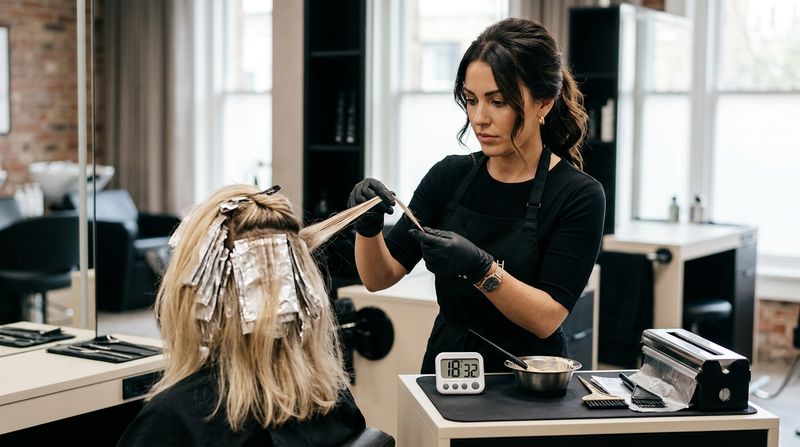
Which Factors Shift the Processing Time?
Your chart’s window sets the limits. Three variables decide where you land within them:
Heat
Heat accelerates chemical kinetics. The higher the temperature, the faster the reaction, which is why the chart gives the heat time separately. For Koleston Perfect, the window goes from 30-40 minutes to 15-25 with Climazon. Use your chart’s heat time, not a rough discount on the no-heat time.
Hair Porosity
High-porosity hair absorbs pigment faster because the cuticle is already open. That means the reaction occurs earlier, and over-processing arrives earlier too. For very porous hair, such as lengths that are already colored or sensitized, the fix is not rinsing early, which would leave the roots half-processed: apply to the porous lengths later than to the roots, so they process for less time, and watch them from the moment you cover them.
Low-porosity hair, on the other hand, may need the full processing time, or heat if your chart allows it, using that chart’s heat time, to facilitate penetration. For information on diagnosing each client’s porosity, see our guide on hair porosity and coloring.
Ambient Temperature
In a cool salon, kinetics slow down. If you work with strong air conditioning in summer or insufficient heating in winter, do not judge the result at the minimum of the window: plan to reach your chart’s maximum (with Koleston Perfect, minute 40 without heat) and do not go past it. If it still falls short at the maximum, minutes are not the fix: plan the next visit with your chart’s heat time or a warmer station.
If your problem is the opposite, a hot salon, we cover it in how salon temperature affects hair color results.
How to Manage Time When Attending Multiple Clients
A timer is not optional. It is a professional tool.
The most common mistake is not ignorance of the times — it is trusting one’s perception of time while attending multiple clients simultaneously. The solution is simple: one timer per client with an active process. Many professionals use their phone, but there are apps designed to manage multiple concurrent timers.
Record the start time in each client’s file as well. If you need to step away from the station, you will have the exact reference when you return.
Blendsor records service details — formula, developer, and processing time — so they are documented in each client file and you can replicate results with precision on future visits. Start using Blendsor with your first formulations included.
Frequently Asked Questions
Is It Harmful to Leave Color on Longer for Better Coverage?
No. Once the optimal reaction window closes, pigment does not increase. What continues to act are alkaline residues that damage the fiber without adding color. If coverage is insufficient once your line’s window is used up, what needs reviewing is the formula and the application — shade, product load, developer — not adding minutes past the ceiling on the chart.
Does Processing Time Change With Developer Volume?
Developer volume determines the degree of lightening. Its effect on time depends on the line: some charts give the same window for every volume and others lengthen it as the volume goes up. Use the time on your line’s chart for that developer.
How Long Does a Toner or Gloss Need?
It depends on the line. A sourced example: Schwarzkopf Professional US gives IGORA VIBRANCE up to 20 minutes, 10-20 for an all-over or regrowth application and 5-20 for a gloss service. Watch the tone the whole time, because deposit speed varies with porosity.
Does Rinse Water Temperature Affect the Result?
None of the manuals we checked says so. What they do spell out is the step: when the development time is complete, Wella’s instructions for Koleston Perfect say to add a little warm water, emulsify and rinse thoroughly. The idea that cold water “seals” the pigment, or that very hot water washes it out, is widespread, but none of those documents says so, so treat it as trade lore.
The timer you set when you apply color is the cheapest and most underrated tool at your station.
What happens if you leave dye on for more or less time than indicated?
In the app, we ask you a question like this one, but about your own client.
Up for this week’s case? → More on global color →Related articles
Practice with our colorimetry tools
Calculators, neutralization wheel, AI consultation...
The Blendsor newsletter
Color techniques and trends for professionals. No spam.
You know the theory. What about today's case?
Send a photo to the Blendsor advisor and get an answer grounded in colour theory: toner, developer and timing, with the brands on your shelf.
Ask about your caseWritten by the Blendsor team
Professional hair colorimetry experts with experience in AI-assisted formulation. We combine color science, salon practice and technology to help colorists formulate with precision.