How to organize hair color formulas in your salon
The color formula record is your salon's most valuable operational asset. Which fields to track, how to structure it, why it protects retention.
Blendsor
Blendsor Team

A client walks into the salon. They haven’t been in for eighteen months. “I want the same as last time,” they say.
Do you have the formula?
If the answer takes more than ten seconds to surface — or there is no answer at all — you’re looking at one of the most costly problems in the color business: loss of reproducibility. Not loss of clients. Loss of information.
Quick summary: A hair color formula record is the document that captures the technical parameters of each color service — diagnosed base level, porosity, dye code, developer, processing time and actual result. Without it, every visit starts from scratch. With it, the formula is exactly reproducible, retention improves and the salon becomes transferable.
Clients don’t disappear because they change their color. They disappear because you can’t reproduce it, and they can’t explain it either.
What makes a color formula record that survives over time?
A formula record that survives is not an administrative document. It is a technical operational record: the exact parameters that allow you to reproduce the service faithfully months later, regardless of who carries out the work.
There are attractive records and there are useful records. They are not always the same thing.
The essential fields in an operational record are:
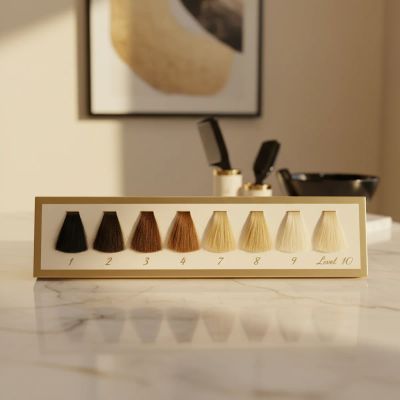
- Actual diagnosed base level — not what it looks like at first glance, but what was confirmed with a shade guide at the nape under neutral light. To go deeper on accurate level identification, read our hair color levels guide.
- Diagnosed porosity — low, medium or high. It determines how pigment behaves and the speed of absorption.
- Exact dye code — brand, line, shade number. Not “a light brown”:
6.34 IGORA Royal,6N Redken Chromatics. Commercial names are unreliable if the brand redesigns its packaging in six months. - Developer and concentration — volume and brand. See our developer volumes guide if you need to review selection criteria.
- Ratios and gram weights — in grams, not “by eye”. A 1:1.5 with 60 g of color is reproducible. “Plenty of mix” is not.
- Actual processing time — the time that was respected, not the theoretical target.
- Actual result vs. expected result — the difference is information. If you aimed for a cool 7 and got a slightly warm neutral 7, that is an adjustment worth documenting.
- Post-processing adjustments — was a toner applied? A protein treatment? Was the rinse modified?
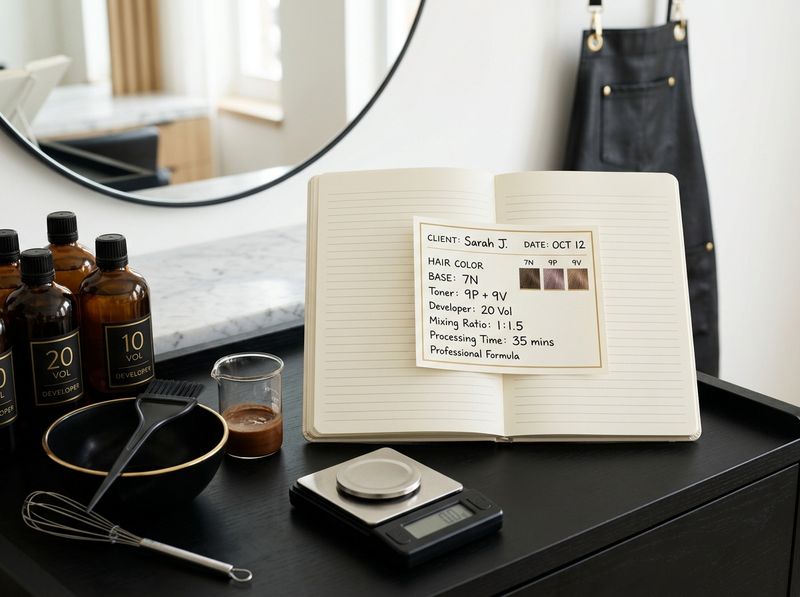
A record without the actual result is just an intention. A record without post-processing adjustments is incomplete. The value lies in the gap between what you planned and what happened.
Why memory is not enough
Those who have been working in color for years know this situation well: mentally you carry a file on every regular client. You know the Thursday client needs a 7 with golden reflection, the Tuesday client has high porosity on the ends, the Friday client gets scalp irritation with 30 volume developer.
That mental file works well with ten clients. With twenty it starts to fail. With thirty or more, the variables blur together.
The problem is not capacity. It is the actual cognitive load of color work.
A professional color service simultaneously manages: hair diagnosis, formula calculation, product mixing, processing times, conversation with the client, attention to the rest of the team and schedule monitoring. That is seven categories of active information running in parallel.
Research in cognitive ergonomics describes this as “working memory overload”: when too many variables are active at once, lower-urgency information gets compressed or lost. According to the American Psychological Association, human working memory can hold between five and nine pieces of information simultaneously before retention begins to degrade.
This is not a question of professionalism. It is a question of how the nervous system works.
The solution is not to have a better memory. It is to stop depending on memory for data that can be recorded.
Paper vs. digital: the honest trade-offs
There is no universally better format. There is the format you actually use consistently.
Paper has real advantages: it is immediate, requires no connection or device, works in any salon and has zero learning curve. A well-designed paper record takes ninety seconds to complete.
Its limitations are structural: no search, no backup, not shareable with another team member without photocopying or transcribing, and if it gets damaged or lost, the information disappears with it.
Digital solves exactly those limitations: instant search by name or date, automatic backup, access from any device and shareable with the team in real time. If the professional who last treated a client is absent, anyone on the team can access the complete record.
The real trade-off of digital is adoption friction: it requires discipline to complete at the moment of service, and if there is no system integrated into the workflow, it ends up being just as inconsistent as paper.
A practical rule: if your salon has more than two professionals or handles more than fifteen recurring clients per month, digital stops being a comfort upgrade and becomes an operational necessity.
The formula record as a business asset
Here is the perspective shift that matters: a color formula record is not just technical documentation. It is a business asset with direct economic value.
Retention: A client who knows their formula is documented has less incentive to try another salon. The exact reproducibility of their color is a differentiating service that very few establishments can offer consistently. You are not selling “a balayage.” You are selling the specific balayage that suits them, that you have on record and can reproduce.
Informed upsell: The historical record shows patterns. If every visit requires a higher developer volume to achieve the same result, the hair is losing responsiveness. That is a conversation about pre-treatment, technique change or a complementary product. Without the record, that conversation has no data. With the record, it has context.
Transferability: When you bring a new professional onto the team, the learning curve on existing clients shrinks dramatically if there are complete records. The new professional does not have to “rediscover” each client. They can read the history and perform with confidence from the first visit.
Business value: If you ever sell the salon or take on partners, the documented formula database is part of the transferable asset. A salon without records is a salon where knowledge walks out the door with the professionals.
The 4 most common record-keeping mistakes
Having a record is not enough. The record has to be useful.
These are the most frequent mistakes that turn it into wasted paper:
1. Recording the shade name, not the code
“Warm golden blonde” is not reproducible. 8.3 Wella Koleston Perfect is. When the brand reformulates or changes the commercial name, the technical code remains the exact reference. Always record the full technical reference.
2. Not recording post-processing adjustments
The final color result is not just the formula applied. It is the formula plus the toner, plus the gloss treatment, plus any time adjustment made because of how the hair behaved. If you don’t record the adjustments, next time you’ll start from the “theoretical” formula and the result will be different.
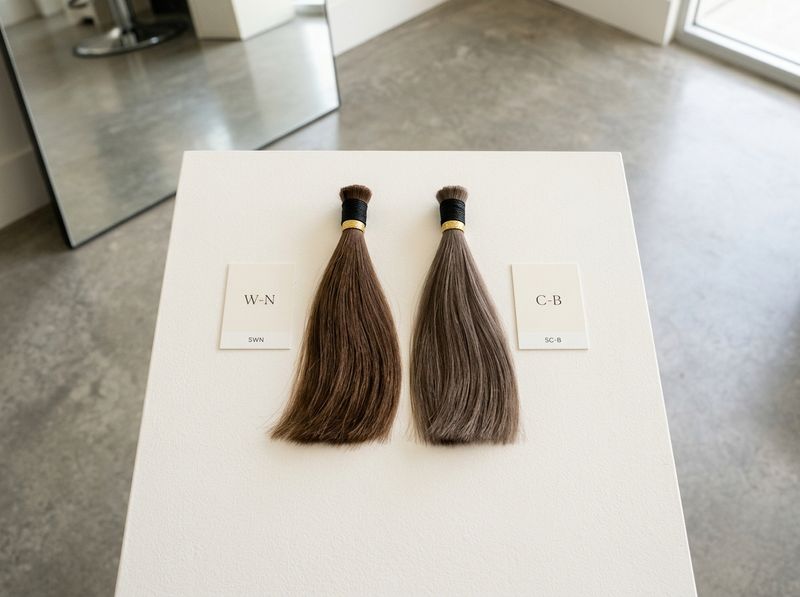
3. Not including a photo of the result
An image of the actual result — well lit, with the hair dry — is worth more than ten lines of descriptive text. The shade perceived under salon lighting is different from the shade perceived in natural light. A photo captures reality without interpretation.
4. Copying formulas between clients without diagnosing
“The formula worked perfectly on Client X, so I’ll apply the same to Client Y” is one of the most frequent and costly mistakes in color work. Base level, porosity, color history and percentage of grey hair are individual variables. The same formula on different profiles produces different results. Read our guide on common color formulation mistakes to understand why each diagnosis is unique.
Where to start: the minimum viable system
The biggest obstacle to starting a records system is not the technology. It is perfectionism as the enemy of beginning.
“When I have the perfect system, I’ll start keeping records.” That thought has left thousands of valuable formulas unregistered.
The minimum viable system is this: three fields and one client.
The three fields are:
- Exact dye code (brand + reference)
- Developer and volume
- Actual result in one sentence
That is enough to start. It is not enough forever, but it is enough for this week.
The consistency of recording something simple has more practical value than the complex system that never gets completed. Three months of minimum records will give you more operational information than years of relying on memory.
Then you add porosity. Then gram weights. Then the photo. The system grows gradually with practice.
If you want to go straight to a digital format with all fields built in, Blendsor manages color formula records with level diagnosis, client history and instant search — no manual configuration needed.
Frequently asked questions
What fields are essential in a hair color formula record?
The minimum operational fields are: base level diagnosed with a shade guide, porosity, exact technical dye code (brand + reference), developer and volume concentration, gram weights of the mix, actual processing time and actual result. A photo of the final result is strongly recommended, though not strictly required in minimal versions.
How often should I update a client’s formula record?
At every service. Even if the formula does not change, the result may vary due to changes in porosity, treatments between visits or changes in the product line. Recording the date and result at each visit makes it possible to spot variation patterns over time.
Is paper or software better for keeping color formula records?
It depends on scale and team size. For a solo salon with a small clientele, well-structured paper works. For two or more professionals or more than fifteen recurring clients per month, digital is necessary because of its search, backup and team-sharing capabilities.
What do I do about existing clients who have no record?
Start with the most frequent ones. At the next visit, record the data for the current service and ask about the last one or two previous services. Do not try to reconstruct the full history all at once — that is paralyzing. Build forward and accept that the unrecorded past is the past.
Related articles


The Blendsor newsletter
Color techniques and trends for professionals. No spam.
Every client, one tap from their history
Formulas, hair health and evolution saved on their own. You and your team open the card and pick up where you left off.
See how it worksWritten by the Blendsor team
Professional hair colorimetry experts with experience in AI-assisted formulation. We combine color science, salon practice and technology to help colorists formulate with precision.