Hair Color Levels: From 1 to 10
Learn to correctly identify natural tone levels and underlying pigments from 1 to 10. The essential foundation for all professional hair color formulation.
Blendsor
Blendsor Team
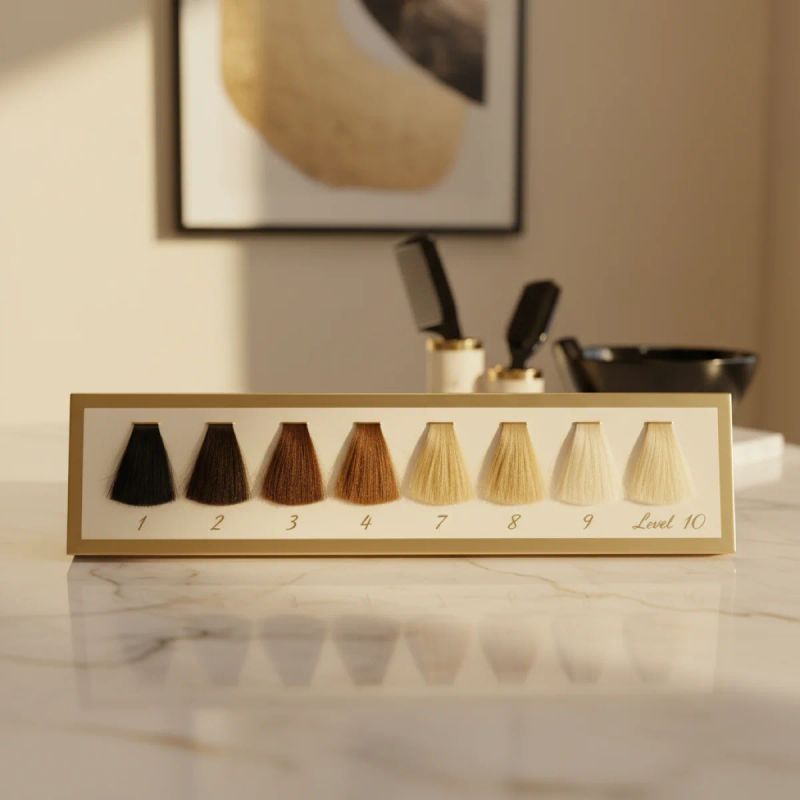
Hair color levels range from 1 (black) to 10 (extra light blonde), representing how light or dark hair appears. This universal numbering system is the foundation of all professional color formulation—master it, and you’ll predict results with precision every time.
If you’re serious about formulating with confidence, understanding levels is non-negotiable. For the complete scientific foundation, see our comprehensive guide to hair colorimetry basics.
Quick summary: Hair color levels 1-10 represent darkness to lightness and are universal across all brands. Underlying pigment shifts from red (levels 1-4) to orange (5-6), yellow-orange (7-8) and pale yellow (9-10). A standard permanent color line lifts up to 3 levels according to what L’Oréal, Wella and Schwarzkopf publish; 4 or 5 levels belong to the high-lift lines, which mix at a different ratio. Always assess level at the nape under neutral white light using your brand’s swatch book.
What Are Color Levels?
Color levels represent the lightness or darkness of a tone — from 1 (black) to 10 (extra light blonde). The chemistry explains it: eumelanin produces dark tones and dominates levels 1-4, while pheomelanin creates reddish and yellow hues and predominates at levels 8-10. In levels 5-7, both types coexist, making this range the most unpredictable during lightening services.
Color levels represent the lightness or darkness of a tone—nothing more, nothing less. The most widely used system goes from 1 (black) to 10 (extra light blonde). Every professional hair color brand uses this scale, making it the universal language of colorists worldwide.
| Level | Description | Underlying Pigment |
|---|---|---|
| 1 | Black | Red |
| 2 | Very dark brown | Red |
| 3 | Dark brown | Red-orange |
| 4 | Medium brown | Orange-red |
| 5 | Light brown | Orange |
| 6 | Dark blonde | Yellow-orange |
| 7 | Medium blonde | Orange-yellow |
| 8 | Light blonde | Yellow |
| 9 | Very light blonde | Light yellow |
| 10 | Extra light blonde | Pale yellow |
Melanin Composition by Level
The chemistry explains it: eumelanin produces dark tones while pheomelanin creates reddish and yellow hues. This composition shifts across levels and directly impacts how hair behaves during lightening:
| Level Range | Dominant Melanin | Resulting Color | Lightening Behavior |
|---|---|---|---|
| 1-4 | Eumelanin (high concentration) | Dark tones, from black to brown | Slow release; intense reds and oranges emerge |
| 5-7 | Mixed (eumelanin + pheomelanin) | Medium tones, browns to dark blondes | Orange-to-yellow transition; most unpredictable zone |
| 8-10 | Pheomelanin (predominant) | Light tones, blondes | Rapid lightening; persistent yellow residue |
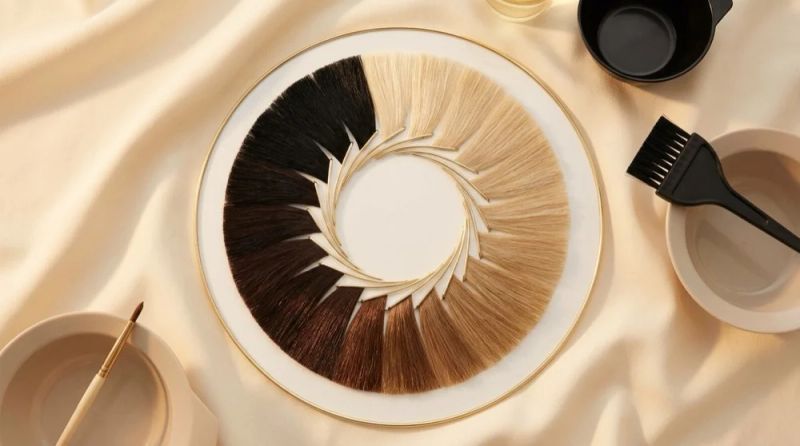
How Do You Identify Natural Level?
The most reliable method is comparing the client’s natural hair at the nape against a professional swatch book under neutral white light. The nape is the least sun-exposed area and has the least artificial color buildup, giving the truest reading. With 50% gray, the perceived level can appear up to 2 points higher than the actual pigmented hair level — always assess pigmented sections separately.
To correctly identify your client’s natural level — and connect that level to the colors that will flatter their skin tone, see our guide to what hair color suits me, which ties level analysis to personal colorimetry.
- Good lighting: Use natural light or neutral white light
- Sample area: Observe the nape area (less sun-exposed)
- Compare with swatches: Use your brand’s swatch book
- Consider gray hair: 50% gray can raise the perceived level
What Is the Underlying Pigment?
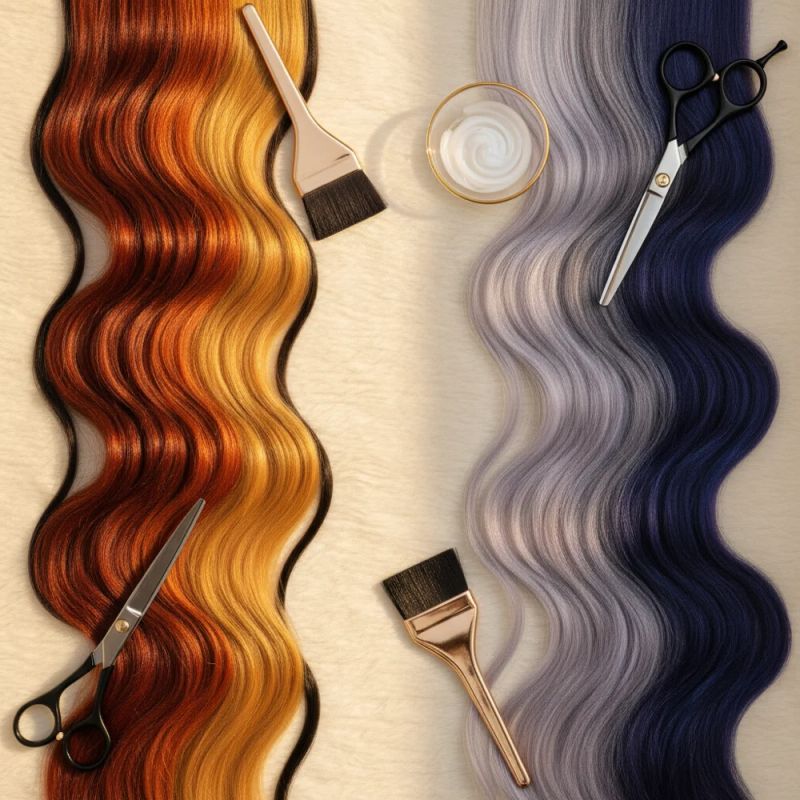
The underlying pigment is the warm pigment exposed when hair is lightened or bleached. At levels 1-4, reds predominate; at levels 5-6, oranges; at levels 7-10, yellows. Ignoring the underlying pigment is the primary cause of unexpected results: lifting level 5 without pre-neutralization always reveals orange residue that contaminates the target shade.
When we bleach or lighten hair, the underlying pigment appears. This underlying pigment varies by level:
- Levels 1-4: Reds predominate
- Levels 5-6: Oranges predominate
- Levels 7-10: Yellows predominate
Why It’s Important
The underlying pigment determines:
- What tones you’ll need to neutralize
- What final shade you’ll achieve
- Which developer volume you need to reach desired level
What Is the 4-Level Rule?
It’s a salon-floor rule worth checking against what the brands publish: a standard permanent color line lifts up to 3 levels, not 4. The three big houses agree. L’Oréal indexes its Majirel range at 12.5 vol (1½ levels), 20 vol (2 levels) and 30 vol (3 levels), and publishes no 40 vol for that range. Wella gives 1 level at 6%, 2 at 9% and 3 at 12% with Koleston Perfect. Schwarzkopf gives 1-2 levels at 20 vol and 2-3 at 30 vol with Igora Royal.
Four and five levels do exist, but only by switching product: that’s the territory of the high-lift lines (Majirel High Lift, Koleston Perfect Special Blonde, Igora Royal Highlifts), which mix at their own ratio and start from a specific natural base range.
Those extra levels carry their own naming per brand: in Koleston Perfect, level 12 belongs to the Special Blonde line (which mixes 1:2). At level 12, Wella’s usage guide marks an exception in how the Special Mix concentrate is dosed, exactly where the “lighter level, less concentrate” rule stops holding. See the guide’s scale in how much Special Mix to add by level.
With a standard line, for example:
- Level 4 → level 7 at most
- Level 6 → level 9 at most
With a high-lift line on virgin hair you can go one or two levels higher, always within the base range that line accepts. Above that, pre-lightening.
Recommended Developer by Lift Target
Choosing the right developer is critical. This table maps lift goals to the appropriate concentration:
| Levels of Lift | Developer | Which line delivers it |
|---|---|---|
| 1 level | 20 vol (6%) | Koleston Perfect at 6%. In Majirel, 12.5 vol gives 1½ levels |
| 2 levels | 20-30 vol (6-9%) | Majirel at 20 vol; Koleston Perfect at 9% |
| 3 levels | 30-40 vol (9-12%) | Ceiling of the standard line: Majirel at 30 vol, Koleston at 12% |
| 4-5 levels | 30-40 vol (9-12%) | High-lift lines only, at their own mixing ratio |
Processing time isn’t set by the volume but by the line’s own sheet: 35 minutes for Majirel, 30 to 45 for Igora Royal, 30 to 40 without heat for Koleston Perfect.
For a deep dive into developers, see our developer volumes guide.
Common Mistakes by Level Range
Each level range presents specific challenges. Knowing them helps you anticipate problems before they happen:
| Range | Typical Mistake | Consequence | Solution |
|---|---|---|---|
| 1-4 (dark) | Underestimating red undertone when lifting | Unwanted orange or coppery result | Use ash (.1) as secondary reflect; pre-neutralize before toning |
| 5-7 (medium) | Misdiagnosing level due to prior color buildup | Wrong formula, unpredictable result | Always compare with swatches at the nape under neutral light |
| 8-10 (light) | Over-toning with violet | Hair turns gray or lavender | Reduce toning time; use .01 instead of .1 |
What Tools Does the Modern Colorist Need?
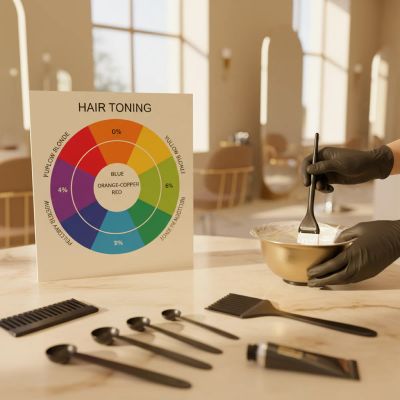
Use the hair color level chart to identify the exact level and expected underlying pigment before formulating. With Blendsor, you can analyze your client’s tone level with just a photo. The AI identifies:
- Natural tone level
- Probable underlying pigment
- Presence of artificial tones
- Hair condition
This allows you to formulate more precisely and reduce costly errors.
Frequently Asked Questions
What is the easiest way to determine hair color level?
The most reliable method is comparing the client’s natural hair against a professional swatch book under neutral white light. Always check the nape area, as it’s least affected by sun exposure and artificial color buildup.
Can I lift hair more than 4 levels with regular color?
With a standard line you won’t even reach 4: the ceiling L’Oréal, Wella and Schwarzkopf publish for their regular ranges is 3 levels, so a level 4 reaches level 7. High-lift lines do reach 4 or 5 levels on virgin hair, within the base range each one accepts. Beyond that, pre-lightening.
Why does underlying pigment matter in formulation?
Underlying pigment (also called contributing pigment) determines what warm tones will appear as you lighten hair. Ignoring it leads to brassy results. For instance, lifting level 5 exposes orange pigment that must be neutralized with blue-based tones.
How do gray hairs affect level identification?
Gray hair has no melanin, so it appears lighter. A client with 50% gray may appear to be level 7, but their natural pigmented hair might be level 5. Always assess the pigmented sections separately for accurate formulation.
Key Takeaways
- Levels 1-10 represent darkness to lightness—universal across all brands
- Underlying pigment shifts from red (levels 1-4) to orange (5-6), yellow-orange (7-8) and pale yellow (9-10)
- Maximum lift with oxidative color depends on the line: Koleston Perfect gives 3 levels with 12% (40 vol), and 4-5 with Special Blonde
- Always diagnose under neutral light, checking the nape area
Ready to formulate with scientific precision? With Blendsor, you can photograph your client’s hair and the AI instantly identifies level, underlying pigment, and recommends the perfect formula.
Manufacturer sources
Manufacturer documents consulted for this article. A copy of each one is kept, and the passages noted from it are checked against that copy.
Note each one's country: the same line's instructions can differ from one market to another, so follow the directions for the product you use.
What does the level of a hair color mean?
In the app, we ask you a question like this one, but about your own client.
Up for this week’s case? → More on global color →Related articles

Practice with our colorimetry tools
Calculators, neutralization wheel, AI consultation...
The Blendsor newsletter
Color techniques and trends for professionals. No spam.
You know the theory. What about today's case?
Send a photo to the Blendsor advisor and get an answer grounded in colour theory: toner, developer and timing, with the brands on your shelf.
Ask about your caseWritten by the Blendsor team
Professional hair colorimetry experts with experience in AI-assisted formulation. We combine color science, salon practice and technology to help colorists formulate with precision.