Koleston Perfect Special Mix: How Much Concentrate By Level
Wella doses Special Mix by depth level, not a flat ratio: it drops from level 2 to 10, then jumps back up at levels 11 and 12. Formulate with Blendsor.
Blendsor
Blendsor Team
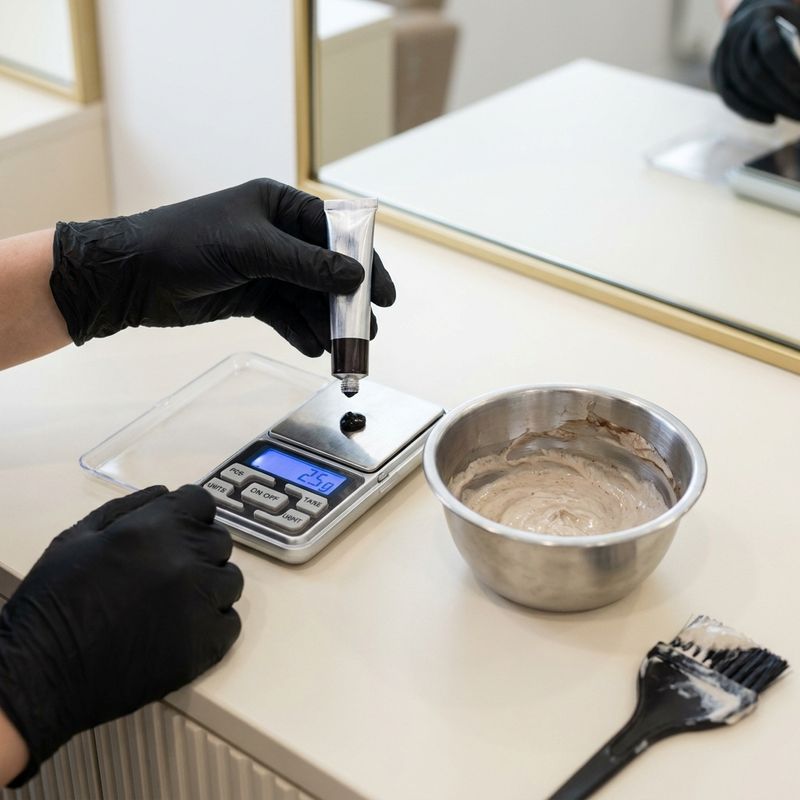
How much Special Mix do you add when the formula uses a level 11 or 12 Koleston shade? If your answer is “about the same as a level 10, maybe a touch less,” Wella’s own usage guide disagrees with you.
If you work with Koleston Perfect, you’re probably already using Special Mix to intensify the reflect in your formulas. And you probably dose it from memory, going by a simple rule: the lighter the level, the less concentrate you need. That rule holds from level 2 to level 10. But right at the two lightest levels in the table, the manufacturer’s own usage booklet breaks its own rule, and it’s easy to miss.
Here’s the full table, the exception, and how the pure-concentrate version works without you guessing. This article is part of our complete colorimetry basics guide.
Quick summary: Wella doses Koleston Perfect Special Mix by the level of the shade you’re mixing, not a fixed ratio: from level 2 to 10, the lighter the level, the less concentrate you need (from 4.5 g down to 0.5 g per 30 g of color cream). At levels 11 and 12, the usage booklet marks an explicit exception, with no stated reason: level 11 goes back up to 1.0 g (same as a level 9, double a level 10) and level 12 to 1.5 g (same as a level 8, triple a level 10). To intensify strands or sections of hair, the concentrate can be used pure with Welloxon Perfect at a 1:1 ratio, except shade 0/43, which goes 1:2; the booklet recommends applying it to pre-bleached hair.
What is Koleston Perfect Special Mix and when do you use it?
Special Mix is Koleston Perfect’s range of pure pigment concentrates. It’s not a base shade: it’s a booster you add into a color formula to intensify one specific reflect, per Wella’s own usage guide.
You reach for it when the reflect in your base formula comes up a little flat: a copper that needs more punch, an ash that needs to go cooler, a gold that needs more presence. Instead of increasing the whole tint proportion (which shifts the level), you add a small amount of pure concentrate in the same reflect.
Knowing it exists isn’t the hard part. Knowing exactly how much to add is, and it’s easy to end up eyeballing it.
How much Special Mix do you add by level?
You dose it in grams, calculated on 30 g of color cream, and it scales with the level of the Koleston Perfect shade you’re formulating (not the client’s natural starting level): the lighter the level, the less concentrate you need, from level 2 through level 10 with no exception.
This is the full table Wella publishes in the Koleston Perfect usage booklet (Special Mix section), calculated for 30 g of color cream. The tube itself carries a centimeter scale to dose it without weighing, which is why the booklet prints centimeters first and grams second:
| Level | Tube scale | Special Mix (per 30 g of cream) |
|---|---|---|
| 2 | 9 cm | 4.5 g |
| 3 | 8 cm | 4.0 g |
| 4 | 7 cm | 3.5 g |
| 5 | 6 cm | 3.0 g |
| 6 | 5 cm | 2.5 g |
| 7 | 4 cm | 2.0 g |
| 8 | 3 cm | 1.5 g |
| 9 | 2 cm | 1.0 g |
| 10 | 1 cm | 0.5 g |
The booklet doesn’t explain why: it states the rule (“The lighter the basic shade, the less mix tone is needed”) and gives the table. What the numbers do show is a 0.5 g drop for every level lighter, step by step, from 2 to 10. The table also gives the tube-length equivalent: 1 cm = 0.5 g.
A real example, taken directly from the booklet (that 2.5 g of concentrate matches the level 6 row in the table above): the full formula is 30 g Koleston Perfect + 2.5 g Special Mix + 32.5 g Welloxon Perfect. The developer is calculated at a 1:1 ratio over the total cream weight (30 g + 2.5 g), consistent with Koleston Perfect (Pure Naturals, Rich Naturals, Vibrant Reds and Deep Browns) mixing its tint and developer at a 1:1 ratio, except for its Special Blonde line, which goes 1:2.
Why do levels 11 and 12 break the general rule?
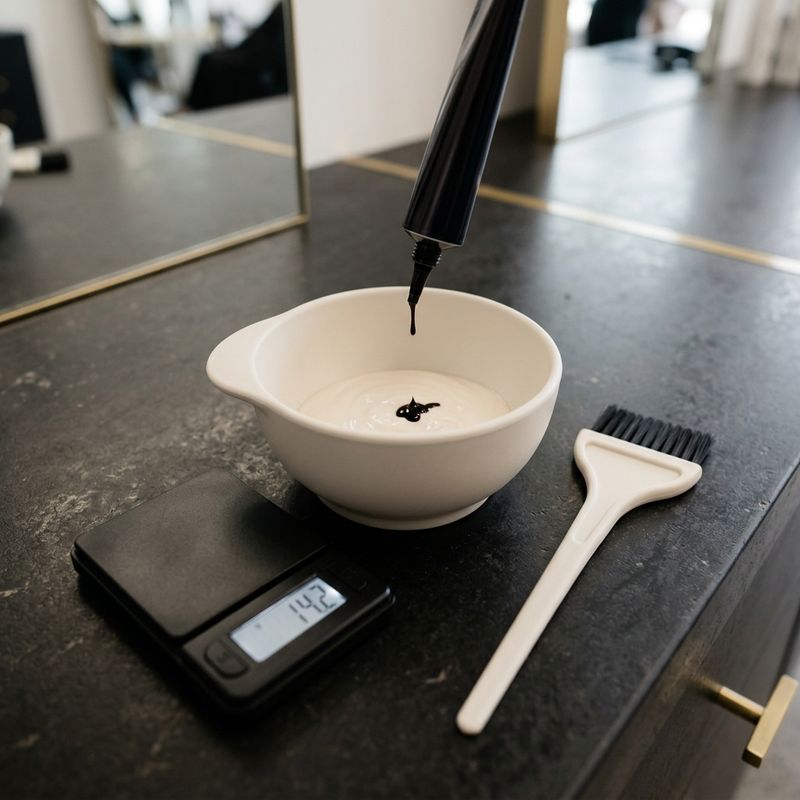
Because the booklet itself marks an explicit exception: “Exception: Levels 11 and 12.” Instead of continuing to drop, the dosage jumps back up: level 11 goes to 1.0 g (2 cm on the tube scale) and level 12 to 1.5 g (3 cm), per 30 g of cream. Level 11 matches level 9 and doubles level 10; level 12 matches level 8 and triples level 10.
The booklet marks this exception with no stated reason: it doesn’t give a technical explanation, so the right approach is to weigh by the table rather than try to reason it out. The two levels don’t even belong to the same range within Koleston Perfect: level 12 is genuinely part of the Special Blonde line (which mixes 1:2 with Welloxon Perfect), while level 11 shades (such as 11/0, 11/1 or 11/3) belong to Pure Naturals and Rich Naturals, the range that mixes 1:1. They’re not the same product family, even though they share the exception in the Special Mix table.
Put another way: the “lighter level, less concentrate” rule stops holding exactly at the two lightest levels in the table. Calculating a level 11 or 12 by the general rule (0.5 g, as if it were a continuation of level 10) leaves the result underwhelming. And if instead you improvise “a bit more, it’s only one level higher,” you risk overshooting and intensifying the reflect beyond what the formula called for.
| Level | Grams (per 30 g) | Follows the general rule? |
|---|---|---|
| 9 | 1.0 g | Yes |
| 10 | 0.5 g | Yes: the lowest amount in the whole table |
| 11 | 1.0 g | No: exception, same as level 9 |
| 12 | 1.5 g | No: exception, same as level 8 |
How do you use pure Special Mix on strands or sections?
Pure, mixed with Welloxon Perfect at a 1:1 ratio. The booklet reserves it for strands or sections, and recommends using it on already-lightened hair.
Wella’s own example is 30 g Special Mix + 30 g Welloxon Perfect. The one proportion exception inside the Special Mix range itself is shade 0/43, which mixes 1:2 (30 g Special Mix + 60 g Welloxon Perfect) instead of 1:1.
This pure application is different from the by-level dosing above. There, the concentrate goes in a small amount inside a full color formula. Here, the concentrate IS the formula, with no color cream involved, meant to boost a specific strand or section that needs more intensity than the rest of the head.
Pro tip: like with any Koleston Perfect tint, the booklet requires a skin sensitivity test 48 hours before each application, including when Special Mix is used pure. Don’t skip it just because it’s “only” a concentrate.
What mistakes do colorists make when dosing Special Mix?
The two most common mistakes are extending the general rule to levels 11 and 12 without checking the exception, and dosing the concentrate by the client’s natural starting level instead of by the level of the Koleston shade being formulated.
- Calculating level 11 or 12 as if they were a continuation of level 10. The result is a reflect that comes up short exactly at the two levels where the table calls for more concentrate, not less.
- Dosing by the client’s natural level instead of by the shade being applied. The Special Mix table is read by the Koleston Perfect shade you’re mixing, not by the client’s starting level before the service.
- Not weighing the concentrate. With 0.5 g differences between consecutive levels, eyeballing it with a spatula introduces an error margin that matters proportionally more in Special Mix than in the base color cream. Weigh it on a precision scale, or measure by tube length the way the table does (1 cm = 0.5 g).
Frequently asked questions
Is Special Mix a shade I can use on its own?
Not as a complete color formula. It’s a pure pigment concentrate meant to intensify the reflect of an already-formulated color, or for pure application on strands or sections, always mixed with Welloxon Perfect.
Why does level 12 need more concentrate than level 9 if it’s much lighter?
Because level 12 is the highest exception in the table: Wella’s booklet marks it explicitly, with no stated technical reason. The result is that it needs 1.5 g, the same amount as a level 8, despite being the lightest shade in the whole scale.
Can I apply this same gram calculation to other brands?
No. This dosage table is specific to Koleston Perfect’s Special Mix range. Other brands have their own intensifying concentrates, with their own usage guides and ratios: always check the one for the specific line in your hands.
What happens if I overdose the concentrate on a dark level?
Too much Special Mix on a dark level (2-4) intensifies the reflect more than the formula called for. Sticking to the table’s gram amounts avoids that drift.
In summary
- General rule (levels 2-10): the lighter the level, the less Special Mix concentrate you need, from 4.5 g (level 2) to 0.5 g (level 10) per 30 g of cream.
- Exception (levels 11 and 12): the booklet breaks its own rule with no stated reason. Level 11 needs 1.0 g (same as a level 9) and level 12 needs 1.5 g (same as a level 8).
- Pure application: for strands or sections. 1:1 ratio with Welloxon Perfect, except shade 0/43 (1:2). Skin sensitivity test 48 hours ahead, as with any application in the line.
- Weigh it, don’t eyeball it: with 0.5 g differences between levels, weigh it or measure by tube length (1 cm = 0.5 g).
Formulate professional formulas with AI
Want exceptions like levels 11 and 12 to stop depending on your memory? Blendsor formulates with the line you use and each client’s chemical history in front of it.
Do you have your own way of dosing Special Mix at levels 11 and 12, or did you learn the exception the hard way, with a reflect that came up short?
Related articles

Practice with our colorimetry tools
Calculators, neutralization wheel, AI consultation...
The Blendsor newsletter
Color techniques and trends for professionals. No spam.
You know the theory. What about today's case?
Send a photo to the Blendsor advisor and get an answer grounded in colour theory: toner, developer and timing, with the brands on your shelf.
Ask about your caseWritten by the Blendsor team
Professional hair colorimetry experts with experience in AI-assisted formulation. We combine color science, salon practice and technology to help colorists formulate with precision.