How to neutralize unwanted tones in hair
How to neutralize unwanted hair tones: orange, yellow and red against their complementary color, which reflect does it in each brand and how much to add.
Blendsor
Blendsor Team
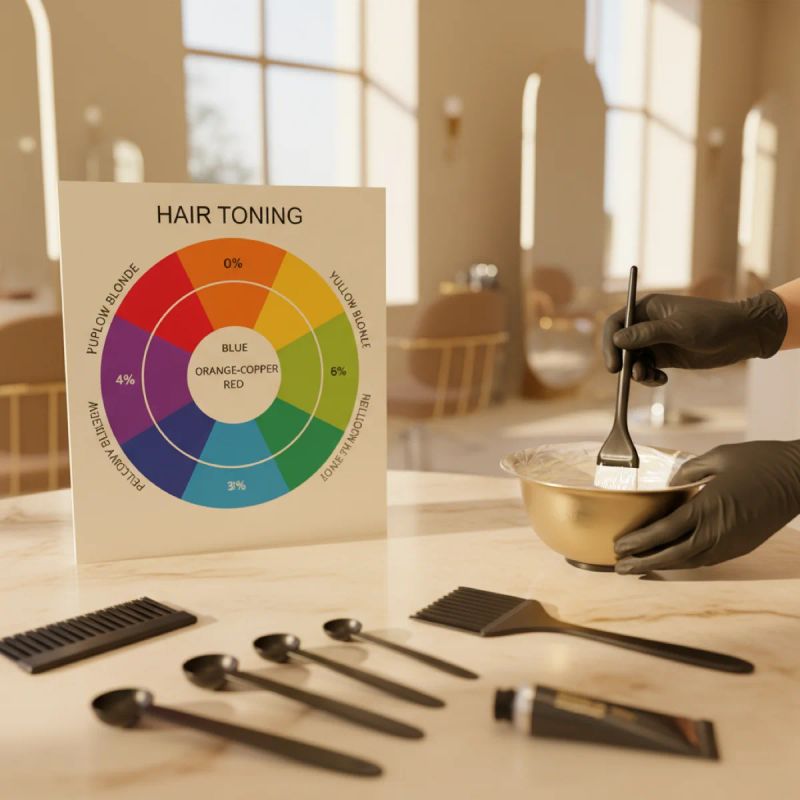
To neutralize unwanted hair tones, use complementary colors: blue cancels orange, violet cancels yellow, and green cancels red. The key is matching the intensity of your corrector to the intensity of the unwanted tone—too little won’t work, too much creates muddy results.
The brassy orange after a bleach. The straw yellow that won’t go away. The red peeking through where it shouldn’t. Every colorist has faced these color ghosts. For the complete science behind why this works, see our guide to hair colorimetry basics.
Quick summary: Neutralizing unwanted hair tones relies on complementary colors: blue cancels orange, violet cancels yellow, green cancels red. The stronger the tone you’re cancelling, the more corrector it takes, and the lighter the base, the less. A strand test settles the exact amount, and your brand’s chart settles which digit carries each reflect.
How does the color wheel work for neutralizing hair tones?
Neutralization works by applying the opposite color on the color wheel: blue cancels orange, violet cancels yellow, green cancels red. In equal proportions, complementary colors produce a neutral tone. Wella draws it right next to its lightening curve in the Koleston Perfect usage guidelines: a wheel that pairs exactly those three, captioned “Opposite colors neutralise one another.” See the complete color relationships with our interactive neutralization wheel.
What neutralizing hair means: switching off a reflect you don’t want (the orange, yellow or red that lightening exposes, or the green left when a cool shade grabs too hard) by adding its complementary. Neutralizing doesn’t lift; it only changes which way the reflect leans. If what’s missing is levels, those come from lightening, and when each route pays off is covered in relift or neutralize the bleach base. A neutralizer, then, is any product or shade that carries that complementary: a permanent or demi-permanent shade with an ash, violet or matte reflect, a concentrate added to the color mix, or a pigmented maintenance shampoo. Some houses sell it under that very name: Schwarzkopf’s IGORA ROYAL mixing brochure describes its Neutralisers 0-11, 0-22 and 0-33 as “three different cool tone directions, which can be mixed with your desired shade for neutralisation purposes.”
| Unwanted tone | Neutralizing color |
|---|---|
| Orange | Blue |
| Yellow | Violet |
| Red | Green |
| Green | Red |
Before you go on, how to read a shade code: the number in front is the level; what follows the separator is the reflect, the first digit leading and the second supporting. The three big charts put it in their own words: primary and secondary tone on the Majirel chart, major and minor tone on Wella’s US pro store blog, primary and secondary tone direction for IGORA ROYAL. The separator tells you whose chart you’re holding: a point for L’Oréal (7.1), a slash for Wella (7/1), a dash for Igora (7-1).
Read the separator before the digit, because each house has its own alphabet. A Majirel 8.1 and a Koleston Perfect 8/1 line up (level 8, ash reflect), but an 8 after the separator is pearl at Wella and red at Igora, and a 4 is red on Wella’s US store blog and beige at Igora. A L’Oréal 7.12 is a level 7 with ash leading and iridescent supporting (blue with a little violet), which the US Majirel chart writes as 7BV; a .21 is the reverse. If the code comes from a brand not covered here, open its chart before assuming what its 1 or 2 does. Digits in this article are L’Oréal unless stated otherwise: translate them to your own line’s chart before you weigh anything.
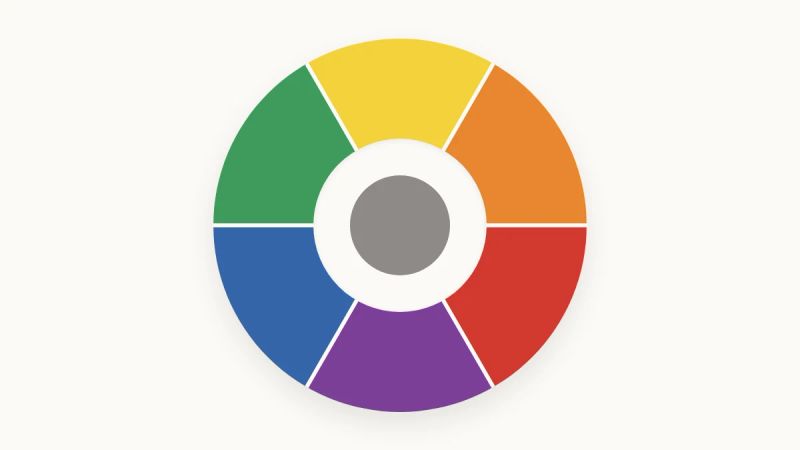
When you mix a color with its opposite in equal proportions, you get a neutral tone (brown or gray, depending on the level). That’s why “what color neutralizes gray?” is a trick question: gray is already the neutral point, so there’s no opposite to cancel it. If a result comes out gray or flat, there was too much corrector, and what balances it is a touch of warmth (a gold), not another cool shade. If what bothers you is the yellow in white hair, that one does neutralize, with violet.
How do you neutralize orange in hair?
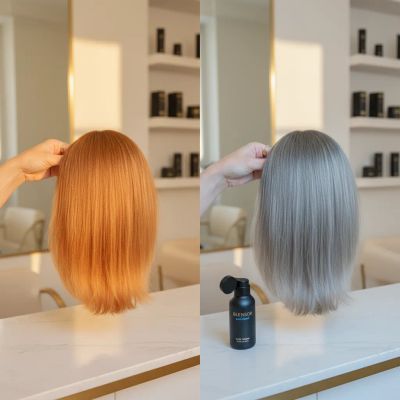
Orange hair is neutralized with blue. On the L’Oréal chart that blue is .1 (ash); on Wella’s it’s /8 (pearl), the digit its hot-roots guide calls for on orange roots, or /1 (ash), which Wella’s US store blog describes as blue/green. When the orange already leans yellow, like the base at level 7, it needs blue with some violet. In a correction with permanent color, the corrector is usually built on the natural shade of the level you’re aiming for.
Orange typically appears in:
- Bleaching that hasn’t reached the desired level (check our color levels guide to understand why)
- Dark dyed hair being lightened (if it’s box black, the oxidation diagnosis before bleaching comes before any corrector)
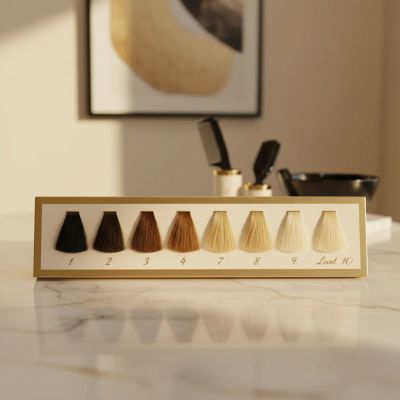
- Lightened bases at level 5 or 6: the Koleston curve shows reddish-orange at 5 and orange at 6
To find the exact toner that neutralizes each type of orange, use our toner selector: input the level and unwanted tone. For a deeper dive into why blue (not violet) is the key, read our blue toner for orange hair guide. To calculate the exact proportions for mixing your neutralizing formula, try the color mix predictor.
Practical solution
-
Identify the orange intensity
- Intense orange → blue (.1 at L’Oréal; /8 or /1 at Wella)
- Yellow-orange → blue with some violet (at L’Oréal, a double reflect such as .12; at Wella, /86)
-
How to build it on a level 6 orange
- Natural shade at your target level + blue in the dose the orange’s intensity calls for (the amount rule is further down)
- Mixing ratio, developer and timing: whatever your line’s instructions say
- If the target is a blonde well above that 6, no corrector will get you there: lighten first
How do you neutralize yellow in blonde hair?
Yellow in blonde hair is neutralized with violet: .2 (iridescent) at L’Oréal, /6 at Wella. Developer and timing depend on the toner you use, and you rinse by what you see on the strand: on the yellow of a level 8 or the pale yellow of a 9, too much violet turns gray or pinkish.
Straw yellow is enemy number one for cool blondes. It appears in:
- Natural blondes with warm undertones
- Lightening that stops at level 8 or 9 (yellow and pale yellow on the Koleston curve)
- Highlights that have lost their toner and show their base again
When the goal is an intentional silver result, not just removing yellow, see our quiet silver formula guide for violet-neutralization formulas.
Practical solution
-
Violet is your friend
- .2 reflect (iridescent) at L’Oréal, /6 at Wella
- Pure violet toners
-
How to tone a yellow blonde
- Violet at the level of the blonde you’re after, in the dose the yellow’s intensity calls for
- Developer, ratio and timing: from the product’s instructions. One example with manufacturer figures: Schwarzkopf’s IGORA ROYAL technical manual for Spain gives its Pasteles (pastel shades designed to neutralize yellow on lightened hair, used on base 9 and lighter) 3% (10 vol) developer, a 1:1 mix and 5 to 30 minutes while watching the process, and advises starting on the warmest areas
- If using a demi like Shades EQ or Igora Vibrance, check toner equivalences between brands to find the exact shade in your line
A tone refresh on a blonde that was already finished still needs an allergy test if the toner is mixed with developer (a demi-permanent, or a permanent like those Pasteles). Wella’s Koleston Perfect leaflet says to “always perform an allergy test 48 hours before any color service”, and each manufacturer sets out how to do its own. That takes it off the toning day; how to plan it is in scheduling the 48-hour allergy patch test.
Caution: Excess violet creates gray or even pink tones. Less is more.
How do you neutralize red tones in hair?
Red tones are neutralized with green, and on a shade chart that green is the matte family: .7 at L’Oréal, /2 at Wella. Watch the .13, which often gets mistaken for a matte. It’s ash with gold, which the US Majirel color chart calls beige; on that chart, green sits on a different digit, the .7. The full red-base case is in neutralize a red undercoat without bleaching.
Unwanted red usually comes from:
- Previous dyes with red bases
- Henna or plant dye in the history (and then, before anything else, an incompatibility test)
- Lightened bases at the low levels: on the Koleston curve, level 4 leaves reddish-brown and level 5 reddish-orange
Practical solution
Green neutralizes red. That green is the matte family, and the digit depends on the house:
| Family (and what it cancels) | L’Oréal (Majirel) | Wella (Koleston Perfect) |
|---|---|---|
| Blue → cancels orange | .1 (ash) | /8 (pearl) or /1 (ash, blue/green on Wella’s US store blog) |
| Matte = green → cancels red | .7 | /2 |
| Violet → cancels yellow | .2 (iridescent) | /6 |
| Gold = yellow | .3 | /3 |
At Igora the English legend hands out the names its own way (-1 cendré, -2 ash, -3 matte, -9 violet), so an Igora “ash” is the -2, not the -1; its Neutralisers 0-11, 0-22 and 0-33 repeat the cendré, ash and matte digits. To move a corrector over to Igora, go by the color wheel in its technical manual, not by a number from another chart.
-
Work with the family, not a digit you half-remember
- Matte (green) for red:
.7at L’Oréal,/2at Wella - A
.13is ash + gold, which makes it a beige, and will not correct red
- Matte (green) for red:
-
How to build it on a level 5 with residual red
- Natural base at the target level + matte in the dose the red intensity calls for (proportion rule further down)
- Add ash only if orange is also showing underneath
- The mixing ratio is set by your line: Majirel runs 1:1.5, Koleston Perfect 1:1
- Test on a strand before you take it through the whole head
For a complete guide on professional toning (types, timing, developer volumes), see our professional toning guide.
How do you neutralize mixed or combined unwanted tones?
When the unwanted tone is not pure orange, pure yellow or pure red but a combination of two, neutralization becomes more complex. The key is identifying which of the two tones is dominant and prioritizing that corrector, while the secondary reflect handles the other.
Orange-yellow (level 7, after partial bleaching)
The one that trips people up most, and exactly the base the Koleston curve places at level 7. The hair is at a midpoint where orange has faded but yellow hasn’t fully taken over.
How to build it on a level 7 orange-yellow:
- Blue and violet at once. At L’Oréal a double reflect carries both: .12 (blue leading, violet supporting) when the orange weighs more, .21 (the reverse) when the yellow does
- At Wella, its hot-roots guide handles it with /86
- A strand test before the global, with the mix as your line specifies it
Orange-red (level 5, dark hair that fell short when lifted)
When dark hair doesn’t lift far enough and stops at level 5, the Koleston curve puts a reddish-orange there: red and orange in the fiber at the same time.
How to build it on a level 5 orange-red:
- Two correctors at once over the natural base of your target level: matte (green) for the red, ash (blue) for the orange
- At L’Oréal that means
.7and.1; at Wella, the hot-roots guide combines them in/28 - Let the dominant tone lead: more red in the fiber, more matte; more orange, more ash
- Mixing ratio per your line (Majirel 1:1.5, Koleston Perfect 1:1), and a strand test before the global
Yellow-copper (between level 7 and 8, highlights warming up again)
This is the warmth that comes back in highlights once the cool toner washes out: a yellow with a hint of copper, halfway between the orange-yellow of a 7 and the yellow of an 8 on the Koleston curve. Why that base is still there even when you can’t see it is explained in residual pigment in bleached hair.
How to build it on a yellow-copper:
- Violet leading with a touch of blue for the copper: at L’Oréal, a .21; at Wella, /6 with a little /8
- Watch the strand within the toner’s timing: on a high blonde, too much violet goes gray
What is the quick reference table for neutralization by tone?
The table pairs each unwanted tone with the base each level leaves on Koleston’s lightening curve and with the family that cancels it: orange against blue, yellow against violet, red against green (the matte), and for mixed tones both families at once, weighted toward whichever dominates. Developer and timing are not in the table: they come from the instructions of the toner or color you use.
| Unwanted tone | Base by level (Koleston curve) | Correcting family | L’Oréal · Wella |
|---|---|---|---|
| Intense orange | 6: orange | Blue | .1 · /8 or /1 |
| Orange-yellow | 7: orange/yellow | Blue with violet | .12 or .21 · /86 |
| Straw yellow | 8: yellow · 9: pale yellow | Violet | .2 · /6 |
| Yellow-copper | Between 7 and 8 | Violet with a touch of blue | .21 · /6 with a little /8 |
| Residual red | 4: reddish/brown · 5: reddish/orange | Green (matte) | .7 · /2 |
| Orange-red | 5: reddish/orange | Green and blue | .7 + .1 · /28 |
| Green (uncommon) | Not on the curve: usually a cool shade porous hair absorbed too much of | Red or copper | .6 or .4 · /4 |
The Wella digits in the orange, orange-yellow, yellow, red and orange-red rows are the ones its guide to fixing hot roots (Wella’s US pro store) assigns to each case; the other two rows combine families from the reflect legend on Wella’s US store blog: violet with pearl in one, red in the other. How you reach each of those bases, stage by stage, is in the professional bleaching guide.
Use this table as your starting point and always validate with a strand test before global application.
What are the golden rules of hair tone neutralization?
Four rules determine whether a neutralization works: (1) accurate diagnosis before formulating, (2) corrector dosed by the intensity of the unwanted tone and by how light the base is, never past the manufacturer’s cap, (3) corrector at the level of the result, never darker, and (4) on hair with a history, a strand test every time.
1. Accurate diagnosis first
You can’t neutralize what you can’t identify. Before formulating:
- Is it orange, yellow-orange, or red-orange?
- What intensity level is it?
- Is it evenly distributed or in patches?
2. Proportion matters
The amount of corrector goes up with the intensity of the tone you want to cancel and down as the base gets lighter. IGORA ROYAL’s technical manual for Spain sets it out when it introduces its color wheel: two opposites of the same intensity cancel each other; if one is weaker it only tones, and if it is stronger it pushes the result toward its own side. Schwarzkopf also caps its Neutralisers, in the IGORA ROYAL mixing brochure and in that same Spanish manual: up to 5% of the color cream on bases 8 and 9, up to 15% on 6 and 7 and up to 25% on 1 to 5, with the developer increased accordingly. Those are caps for that product, not a rule for any chart, but they show the direction: on a light base, very little corrector already shows.
On a lightened, porous section the cool shades grab even harder. Explaining what happens when you color already-lightened hair back to its natural shade or darker, the Spanish manual warns that porous hair absorbs cool pigments and can end up dark, matte and blurred, or even green in the worst case. There, lower the dose and let the strand decide.
3. The corrector level
Use the corrector at the level of the result you’re after, never darker: a corrector darker than the target muddies the result. On lengths that are already lightened, a strand test shows whether it’s worth going lighter.
4. Validate with a test strand
On hair with a history (bleach, highlights, previous color or henna), the strand test is a given, not just something for when in doubt: apply the mix to a hidden strand, wait the full time, rinse and dry before you decide. If the hair has been bleached, use that same strand for the elasticity test: a fiber that stretches and doesn’t recover is not ready for another round of lightener, and the tone gets fixed with the gentlest product that does the job.
What are the most common neutralization mistakes?
The four most common neutralization mistakes are: too much ash, or ash over a base that is already yellow (flat gray or greenish), using violet on orange instead of blue (does not work), choosing a corrector that is too dark (dull result), and leaving the toner on too long (over-neutralization that is hard to reverse).
| Mistake | Consequence | Solution |
|---|---|---|
| Too much ash, or ash over a yellow base | Flat gray or greenish tone | Bring warmth back with a warm reflect, tested on a strand first: copper if it leans green (its opposite on the wheel is red, not gold), and gold if it has only gone gray |
| Violet on orange | Won’t neutralize (needs blue) | Reformulate with ash |
| Corrector too dark | Dull, lifeless tone | Bring the corrector up to the level of the result |
| Excessive toner time | Over-neutralization | If it’s already happened, warmth as in the first row: gold if there was too much violet (its opposite is yellow) and copper if there was too much blue (its opposite is orange), tested on a strand first. Next time: rinse as soon as the strand reaches the tone, within the toner’s timing, starting on the warmest areas |
Preview the neutralization before you apply
Neutralizing is mixing opposites: ash over orange, violet over yellow. In the Blendsor app’s mixer you enter the tone and the corrector and the AI reasons how that mix really turns out — it factors in your developer and the brand’s actual ratio instead of averaging levels, and warns you if the corrector falls short or overshoots. Try it in the app.
Blendsor helps you formulate
Unsure which corrector to use? With Blendsor you can:
- Upload a photo of current hair
- Indicate the desired tone
- Receive a formula with exact neutralization proportions
The AI considers the current level, present reflects, and your favorite brand to give you a precise formula.
Frequently Asked Questions
What color cancels out orange in hair?
Blue cancels orange: ash .1 at L’Oréal, /8 or /1 at Wella. If the orange leans yellow, blue with violet (a .12 at L’Oréal, /86 at Wella). The key is matching the blue intensity to the orange intensity: pure blue for pure orange.
How do I fix yellow brassy tones in blonde hair?
Violet (purple) cancels yellow. Use toners with a .2 reflect (iridescent) at L’Oréal or /6 at Wella, or purple shampoos for maintenance. For professional toning, developer and timing come from the toner’s instructions, and it pays to watch the strand: excess violet creates gray or pink tones.
Why does my hair turn orange when I bleach it?
Orange appears because you’ve exposed the hair’s underlying pigment (also called contributing pigment) but haven’t lifted past it yet. On Koleston’s lightening curve, dark hair passes through reddish-orange at level 5 and orange at level 6 before it reaches yellow. To avoid orange, either lift further or neutralize with blue-based tones.
Can I use purple shampoo on orange hair?
No. Purple shampoo is designed for yellow tones, not orange. For orange hair, you need blue-based products (blue shampoo or professional ash toners). Using purple on orange won’t neutralize it effectively.
Key Takeaways
- Orange → Blue: ash .1 at L’Oréal, /8 or /1 at Wella; blue with violet (.12, or Wella’s /86) when it leans yellow
- Yellow → Violet: .2 (iridescent) at L’Oréal, /6 at Wella
- Red → Green: green is the matte family,
.7at L’Oréal and/2at Wella. A.13is beige (ash + gold), not a matte - Match intensity: more corrector for a stronger tone, less on a lighter base, within the manufacturer’s cap
- Test first: on hair with a history, always a strand test
Unsure which corrector to use? Blendsor analyzes your client’s current tone and calculates exact neutralization proportions for any brand.
Manufacturer sources
Manufacturer documents consulted for this article. A copy of each one is kept, and the passages noted from it are checked against that copy.
Note each one's country: the same line's instructions can differ from one market to another, so follow the directions for the product you use.
What happens if you neutralize a tone without knowing its complementary?
In the app, we ask you a question like this one, but about your own client.
Up for this week’s case? → More on color correction →Related articles
Practice with our colorimetry tools
Calculators, neutralization wheel, AI consultation...
The Blendsor newsletter
Color techniques and trends for professionals. No spam.
You know the theory. What about today's case?
Send a photo to the Blendsor advisor and get an answer grounded in colour theory: toner, developer and timing, with the brands on your shelf.
Ask about your caseWritten by the Blendsor team
Professional hair colorimetry experts with experience in AI-assisted formulation. We combine color science, salon practice and technology to help colorists formulate with precision.