Residual Pigment in Bleached Hair: Why the Same Formula Gives You Two Results
Same level 7 base, same formula, two different results. Residual pigment from an old bleach explains it: how to diagnose it and compensate with .1/.2 neutralizers.
Blendsor
Blendsor Team
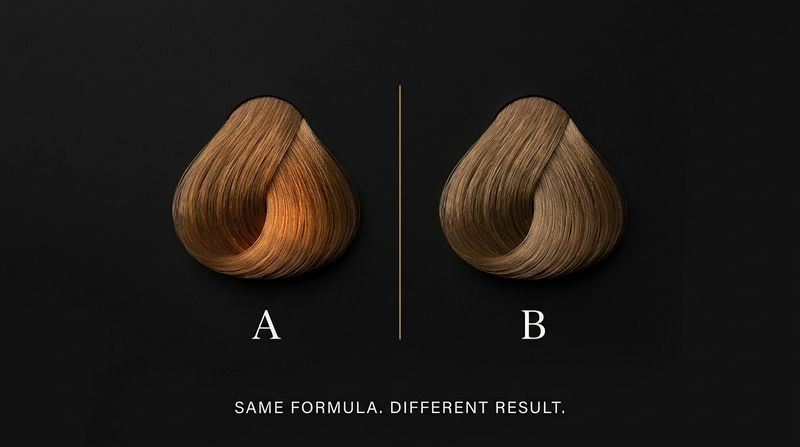
Two clients. Same level 7 base. Same formula. Same processing time. Two completely different results.
If you formulate in a salon regularly, this scenario is familiar. One head comes out with exactly the reflect you targeted. The other comes out with a warm undertone nobody asked for. And often the explanation lies in what the hair was already carrying before the color went on.
Residual pigment in previously bleached hair does not always show at the consultation, yet it changes the final result. This article explains what it is, where it stays in the fiber, why it changes what the new formula does, and how to compensate before application.
Quick summary: residual pigment is the warm background (red, orange or yellow) that a previous lightening service exposed and that stays in the length, even when the hair reads as one even level. The new formula lands on top of it and the result usually comes out warmer. You spot it through the lightening history and natural light, and you compensate with the complementary of that background (in L’Oréal’s key, .1 ash against orange and .2 iridescent against yellow), in the amount a strand test tells you.
The consultation scenario: two clients, same level 7, same formula, two results
A client walks in with level 7 hair. Uniform base, no visible regrowth, no visible highlights. The consultation turns up one detail in passing: “I had some highlights done a while ago, all grown out now.” You apply the standard formula for that level. The result comes out with a coppery reflect nobody expected.
The session before: another client, same level 7, the same reflect to the eye and no lightening in their history. Same formula, perfect result.
What variable changed? Not the color, not the developer, not the timing: what changed was what sat under the visible color. On the first head, the length had already been through a lightening service, and that service had exposed the hair’s warm background. On the second, that background was still covered by eumelanin, even though both heads looked like the same level 7.
The diagnostic error is judging only the visible level without asking what that length has been through.
What residual pigment is and where it lives in the fiber
To understand residual pigment, you need to know what goes, and what stays, when hair is lightened.
Natural hair color comes from two melanins: eumelanin, behind browns and blacks, and pheomelanin, behind reds and yellows. Schwarzkopf’s IGORA ROYAL technical manual for Spain describes what happens to each during lightening: brown-black eumelanin “dissolves more easily”, while pheomelanin gets smaller, “changing from red to orange, then to yellow, and finally dissolves” (our translation from the Spanish edition, as with every quote from this manual). That is why, the same manual says, pheomelanin “shows up more intensely in the final stages of lightening” and sometimes leaves “unwanted warm tones”.
The lightening curve in Wella’s Koleston Perfect usage guidelines maps that sequence onto levels: the lower the lift stops, the redder or more orange the exposed background; the higher it goes, the more yellow and the paler. The compensation table further down gives that background for each level, and the full lightening background chart lives in the colorimetry basics guide.
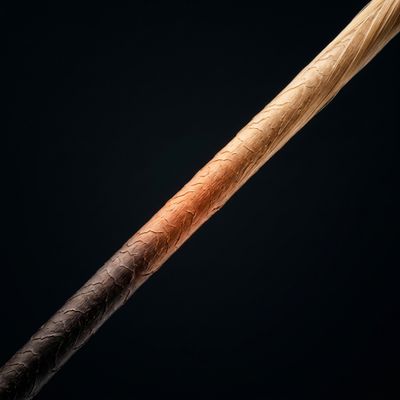
That is residual pigment: the unwanted warm pigment a previous lightening exposed, which stays in the lightened length. It is not leftover dye and it is not something added. The regrowth that came in afterwards does not have it; the length that went through the lightening does, and keeps it for as long as that section stays on the head and is not lightened again.
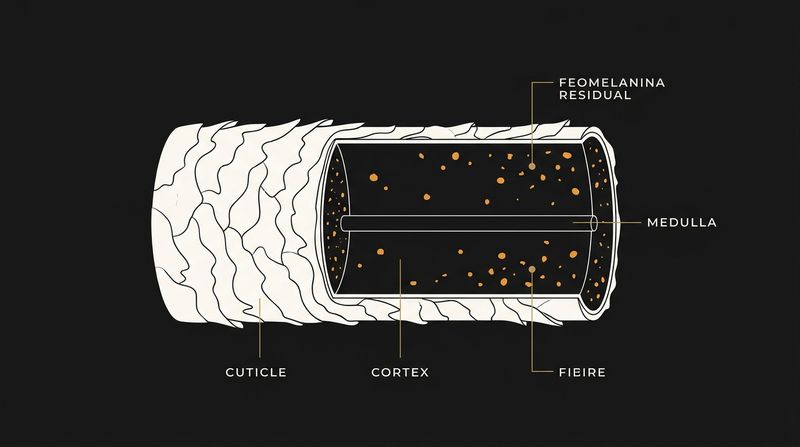
That background does not always show at the consultation. Under salon lighting, and even more with a toner on top, a lightened section can read as the same level as the root. And lightened hair tends to get more porous towards the ends, which changes how it grabs whatever you put on it (more on that in the diagnosis).
Why the same formula produces different results
The key lies in what the color meets when it lands on hair whose background is already exposed.
An oxidative color lifts some of the natural pigment and deposits artificial color in the same process. What you see at the rinse is that color added to the background underneath. That is why Wella prints this next to its lightening curve: “Understanding the lightening curve will help you to choose complementary colors to work with or neutralize exposed underlying pigments in the hair during coloring.”
On a virgin head, eumelanin still covers the background and the formula for that level comes out as expected. On the length that was lightened before, much of that eumelanin went in the first service, so the same reflect lands on an orange or a yellow that was not showing on the other head.
The visible result is an unplanned overlay of pigments: the reflect you targeted plus the warmth of the background. How far it drifts depends on:
- How high the previous lightening went: each level leaves a different background. If it stopped low, the background is reddish or orange; if it went high, pale yellow.
- The reflect you apply: a natural or a cool reflect lets that warmth show more than a gold or a copper, which point the same way and disguise it.
- The porosity of that section: the IGORA ROYAL manual warns that if the hair is porous it “will absorb more color and the result may be darker than required”.
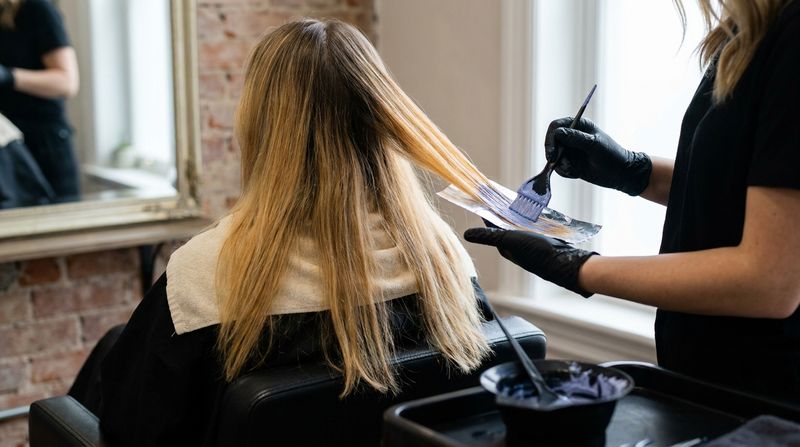
Professional tip: If the output reflection is coppery or warmer than expected and the developer volume was correct for the level, the first suspect is not the tint. It is the fiber’s bleach history.
In-consultation diagnosis: 3 visible signals, 1 key question and porosity test
Detecting residual pigment in consultation requires no special equipment. It requires a three-step protocol.
Visible signals
1. Warm translucency in natural light: on a section with lightening history, direct light tends to bring out a golden or orange undertone that does not look the same under artificial light. Tilt a strand toward natural light and look at the reflect inside it.
2. Irregularity in level distribution: residue is rarely uniform. Hair with grown-out balayage or highlights often shows micro-variations in warmth across different sections of the shaft, visible when comparing adjacent strands.
3. A change line along the length: when you open the hair in sections, you can sometimes see where the old lightening started, a lighter or warmer band at the same height across several sections. It marks the stretch that will need compensation.
The key question
Before formulating, one question changes everything: When was the last time any type of lightening service was applied, even if it has fully grown out?
The answer determines the protocol, and where the lightened section sits matters more than how long ago it was done: if that length is still on the head, assume its background is still there. The IGORA ROYAL manual builds this into its color consultation: find out whether the client has colored, permed or “previously lightened” their hair, because that “will influence the decision on how, or whether, to go ahead with another coloring process”.
Porosity test
As detailed in the hair porosity and coloring guide, porosity changes how color behaves on the lightened section. The same Schwarzkopf manual describes what happens when you color hair that was lightened or highlighted back to its natural shade, or darker: porous ends lose “the small red-orange pigments” quickly, while “cool pigments are absorbed by porous hair, leaving it dark, matte, muddy or, in the worst case, green”. Applied here: on that section, a cool neutralizer can grab more than you expect. A basic porosity test (sliding the thumb toward the root on a dry strand) completes the diagnosis before formulating.
Formula compensation: .1/.2 neutralizer table by lightened level
Once residue is confirmed, compensation goes into the formula as the complementary of the background the lightening left. Rule out the opposite case first: if that background sits darker or redder than the target allows, the job may not be neutralizing but gaining levels, a call we unpack in relift or neutralize the bleach base. At the other extreme, if the lightened section is lighter than the color you are about to apply, what it lacks is background. For coloring hair that was lightened or highlighted back to its natural shade or darker, the IGORA ROYAL manual for Spain (quotes in our translation) warns that such a base can give a result “lighter and paler than desired”. Its answer is pre-pigmentation: you “have to return the contributing pigments to the hair before applying the desired color”, using a semi-permanent on the lightest, most porous areas. Adding cool tones there only makes it worse: as the diagnosis showed, porous hair soaks them up and turns dark, matte or green.
Each background cancels with the color opposite it on the color wheel (Ostwald’s star): orange with blue, yellow with violet and red with green. The color wheel in Wella’s Koleston Perfect booklet pairs exactly those three, and L’Oréal sums it up on its Majirel chart under “Law of color”: “Opposite colors on the color wheel will counteract or neutralize each other.”
What changes from one chart to the next is the digit each house uses to write those colors:
- L’Oréal: the dual-coded US Majirel color chart lists .1 as blue (B), .2 as violet (V) and .7 as green (Gr). In double reflects the first digit leads: .12 is blue-violet and .21 violet-blue. A .13, on the other hand, is blue plus gold, and the same chart calls it beige: it will not fix red.
- Wella: the Koleston Perfect booklet lists /1 as “Ash (blue/green)”, /8 as “Pearl (blue)”, /6 as “Violet (cool)” and /2 as “Matt (green)”. In Wella, the green for red sits in the /2.
- Schwarzkopf: in IGORA ROYAL’s current English shade names the -1 is Cendré, the -2 Ash, the -3 Matte and the -9 Violet, and its technical manual places every reflect on its own color wheel. Before carrying a digit from another chart over to Igora, check on that wheel which shade sits opposite the background.
| Level of the lightened section | Exposed background (Koleston curve) | Complementary | Where it sits on the chart |
|---|---|---|---|
| Level 5-6 | Reddish-orange at 5, orange at 6 | Blue; if red dominates, a touch of green | L’Oréal .1 (and .7 for red) · Wella /8 or /1 (and /2 for red) |
| Level 7 | Orange-yellow | Blue with some violet | L’Oréal .12 or .21 · Wella /8 together with /6 (the /86) |
| Level 8 | Yellow | Violet | L’Oréal .2 · Wella /6 |
| Level 9-10 | Pale yellow at 9, very pale at 10 | Violet, with a light hand | L’Oréal .2 · Wella /6 |
Technical note: the table tells you which reflect to pick, not how much: the amount comes from a strand test on the lightened section. Where a manufacturer does give a figure, it gives a ceiling, set by base. Schwarzkopf’s manual for Spain caps its IGORA ROYAL neutralizers (0-11, 0-22 and 0-33) at “up to 5%” of the color cream on bases 8 and 9, “up to 15%” on bases 6 and 7 and “up to 25%” on bases 1 to 5. It also asks you to raise the developer in the same proportion. Those figures are written for its color, by base; on a lightened, porous section cool tones grab harder, so there the strand test decides. The exact per-case calculation (level, porosity, history and how high the lightening went) means crossing every variable at once, something that 30V and the variables that depress lift also addresses from the developer angle.
Two questions are still open before the compensated formula goes on. The allergy alert test answers whether the skin tolerates it: Wella, in the Koleston Perfect booklet, and L’Oréal, on the Majirel chart, ask for it 48 hours ahead, every time you color. A strand test on the lightened section answers how much neutralizer that section needs.
Common salon cases: old balayage, grown-out ombré and a single bleach service
Three profiles keep coming up in consultation when residual pigment is involved.
Old balayage
This is the one that creates the most confusion. The original balayage has grown out, new regrowth has visually covered the previous work, and the current level appears uniform. However, the areas that were lightened, typically mid-lengths and ends, still carry their background. It weighs more if the balayage stopped at mid levels: on the Koleston curve a 6 leaves orange and a 7 orange-yellow, both far more present under a natural shade than the pale yellow of a 9.
The typical deviation: when applying a full-length color treatment or maintenance tint, mid-lengths and ends come out warmer than the root. Residue in those areas adds warmth to the applied reflect.
And if the brief is not maintenance but one even color from root to ends, that residue is only one of two variables. The other is which direction you even out in, because the lightened band and the untouched base do not take the same deposit in the same time.
Protocol: identify zones with bleach history through visual inspection under natural light and apply selective compensation in those areas only, not throughout the full length.
Grown-out ombré
A defined ombré leaves a lightening gradient from mid-lengths to ends. Someone who wore one years ago can still carry that history in the ends, even if the current look is completely different: the background stays until a new bleach service or a cut takes it away.
Warning signal: ends that consistently come out warmer than mid-lengths and roots in any color work, regardless of the reflect applied.
Single bleach service, now grown out
The quietest case. Someone who bleached once, for a special occasion or just to try it, and has been growing it out since. The new root has no residue. The lightened length does. If the cut has not eliminated that entire section, the formula will encounter two substrates with very different behavior.
Common mistakes when residue goes undetected and how to rescue an already-applied result
Three mistakes that keep coming back
Error 1: Increasing developer volume. When a result comes out warmer than expected, the instinctive reaction is to assume insufficient lift power. But more volume means more lift, and more lift does not remove warmth: it moves it along the lightening curve, from orange to yellow, and keeps it on show. What cancels warmth is the complementary. If what is really missing is levels, the decision is a different one (relifting), not a stronger developer in the color.
Error 2: Changing the reflect without compensating for the residue. Switching from a gold to a natural or an ash without accounting for the background uncovers the warmth the gold was disguising, because what you see is always background plus color.
Error 3: Repeating the “formula that worked before”. If it worked when the lightening was fresh or barely grown out, that section was in a different state. Every service in between and every cut changes how much lightened length is left and where.
How to rescue an already-applied result
If the result is already in and the warm deviation is visible, the options are:
-
Deposit toner with the opposite reflect: a demi-permanent or a gloss carrying the complementary of the undertone that came through, with the developer and timing its product sheet gives. We go into it in toner on bleached hair. Mind the calendar: Wella asks for an allergy test 48 hours before any color service, its Color Touch demi-permanent included, so the rescue gets scheduled with that test done.
-
Wait for the next service with planned compensation: if the deviation is mild and the person is happy to live with it, document the complete history and formulate with compensation at the next service. Forcing neutralization on the spot on porous hair can overcompensate.
-
Direct-dye toning (semi-permanent): for moderate deviation on high blondes, where the background is already yellow, a direct-dye semi-permanent with violet (or blue, if what shows is orange) can balance the undertone. How it goes on, dry or on shampooed, towel-dried hair, is set by its product sheet.
Warning: trying to neutralize a very warm result with a second oxidative color application the same day puts developer back on fiber that has just come out of a chemical process. In hair with high porosity, the risk of structural damage outweighs the cosmetic benefit. If it is still on the table, the most stressed area gets two checks first: an elasticity test and a test strand with the mix. A fiber that stretches without springing back, or snaps, rules out a second application that day.
Frequently asked questions about residual pigment in previously bleached hair
How long does residual pigment from bleaching last?
It has no expiry date. Lightened hair does not get back the pigment it lost, so the background left on show stays in that section until it is cut off or lightened again. What does wash out is the toner that was covering it, and then the warmth comes back through.
Does level 7 hair with bleach history always have residual pigment?
If the lightened section is still on the head, it carries the background of the level that lightening reached; what changes from one case to the next is which background. On the Koleston curve, a lightening that reached a 9 or a 10 left a pale yellow, and one that stopped at a 7 left an orange-yellow that shows far more under a natural shade. Consultation history, natural light and a strand test are the clues you have, and none of them is enough on its own.
Do conditioning treatments between sessions affect residual pigment?
They do not remove it: a maintenance treatment, moisturizing or protein, is not designed to lift or deposit color. Where they matter is porosity, and porosity changes how the neutralizer grabs on the lightened section. That is why the strand test is worth doing on the hair exactly as it comes in that day.
Is the behavior of residual pigment different with powder vs. cream bleach?
The background is set mainly by the level the lightening reached, because the curve runs by level. Format, mix and timing change how and how far each product lifts, and that is what each lightener’s product sheet tells you. For diagnosis, knowing how high it went, and where, tells you more than knowing which format was used.
How can I neutralize orange undertone in previously bleached hair without damaging the fiber?
The neutralizing unwanted hair tones article details the protocol by undertone. On hair that is already lightened and porous, the idea is to work with the lowest volume the product allows. Some manufacturers put it in writing: the developer guide in Schwarzkopf’s IGORA ROYAL manual for Spain assigns the 3% (10 vol) to “treating color deposit on pre-lightened hair”, and a demi-permanent usually comes with its own low-volume developer (Wella mixes Color Touch with a 1.9% or 4% emulsion).
What is the difference between residual pigment and the underlying pigment that appears when lightening?
Underlying pigment is the warmth any lift reveals: it belongs to the hair’s natural melanin and follows the level. On Wella’s Koleston curve it goes reddish-orange at 5, orange at 6, orange-yellow at 7, yellow at 8 and pale yellow at 9. Residual pigment is that same exposed warmth still sitting in a length that was lightened in a previous service. The practical difference is timing: underlying pigment shows up while the peroxide is working and can be anticipated from the target level, whereas residue is already there before you mix anything, at the level the old lightening reached. That is why a length that reads as a clean level 7 can carry more warmth than a virgin 7.
Does a color remover or a bleach wash eliminate residual pigment?
A color remover is built for artificial color: Schwarzkopf describes its Bond Enforcing color corrector, in the IGORA ROYAL manual for Spain, as a way to remove “leftover artificial color while keeping the hair’s integrity”. Residual pigment is the natural background a lightening exposed, so a remover is the wrong tool for it. A bleach wash is still lightening: it moves that background along the curve rather than clearing it, and it does so on fiber that has already been lightened. Before a cool target, the choice is between compensating in the formula and lifting that section further, and that decision is the one covered in the compensation section above.
In summary
- Residual pigment is the warm background a previous lightening exposed, still sitting in the lightened length.
- Salon lighting or a toner can hide it, and new color landing on top can come out warmer than planned.
- Diagnosis combines lightening history, natural light, a porosity test and a strand test.
- Compensation uses the complementary of that background: blue against orange (.1 in L’Oréal), violet against yellow (.2 in L’Oréal) and green against red (.7 in L’Oréal, /2 in Wella), in the amount the strand test tells you.
- The typical cases are grown-out balayage, an ombré from years back and a one-off bleach that has grown out.
The same formula can produce two different results. Not because the formula is wrong. But because the two hairs are not the same on the inside.
Formulate with complete information. Blendsor integrates bleach history, porosity, and current level into the compensation calculation.
Manufacturer sources
Manufacturer documents consulted for this article. A copy of each one is kept, and the passages noted from it are checked against that copy.
Why does the same formula give two results on bleached hair?
In the app, we ask you a question like this one, but about your own client.
Up for this week’s case? → More on blondes and lightening →Related articles

Practice with our colorimetry tools
Calculators, neutralization wheel, AI consultation...
The Blendsor newsletter
Color techniques and trends for professionals. No spam.
You know the theory. What about today's case?
Send a photo to the Blendsor advisor and get an answer grounded in colour theory: toner, developer and timing, with the brands on your shelf.
Ask about your caseWritten by the Blendsor team
Professional hair colorimetry experts with experience in AI-assisted formulation. We combine color science, salon practice and technology to help colorists formulate with precision.