How to Get Rid of Highlights and Go Back to Solid Color
Highlights don't come out, they get matched. What decides the direction of the match, why it's three zones and not two, and when solid costs more than it gives.
Blendsor
Blendsor Team
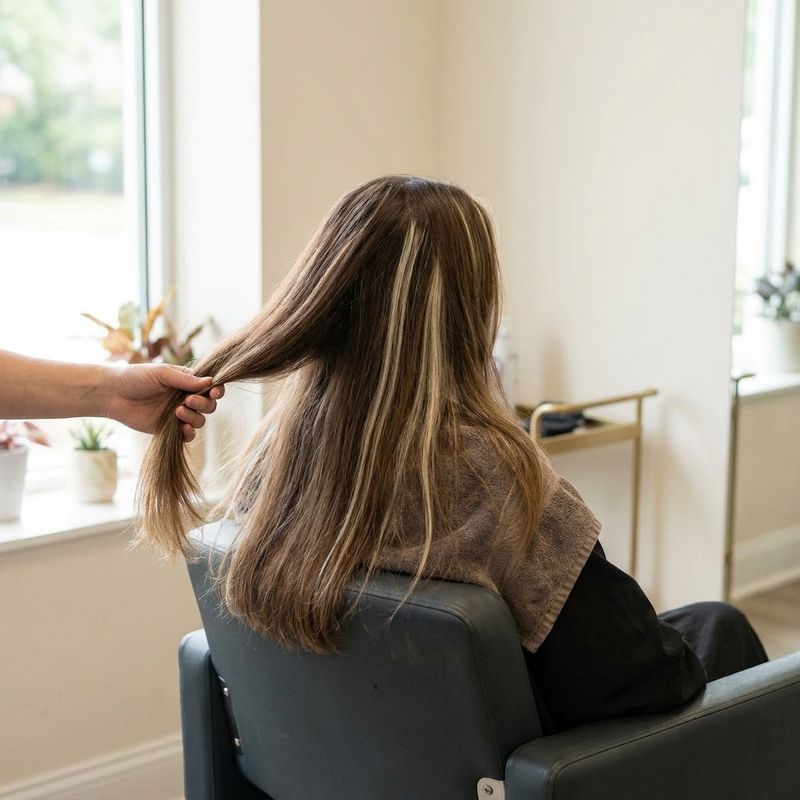
Lightening doesn’t reverse — wherever a highlight sat, the hair lost a pigment of its own that it never makes again. Evening that color out is your work, with the hair in front of you and in your hands.
For anyone formulating, the problem isn’t where it seems, either. The question that decides the result isn’t which product goes on. It’s which direction you’re matching in, and that call gets made before a tube is opened.
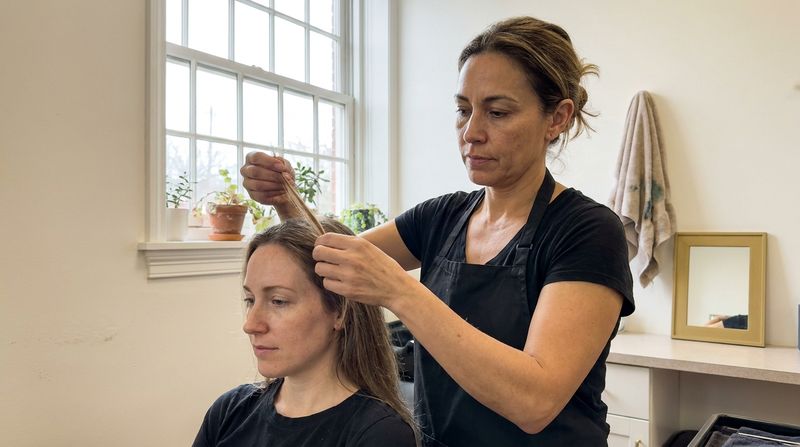
What’s actually left where a highlight used to be
What’s left is hair with no pigment of its own and holes where that pigment used to be. Lightener doesn’t “lift” color so much as dissolve the melanin granules that were giving it, and what it leaves behind are cavities scattered through the cortex.
A microscopy study on bleached hair says it plainly, and the scale is worth placing first: the protocol used 6% peroxide with alkaline powder, under heat, repeated three times on the same sample — bleaching taken to its limit, not one well-placed foil. With that caveat, the finding: no intact melanin granules in the cortex of bleached hair, and that cortex showing “a porous structure, with scattered holes of varying sizes formed by the dissolution of melanin granules between the macrofibrils” — although the macrofibril structure remained intact.
That is the real difference between the lightened section and the rest of the head: in the base the pigment is still in place, and in the lightened section it left holes as it dissolved. The scaffolding of the fiber is still there; what is missing is what gave the color.
Two consequences follow, and they govern everything after. First, those cavities don’t refill on their own: a strand already grown doesn’t make new melanin. Second, hair carrying them behaves differently under the same color, and that’s the one you pay for in the result.
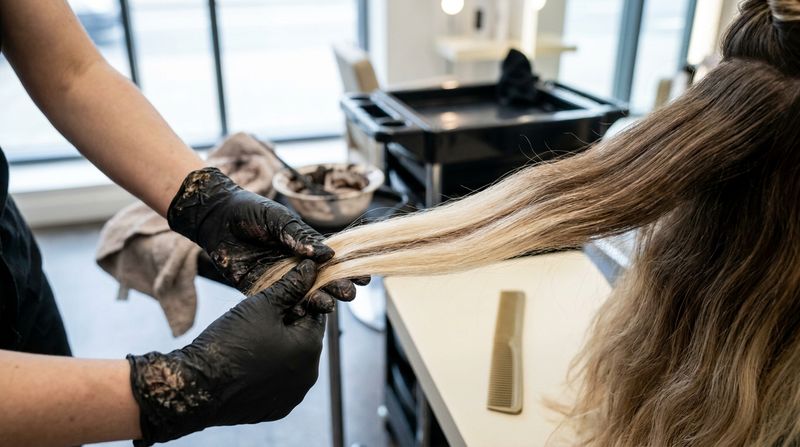
The question that comes before the bowl: which direction are you matching in?
There are two directions to a solid result, and picking the wrong one is what turns a single appointment into a two-appointment correction.
Bringing the highlight down to the base means giving the lightened section back the pigment it needs before it will hold the target shade without turning. It’s the route when the highlight sits well above where you’re going. On heavily lightened hair it makes filling non-negotiable — within two levels of the target it is a judgment call — and the rule most often missed is which underlying tone you’re replacing: you fill for the level you’re going to, not the one you’re coming from. Which reflect belongs to which level lives in the guide to pre-pigmenting when going darker, and that’s where that chart belongs.
Bringing the base up to the highlight is the opposite route: instead of knocking the light pieces down, you lift or tint everything else until the difference stops reading. It’s the call when the highlight already sits close to target, when the contrast is short, and above all when the person in your chair says they want it even but they don’t want to go dark.
Before picking a direction there is one check that conditions both: how much white there is and where it sits. White has no pigment to lift, and that closes no route: it means there is nothing to lift in those strands, because they are already up there. A permanent keeps lifting the pigmented hair while it deposits on the white — the white ends up covered, not lifted. Going lighter with gray in front of you is a brief the manufacturer itself publishes: in its gray-to-blonde guide, Wella has you lift the pigmented regrowth “to the right level of blonde”, reserves lift-and-tone in one step for its Special Blondes — “a range of high lift hues” — and on application says to begin where there is most gray: “you should always start where the gray is most prominent.”
What changes with the proportion of white is not the direction, it is the coverage formula. The moment natural base goes into the mix, what you are buying is opacity over that white, not more lift, and each brand brings it in from its own threshold: Wella from 30% white, L’Oréal Majirel from 50%. Neither ties it to where the white sits: hairline and parting matter because that is where it shows first and where Wella says to start applying, not because they change the formula. With white scattered over a dark base, camouflaging it with highlights and reflects is still ordinary salon work. From there the brief is a coverage one, with its own rules on level and reflect: guide to professional gray coverage.
| Direction | When you pick it | What has to be accepted |
|---|---|---|
| Highlight down to base | The lightened section sits well above target; you’re heading mid or dark | On heavily lightened hair filling is not optional; within two levels of target it is a judgment call |
| Base up to highlight | Contrast is short, or the target is light and going darker is off the table | You’re now working hair that was untouched until today |
| Neither one yet | Very high contrast on already-compromised fiber | Contrast comes down first, and the match happens at a second visit |
That third row isn’t a get-out. Forcing both zones into the same appointment runs two chemical services through fiber that already arrived tired, and that shows up at the comb-through, not at the bowl.
Why it’s three zones, not two
Reading that head as “highlight and everything else” fails because there are rarely two histories on it. There are three.
There’s the virgin regrowth since the last service, which has never seen lightener or tint. There’s the base with history, carrying as many layers as it has had refreshes. And there is the lightened section, the one carrying those holes. Three zones, three behaviors, and a single formula going over all of them.
| Zone | What it’s carrying | How it behaves under the same mix |
|---|---|---|
| Virgin regrowth | Nothing: new hair, its own pigment intact | Least porous of the three; lifts fastest, and — trade criterion — deposits least in the same time |
| Base with history | As many layers as it has had refreshes | Middling and uneven, depending on how many services it has stacked |
| Lightened section | Own pigment destroyed, holes left in the cortex | Takes the most and fastest (craft judgment); it sets the ceiling on what you can ask the formula to do |
Of the three, virgin regrowth is what decides whether the work holds. It’s the only one that keeps growing in its own color, so it sets the contrast that shows up weeks from now. A match decided by looking only at the highlight solves today and shows at the root weeks later.
Why one formula leaves stripes
Because the three zones don’t take color equally. Worth saying where the data comes from before giving it: the study measuring it dyes with a natural colorant that deposits directly, not with an oxidative color. It shows the mechanism; it doesn’t settle how a permanent distributes itself across these three zones.
A study measuring dye uptake against porosity — using bleached human extension hair and yak belly hair, which lacks melanin naturally, as its comparison — puts it in one line — “One key parameter for the uptake of color is porosity” — and observes that both fibers are “on the one hand very bright and exhibit on the other hand a much stronger color distance” than natural human hair.
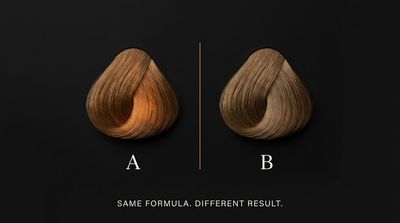
What carries the decision in front of the hair is craft, and it points the same way. Behind the chair: same mix, same timing, more of it going into the lightened section than into the base, and going in sooner. Which is why a one-pass solid lands with the old highlight heavier, denser and flatter than everything around it, and why it reads worse the darker you go.
Two opposite reasons for a lighter root
This is the one that throws people, because the symptom is identical and the cause is reversed.
On a lifting service, the root usually runs ahead of the rest. The reason that holds up is heat: Wella’s professional guidance on hot roots puts it plainly — “unlike the lengths and ends, the roots benefit from the warmth of your client’s scalp”. Result: the root comes out lighter because it did too much.
On a deposit service, the reverse happens. Virgin regrowth is the least porous zone on that head, so it’s the one that takes least in the same timing. Result: the root comes out lighter because it did too little. That second one is craft judgment rather than manufacturer data, and it’s worth saying so.
Practically: “the root came out lighter” is not a diagnosis. Without knowing whether the service was going up or down, the two available corrections are opposites.
The cost nobody sees on day one
Solid color over hair that used to be highlighted usually inherits worse upkeep than what it replaced. That is craft judgment rather than manufacturer data, and it belongs in the conversation before the service, not after.
Highlights forgive regrowth because there’s no single line moving: the contrast was already distributed. Flat color leaves one border against growing roots, and that border shows. Someone asking to “go back to my own color” is often asking to come in less often — and solid, depending on which direction you resolve it in, does exactly the opposite.
That’s not an argument for refusing the work. Nor does it decide on its own: a lifted base leaves the same hard line against the root. Where it does weigh is the brief to make it even without going darker — which is where lifting the base was already the route.
Common mistakes
- Choosing the shade off the base instead of the lightened section. The target gets decided by the worst-behaved zone, which is the lightened one. The base tolerates far more latitude than it looks.
- Skipping the filler because “the tint already has a reflect in it.” A formula’s reflect refines; it doesn’t replace pigment the fiber no longer holds. Without that step a dark target lands muddy.
- Filling for the starting level instead of the target level. The quiet one: the formula looks right and the result comes up short on depth.
- Treating grown-out regrowth as though it were tinted base. It’s the most resistant zone on deposit and the fastest on lift, and in both directions it needs a call of its own.
- Promising solid in one appointment without reading the hair both ways. Contrast and level read dry, in daylight; condition and porosity read wet. Promise on one of the two and you book the second appointment yourself.
Frequently asked questions
Can highlights be removed by putting the natural shade over them?
No, and that’s where most of the corrections that land later begin. Tint deposits color on top; it doesn’t restore what the fiber lost. It goes into the lightened section further, and by trade criterion sooner, than into everything else, so the result lands uneven in the opposite direction to the one you wanted.
How long until highlights fade out on their own?
The lightened section doesn’t fade back — the level stays where lightener put it, and what moves is its position, down the length as the hair grows. What does fade is whatever you toned it with, which is why those pieces go warm long before they grow out.
Is cutting a better option than matching?
It depends where the lightening lives. If it sits in the ends, cutting is the cleanest correction and the cheapest one for whoever’s paying. If the lightened section runs to mid-length or to the root, cutting stops being an option and the decision goes back to matching.
What do you offer someone who wants their color even but doesn’t want to go darker?
That request is the most misread of all. It sounds contradictory, but what they are asking for is to stop seeing the difference, and dropping levels is only one way to get there. It’s the textbook case for lifting the base to the highlight rather than dropping the highlight to the base. And if the target still lands under the lightened section, the reflect drift that shows up is explained by residual pigment from the previous lightening.
In short
- Lightening doesn’t reverse. It dissolved the melanin granules and left gaps a strand already grown never refills; that is what has to be matched.
- Direction gets decided first; the product comes after. Either the highlight comes down to the base or the base goes up to the highlight, and each route carries a different price.
- Three zones, three histories. Virgin regrowth, base with history and lightened section — and it’s the regrowth that decides whether the result holds.
- Solid gets paid for in upkeep. As craft judgment, flat color marks regrowth harder than highlights did, and that belongs in the conversation before the service.
Once the direction is settled, the execution steps live in the professional color correction guide and in the coloring techniques pillar. And if the question is how much that zone is over-absorbing, the porosity guide is where to start.
Calculate professional formulas with AI
Want to work out the match on grown-out highlights, with each zone’s level and each client’s chemical history on the same record?
What happens if you remove highlights to get back to one solid color?
In the app, we ask you a question like this one, but about your own client.
Up for this week’s case? → More on color correction →Related articles


Practice with our colorimetry tools
Calculators, neutralization wheel, AI consultation...
The Blendsor newsletter
Color techniques and trends for professionals. No spam.
A client in the chair right now?
The Blendsor advisor gives you the precise formula for this technique with your salon's brands — and saves it to your client's card.
Ask about your caseWritten by the Blendsor team
Professional hair colorimetry experts with experience in AI-assisted formulation. We combine color science, salon practice and technology to help colorists formulate with precision.