Patch Test: How to Keep the 48-Hour Rule Without Losing the Appointment
The window is published by your brand's protocol, not held in your memory. How to run the test in the salon without losing the appointment, and what breaks when it's repeated from memory.
Blendsor
Blendsor Team
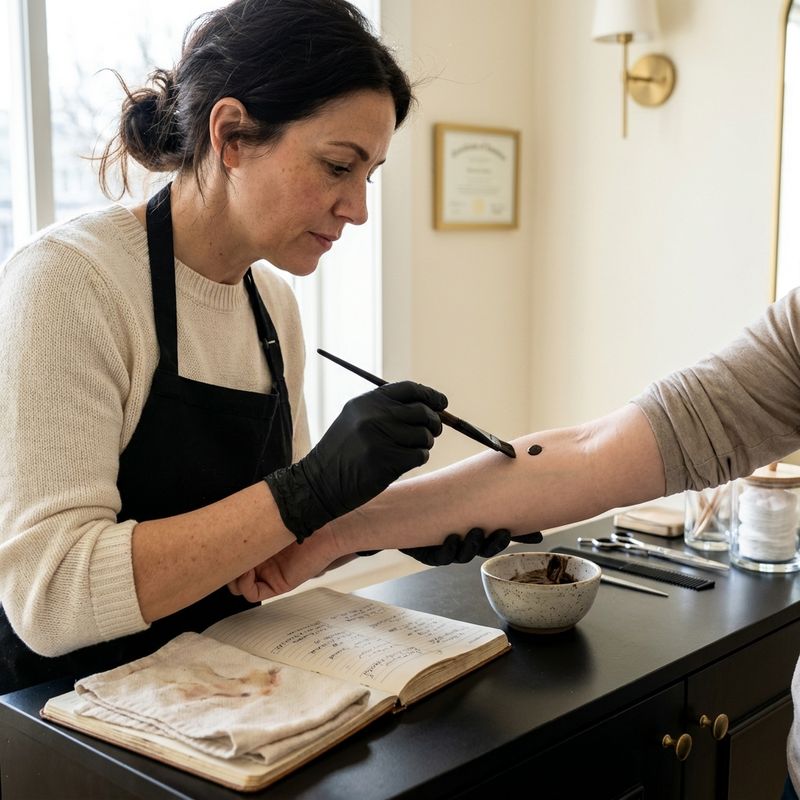
The protocol asks for 48 hours of watching before color goes on. The person in your chair wants color this afternoon.
If you work with color every day, you know which of the two usually gives. It’s almost never the appointment book.
The problem isn’t that the rule is badly written or that nobody knows it. It’s that, run from memory, it turns into a dedicated visit two days before every single color service — and almost no salon works that way. Here’s how to honor it without losing the appointment, what breaks when it gets repeated from memory instead of read, and who genuinely cannot be colored today.
How often does a patch test actually need repeating?
The window is published by the brand you’re using, and not every brand publishes the same one. A retail box instructs a test 48 hours before every application. Wella Professionals sets its Allergy Alert Test at a first-time client, or when more than twelve months have passed since the last one. What doesn’t change between brands: sensitization to an oxidative dye can develop at any point in someone’s history, and twenty years of clean coloring doesn’t protect the next application.
So the working rule isn’t a number held in memory. It’s your brand’s published protocol in front of you, plus asking again at every visit.
Three assumptions people make that don’t hold up:
- A “PPD-free” line doesn’t exempt anyone. Many lines swap PPD for PTD (toluene-2,5-diamine), which can cross-react with PPD. What decides whether a test is needed is the chemical family of the product, not the label claim.
- A valid patch isn’t inherited from the file. Even where your brand publishes a window of months, that window covers one skin, not a history: a reaction, a temporary black henna tattoo, or a change of line since then closes it, and the test gets redone. A filed date without those questions isn’t coverage.
- It isn’t just permanents. A direct dye or a tone-on-tone carries no developer, but it does carry colorants — so the test still applies. It’s the colorant that calls for it, not the developer, which means “it’s only a gloss today” isn’t a way out.
| Situation | New test needed? |
|---|---|
| First-ever coloring | Yes, always |
| Regular client, same product as usual | Per the window your brand publishes (Wella Professionals: first-time client, or more than 12 months) — plus asking again at every visit |
| Switching brand or line | Yes |
| A prior reaction, even mild | No test: refer instead (see below) |
Two things worth separating, because they get merged daily. EU Regulation (EC) 1223/2009, Annex III does not require packaging to instruct a test before every application. What it mandates is the warning that hair colorants can cause severe allergic reactions, that the manufacturer’s instructions must be read and followed, that the product isn’t intended for anyone under 16, that temporary black henna tattoos may increase the risk of allergy, and that nobody who has ever reacted after coloring should color again. The test and its frequency are published by the manufacturer; the regulation orders you to follow that instruction, it doesn’t write it.
And there’s a solid reason for the professional to apply it rather than the client at home. The European Commission’s scientific committee on consumer products reviewed home self-testing and reached two uncomfortable conclusions: that it can produce false negatives, because dose, timing, and reading vary wildly from one person to the next; and that the self-test itself, done badly, can end up inducing the very sensitization it’s meant to rule out. The same committee acknowledges the test does protect anyone who develops a positive reaction and spots it. The problem is the other side: a misread test reassures exactly the person who shouldn’t be reassured.
The scheduling gap nobody solves by asking twice
Here’s the real conflict: the test needs 48 hours ahead of it, and most color services are booked as a single appointment. Repeating “I already asked over the phone” doesn’t solve anything if nobody applied anything.
What works is moving the test into the previous visit, not into a phone call:
- At today’s visit, while booking the next color appointment, apply the test right there in the salon: mix the product that will be used, at the real ratio, and apply it at the site and quantity your brand’s protocol specifies — Wella Professionals, for instance, sets 5g of color with 5g of developer on 1cm² directly below the crook of the elbow.
- Respect that brand’s timing, without mixing protocols. Wella’s professional protocol leaves the product uncovered for 45 minutes, then rinses with lukewarm water and pats dry with a clean towel. A retail box says let it dry and leave it unwashed. Run the one for the product in your hand, all of it, not half of each.
- The area gets watched for the following 48 hours, at home, and you send a message the next day: any itching, stinging, or rash at the test spot — even mild, even if it passed? What you need to catch is felt before it’s visible, so the answer tells you more than a photo would — and it keeps images of someone’s skin off the salon phone.
- Write the test date in the file next to the date of the appointment it belongs to, along with the brand and line used. A test without those three details is worthless three months from now.
- When they come in, ask again like it’s the first time: any reaction since then? Any temporary black henna tattoo? Any new product at home? Those three questions on the way back in are the real control, not the archived paper.
The mistake to avoid here is treating the filed date as if it decided on its own. Even where your brand’s protocol covers that date, what validates it is asking again before mixing: without those questions, the paper documents a formality, not a check.
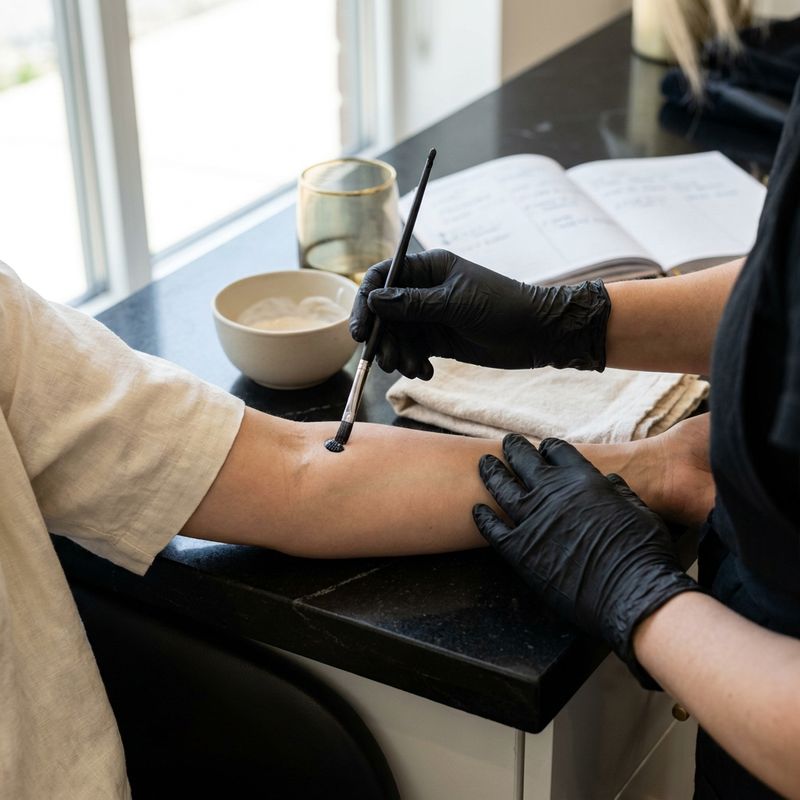
The test is applied at today’s visit, in the salon, for next month’s appointment — never improvised over the phone two days out.
The gesture, so it’s always your brand’s
- Open the published protocol for the product going on that day. It’s the step everyone skips and the one that decides the other four.
- Mix the product exactly as it will be used for the service, at the real ratio, in the quantity that protocol specifies.
- Apply at the specified site — usually the crook of the elbow or behind the ear, depending on the brand — uncovered.
- Remove it when the protocol says, not when it looks done. This is where brands diverge most: some rinse at 45 minutes, others let it dry and leave it unwashed for the full 48 hours. Both are correct in their own document and neither is correct in the other’s.
- Watch it for the full 48 hours, not just check at the end. If itching, stinging, or a rash appears at any point, remove it and wash immediately — that’s already a positive, and color is off the table that day.
The step people skip most is number 5. It’s easy to treat the 48 hours as passive waiting checked at the deadline, and it isn’t: the watching is the test. Waiting until the final minute to look for the first time turns an early reaction into an unattended one.
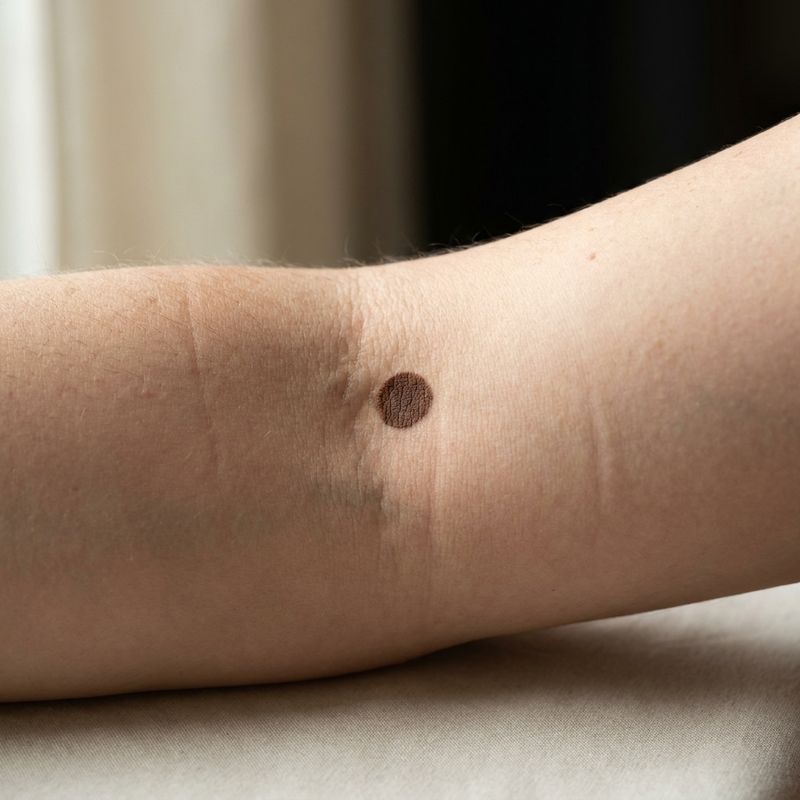
The watching is the full 48 hours, not a last-minute check.
Whoever walks in today asking for color today doesn’t get colored today
This is the one appointment the system above can’t rescue, and it’s worth saying over the phone at booking, not at the salon door.
Someone showing up for the first time, with no file and no history, has no valid test that could have been applied at a previous visit. There’s no “just do it quickly today” option: 48 hours is 48 hours, not an afternoon. What you offer instead is a diagnostic appointment — cut, hair analysis, test applied — with the color appointment set for at least two days out.
That first appointment is also where you gather the rest of the history that will shape the service, not just the patch test: henna, straightening treatments, previous dye jobs with their dates. The order worth asking in, and why, is covered in what to tell your colorist before coloring.
If the person is pregnant or breastfeeding, the patch test is done exactly the same way: pregnancy doesn’t replace it or make it unnecessary. What does change in the rest of the service is covered in can you dye your hair while pregnant?.
Saying it at booking avoids the awkward conversation once someone is already in the chair, and makes clear the wait isn’t a favor — it’s the protocol applied to everyone alike.
What this test is not
Worth separating from two sibling tests it gets confused with in daily conversation, mostly because all three involve “applying something before the service”:
- It’s not the strand test. That predicts the color outcome on a cut strand of hair, not an allergic reaction on skin. They exist for different reasons and neither replaces the other — full detail in the strand test.
- It’s not the incompatibility test. That one detects metallic salts from henna or prior products on a cut strand, outside the head, and decides whether chemical processing can go on top without damaging the fiber. It’s a physical safety test for the hair, not a skin-reaction test. What to say when it comes back positive is covered in incompatibility test positive: what to say and what to do.
All three can coexist in the same client’s history, and none replaces the other two.
What the skin already knows: refer instead of retesting
The patch test is a filter for the unknown, not a permission slip for the already-known. If someone has already had a reaction — itching, a rash, swelling — after a dye, repeating the patch on that same skin isn’t caution: it can trigger a worse reaction than the first one, because the skin is already sensitized to that chemical family.
At that point you don’t schedule another patch. You refer to medical evaluation before considering any oxidative color service.
And there’s one factor almost nobody connects to a patch-test conversation: temporary black henna tattoos, the kind done on the beach or on vacation. They’re a recognized sensitization risk factor, worth asking about with the same matter-of-factness as asking about dye reactions.
In summary
- The window is published by your brand, not held in your memory: a retail box asks for 48 hours before every application; Wella Professionals’ protocol, a first-time client or more than 12 months.
- The test is applied in the salon, at the previous visit, never improvised over the phone two days ahead.
- No window survives a change: a reaction, black henna, or a change of line since the last test closes it and forces a redo.
- Watch the full 48 hours, not just the end — remove and wash immediately if a reaction shows early.
- Whoever walks in today asking for color today doesn’t get colored today.
- Whoever already reacted once doesn’t get retested: they get referred.
Frequently asked questions
Does a regular client need to repeat the patch test every time?
It depends on the published protocol of the brand you use: a retail box asks for 48 hours before every application; Wella Professionals’ Allergy Alert Test repeats for a first-time client or after more than 12 months. What doesn’t depend on the brand is asking again at every visit: any reaction, black henna tattoo, or new product since the last test forces a redo, however recent it was.
Does a patch test from a few weeks ago count for today’s appointment?
Only if your brand’s protocol publishes a window that covers it, and only if nothing has changed since. The filed date isn’t enough on its own: what validates an earlier patch is asking again about reactions, black henna, and new products before mixing. Without those questions, the date is paperwork, not coverage.
Can the patch test be done the same day as the service?
No. It needs a full 48 hours of monitoring before color goes on. If someone books color for the same day without a current test, the color gets postponed and a diagnostic appointment is booked first.
What happens if a reaction shows up before the 48 hours are up?
Remove the product and wash the area immediately. There’s no need to wait for the deadline: any itching, stinging, or rash during the 48 hours is already a positive result, and color isn’t applied that day.
Formulate with Blendsor
Want each client’s history — including the dates of their patch tests and the line they were run with — in front of you when you decide, instead of rebuilding it from memory at every appointment?
What happens if you skip the sensitivity test before dyeing?
In the app, we ask you a question like this one, but about your own client.
Up for this week’s case? → More on global color →Related articles
Practice with our colorimetry tools
Calculators, neutralization wheel, AI consultation...
The Blendsor newsletter
Color techniques and trends for professionals. No spam.
A client in the chair right now?
The Blendsor advisor gives you the precise formula for this technique with your salon's brands — and saves it to your client's card.
Ask about your caseWritten by the Blendsor team
Professional hair colorimetry experts with experience in AI-assisted formulation. We combine color science, salon practice and technology to help colorists formulate with precision.