Can You Dye Your Hair While Pregnant?
Most experts don't consider it toxic for the fetus (ACOG). What actually changes in your protocol during pregnancy and breastfeeding, and what stays exactly the same.
Blendsor
Blendsor Team

Ever had someone already in your chair ask whether they can actually color their hair while pregnant?
You’ve probably heard the question more than once. It has a medical answer, and it helps to know what it is before the next person asks.
Here’s what the medical source says, what actually changes in your protocol when there’s a pregnancy or breastfeeding involved, and what stays exactly the same.
Quick answer: most experts consider hair coloring during pregnancy not toxic for the fetus, according to the American College of Obstetricians and Gynecologists (ACOG). What changes is the protocol: gloves always, good ventilation, and many doctors recommend waiting until week 13 just to be safe. The patch test still applies the same way it always does. And the final call is always theirs to make with their doctor.
Is it safe to dye your hair while pregnant?
Most experts consider hair coloring during pregnancy not toxic for the fetus. That’s according to the American College of Obstetricians and Gynecologists (ACOG), a leading US medical authority on pregnancy care: “Most experts think that using hair dye during pregnancy is not toxic for your fetus.”
For years, the default answer behind the chair has been “no, just in case,” treated as an unwritten rule. The medical source says something different. That gap matters, because whatever you tell your client in that moment either adds anxiety to a stage of life that already has plenty of it, or gives them real information to take to their next checkup.
Your protocol does adjust, though, in the precautions.
What actually changes in your protocol during pregnancy
Three concrete things change: ventilation in your application area becomes a priority, week 13 enters the conversation (many doctors recommend holding off until then), and techniques that keep color off the scalp gain weight. Gloves don’t change: whoever applies color already wears them every time.
The Cleveland Clinic, one of the leading US medical centers, breaks it down into three points.
The first is protection for whoever applies the color: “Hairstylists should always wear gloves when coloring or perming hair.” Gloves protect you, not your client’s skin. For their skin, what counts is the patch test and asking about skin conditions: if there are any, the Cleveland Clinic says to check with a healthcare provider before coloring.
The second is ventilation: “Proper ventilation is also a good way to lower your exposure to chemicals in the air.” If your station has a corner with poor airflow, this is the appointment to open a door or turn on the exhaust fan. Not the next one.
And the third is timing: “Many doctors recommend holding off on hair color until week 13 of your pregnancy, just to be safe,” because the first trimester is when the major organs, including the brain and spinal cord, are forming. Your client can follow that caution or not, based on what their own doctor says, and tipping the balance either way isn’t your job.
| What the medical source says | What you do at the chair |
|---|---|
| Most experts don’t consider it toxic for the fetus (ACOG) | You proceed with the service as usual, if they decide to |
| Hairstylists should always wear gloves | Gloves always, like every service, and product only where it belongs |
| Lower exposure to airborne chemicals | Good ventilation in the application area |
| Many doctors recommend waiting until week 13 | You mention it as an option, not a condition |
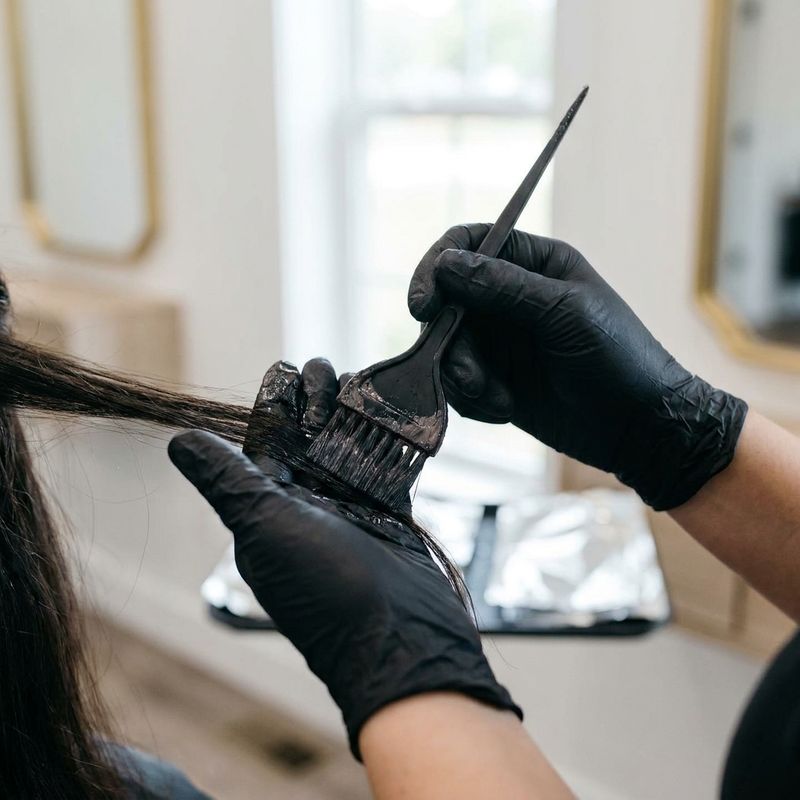
Gloves, pregnant client or not: this part of your protocol doesn’t change.
If they’d rather reduce scalp contact: highlights or balayage
Some clients, even though the medical source doesn’t ask for it as a condition, prefer to minimize direct scalp contact while pregnant. For those cases, highlights or balayage are a real option: color change is still possible without working right at the root.
Cleveland Clinic itself mentions highlights and balayage, which don’t touch the scalp, as a way to lower exposure. It’s a technique that responds to your client’s preference, and you can offer it as exactly that: an option, not an obligation.
What about breastfeeding?
Cleveland Clinic admits there’s very little real data on breastfeeding, and notes that, at this point, there’s no evidence that hair dye gets into breast milk when used as directed.
Here’s the full quote: “there’s no evidence at this point to suggest that hair dye will get into your breast milk if you use it as directed” (Cleveland Clinic).
The same precautions apply: gloves and good ventilation. And one more the source does ask for: “keep your baby out of the room” while you’re applying the product, so the smells don’t irritate them.
What doesn’t change: the 48-hour patch test
Pregnancy doesn’t replace the patch test, and it doesn’t make it unnecessary either. It applies exactly the same way it does for any other color service.
As we covered in the 48-hour patch test, sensitization to an oxidative dye can show up at any point in someone’s history. Twenty years of coloring without a reaction don’t protect against the next time. Pregnancy doesn’t change that rule or soften it. If your brand’s protocol calls for a test, it calls for a test, same as for any other client.
This connects to something you should already be asking every single time, pregnant or not: the full history before you touch the hair. We cover it in detail in what to tell your colorist before coloring: past reactions, henna, chemical straightening, dated color history. Pregnancy adds to that list of questions. It doesn’t replace it.
What to log in the client file
Three things, nothing more: whether they’re pregnant (and how many weeks along) or breastfeeding, any skin reaction or discomfort during the service, and what was decided that day. That way, whoever sees them next doesn’t have to ask from scratch.
That detail shouldn’t live only in your memory, especially in a salon where different people might see the same client on different visits. In Blendsor, the note stays saved next to their history, ready for the next appointment: whoever does their color six months from now doesn’t have to start over, or ask the same questions that already got answered today.

Today’s note is what saves you from asking the same questions six months from now.
Frequently asked questions
Is it safe to dye your hair in the first trimester?
Most experts think hair dye during pregnancy is not toxic for the fetus, according to ACOG. Even so, many doctors recommend waiting until week 13, just to be safe, because the major organs are forming during the first trimester. It’s a caution, not a prohibition, and it’s a call to make with their doctor.
Can you dye your hair while breastfeeding?
Yes, with a caveat: Cleveland Clinic says there’s very little real data, and notes there’s currently no evidence that hair dye gets into breast milk when used as directed. The same precautions apply: gloves and good ventilation.
Does a pregnant client still need the patch test?
Yes, exactly like any other client. Pregnancy doesn’t replace your brand’s protocol or make it unnecessary.
Who decides whether a pregnant client can get their color done that day?
The client, together with their doctor. Your protocol brings the precautions (gloves, ventilation, and the option to wait or reduce scalp contact), but the final call is never yours, and never Blendsor’s.
The takeaway
- Most experts don’t consider it toxic for the fetus (ACOG): the default answer isn’t no, and the call is made with their doctor
- The protocol changes in precautions: gloves always, good ventilation, and many doctors recommend waiting until week 13
- Breastfeeding gets the same answer and the same precautions: no evidence that hair dye reaches breast milk when used as directed
- The patch test still applies: pregnancy doesn’t replace it
- The call is the client’s, made with their doctor, never the salon’s
Keep every history ready for your next formula
Want every client’s full history (allergies, dates, notes like this one) saved and ready before your next formula?
How many times has a client already asked you this in the chair?
Related articles

Practice with our colorimetry tools
Calculators, neutralization wheel, AI consultation...
The Blendsor newsletter
Color techniques and trends for professionals. No spam.
You know the theory. What about today's case?
Send a photo to the Blendsor advisor and get an answer grounded in colour theory: toner, developer and timing, with the brands on your shelf.
Ask about your caseWritten by the Blendsor team
Professional hair colorimetry experts with experience in AI-assisted formulation. We combine color science, salon practice and technology to help colorists formulate with precision.