Incompatibility Test Came Back Positive: What to Say
The incompatibility test came back positive and someone is waiting for colour. What to say, what you can offer instead, and how not to lose them.
Blendsor
Blendsor Team
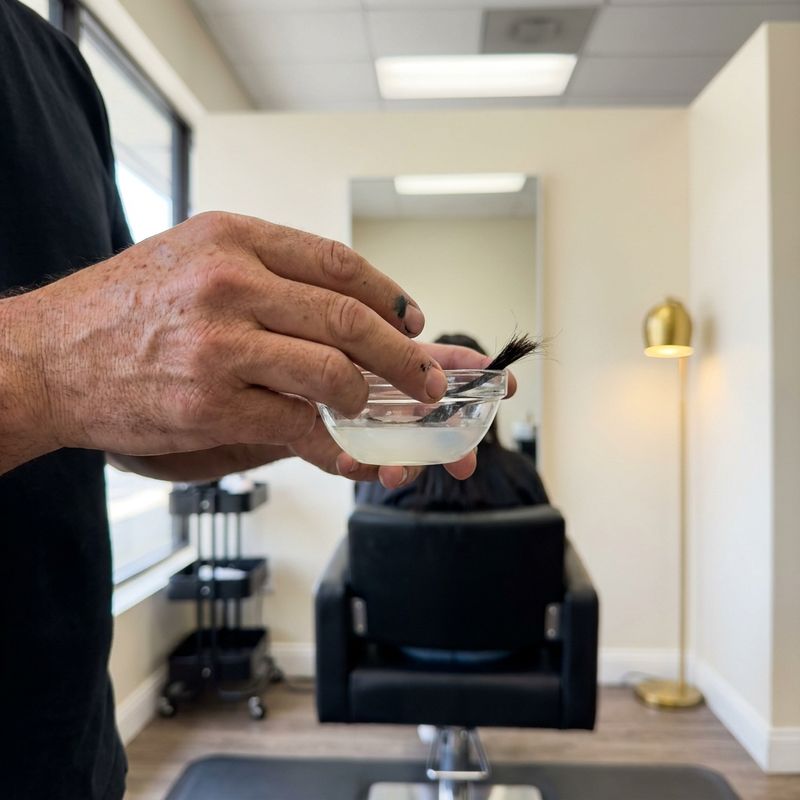
You ran the test and it came back positive. And there is someone waiting for a colour you cannot do today.
If you work behind the chair, you know that is the genuinely uncomfortable part. The test is chemistry and it resolves in thirty minutes. What comes after is a conversation, and whether that person comes back depends on it.
Here is what to say, what you can offer instead, and how to turn a service that falls through into a plan that holds.
The conversation starts before the test, not after
This is the change that lowers the temperature most, and it costs nothing: announce the check before you run it.
“Before I mix anything I’m going to run a check on one strand. It takes half an hour. If the hair reacts, I can’t colour you today — and I’ll show you why and what we do instead.”
Framed that way, a positive stops being bad news and becomes the confirmation of something already on the table. The difference is enormous: in one version you are backing out, in the other you are doing exactly what you said.
And if it comes back clean, you have still won. You have just shown that in your salon things get checked before they get applied.
What does a positive incompatibility test actually mean?
It means there is something in that hair that reacts with the chemistry of the service, and that putting colour or lightener over it can heat, break or dissolve the fibre. This is not textbook caution: it is one of the two points in the service with real physical risk. The other is allergy, which is why the 48-hour sensitivity test exists. They are different tests and neither replaces the other.
The full protocol and how to read each signal live in their own article. The working summary is short: the service closes on an obvious physical reaction (heat, bubbling, smoke, smell, the strand falling apart), on a strand that shifts colour, on one that lightens all at once, and on one that does not move at all after thirty minutes. Only one opens it: the strand that lightens very slightly, with no reaction and no shift in tone.
The two silent signals are the ones most often missed. Neither bubbles, neither heats up, so they read as “nothing happened”. A strand that does not react is not a permission.
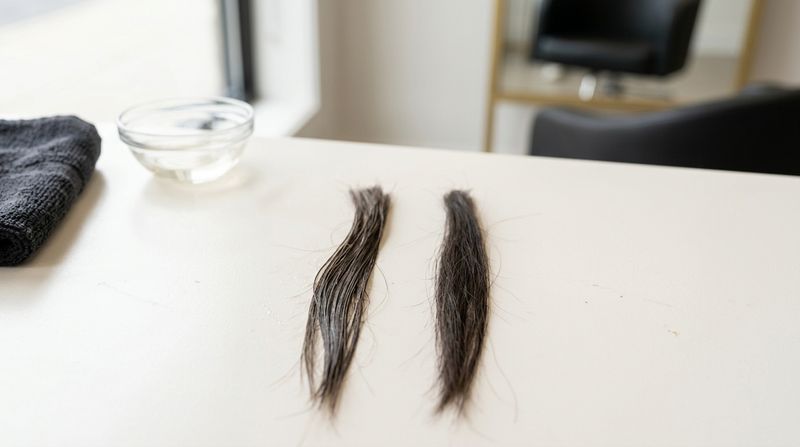
The untreated reference strand beside it turns “lightens very slightly” into a comparison rather than a memory.
The question that decides what you can offer
Before you open your mouth, place the origin, because it changes entirely what you are able to promise. If the metal came from water, there is a route and it is short to explain: treatment, repeat the check, carry on once it comes back clean. If it came from a colour product — a compound henna, one of those that darken little by little — there is no chemical shortcut, and what you are about to explain is a long wait. The protocol article covers why a chelator solves one case and not the other.
Behind the chair you can almost never confirm what was in that bottle. If the history mentions henna, vegetable colour or a product that kept darkening over time, get ready for the second conversation even if the signal was mild. That is the prudent route.
Lead and its compounds have been banned from cosmetics in the European Union for decades — the ban now lives in Annex II of Regulation (EC) 1223/2009 — and in the United States the FDA withdrew its approval of lead acetate for hair dyes, effective January 2022. That shrinks the problem, it does not close it: bottles kept at home for years, products bought outside the EU, and vegetable colours with added salts the label never mentions all keep turning up.
And there is the knot in the conversation ahead: the person in front of you almost never knows they used something incompatible. In their head, they used a natural product.
What to say when the test closes the service
The first thing you say is not chemistry. It is what you saw, what it means for them, and what happens now. In that order. The technical explanation comes after, and only if they ask.
Two lines that work, in the language they work in:
— “I ran the check before mixing and the strand reacted. If I put colour on today, that hair can break on you.”
— “This isn’t your fault. It’s something a previous product left inside: it happens with hennas, with health-shop dyes, and with the ones that darken little by little.”
Notice what is not in either: blame, or jargon. “What did you put on it?” turns a technical decision into an argument about fault. And “the fibre” or “metallic salts” are our words, not theirs — name the product by what it does (“the one that darkens little by little”), because that is what they recognise instantly.
What convinces most, though, is not a line at all. It is putting both strands in their hand — theirs and the reference — and letting them see it. The physical proof does in three seconds what a paragraph of explanation cannot.
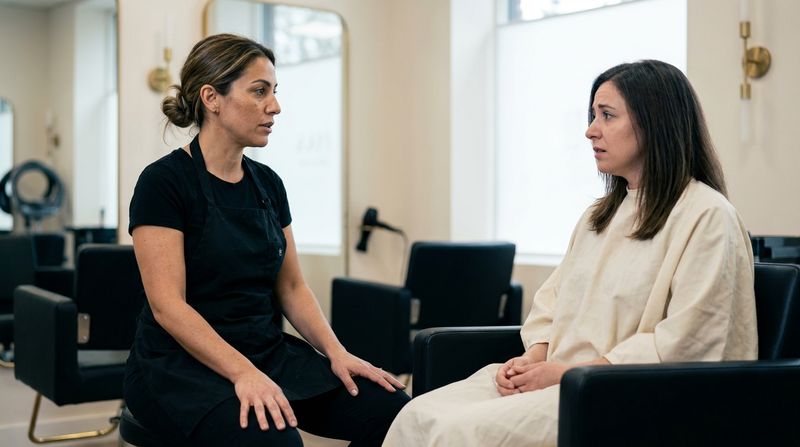
Sitting at their eye level to deliver the news changes how the same sentence lands.
What you can offer instead of colour
Today all of the chemistry is out, not just the parts carrying developer. That rules out permanent colour, demi, bleach and any lift — and also perming, relaxing (thio or hydroxide) and colour removers. It is worth spelling out that completely, because the shortcut “no developer, so I can” fails: a hydroxide relaxer carries no developer and is contraindicated all the same.
What does stand is a real service: a cut, a fibre treatment with no chemical process, a wash and a finish.
And one colour route survives, with fine print: direct dyes, the ones applied without developer. With no peroxide there is no reaction with the salts, which is the same logic the rest of this article rests on. But it is not a shortcut, and it deserves its limits stated: it will not cover grey the way permanent does, it fades wash by wash, it can stain, and it clouds the reading of the next test — a pigment bleeding into the solution, or a coating stopping the mixture getting in, can produce a shift or an absence of reaction that has nothing to do with the salts. It changes neither the diagnosis nor the wait, and it goes in the record like everything else.
Two conditions slip easily right here. First, the label: demi does carry developer and is out, however gentle the marketing; if you cannot confirm the product is developer-free, the prudent route is no colour today. Second, allergy: a direct dye carries no developer, but it does carry colourants, so the 48-hour sensitivity test is still required. With no current test on file, today’s colour is not this one either — you book them in.
That is the difference between losing someone and keeping them:
| Way out | What they leave with | What stays on record |
|---|---|---|
| ”I can’t colour you today” | A no and a wasted afternoon | Nothing: in three months you start from zero |
| ”Today we do this, and colour comes back in this way” | A service and a clear condition for returning | The diagnosis, the signal it gave, what is missing |
The second costs five minutes more. What you are selling in those five minutes is not a cut: it is that in your salon things get checked before they get applied.
Writing the diagnosis down is part of the service
A positive that never gets recorded is lost. In three months either someone else on the team runs it again, or — worse — nobody does and the colour goes on blind.
What is worth putting in their record is short:
- Which signal the test gave, in exact words: lightened all at once, did not move, heated up, shifted colour.
- When it was run and which area the strand was cut from.
- A photo of both strands together, and the physical strand in a bag stapled to the record. It costs nothing, it is stronger than any description, and it holds up the “we have to run it again” months later.
- What was done instead that day.
- What is missing before trying again: repeat the incompatibility test on whichever hair applies. The 48-hour sensitivity test is separate and gets repeated before every colour service, new product or not — sensitisation shows up precisely in people who have been colouring for years without incident.
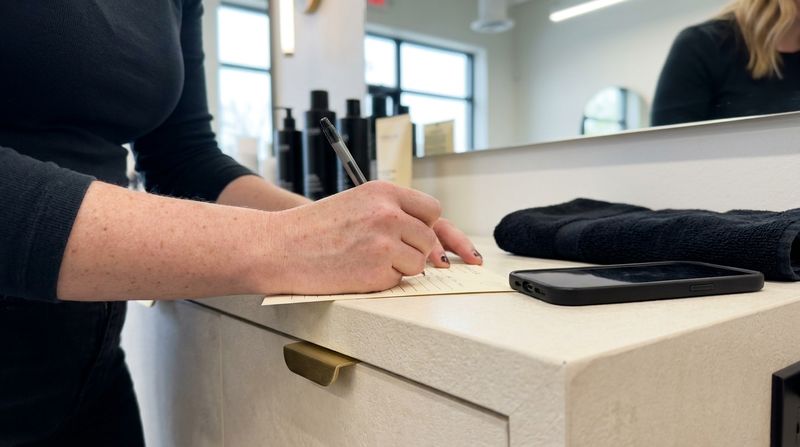
A positive that never gets written down gets repeated from scratch three months later.
That note is what turns today’s no into a yes further down the line. Without it you start from the beginning again, and with less credibility: they already heard once that it could not be done and do not see why it needs checking all over again.
How long before trying again?
There is no fixed calendar, and promising one is the most common mistake. When the origin is metallic salts, what is in the hair does not wash out and a chelator does not lift it either: it leaves as the hair grows and gets cut. So the honest answer is not a number of weeks but a condition: you try again when the test allows it, and the test gets repeated before any chemical service.
Without promising a date you can still give scale, and it is worth doing so nobody walks out thinking in weeks: if the product is through the whole length, we are talking long months of growing out and cutting, not one month. When you work only on new growth, the timeline is set by how much is left to remove.
And do not confuse this with the strand test: that one predicts colour, timing and evenness, and it happens once you already know you can work. The level decision and the consultation come after, not before.
The mistakes that stop them coming back
- Leading with the chemistry: if your first sentence is about developers and salts, the only word that lands is “no”.
- Asking what they used, in a tone of reproach: now the conversation is about whose fault it was, not about what happens next.
- Leaving it with no plan and no condition: a bare no is an exit, not a postponement.
- Not recording it: today’s diagnosis disappears and has to be redone from scratch.
- Delivering the news standing up and in a hurry: the same information, said in twenty seconds into the mirror, lands as a rejection.
Frequently asked questions
What about the chelator or the anti-metal treatments on my shelf?
It depends on the origin, and this is the question that comes up most. Chelators are formulated to sequester metal ions — the ones hard water leaves behind — and there they work: you treat, repeat the test and proceed if it comes back clean. Over metallic salts from a compound henna or a progressive dye they do not do that job, because those are not a deposit you can lift. In that case the treatment does not reopen the service: the only thing that reopens it is a repeated test that comes back clean.
Can I do mid-lengths and ends only if the roots are clean?
Not on hair that tested positive — and look at where you are asking to work: mid-lengths and ends are precisely the old hair, the hair that received that product. New growth may well be clear, and you can work on new hair once the affected length has been cut away. But then the test goes on that area and has to come back clean, and the rest gets properly protected, not protected in theory.
What if they insist and offer to sign something?
What gets signed is not permission: it is the record of the diagnosis, and they should take a copy. Permission does not exist. If you apply knowing the test came back positive, you are acting against your own recorded diagnosis, and you are the one who answers for it. It is worth asking your professional liability insurer what exactly they cover in that scenario, because an accident and harm caused against your own written judgement are not the same thing. A signature does not change the chemistry.
Should I charge for that appointment?
Charging for the slot to someone who has just had bad news is the fastest way to make sure they do not return. What does work is turning it into a product: a technical consultation with a test, with a name, a price and its own duration at booking, deducted from the colour when it happens. That way you charge for the diagnosis without punishing anyone for the result — and the gap never opens, because you never blocked three hours in the first place.
In short
- Announce the test before you run it: it turns a positive into a confirmation rather than a retreat.
- Positive means not today: physical reaction, colour shift, lightening all at once and total absence of reaction all close it. Only very slight lightening opens it.
- Place the origin: a chelator handles metals from water, not metallic salts from a colour product.
- All of the chemistry is out, not just what carries developer: perming, relaxing and colour removers too.
- The condition for returning is the test, not the calendar. And what is not written down gets repeated from scratch.
Formulate with Blendsor
Want every client’s chemical history in front of you when you decide — including the diagnoses that closed a service — and to formulate on that instead of on memory?
How do you handle it when a test takes down the day’s service?
What happens if the incompatibility test comes back positive?
In the app, we ask you a question like this one, but about your own client.
Up for this week’s case? → More on global color →Related articles


Practice with our colorimetry tools
Calculators, neutralization wheel, AI consultation...
The Blendsor newsletter
Color techniques and trends for professionals. No spam.
A client in the chair right now?
The Blendsor advisor gives you the precise formula for this technique with your salon's brands — and saves it to your client's card.
Ask about your caseWritten by the Blendsor team
Professional hair colorimetry experts with experience in AI-assisted formulation. We combine color science, salon practice and technology to help colorists formulate with precision.