How to Tell What's Really on Hair Before Coloring
What's said on the phone and what turns up at the shampoo bowl don't always match. What to check before you mix, and what to do with the gap without accusing anyone.
Blendsor
Blendsor Team
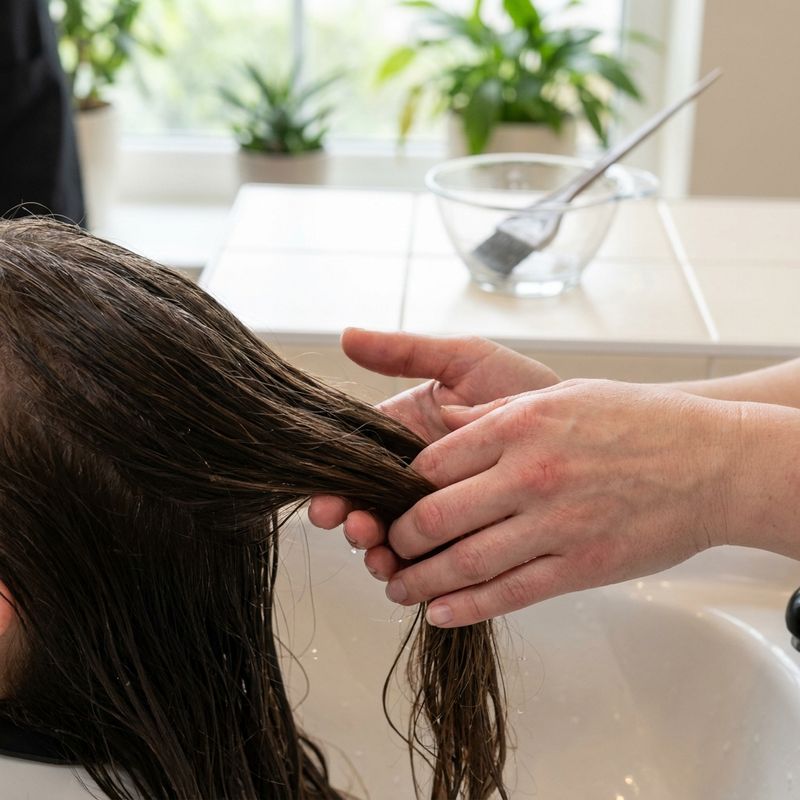
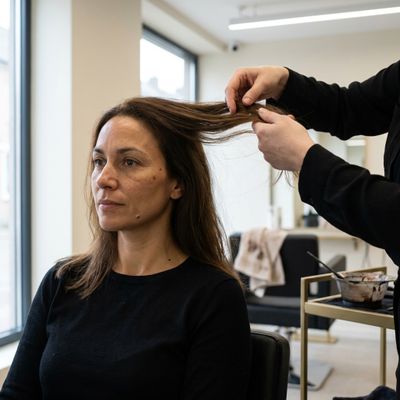
On the phone, they said nothing, just water and shampoo. At the bowl, the strand between your fingers says otherwise: it weighs different, it doesn’t shed water the same way, it has that faintly compact feel that isn’t a recent drugstore dye.
If you formulate color every day, you know this isn’t rare. It’s the norm. Nobody’s lying on purpose: hair’s memory isn’t the same as the memory of whoever’s wearing it. But between what gets said at booking and what shows up once the hair is wet in your hands, there’s a gap — and it gets wider after a long summer, a change of water, months without a touch-up.
Here’s what to check before you mix anything, what to do when the answer doesn’t add up, and how to note it down so the next visit doesn’t start from zero.
Quick summary: to tell what’s really on hair before coloring, check the feel, how it sheds water, and how it takes a comb at the shampoo bowl — before you mix. If something doesn’t match what was declared, don’t accuse: run a strand test before the clock, not after. Today’s service gets reworked around that information — and if the strand reacts, you stop and the metallic-salts protocol takes over — and the gap gets logged for next time.
Why what gets said at booking and what shows up at the bowl don’t always match
They don’t match because a phone answer is a memory, and the strand in your hand is a record. Nobody tracks their own chemical history the way you read it: “about a year ago” can mean four months, and “nothing from a box” can mean a product the person doesn’t even file under “dye.”
This isn’t a communication gap you fix with a better intake form. However well-designed the questions are — and the order that works best, from the client’s side of the chair, is already covered in what to tell your colorist before coloring — some information only surfaces once the hair is wet in your hands: real porosity, the weight of built-up product, the feel no form can capture.
That’s why the bowl is the second filter, not proof the first one failed. And what you decide there, before mixing, matters as much as what you asked at booking.
What to check before you mix anything
Straight answer: before you prep the formula, check the feel dry and wet, how it sheds water when you rinse the pre-wash, how it takes a comb, and the color wet compared to the fresh regrowth. No single sign confirms anything on its own — together, they tell you whether it’s worth pausing before you mix.
This isn’t about re-running the full strand test here — that one predicts the actual color result and processing time, and the complete protocol lives in the strand test guide. This comes earlier: it’s the quick read that tells you whether that strand test is the prudent next step, or whether you can go ahead with the service as booked.
| Sign at the bowl | What it suggests | What NOT to do yet |
|---|---|---|
| Compact or slightly gummy feel when wet | Buildup or a coating on the fiber | Don’t mix the planned formula |
| Water doesn’t soak in evenly along the length | Uneven porosity by zone | Don’t treat the length as one uniform base |
| Comb snags or grips differently in one section | A zone with a different history from the rest | Don’t force the comb through “to get it over with” |
| Wet color doesn’t match the fresh regrowth | A possible undeclared product on mid-lengths or ends | Don’t lock in the target shade yet |
| A smell that isn’t a recent oxidative dye | May point to a vegetable or home-mixed product | Don’t dismiss it just because it lightened a bit |
Notice that last column: in every row, the action isn’t “carry on.” These five signs aren’t a diagnosis — they’re the reason to pause for two minutes before mixing, not an alarm to solve on the spot in front of the client.
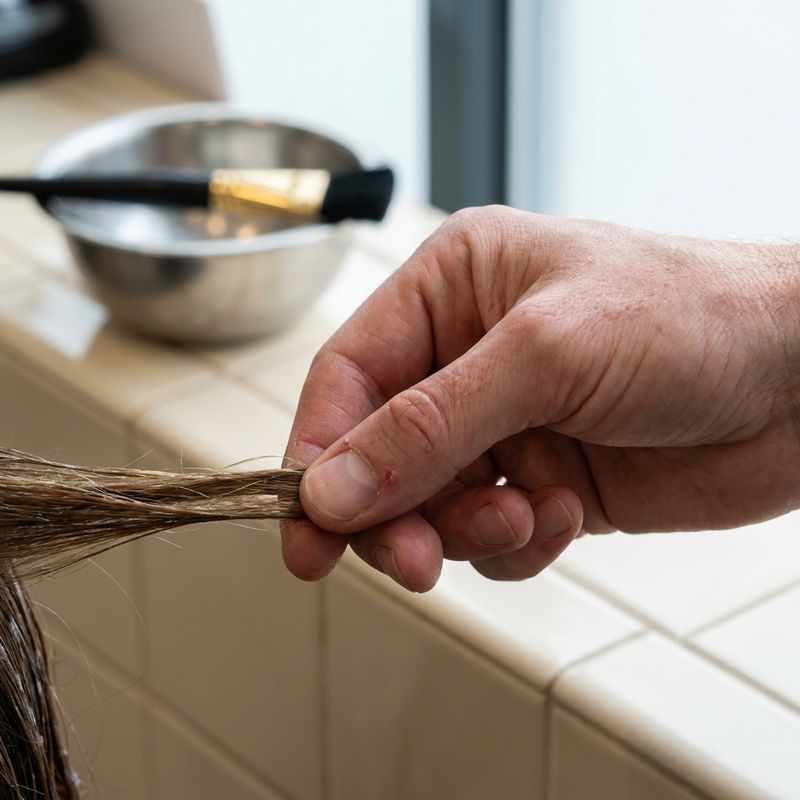
The feel you read between your fingers before mixing says more than any phone answer.
What to do when a sign shows up
Short answer: if a sign at the bowl doesn’t match what was declared, don’t mix yet. With a suspected vegetable dye or an unidentified home product, the strand test goes ahead of the clock — it happens before you decide the service, not after you’ve started it.
The sequence has three steps, and the order isn’t optional:
- Name what you see, without accusing. It’s not “what did you put on it?” in a suspicious tone. It’s “this section feels different from the regrowth, I want to check it with a strand test before I mix.” The difference between those two sentences is the difference between an accusation and a protocol.
- Run the strand test before deciding anything. The full protocol — how to cut it, how long to leave it, how to read it dry — is already covered there; what matters here is the consequence: until you have that read, today’s service is on pause, not cancelled.
- If the strand reacts oddly, escalate to the metal-salts protocol. Unusual heat, bubbling, an unexpected color shift — those signs have their own safety procedure, detailed in oxidation diagnosis before bleaching and in what to say when the incompatibility test comes back positive. We’re not rewriting it here because it’s already covered and audited there — a suspected vegetable dye is the door into that protocol, not a shortcut around it.
Pro tip: keep the order in your head as a rule, not an exception: read first, decide second, mix only after that. Reversing the order is exactly what turns a minor gap into a service you correct blind.
Reworking today’s service without it sounding like a complaint
Here’s the nuance that separates this from saying no. When the strand test confirms something doesn’t add up, you’re not cancelling the service — you’re reworking it with the information you just got. The full framework for when you genuinely need to say no — an impossible request, not a history gap — lives in how to say no to a client without losing them, and it’s worth reading because the language logic is the same: name the data, not the blame, and offer a plan before you close the sentence.
Two lines that work at the bowl:
— “This section feels different from the regrowth. I want to check it with a strand test before I decide today’s formula — it takes ten minutes.”
— “Given what I just found, today’s service is going to change a little from what we talked about on the phone. Let me walk you through it.”
Neither one blames anyone. Neither promises the original result before the data’s in. And both make clear there’s a plan, not a dead stop.

What gets logged today is what keeps the same discovery from happening all over again a few months from now.
Logging the gap so the next visit doesn’t start from zero
Whatever shows up at the bowl today and doesn’t make it into the record gets lost. A few months later, someone else on the team — or you — rediscovers it from scratch, with the same lost minute and the same surprise.
What’s worth logging is short:
- What sign showed up, and where (roots, mid-lengths, ends)
- What booking said versus what you found, in exact words if you can
- What you did that day: strand test, reworked service, or no change because the sign didn’t hold up
- What still needs checking at the next visit, if anything was left open
That short note is the difference between a gap that repeats every visit and one that gets solved once. And it feeds directly into what gets asked at the next booking: if the record already says “suspected vegetable dye, unconfirmed,” the next conversation doesn’t start at the same square one as this one did.
Common mistakes that turn a gap into a rescue job
- Mixing before confirming the sign. This is the original error: if the feel or the color doesn’t add up, mixing “to save time” is exactly what costs more time if the formula reacts badly.
- Turning the check into an interrogation. Asking in a suspicious tone shuts the conversation down instead of opening it. The data matters; the accusation adds nothing.
- Promising the original service so no one’s disappointed. If the diagnosis changes, the service changes. Holding onto the original promise against the evidence is the fast track to a result that disappoints anyway.
- Not writing it down. Without the note in the record, the next visit repeats the same discovery from scratch.
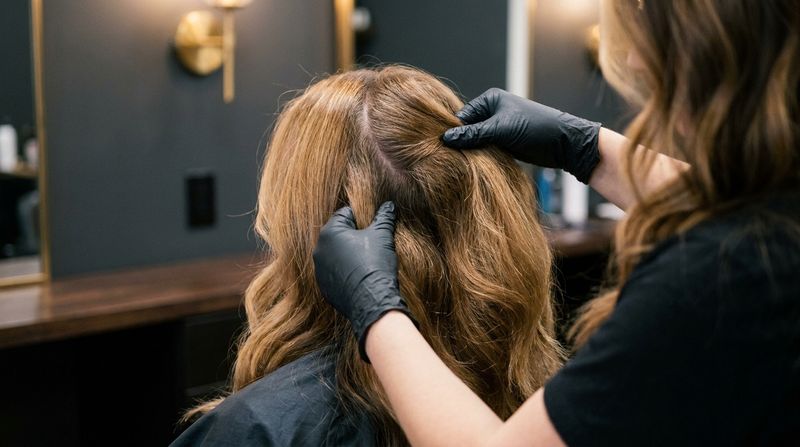
Set next to an untreated reference, a different feel stops being an impression and becomes a comparison.
Frequently asked questions
What do I do if I suspect henna or a vegetable product even though I was told there wasn’t any?
Don’t mix the planned formula yet. Run a strand test before deciding anything — it’s the only way to turn a suspicion into a data point. If the strand reacts with heat, bubbling, or an odd color shift, follow the metal-salts protocol detailed in oxidation diagnosis before bleaching. If it lifts clean with no reaction, the service goes ahead as planned.
Can I lighten the hair even if the booking answer doesn’t match what I’m seeing?
Not without checking first. The rule doesn’t change based on what was said on the phone: if there’s a suspected undeclared product, the strand test goes ahead of the clock. Lightening straight over an unresolved doubt is the scenario that causes the most rescue jobs.
How long does it take to check the gap before deciding on the service?
A strand test, following the planned formula, usually gives you a first read in ten minutes. That’s time you get back many times over if it saves you from mixing over an unresolved doubt.
Is this the same as the strand test?
Not exactly. What’s covered here is the quick read at the bowl — feel, water, comb, color — that tells you whether it’s worth pausing. The strand test is the next, more formal step, and it predicts actual color, timing, and reaction before you apply anything to the full head. The full protocol is in the strand test guide.
What if the client gets offended because I’m asking again about what they used?
Name the data, not a doubt about their word: “this section feels different from the regrowth” describes what you see, not what you assume they’re hiding. Said before you mix, that line almost always reads as care, not suspicion.
Key takeaways
- What gets said at booking and what’s really on the hair don’t always match, and it isn’t bad faith: hair’s memory isn’t the memory of whoever’s wearing it.
- Before you mix, check and feel: texture when wet, how it sheds water, how it takes a comb, color under the bowl’s light.
- With a suspected vegetable product, the strand test goes ahead of the clock. It happens before you decide, not after you’ve started.
- Today’s service gets reworked, not cancelled — unless the strand reacts: then you stop and the metallic-salts protocol takes over. The language that says so without sounding like an accusation is the same language that separates a protocol from a complaint.
- What doesn’t get logged repeats from zero at the next visit.
Formulate with Blendsor
Want the complete history of every client in front of you — including the gaps that reshaped a service — and to decide from that record instead of the memory of a phone call?
How do you handle it when what shows up at the bowl doesn’t match what was booked?
What happens if you dye hair without knowing what's already on it?
In the app, we ask you a question like this one, but about your own client.
Up for this week’s case? → More on global color →Related articles

Practice with our colorimetry tools
Calculators, neutralization wheel, AI consultation...
The Blendsor newsletter
Color techniques and trends for professionals. No spam.
A client in the chair right now?
The Blendsor advisor gives you the precise formula for this technique with your salon's brands — and saves it to your client's card.
Ask about your caseWritten by the Blendsor team
Professional hair colorimetry experts with experience in AI-assisted formulation. We combine color science, salon practice and technology to help colorists formulate with precision.