Pre-pigmentation for Gray Hair: When and How to Do It
Learn when pre-pigmentation is needed before coloring gray hair and how to do it step by step. Prevent transparent results and color-resistant grays.
Blendsor
Blendsor Team
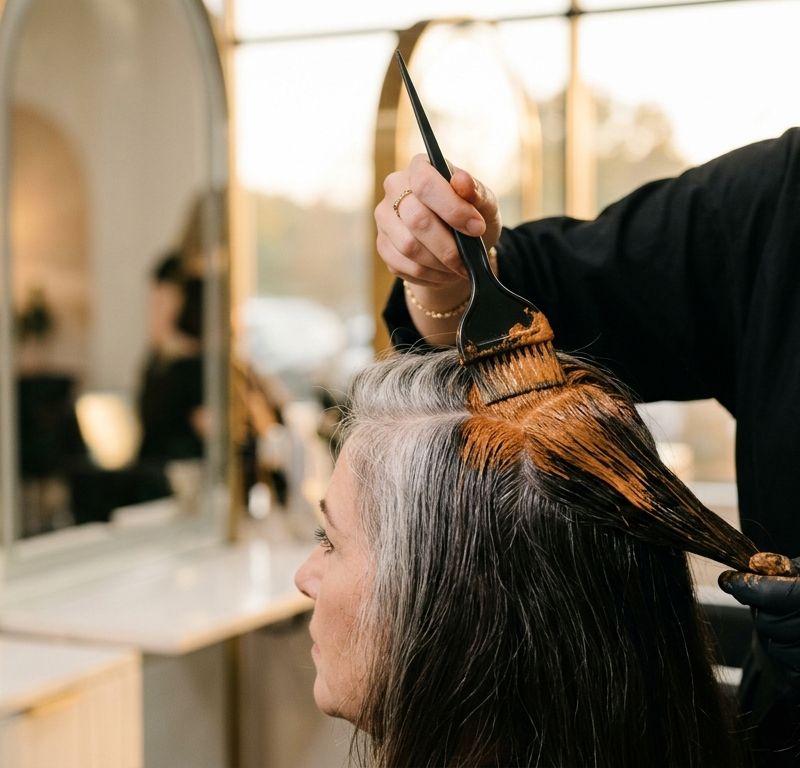
Have you ever followed a gray coverage process exactly and ended up with a result that looked transparent, flat, or completely off-tone?
If you work with clients with resistant grays, you know exactly what I’m talking about. That feeling when you remove the foil and the grays are still there, completely indifferent to everything you applied. Or worse: they took some color, but with a sheer quality that ruins the whole result.
The reason is almost always the same: missing pre-pigmentation.
Quick summary: Pre-pigmentation for gray hair means filling white hair with warm pigments (families .3, .34, or .43) before the final color. It’s required when gray percentage exceeds 50%, with color-resistant grays, or after previously failed coverage. Without this step, white hair absorbs pigment unevenly and the result looks transparent or washed out.
What is gray hair pre-pigmentation and why does it exist?
Gray hair pre-pigmentation is a step performed before coloring that deposits warm pigments onto white hair to compensate for the absence of melanin. It’s applied before the final color and acts as a foundation so the tint adheres evenly.
White hair has completely lost its natural melanin. According to the International Association of Trichologists, melanin serves two functions in the coloring process: it provides base color and acts as a chemical anchor for artificial pigments. Without it, hair dye has few molecules to bond to, which explains why grays end up looking transparent or reject color entirely.
Pre-pigmentation solves exactly this problem: it creates a layer of artificial pigments that mimics what natural melanin would do.
The science behind gray hair resistance
White hair hasn’t only lost pigment. Its structure is also different:
- More compact cuticle: The scales are tighter, making it harder for colorant to penetrate.
- Irregular porosity in previously treated areas: If grays have been colored before, porosity is uneven across the fiber.
- Altered internal pH: Without melanin, the internal pH of the hair shifts and affects how the dye oxidizes.
This means using a higher developer volume isn’t the answer. The problem is structural and requires a structural solution: prior repigmentation.
When should you pre-pigment gray hair before coloring?
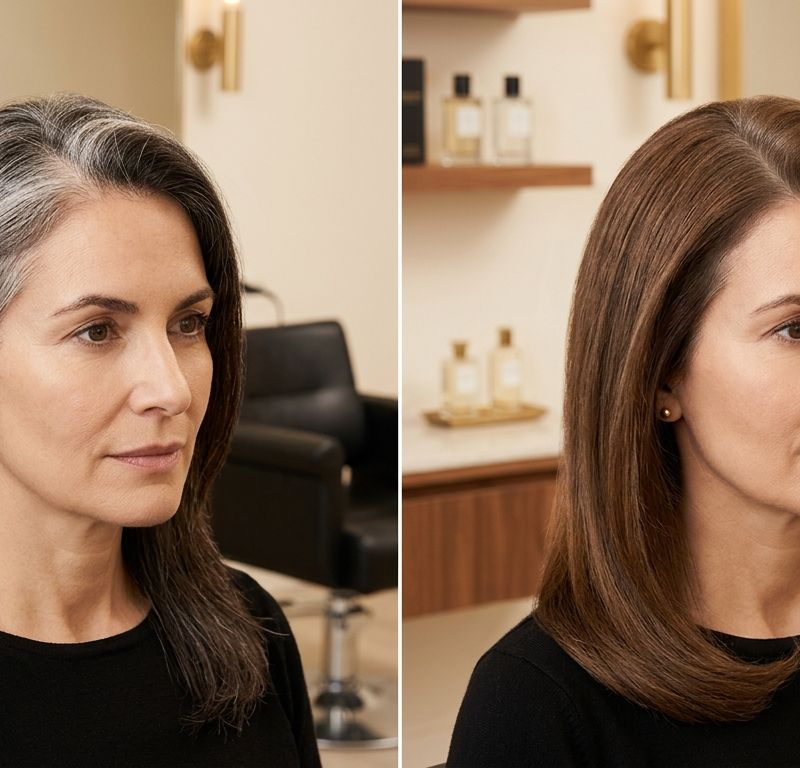
Pre-pigmentation is required when gray percentage exceeds 70%, recommended at 50-70%, and necessary for color-resistant grays (color that fades in under 3 weeks), very fine hair, post-bleaching, or clients with very hard water. Under 30% gray with no resistance history, the step is not needed.
Not every client with gray hair needs pre-pigmentation. The decision depends mainly on the percentage of gray and how the hair has behaved in previous color services.
| Gray percentage | Pre-pigmentation | Notes |
|---|---|---|
| Under 30% | Not needed | Natural pigmented hair acts as an anchor |
| 30–50% | Optional | Recommended if grays are resistant |
| 50–70% | Recommended | High probability of transparent result without it |
| Over 70% | Required | Without pre-pigmentation the result will fail |
| 100% (fully gray) | Always required | No natural melanin for support |
Beyond the percentage, there are specific situations where pre-pigmentation is non-negotiable:
- Color-resistant gray hair: If previous services failed to cover or color faded within 3 weeks.
- Very fine or low-density hair: Less hair fiber volume = less pigment retention capacity.
- After previous bleaching: Structural damage makes grays especially difficult to cover.
- Clients with very hard water: Mineral buildup blocks the cuticle and increases resistance.
- History of failed gray coverage: If another colorist already attempted it and the result was sheer.
Pro tip: Before deciding whether to pre-pigment, perform a strand test on a representative gray. If the result is transparent or color deposits unevenly, pre-pigmentation is necessary.
How do you do gray hair pre-pigmentation step by step?
Pre-pigmentation follows 4 steps: diagnose the level and gray percentage, choose a warm tone one level lighter than the final color, apply without developer for 10-20 min with heat without rinsing, then apply the final color directly on top. Not rinsing between steps is the single most critical detail of the technique.
The process of pre-pigmenting gray hair before coloring follows a clear logic: first you restore the missing warm pigment, then you apply the final color. Here’s the complete process.
Step 1: Diagnosis before you start
Evaluate three factors under neutral light:
- Natural level of non-gray hair (to understand how much contrast exists)
- Gray percentage and distribution (diffuse, concentrated, frontal)
- Fiber condition: porosity, previous damage, residual color
This information determines which pre-pigment family to use and at what concentration.
Step 2: Choose the pre-pigmentation tone
The pre-pigment family depends on the level you’re targeting with the final color:
| Target level (final color) | Pre-pigment family | Example tone |
|---|---|---|
| Level 4–5 (dark brown) | Red-copper (.44 / .4) | 5.4 or 4.44 without developer |
| Level 5–6 (medium brown) | Copper-gold (.3 / .34) | 6.3 or 5.34 without developer |
| Level 6–7 (light brown) | Gold-copper (.34 / .43) | 7.34 or 6.43 without developer |
| Level 7–8 (dark blonde) | Gold (.3 / .31) | 8.3 or 7.3 without developer |
The general rule: the pre-pigment tone should be one level lighter than the final color and belong to the warm family complementary to the desired result.
Step 3: Application of pre-pigmentation
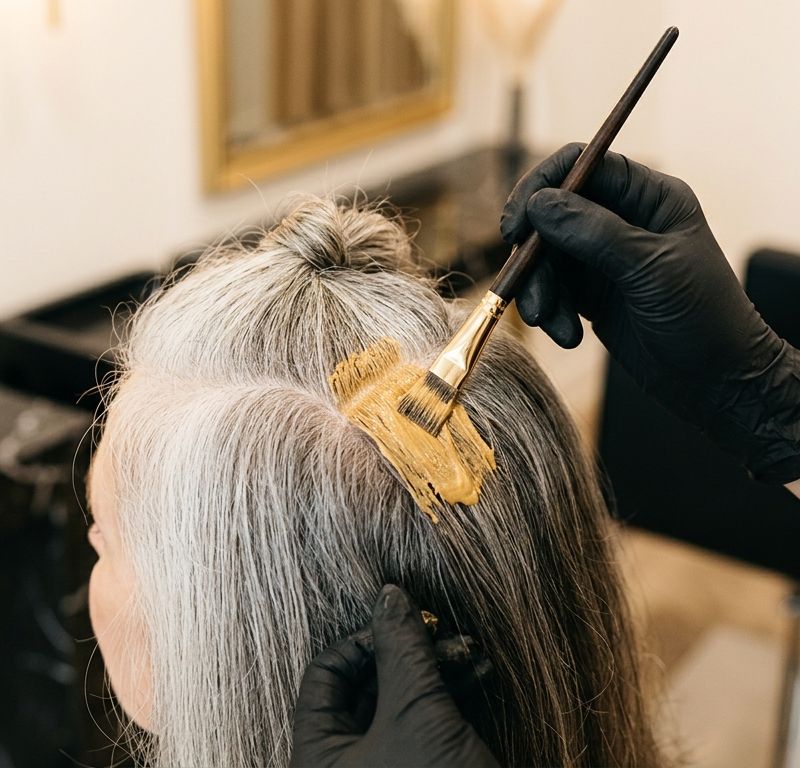
Here’s the detail many colorists miss: pre-pigmentation is applied without developer or with very low-volume hydrogen peroxide (6–9 vol, depending on the brand).
Application process:
- Dry or slightly damp hair (not wet — excess moisture dilutes pigment concentration).
- Apply the pre-pigment directly over gray areas, root to ends if grays are distributed throughout, or only over affected zones.
- Processing time: 10–20 minutes with heat or 20–30 minutes without. Heat improves absorption.
- Do not rinse: Apply the final color directly on top of the pre-pigment. Rinsing it out would remove the pigment you just deposited.
Pro tip: If your brand doesn’t have a specific pre-pigmentation tone, you can use a direct color from the range without developer, or mix the tone with warm water in a 1:1 ratio. Always check the specific protocol from your brand.
Step 4: Apply the final color
Once pre-pigmentation is complete, apply the final color with normal developer and timing. The result will be noticeably more uniform and longer-lasting.
For professional gray hair coverage, the standard approach is to use 20-volume developer (6%) over the already-applied pre-pigmentation. You can read more about choosing the right developer volume based on gray percentage and the level of lift needed.
What are the pre-pigmentation formulas by gray percentage?
For 50-70% gray with a target level 5: pre-pigment 5.4 without developer, 15 min with heat, final color 5.0 + 5.1 at 50% with 20 vol. For over 70% gray with target level 6: pre-pigment 6.34 without developer, 20 min without heat. For 100% gray with target level 7: pre-pigment 7.3 or 7.43, 20-25 min without heat. Use the gray coverage calculator to plan the service.
To save you thinking time during the service, here are concrete references by case:
Client with 50–70% gray, target level 5
- Pre-pigment: 5.4 or 5.44 without developer (or with 6 vol)
- Time: 15 min with heat
- Final color: 5.0 + 5.1 at 50%, 20-vol developer, 35–40 min
Client with over 70% gray, target level 6
- Pre-pigment: 6.34 without developer
- Time: 20 min without heat / 12 min with heat
- Final color: 6.0 + 6.3 at 20%, 20-vol developer, 40 min
Client with 100% gray, target level 7 (natural dark blonde)
- Pre-pigment: 7.3 or 7.43 without developer
- Time: 20–25 min without heat
- Final color: 7.0 + 7.3 at 15%, 20-vol developer, 40–45 min
These are reference guidelines. The exact percentage of each tone in the final mix depends on factors like porosity, color history, and client preferences.
What are the most common pre-pigmentation mistakes?
The four most frequent mistakes are: using cool or neutral families (.1 or .0) instead of warm ones (.3, .34, .4 or .43), rinsing the pre-pigment before the final color, not adjusting processing time on very fine hair (which absorbs faster), and using permanent oxidative developer instead of demi-permanent for the pre-pigmentation step.
Knowing the common errors saves you failed consultations and unsatisfied clients.
Mistake 1: Choosing the wrong tone family
The most common error is using a cool or neutral family for pre-pigmentation. Families .1 (ash) or .0 (neutral) don’t provide the warmth needed to compensate for missing melanin. The result will be equally transparent — just with a different cast.
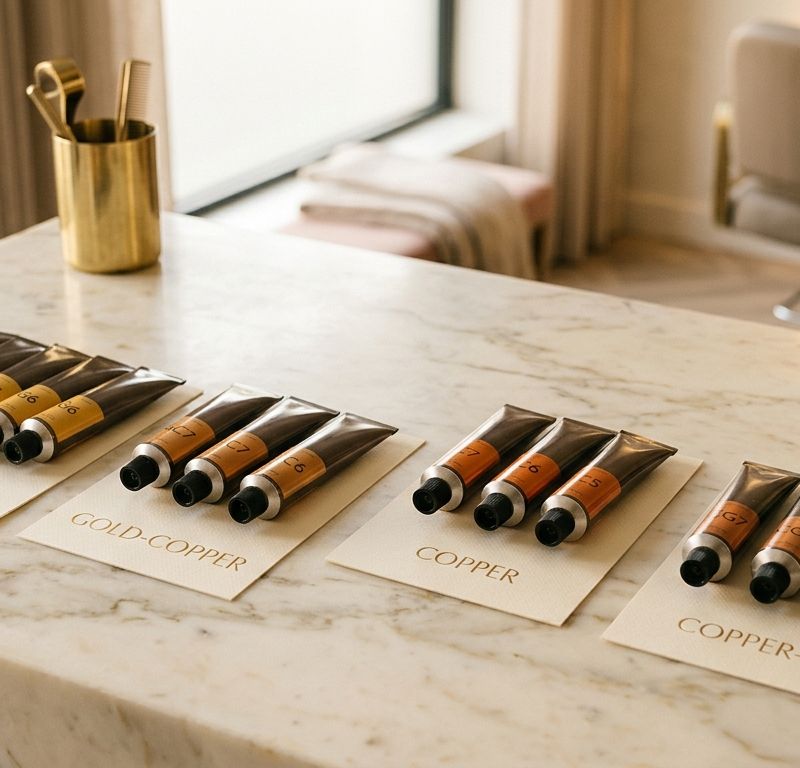
The fix: Always pre-pigment with tones from families .3 (gold), .34 (gold-copper), .4 (copper), or .43 (copper-gold). These best replicate natural eumelanin pigments.
Mistake 2: Rinsing the pre-pigment before the final color
If you rinse between the two steps, you remove exactly what you just deposited. This is one of the most frequent errors among colorists learning the technique for the first time.
The fix: Apply the final color directly over the pre-pigment without rinsing.
Mistake 3: Pre-pigmenting very fine hair without adjusting timing
Fine hair absorbs faster. Using the same timing as for normal hair can overload it with pigment and leave a result that’s excessively warm.
The fix: Reduce processing time by 20–25% for very fine hair. Start at 10 minutes and evaluate.
Mistake 4: Using permanent instead of demi-permanent
With very resistant grays, the temptation is to use higher developer volume. But this can over-oxidize the pre-pigment and eliminate its effect before the color has a chance to work.
The fix: For pre-pigmentation, always use demi-permanent or color mixed without developer. Reserve the permanent step for the final application.
When is pre-pigmentation not needed for gray hair?
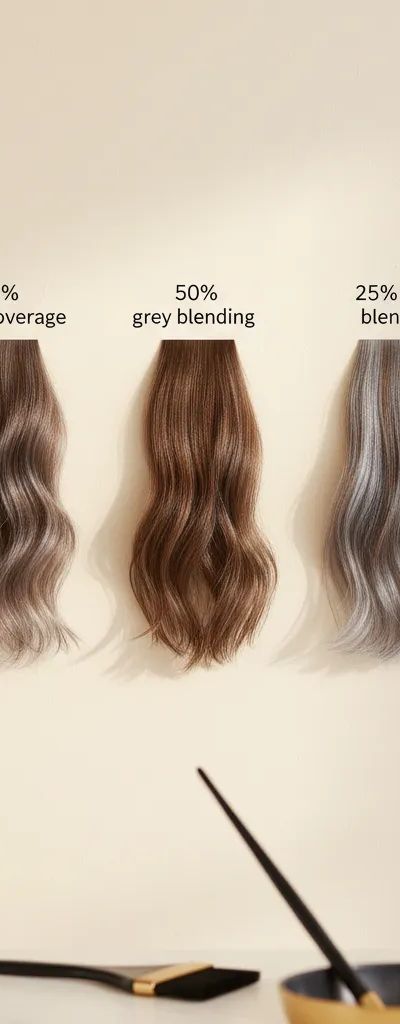
Pre-pigmentation is not needed for clients with under 30% gray and no resistance history, grey blending or Quiet Silver techniques where the goal is integration not coverage, root touch-ups when pigmented hair represents over 70%, or grays that have always covered well in previous services without this step.
Not every gray hair case requires this extra step. To understand the full spectrum of options, read about the gray coverage levels, which range from full coverage to grey blending.
Pre-pigmentation is not needed for:
- Clients with under 30% gray and no history of resistance
- Grey blending or Quiet Silver techniques, where the goal is to integrate grays, not cover them
- Root touch-ups when pigmented hair represents more than 70%
- Grays that have covered perfectly in previous services without pre-pigmentation
If your client’s grays have always covered well, don’t add this step. Pre-pigmentation is a problem-solving tool, not a universal protocol.
How do you calculate the exact pre-pigmentation formula?
Blendsor analyzes gray percentage, target level, color history, and hair porosity to automatically determine whether pre-pigmentation is needed and which specific formula to apply. Use the gray coverage calculator to estimate results before the service starts.
One of the most complex parts of pre-pigmentation is deciding exactly which tone to use, at what proportion, and for how long — especially when hair has previous color or gray distribution is uneven across the head.
Blendsor analyzes gray percentage, target level, color history, and hair porosity to automatically calculate whether pre-pigmentation is needed and which specific formula to apply. Instead of estimating by eye, you have the exact parameters before the service starts.
Want to see how it works? Start free on Blendsor.
Frequently Asked Questions
What is the difference between pre-pigmentation and repigmentation for gray hair?
In professional practice, pre-pigmentation and repigmentation are used interchangeably. Both describe the process of depositing warm pigments onto white hair before the final color. Some colorists use “repigmentation” for cases with previous color history and “pre-pigmentation” for virgin hair, but the technique is essentially the same.
Can I use the same tint I’ll apply as final color for pre-pigmentation?
Yes, it’s a valid option — with nuance. You can use the final tone mixed without developer or with very low-volume developer (6 vol) for pre-pigmentation. The important thing is that the tone belongs to a warm family. If the final color is ash or neutral, don’t use it as a pre-pigment: add a warm tone of the same level first.
How much time does the service add with pre-pigmentation?
It adds between 20 and 35 minutes to the total service: the application time plus processing. Since there’s no rinse between steps, you don’t lose time there. Factor this into your appointment scheduling and when communicating service pricing to your client.
Can you pre-pigment and color in the same appointment?
Yes, and in fact that’s always how it’s done. Pre-pigmentation and the final color are two steps of the same service, applied consecutively. There’s no need to split the applications into two separate visits.
Does pre-pigment damage the hair?
When used without developer or with very low volumes, pre-pigment has minimal impact on the hair fiber. It’s considerably less aggressive than a standard oxidative process. If there’s concern about cumulative damage, you can complement with a bonding treatment during the final color step. For guidance on how porosity affects coloring results, check the developer volume guide for more on how oxidant choice impacts the fiber.
In summary
- Gray hair pre-pigmentation replenishes missing melanin with warm pigments before the final color.
- It is required above 50–70% gray, especially with resistant grays or after failed coverage.
- Always use warm families: .3, .34, .4, or .43, one level lighter than the final color.
- Apply without developer or with very low volume and do not rinse before applying the final color.
- Not rinsing between steps and choosing the correct family are the two critical points of the technique.
Do you have clients whose grays have always been a challenge? Try Blendsor to calculate the exact formula before the service starts. See plans and pricing →
And tell me — do you have any particularly resistant gray cases you haven’t been able to crack? Let’s work through it together.
Related articles


Practice with our free tools
Calculators, neutralization wheel, AI consultation...
The Monday Briefing
Color techniques and trends for professionals. No spam.
Apply this theory with precision
Blendsor analyzes 70+ variables and generates exact formulas based on real colorimetry. Try our free color consultation or download the app.
Download freeWritten by the Blendsor team
Professional hair colorimetry experts with experience in AI-assisted formulation. We combine color science, salon practice and technology to help colorists formulate with precision.