How Salon Temperature Affects Hair Color Results
Salon heat speeds up hair dye processing. Learn to watch the clock more closely on hot days and keep roots from over-processing for consistent results.
Blendsor
Blendsor Team
Have you ever noticed that in summer, hair color seems to process faster than usual?
You apply the mix as normal, follow the technical data sheet timing, check at 30 minutes, and the development looks like it has been on for 40. Or worse: the roots have already closed while the mid-lengths are still processing.
What you’re seeing is chemical kinetics, and understanding what salon heat does to the color reaction lets you anticipate the problem rather than correct it after the rinse.
Quick summary: Yes, heat speeds up hair dye: it is a chemical reaction, and it runs faster the warmer it gets. In a hot salon, what you adjust is how closely you watch the clock: check earlier and zone by zone, roots first, without leaving the window on your data sheet. The mix ratio stays the same, and on gray, so does the full development time. Roots run ahead because they get the warmth of the scalp: their developer is set by your objective in that zone, following your color’s manual, not by the heat, and when you are lifting, they go on last.
Why Does Salon Heat Speed Up Hair Dye Processing?
Because oxidative hair color is a chemical reaction, and chemical reactions generally run faster when it is warmer. That’s why heat speeds up hair dye: the same color, in the same mix, moves faster in a hot salon than in a cool one.
General chemistry has a rough rule for this, derived from the Arrhenius equation: for many reactions, every 10°C (18°F) rise multiplies the rate by roughly two to three. It is a textbook approximation, not a measurement of your color. It explains why you notice the heat; it will not give you minutes.
In practical salon terms, this produces two concrete effects:
- Overall processing is faster. Your data sheet gives you a time window. Koleston Perfect’s, for example, gives one time without applied heat (30-40 minutes) and another with Climazon (15-25), but says nothing about your salon’s room temperature. When it is very hot, the mix can run ahead of where you expect it within that window.
- The root zone processes faster than the rest. Wella puts this down to the warmth of the scalp, which the roots get and the mid-lengths and ends do not. That is true all year round. In summer, ambient heat speeds up the whole head, and the roots stay ahead.
Picture a client with a level 5 base, 40% gray, and a coverage formula on 20 vol. On a cool day, the color moves at the pace you know. On a summer afternoon with no air conditioning, it moves faster, and faster still at the root. Wella describes what can happen with permanent color (its example is a chocolate brown): the roots can lift warm while the ends lift less and look darker. And with gray you cannot fix that by rinsing early, because gray needs the time on the data sheet. What you do control is the root developer, the application order and when you check.
And can heat change hair color once the service is done? That is a different heat. This article is about heat while the color is processing. Heat afterwards, from blow-dryers and flat irons, is a separate question, and what is known about how it affects color is in our heat protectant guide and in how long hair color lasts.
What About Hair Dye Left in a Hot Car or Stockroom?
Here the heat is not acting on the mix on the head but on the sealed product. Wella’s safety data sheet for Koleston Perfect says: “Keep containers tightly closed in a dry, cool and well-ventilated place.” The sheet for its Welloxon developer says the same. Neither gives a temperature. A car trunk in the sun is not that place. Neither sheet says what happens to a tube or a developer that has sat in the heat for hours either, so you have no number to confirm it is still fine: if in doubt, don’t use it on a client without a strand test first.
How to Adjust Processing Time When the Salon Is Hot
Can you color or bleach hair in hot weather? You can, with your usual formula and a closer eye on it. When the salon is warm, the adjustment is to check earlier and zone by zone, starting at the roots. The mix ratio does not change, and you do not drop the developer on the lengths because of the heat. With lightener, the key is the order: roots last (more on that in the roots section).
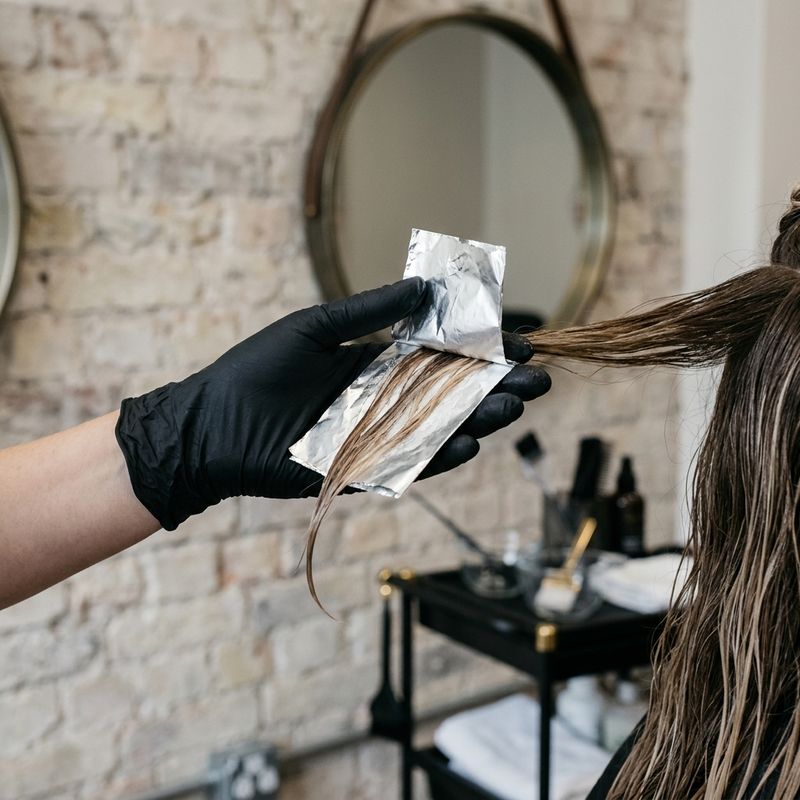
The hair color processing time guide covers timing by process. In the heat, your reference time is still the one on your data sheet; what changes is when you start checking:
| Process | Reference time | In a hot salon | Control signal |
|---|---|---|---|
| Permanent color, same depth or darker | Your data sheet (Koleston Perfect: 30-40 min without Climazon) | Check earlier, roots first, within the data sheet window | Strand test zone by zone |
| Gray coverage | Your data sheet, in full (Koleston Perfect: 30-40 min, 40 max) | Don’t cut it short: gray needs its time | Coverage in the grayest zone, before rinsing |
| Demi / semi-permanent color | Your data sheet | Bring the visual check forward | Visual check |
| Acid gloss / toner | Your data sheet | Watch from the start | Based on desired intensity |
Three rules for hot days:
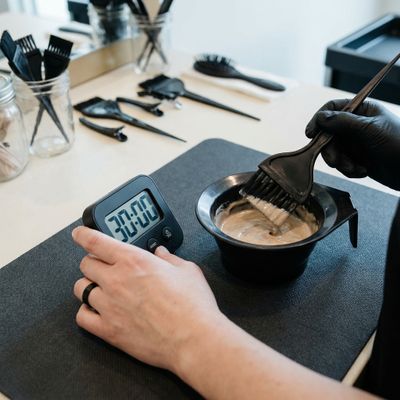
- Start the timer when you apply the first section, not when you finish. When temperatures are high, the reaction starts from the very first second of application. With gray, when the timer goes off, that’s your cue to start checking: the last zone you applied needs its full time too. On a regrowth application, the Koleston Perfect usage booklet has you start where the percentage of gray is highest.
- Do the strand test proactively. In summer this is not optional: it is the most reliable control you have against under- or over-processing.
- Record the ambient temperature alongside the formula. If you use Blendsor to log your formulas, note whether the service was carried out in high-heat conditions. At that client’s next appointment, you will have a real data point, not a guess.
Professional tip: If the salon has climate control, keeping a steady temperature all year round keeps your usual timings a reliable reference. The trouble starts in spaces without climate control or with strong direct sunlight.
What Happens at the Roots When It Is Hot?
Roots usually process faster than mid-lengths and ends, and not only in summer. Wella’s guide on hot roots gives two reasons: the roots get the warmth of the scalp, which can make the formula process faster, and new growth hasn’t fully hardened (keratinized) like the mid-lengths and ends. On a hot day, ambient heat comes on top of that.
What that does depends on the product. With lightener, Wella says, the roots lift clean while the ends may look yellow. With permanent color, the roots can lift warm while the ends lift less and look darker. That is hot roots: a root that ends up lighter or warmer than the rest. Wella lists scalp heat among the causes, alongside new growth at the root, a developer that is too strong for that zone and, when lightening, lightener that hasn’t been on the roots long enough. For how this plays out on a retouch, see why a root touch-up turns out uneven and, with lightener, banding on a bleach root touch-up.
That is why the root is treated as a zone of its own, with the same zone-by-zone diagnosis you run on any retouch. It comes down to three decisions:
- Your objective at the root sets the developer, not the heat. Wella warns that a developer that is too strong can make the roots lift too light or too warm compared with the rest, and says to choose it carefully. If you are only depositing at the root (same depth or darker, no gray to cover), check whether your manual gives a lower developer for that objective: for Koleston Perfect, Wella keeps 4% (13 vol) for working at the same depth or darker on natural hair with no gray coverage required. If there is gray to cover or a level to lift at the root, use what your manual assigns to that objective (6%, 20 vol, for Koleston Perfect) and don’t lower it because of the heat.
- Application order, when you are lifting. The virgin root goes on last. The Koleston Perfect manual spells it out for a first-time application with lift: mid-lengths and ends first, leaving about 2 cm (roughly 3/4 inch) clear of the scalp, then the roots in a second step. With lightener, Wella’s guide gives the same advice: apply the roots last so that zone has less time to develop, especially on hot days, when scalp heat might make the lightener lift more.
- Check the root first. With gray at the root, the data sheet time is not cut (see the table above). Your control is the strand test, checking the root before the mid-lengths.
What you do not do is change the mix ratio. The hair dye mixing ratios are set by the manufacturer for each line (Koleston Perfect mixes 1:1, 60 g of color to 60 ml of developer; Majirel, 1:1.5) and are not adjusted to compensate for temperature.
For a full breakdown of the logic behind developer volumes and when to use each one, see the professional developer volumes guide.
Is There a Difference Between a Hot Salon and a Hood Dryer or Climazon?
Yes, and it matters not to conflate the two, because they work differently.
Ambient salon heat acts on the whole mix at once: the bowl, the hair and the scalp all sit at the same room temperature. You are not the one applying it, and none of the manuals we checked gives a timing for it.
A hood dryer or Climazon is heat you apply, and it only makes sense when your product’s manual allows it. Some manuals plan for it; others rule it out:
| Heat source | Type of effect | What you do |
|---|---|---|
| Ambient heat | Diffuse, across the whole mix | Check earlier, zone by zone, within your data sheet window |
| Hood dryer / Climazon | Direct and controlled | Only if your manual allows it. Koleston Perfect gives 15-25 min with Climazon (30-40 without); Schwarzkopf’s US IGORA chart says “Do not use heat” |
| Scalp (body heat) | Localized at the root | Developer by zone objective, roots last when lifting, root checked first |
The same goes for lightener: heat only if that lightener’s manual allows it. Schwarzkopf’s IGORA ROYAL technical manual for Spain, for example, asks on its lightening page (Highlifts and Vario Blond) for the maximum development time without applying heat.
A common mistake is combining both: using a hood dryer in an already-warm salon without recalculating the timing. The two heats compound, and frequent strand testing becomes non-negotiable.
Checklist: 4 Things to Check Before Applying on a Hot Day
Before mixing and applying when the salon is warm, run through these four points:
-
Salon temperature. If it is hotter than usual, expect the mix to move faster and bring your first check forward. If you have climate control, switch it on before you start, not halfway through the service.
-
Developer volume at the root zone. Decide by zone objective before you mix, with your color’s manual in front of you: if you’re only depositing at the root, see whether it gives a lower developer for that objective; if there’s gray to cover or a natural base to lift, use the one it assigns to that objective and manage the heat with timing and the strand test. Diagnose each zone separately, as in the guide to developer volume on porous hair.
-
Timer from the first section. On hot days, timing starts the moment you apply the mix, not when you finish. Adjust your routine: activate the timer when applying the first section, not the last.
-
Scheduled check. Do not wait for the timer to run out: in the heat, bring your first check forward and start at the root. With gray, don’t rinse early: for Koleston Perfect, Wella says to stick to the correct development time and check coverage before rinsing, up to a maximum of 40 minutes.
And the usual, whatever the weather: an allergy test 48 hours before, following the manufacturer’s instructions, and a strand test if the hair has a chemical history.
Frequently Asked Questions
Does Salon Temperature Affect All Types of Hair Color Equally?
Not in the same way. Permanent and demi-permanent color both involve a reaction with developer, and heat speeds it up. Semi-permanent color without developer has no such reaction. In every case, the timing comes from each product’s data sheet, and a visual check tells you when to stop. With glosses and acid toners, which have short timings, watch from the start.
Do I Need to Adjust the Timing If I Use a Hood Dryer or Climazon?
First, check whether your product allows heat at all. Koleston Perfect gives two timings, without and with Climazon (30-40 and 15-25 minutes in its leaflet); Schwarzkopf’s US IGORA chart, by contrast, says not to use heat. If your product allows it and the salon is also hot, the two heats compound: start from the with-heat timings on your data sheet and check earlier, zone by zone.
Why Do Roots Usually Process Faster Than Mid-Lengths and Ends?
Wella gives two reasons: the roots get the warmth of the scalp, which the mid-lengths and ends don’t, and new growth hasn’t fully keratinized yet. In summer, ambient heat speeds up the whole head and the roots stay ahead. The fix depends on your objective at the root: the developer your manual assigns to that objective (lower if you’re only depositing and your manual allows it; the coverage one if there’s gray), roots last when lifting, and the root checked before the rest.
Does the Temperature of the Rinse Water Affect the Final Color Result?
None of the manuals we checked says so. What they do spell out is the step: when the development time is complete, Wella’s instructions for Koleston Perfect say to add a little warm water, emulsify and rinse thoroughly. The idea that cold water “seals” the pigment, or that very hot water washes it out, is widespread, but none of those documents says so, so treat it as trade lore.
In Summary
- Salon heat speeds up hair dye kinetics. In the heat, bring your first check forward and start at the root, without leaving the window on your data sheet.
- What you adjust in a hot salon is how closely you watch the time, never the mix ratios. On gray, the full data sheet time is not cut.
- The root processes faster because of scalp heat, but its developer is chosen for the job the root needs and by what your color’s manual says: for Koleston Perfect, 4% for same depth or darker with no gray, and 6% for gray coverage or one level of lift.
- Hot roots (a root lighter or warmer than the mid-lengths) have several causes according to Wella: scalp heat, new growth at the root, a developer that is too strong for that zone and, when lightening, too little time on the roots. When you are lifting, the root goes on last.
- Hood dryer or Climazon only if your manual allows it. If you use one in an already-warm salon, the two heats compound and active monitoring is essential.
- Start the timer when you apply the first section, not when you finish. If there’s gray, count the full time for the last zone as well.
Recording the service temperature alongside the formula is what lets you replicate or correct a result at the next appointment. In Blendsor you can store each client’s complete formula (color, volume, timing and service notes) so that in summer you are not guessing what changed.
Try Blendsor - Permanent Free plan. No commitment.
Why does salon temperature change how a dye turns out?
In the app, we ask you a question like this one, but about your own client.
Up for this week’s case? → More on global color →Related articles
Practice with our colorimetry tools
Calculators, neutralization wheel, AI consultation...
The Blendsor newsletter
Color techniques and trends for professionals. No spam.
A client in the chair right now?
The Blendsor advisor gives you the precise formula for this technique with your salon's brands — and saves it to your client's card.
Ask about your caseWritten by the Blendsor team
Professional hair colorimetry experts with experience in AI-assisted formulation. We combine color science, salon practice and technology to help colorists formulate with precision.