Salon water pH and hard water: what it does to hair color
Hard water and high pH in your salon may be undermining your color results. Learn the real numbers, how to test in 60 seconds, and what to do when water is the problem.
Blendsor
Blendsor Team
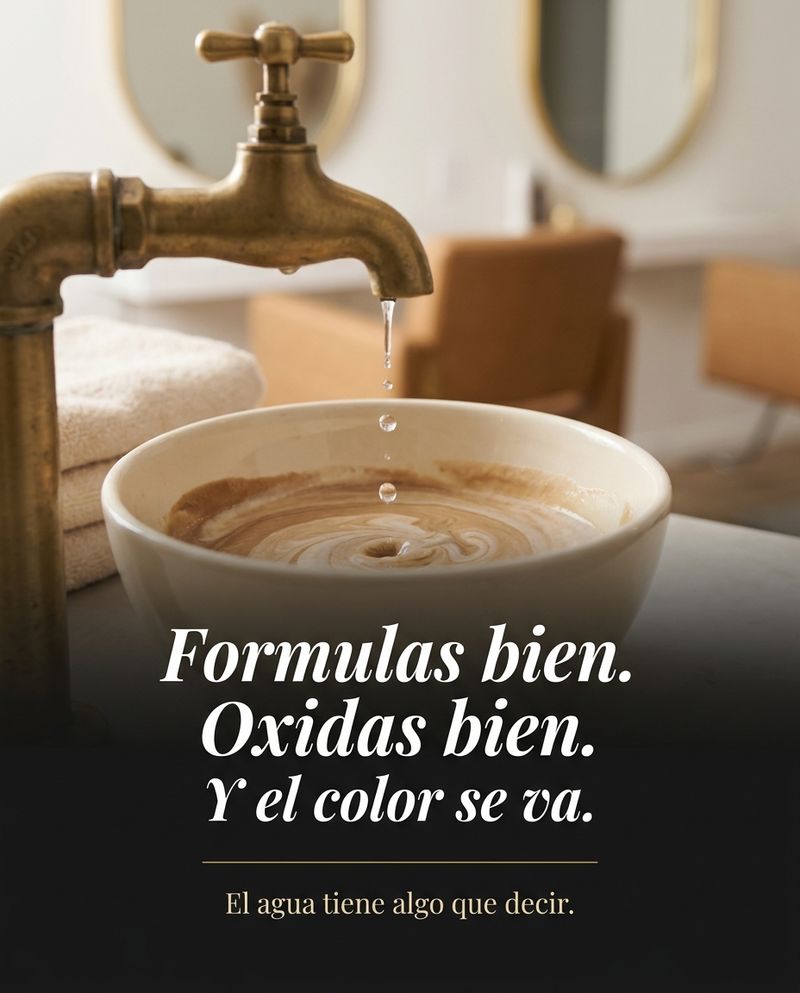
Have you ever blamed the manufacturer when a color service didn’t perform the way it should?
It’s a completely natural reaction. You’ve been using that brand for years, you know how it behaves, and suddenly the result doesn’t add up. What most colorists don’t ask in that moment is: have I actually tested the pH of the water I’m working with?
It’s not something that comes up in most training programs. But it’s there — quietly influencing every color service you do.
In this article you’ll understand exactly what happens when salon water pH or mineral content is off, what the legal values are, and how to check it in under a minute with an investment of 10–20 € (around $11–22).
Quick summary: Drinking water in Spain must have a pH between 6.5 and 9.5 according to Royal Decree 3/2023, the regulation in force since January 2023. Municipal water typically sits between 7.2 and 8.2. Water with elevated pH can interfere with cuticle closure during emulsification and the final rinse. Water with high mineral content leaves deposits that hinder color penetration before a service — two separate routes. The fix is straightforward: measure, and if needed, use the right products for hard water.
Why does water affect color results?
Water’s pH doesn’t override the pH of the color bath. That’s already handled by the alkaline agent in the tint itself, which takes the applied mix up to a range of 9.5 to 10.5 to open the cuticle and deposit pigment. The product’s chemistry is in control there.
Water acts before and after that process — in two specific windows:
1. Cuticle closure during emulsification
When you add water at the end of a service to emulsify the color, the pH of that water matters. Highly alkaline water can interfere with the gradual cuticle closure that happens during this phase.
2. Mineral residue that seals the hair before the service
This is the most common issue in areas with hard water. Minerals — mainly calcium and magnesium — deposit on the cuticle with every wash. Over time they build a film that acts as a barrier. The tint reaches the hair, but it hits that mineral shield before it can penetrate normally.
The result isn’t always a dramatic failure. Sometimes it’s subtle: a tone that doesn’t quite land as expected, shorter-than-usual color longevity, or a shine that never fully develops.
What are the legal pH values for salon water?
In Spain, Royal Decree 3/2023 (BOE) sets the permitted pH range for drinking water at 6.5 to 9.5. It has been the regulation in force since 12 January 2023, when it replaced the earlier Royal Decree 140/2003 — the pH range itself did not change with the update.
One detail worth knowing: pH is listed as an indicator parameter (Annex I, Part C), not among the parameters of direct health risk. Testing it is mandatory in routine controls, but falling outside the range doesn’t automatically make the water unfit — it triggers an investigation into the cause. Water is only declared unfit below 4.5 or above 10.0 pH units.
There’s a practical reading here for you: pH is a screening test, not a diagnosis. It rules out oddities in thirty seconds. What actually explains color failures is hardness, which is why both are worth checking.
Municipal water typically operates within a narrower range, usually 7.2 to 8.2 — values that under normal conditions don’t cause direct problems for color services.
If your salon is outside Spain, the equivalent figures come from your own national or regional drinking water regulation; the reasoning in this article holds regardless of the number on the label.
Issues tend to appear in specific scenarios:
- Areas with highly calcareous water (high mineral hardness): the pH may be fine, but the concentration of mineral salts the water carries is the actual problem.
- Installations with aging or remineralising filters: depending on the type of filtration and the state of the pipes, the output value can drift from the input range. A poorly maintained system can shift pH beyond what’s expected.
- Well water or private supplies: outside the public network’s control, with greater variability.
None of these scenarios are unusual. And none are visible to the naked eye.
Water reference values (Spain)
| What you measure | Reference | What it means behind the chair |
|---|---|---|
| pH — legal range (Annex I, Part C) | 6.5 – 9.5 | Below 4.5 or above 10.0 the water is declared unfit |
| pH — typical municipal supply | 7.2 – 8.2 | Normal; on its own it doesn’t explain a color failure |
| pH — expected reading, urban installation | 6.5 – 8.5 | Screening passed: rules out oddities, doesn’t close the diagnosis |
| pH — consistently above 8.5 | > 8.5 | Own watch threshold (not regulatory): worth investigating |
| Total hardness — potability ceiling (Annex I, Part F) | 500 mg/L CaCO₃ (reference value) | Health limit, not a cosmetic threshold |
| Total hardness — professional scale | > 180 mg/L CaCO₃ = very hard water | This is where color trouble starts, well below the legal ceiling |
Source for the regulatory values: Royal Decree 3/2023 — pH in Annex I, Part C, Table 3 (parameter 51) and Note 14; total hardness in Annex I, Part F, Table 7. The hardness classification (>180 mg/L = very hard) is from the USGS; placing the onset of color trouble there is our own judgement. The “expected reading” row is editorial judgement, not a regulatory figure.
If your pH reads high consistently, don’t start by spending money. The cheap order is this:
- Ask your water utility for its annual report, or look your area up in the public register your country runs (in Spain, SINAC). It gives you pH and hardness for your supply at no cost.
- Test two different taps at two different times. If the mains read normal and your tap doesn’t, the problem is your internal plumbing; if both agree, it comes from upstream and the salon can’t fix it.
- Only then call a technician. And if you rent your premises, that’s a conversation with the landlord, not a bill of yours.
One note: the water softener isn’t the suspect when pH reads high. An ion-exchange unit swaps calcium and magnesium for sodium — it lowers hardness but barely moves pH. Sustained high pH usually comes from mains treatment, cement-lined pipework or remineralising filters.
What’s the difference between high pH and hard water?
They’re two separate things, though they often appear together.
High pH means the water has more hydroxide ions (OH⁻) than hydrogen ions (H⁺). Water at pH 8.5 is perfectly legal and in most cases doesn’t create real problems for coloring services.
Hard water refers to the concentration of dissolved minerals, primarily calcium carbonate. It’s measured in degrees of hardness or mg/L of CaCO₃, not in pH. Water can have a neutral pH and still be very hard.
For colorists, hardness is typically the more relevant factor. The calcium and magnesium that water deposits on the hair shaft with every wash build up over time into a barrier that reduces color absorption and accelerates fade. If you want to revisit the fundamentals of levels, tones and formulation underneath all this, the colorimetry basics guide covers them.
This is exactly what mineral buildup removal products like Malibu C Hard Water Wellness are designed to address — dissolving these deposits before a color service. Redken Hair Cleansing Cream works similarly, with a deep-cleansing formula that prepares the cuticle to receive color without interference.
Professional tip: If you suspect hard water but don’t have data yet, look around: if hair feels dull after rinsing or if you notice limescale on faucets and shower screens in the salon, your water likely has high mineral hardness.
Tint alkalinity vs. water pH: which one dominates?
This is worth clarifying because there’s a lot of confusion around it.
The alkaline agent in the tint (ammonia or other alkalizing agents) takes the pH of the applied mix to 9.5–10.5. That’s the value that actually drives cuticle opening during color development.
Your salon’s water pH can’t compete with that concentration. It’s not the variable that controls whether the tint penetrates or not.
What water does control is the condition of the hair before the service. If a client arrives with months of accumulated mineral deposits, the tint encounters a surface-level obstacle it can’t overcome on its own. And after the service, water quality affects the rinse and final emulsification.
These are different windows of influence. Understanding them allows for precise diagnosis — without attributing to water what’s actually a formulation issue, or the other way around.
For a deeper look at how alkalinity and developer interact with the hair structure, the article on developer volumes and their chemistry covers the full picture.

How to test your salon’s water pH
You don’t need a lab. A basic digital pH meter — the kind designed for water analysis, not for hair — costs between 10 and 20 € and gives a reading in seconds.
The process:
- Fill a clean glass with water from the tap you actually use for services (the shampoo bowl faucet, not the break room sink).
- Rinse the electrode with distilled water.
- Submerge the electrode and wait for the reading to stabilize (10–15 seconds).
- Record the value. Repeat at different times of day if you want a more complete picture.
A value between 6.5 and 8.5 in most urban installations is expected and shouldn’t be a direct source of problems for coloring.
If the reading consistently exceeds 8.5, it’s worth reviewing the installation (especially if you have remineralising filters or old pipework) and consulting a water technician.
If the value is within range but you’re still seeing irregular results, the diagnosis points more toward mineral hardness (calcium/magnesium) than pH. In that case, the next step is a hardness test or a direct trial with a chelating pre-treatment.
Hair porosity and the client’s prior hair condition interact with all of this. A complete pre-service diagnosis always includes both variables.
When to suspect water is the problem
Not every color failure has water as the cause. But there are signals that point in that direction more frequently:
- Inconsistent results between clients with identical formulas and no apparent difference in hair condition.
- Color fading within 2–3 weeks in clients who take good care of their hair at home.
- Dull shine immediately after rinsing, before applying anything additional.
- Visible limescale on faucets and shower screens in the salon.
- Clients who notice a difference when they wash their hair elsewhere (water while traveling, water at home).
None of these signals alone is a definitive diagnosis. But if two or more appear together, measuring water pH and hardness makes more sense than changing your color brand.
What to do when water is the problem
If measurement confirms a relevant deviation, or if you have strong indicators of high hardness, there are several approaches:
Chelating pre-treatment: Products like Malibu C Hard Water Wellness or Redken Hair Cleansing Cream remove mineral deposits before coloring. This is the most direct intervention, with the most immediate impact on the client’s hair.
Important warning: a chelator dissolves limescale, but it does not reliably remove the metallic salts left by a metallic henna or an at-home progressive dye. If you suspect either one, run a strand test before any service involving developer — and run it on a strand that is cut off and away from the head, in a ventilated area away from the client — never on her: those metals can react exothermically with peroxide. It’s a positive if you see heat, bubbling, smoke, an unpleasant smell, sudden lightening or fibre that falls apart. If any of those show up, do not apply developer — neither bleach nor tint: refer the client or plan a recovery over months. The full protocol is in metals in hair and bleaching.
Filtered or demineralized water for the final rinse: Some salons use bottled or filtered water for the last rinse and emulsification, eliminating the mineral variable in the most sensitive phase of the service.
Installation review: If pH values are consistently out of range, reviewing the condition of filters and plumbing can solve the problem at the source. Don’t mix up the two units: the softener is the hardness appliance, not the pH one.
Documentation and monitoring: Record measured values and repeat the test every few months. Municipal water pH can shift with the season and changes in the water supply source.
Once the water variable is controlled, the most common color formulation mistakes that remain are much easier to isolate and correct.

Key takeaways
- Drinking water pH in Spain must be between 6.5 and 9.5 (RD 3/2023, in force since January 2023). Municipal water typically runs between 7.2 and 8.2.
- Water doesn’t control the pH of the color bath (the tint’s alkaline agent does), but it does affect hair condition before the service and the quality of the final rinse.
- Mineral hardness (limescale) is usually the most problematic factor: it creates a cuticle barrier that reduces color absorption.
- Testing is simple and inexpensive: a digital water pH meter costs between 10 and 20 € and delivers results in seconds.
- If water is the problem, chelating pre-treatments are the most direct intervention.
Do you have data from your salon? If not, this week is a good time to check. A two-minute reading can save a lot of explanations to clients — and a lot of wasted formulas.
Frequently asked questions
Does water pH change throughout the year?
Yes. Municipal water can vary depending on the season, the water sources in use (reservoirs, aquifers), and rainfall levels. In summer, with lower reservoir levels and higher water temperatures, small variations are common. In well-maintained municipal networks these aren’t dramatic, but they can be enough to notice a change in service quality. Testing at different times of year gives a more complete picture.
Can I use the same pH meter for water and for hair?
They’re different instruments. A water pH meter analyzes an aqueous solution that the electrode can be fully submerged in. Meters designed for hair surfaces have flat electrodes adapted for contact with the fiber shaft. Using a water meter on hair doesn’t give reliable readings. For the salon, the most practical approach is to have both separately: the water meter runs 10–20 €, and surface meters for hair are in a different price range.
How long does a chelating pre-treatment last?
It acts on the mineral deposits accumulated at that point in time. It has no lasting preventive effect: if the client continues washing their hair with hard water at home, buildup forms again over time. That’s why chelating treatments are applied as a periodic pre-service step, not as a one-time fix. How often depends on the hardness level of the water the client uses at home.
What happens if the salon's water has the wrong pH?
In the app, we ask you a question like this one, but about your own client.
Up for this week’s case? → More on global color →Related articles


Practice with our colorimetry tools
Calculators, neutralization wheel, AI consultation...
The Blendsor newsletter
Color techniques and trends for professionals. No spam.
You know the theory. What about today's case?
Send a photo to the Blendsor advisor and get an answer grounded in colour theory: toner, developer and timing, with the brands on your shelf.
Ask about your caseWritten by the Blendsor team
Professional hair colorimetry experts with experience in AI-assisted formulation. We combine color science, salon practice and technology to help colorists formulate with precision.