Shatush vs balayage: technical differences that change the result
Shatush and balayage look alike but have opposite mechanisms. Learn when to choose each technique and why the most common mistake is applying one while expecting the result of the other.
Blendsor
Blendsor Team
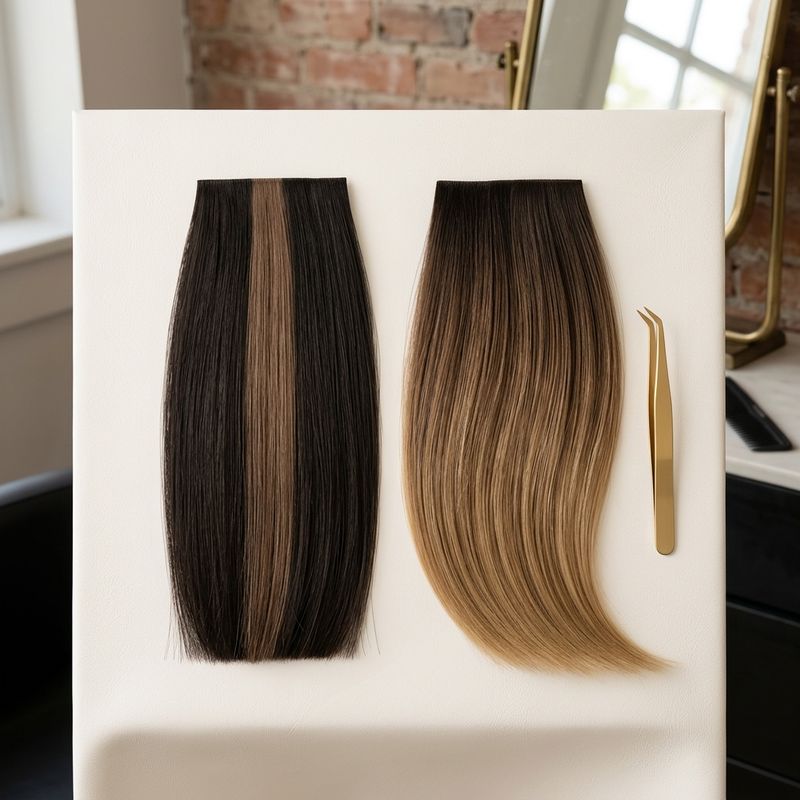
How many times has a client asked for a shatush and ended up with a balayage? Or the other way around?
If you work in color professionally, you’ve probably had that uncomfortable conversation where the person in your chair expected one thing and received another. Both techniques are applied freehand, without foil, and both lighten mostly toward the ends. But their mechanisms are opposite — and the visual result makes that clear.
This article breaks down the confusion once and for all: shatush vs balayage, when to use each one, and the most common mistake made in the salon.
What is shatush and how is it applied
Shatush is a freehand lightening technique that works with wide sections of hair, starting from the root or very close to it, without blending. The result is a visible, deliberate contrast: the root stays dark and the lightened sections appear with a defined edge, no gradual transition.
The name comes from the Persian chatush, meaning “four colors.” The original idea was to create an effect of multiple juxtaposed tones — not fused, not blended.
Technical characteristics of shatush:
- Section width: wide, between 1 and 3 cm
- Starting point: at or near the root
- Blending: none or minimal
- Contrast: high and visible
- Maintenance: every 4-6 months depending on growth rate
The technique demands precision in selecting the section. Take wide pieces of hair, apply the lightener directly without working it toward the root, and leave a clean edge. No blending, no fading.
Professional tip: In shatush, the line of demarcation is the design, not a technical mistake. If the client isn’t ready for that visual contrast, shatush is not their technique.
What is balayage and how does it differ
Balayage is also applied freehand and without foil. So far, the same. The difference lies in the gesture and the objective: in balayage the brush stroke is free, applied from the mid-lengths or lower, blending the root of each section to create a gradual transition.
The word comes from French balayer, meaning “to sweep.” The image is accurate: you sweep the lightener through the hair in an upward motion, depositing more product at the ends than in the mid-section.
Technical characteristics of balayage:
- Section width: variable, generally finer than shatush
- Starting point: mid-lengths or lower, blended upward
- Blending: yes, a fundamental part of the technique
- Contrast: soft, graduated effect
- Maintenance: every 3-5 months, with the possibility of growing out without a visible line
The key is brush pressure: heavier at the ends, lighter as you move up. That’s what creates the gradient that defines balayage.

Comparison table: shatush vs balayage
| Feature | Shatush | Balayage |
|---|---|---|
| Section width | Wide (1-3 cm) | Variable (0.5-2 cm) |
| Starting point | Near the root | Mid-lengths or lower |
| Blending | No | Yes, essential |
| Resulting contrast | High, defined | Soft, gradual |
| Visual effect | Defined sections | Natural gradient |
| Maintenance | Every 4-6 months | Every 3-5 months |
| Visible growth | Yes, by design | Minimal |
| Best for | Intentional contrast, dark bases with light | Natural blondes, sun-kissed effect |
Learn also how to combine these techniques with shadow root for more complex results.
When to choose shatush and when to choose balayage
The choice between shatush or balayage depends on three variables: the base of the person in your chair, the result they want, and the maintenance they can commit to.
Choose shatush when:
- The base is dark (level 3-5) and visible luminosity is wanted without lightening the entire hair
- A modern, bold look is desired — not a soft gradient
- The client cannot or does not want frequent salon visits
- The look needs to work on straight hair (where shatush contrast reads most clearly)
Choose balayage when:
- The base is light brown or blonde (level 5-8) and a sun-kissed or lived-in effect is desired
- A comfortable grow-out without a visible line of demarcation is needed
- Movement and depth are wanted, not defined sections
- The hair has waves or curls (balayage gradient integrates more naturally)
Professional tip: If the person in your consultation says “I want something natural that doesn’t show too much,” the answer is almost always balayage. If they say “I want the sections to be visible,” that’s shatush.

The most common mistake: applying one technique expecting the result of the other
This is the problem that generates the most complaints in salons that work with freehand color: applying shatush with the intention of balayage, or vice versa.
It usually happens in two scenarios:
Scenario 1: client asks for balayage, receives shatush
The consultation says “I want something natural, that grows out well.” The brush is applied from the root of the section, without blending. The result: sections with a defined edge and very visible regrowth within two months. The client feels they didn’t get what they asked for. And technically, they’re right.
Solution: in balayage, never start the lightener from the root of the section. Always begin from the mid-lengths and blend upward with decreasing pressure.
Scenario 2: client asks for shatush, receives balayage
Here the request is “I want the sections to be visible, something with character.” The lightener is applied from the mid-lengths with a gradient. The result: a soft effect, nothing defined. The client feels the technique “doesn’t show.”
Solution: in shatush, work from the root or very close to it. The section must emerge visibly from the scalp, without blending.
The root of both errors is not confirming in the consultation what type of contrast is desired. Showing a visual reference before mixing avoids 90% of these situations. Check our guide on the most common balayage mistakes for more context.
The technical question that resolves everything
Before deciding between shatush and balayage, one question simplifies everything:
“Do you want the sections to be clearly visible or do you want the hair to look like it’s been in the sun?”
- Visible sections → shatush
- Sun-kissed, gradient effect → balayage
From there, you can work on the formulation based on the base, the condition of the hair, and the level of lightening needed. If you want Blendsor to do that calculation based on the specific case, you can do it directly from the app.
To go deeper on the technical side of freehand application and how it differs from foil techniques, also read balayage vs traditional highlights: technical differences.
Frequently asked questions
Is shatush harder to do than balayage?
Not necessarily harder, but certainly different. Shatush requires precision in section selection and clarity about where each section starts and ends. Balayage demands brush pressure control to create the gradient. They are different skills. Professionals with extensive balayage experience often need a mental adjustment to stop blending when they switch to shatush.
Can shatush and balayage be combined in the same service?
Yes, and the results can be very interesting. A common option is to do balayage on the lower part of the hair and shatush on the upper sections or around the face. The result has movement at the ends and visible contrast in the face-framing zones. It requires planning before you start.
Which technique causes more damage?
The level of damage depends on the lightener and developer used, not the technique itself. Both shatush and balayage are applied without foil, which reduces the intensity of the process compared to full highlight services. The key is correct formulation for the porosity and color history of each client’s hair.
Does shatush work well on hair with previous highlights?
It depends on the condition of the hair and what type of highlights are present. If there are already very lightened zones, shatush can add sections in darker areas to create new contrast. If the hair already has a lot of luminosity, the shatush result may be less visible. A thorough consultation beforehand is essential.
How long does shatush last compared to balayage?
Shatush lasts visually longer than balayage because the growth is part of the design: the contrast between dark root and lightened section doesn’t disappear with growth, it just shifts. Balayage, with its blended starting point, remains invisible for more weeks as the hair grows. Both are typically refreshed every 3-6 months depending on growth rate and desired result.
In summary
- Shatush: wide sections from the root, no blending, visible and deliberate contrast
- Balayage: free brush stroke from mid-lengths, blended upward, soft gradient
- The choice depends on: the base, the desired result, and maintenance possibilities
- The most common mistake: applying one technique expecting the result of the other because the consultation didn’t confirm what type of contrast was desired
- The key question: “Do you want the sections to be visible or a sun-kissed effect?”
Formulate with Blendsor for custom color techniques
Want to calculate the full formulation for shatush or balayage based on the starting level, porosity, and color history of each case?
What freehand technique mistake have you had to correct most often?
What's the difference between shatush and balayage?
In the app, we ask you a question like this one, but about your own client.
Up for this week’s case? → More on highlights and techniques →Related articles
Practice with our colorimetry tools
Calculators, neutralization wheel, AI consultation...
The Blendsor newsletter
Color techniques and trends for professionals. No spam.
A client in the chair right now?
The Blendsor advisor gives you the precise formula for this technique with your salon's brands — and saves it to your client's card.
Ask about your caseWritten by the Blendsor team
Professional hair colorimetry experts with experience in AI-assisted formulation. We combine color science, salon practice and technology to help colorists formulate with precision.