Balayage: Common Mistakes and How to Avoid Them
The 7 most frequent balayage mistakes and how to prevent them step by step. Diagnosis, technique, and formulation for professional colorists.
Blendsor Team
Blendsor Team
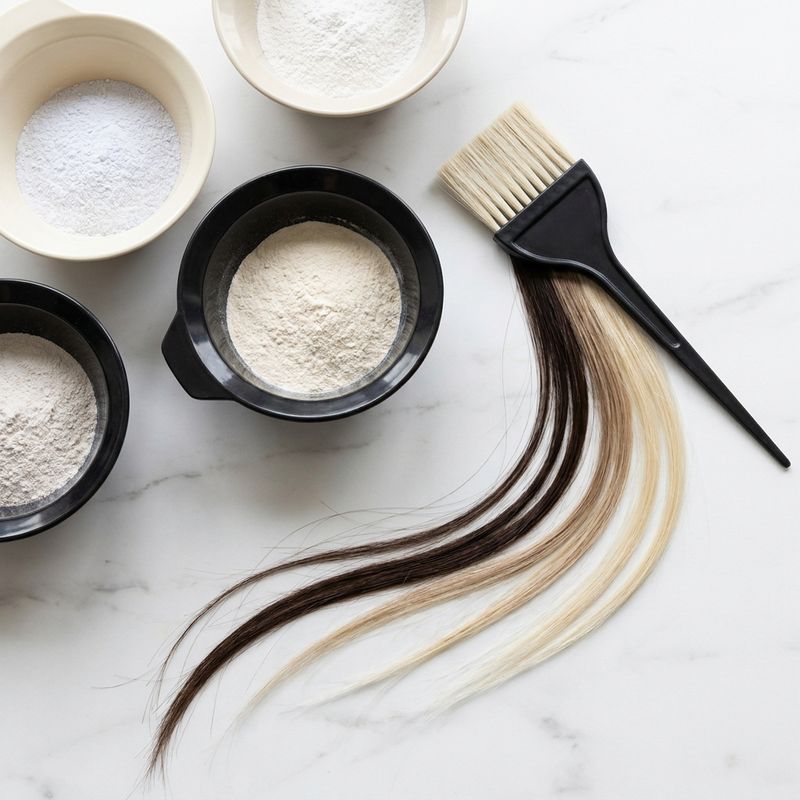
Has it ever happened that you finish a balayage and the transition just doesn’t flow the way it should?
The lines look marked. The lift is uneven. The final tone doesn’t match what the client asked for. And the most frustrating part: you know the technique has potential, but something in the process went wrong before you opened the first product.
Balayage is one of the most in-demand coloring techniques — and one that hides the most margin for error when the pre-diagnosis isn’t precise. In this article, you’ll see exactly where most professionals go wrong and what to do differently from the very first section.
Mistake 1: Skipping the porosity diagnosis
Balayage lifts from mid-lengths to ends. If porosity isn’t uniform along that stretch, the product behaves differently in each zone — even when you apply with the same pressure and the same timing.
The result: overprocessed mid-lengths, ends that won’t lift, or an uneven tone distribution that no toner is going to fully correct.
Before sectioning, check:
- Low porosity: hair dries slowly and absorbs little. The lightener reacts more slowly and needs more processing time.
- High porosity (ends with accumulated chemical processing): the lightener reacts faster. If you don’t compensate, the ends will be over-lifted.
Professional tip: On hair with mid-to-high porosity differences between mid-lengths and ends, apply the lightener to the ends 5–8 minutes after the mid-lengths, equalizing total exposure time.
Porosity isn’t something you improvise — it’s something you read before touching the hair.
For an in-depth look at how porosity affects formulation, check the complete guide to hair porosity and coloring.
Mistake 2: Not reading the actual chemical history
The apparent level of the hair doesn’t always match the real level when there’s existing color on top.
A level-5 hair with a recent permanent wave or dark tint applied 8 weeks ago will respond completely differently from a virgin level 5. The underlying tone you’ll find during lift won’t be the same either.
If you formulate as if the hair is virgin when it has a chemical history, you’ll end up with:
- Unexpected underlying tones (orange or red where you expected gold)
- A second session that wasn’t budgeted
- Mechanical damage if you compensate with extra time or volume
Always ask — even when it seems obvious:
- When was the last color application?
- What product and what shade?
- Has there been a perm, relaxer, or keratin treatment?
With that map in hand, the formulation is no longer a guess.
Mistake 3: Applying without respecting zone saturation
This is the most common technique error: applying the same amount of product throughout the entire section, from root to tip.
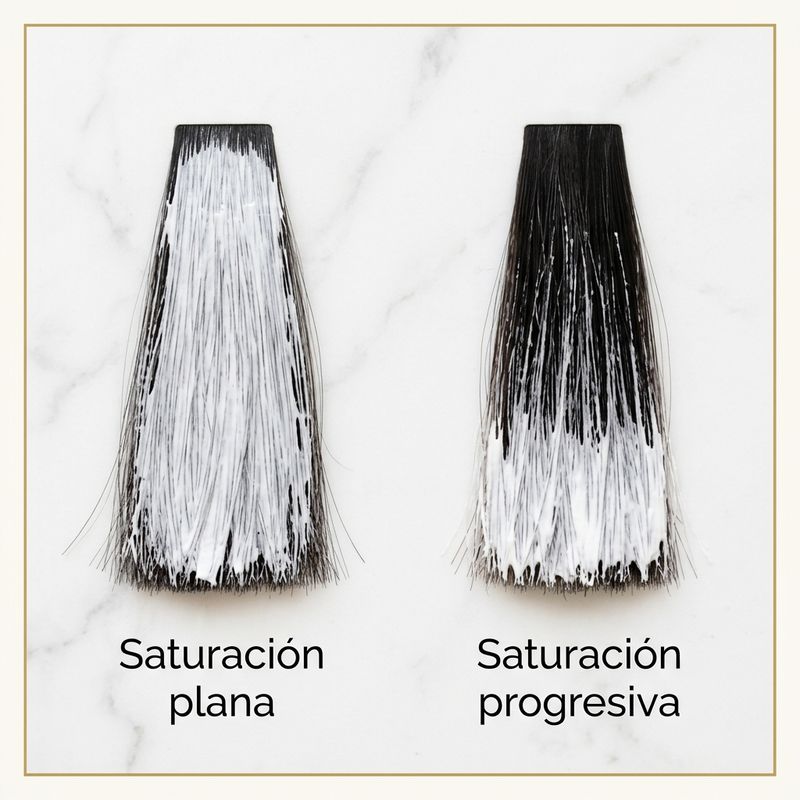
In balayage, saturation should be progressive. Minimal at the root, maximum at the ends. The gradient of product intensity is what creates the natural transition afterward.
If you saturate evenly across the whole section:
- Horizontal banding appears (the “step” effect)
- There’s no visible gradient — the result looks like hand-painted foils, not balayage
- Toning afterward can’t disguise a flat application
The fix: use the back of the brush at the root (minimal deposit) and increase pressure and product as you move toward the ends. Check the saturation before wrapping — if you see the same product density at the top and bottom, correct it in the moment.
Mistake 4: Sections that are too thick
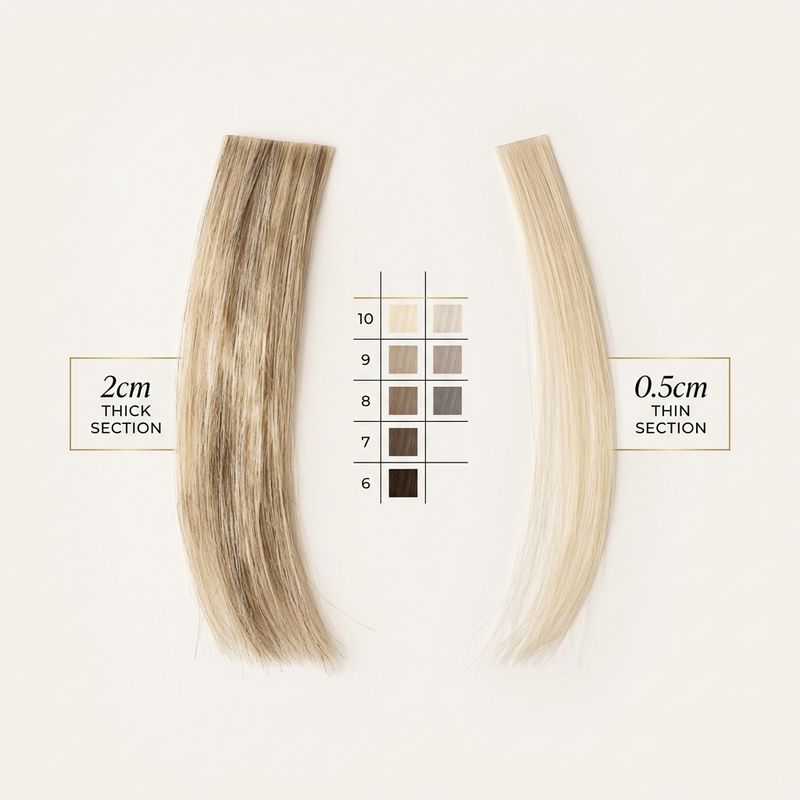
Thick sections in balayage compromise two things: the visibility of the work and heat penetration.
With thick subsections, the lightener inside the section doesn’t receive the same heat as the exterior, leading to an uneven result. Plus, the distance between illuminated sections is so wide that the effect loses its natural quality.
The recommended range for medium-density hair is working with sections 0.5 to 1 cm thick. On very dense hair, drop to 0.3–0.5 cm.
Finer sections:
- Let you see exactly what you’re lightening
- Process more uniformly
- Give you more freedom to design the light distribution
If your result has very dark zones between sections, the issue usually starts here before it starts with the product.
Mistake 5: Ignoring the underlying tone before toning
Toning without knowing the underlying tone is formulating blind.
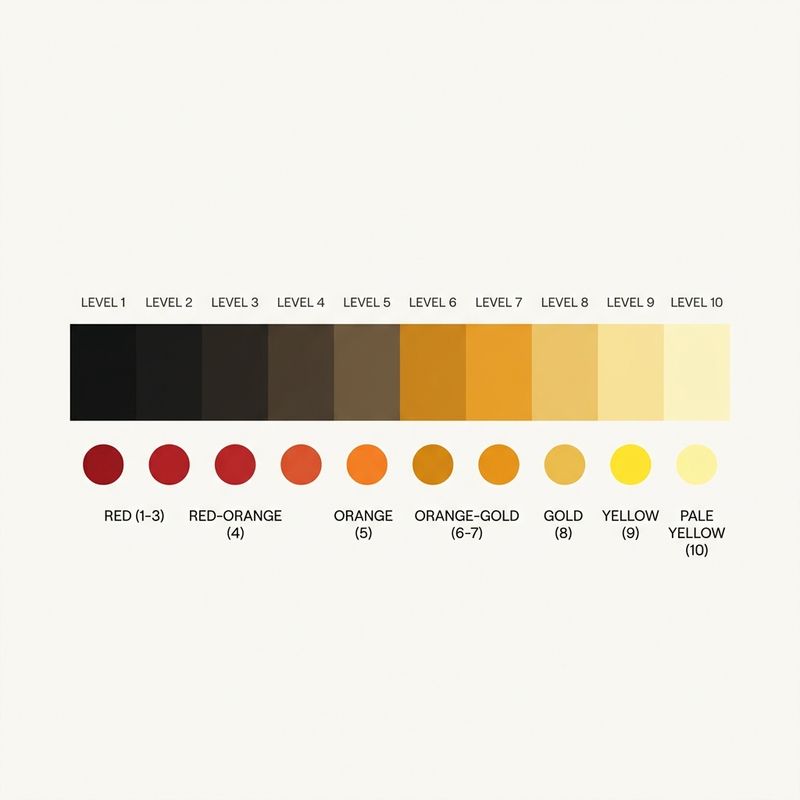
Depending on the base level and the degree of lift, balayage will leave a specific underlying tone when it lifts. That underlying tone determines which neutral shade you’ll need to reach the final result.
If the hair has a level 4–5 base and the lightener lifts to an orange-gold underlying tone (level 6–7 of lift), a violet toner won’t be enough to neutralize it. You need to work with blue or a cool-base toner that acts on orange, not on yellow.
For a deeper look at how this relationship works, check our guide on color levels and underlying tones.
The underlying tone is not a secondary technical detail — it’s the starting point of the formulation.
Mistake 6: Not controlling product bleed
Lightener moves. Always. If you don’t control that movement, a clean section becomes a diffused stain.
The points where bleed is most common:
- Between stacked sections with no physical separation
- On fine or high-porosity hair, where the product travels further
- With long processing times without checking
Technical solutions validated by manufacturers including Wella Professional and Schwarzkopf Professional:
- Separate each worked section with a thin piece of film or foil — it contains the product without creating a foil-highlight effect
- Check at 15 minutes, before the lightener reaches liquid consistency
- On fine hair, reduce the developer to 20 vol and slightly extend processing time
For a better understanding of how developer volume affects the result, see the article on developers and volumes.
Mistake 7: Formulating the toner without calibrating the actual balayage result
The finished balayage is not the final result. The toner is part of the process, not the close.
A common mistake is choosing the toner shade by looking at the color palette without accounting for:
- The actual underlying tone (not the expected one)
- The porosity of the lightened zones — which absorbs toner differently
- The base chromatic temperature of the unlightened hair, which will also be visible
If the transition zones (where natural hair blends with the lightened sections) aren’t toned correctly, the final result will lose the chromatic harmony you designed at the outset.
For guidance on handling unwanted tones in these transition zones, check the guide on neutralizing unwanted tones.
Before the next appointment: a checklist
Before starting any balayage, run through these points:
- Porosity — is it uniform from mid-lengths to ends?
- Chemical history — what’s underneath the apparent level?
- Density — what section thickness suits this hair?
- Achievable underlying tone — what lift level can you safely reach from this base?
- Progressive saturation — do you know how you’ll graduate brush pressure?
- Bleed control — do you need physical separation between sections?
- Toner formulation — do you know what shade and base you’ll use once the lift is complete?
Well-executed balayage doesn’t depend on working fast. It depends on reading the hair carefully before you start.
To see how to integrate this analysis into the complete formulation process, check common mistakes in color formulation.
In summary
- Porosity and chemical history diagnosis is not optional — it’s the starting point
- Progressive saturation defines the quality of the gradient, not the product
- Lightener bleed is controlled with technique, not just timing
- The toner must be formulated based on the actual underlying tone, not the expected one
Which of these mistakes have you corrected most often in the salon? The solutions that work in practice always start by identifying the exact point where the process went off track.
What happens if you skip the diagnosis before a balayage?
In the app, we ask you a question like this one, but about your own client.
Up for this week’s case? → More on highlights and techniques →Practice with our colorimetry tools
Calculators, neutralization wheel, AI consultation...
The Blendsor newsletter
Color techniques and trends for professionals. No spam.
A client in the chair right now?
The Blendsor advisor gives you the precise formula for this technique with your salon's brands — and saves it to your client's card.
Ask about your caseWritten by the Blendsor team
Professional hair colorimetry experts with experience in AI-assisted formulation. We combine color science, salon practice and technology to help colorists formulate with precision.