Toning Mistakes: The Step That Ruins Good Blondes
The 5 toning mistakes that ruin great blonde services. Underlying pigment, toner family, and porosity explained with a complete decision table.
Blendsor
Blendsor Team
You did a perfect bleach. Flawless technique, uniform lift, exactly the underlying pigment you were targeting. Then you tone.
And the blonde comes out gray. Or mauve. Or the underlying warmth is still there like nothing happened.
That moment is the most frustrating in the service because the hard work was already done. And yet the toning step ruined everything.
Toning mistakes hair colorists see in practice don’t come from bad luck. They come from specific technical decisions made before the toner is even mixed. Identifying them is what separates a predictable blonde service from one that relied on chance.
Quick summary: The 5 toning mistakes that ruin good blondes are: toning for the level you want instead of the underlying pigment you have, choosing the wrong toner family for the base, over-toning from excess processing time, overlapping toners on an uneven base, and ignoring porosity. Each has a precise cause and a concrete fix.
Why Is Toning the Most Critical Step in a Blonde Service?
Toning is the most critical step in a blonde service because it’s where three variables converge simultaneously: the actual underlying pigment level, the toner family, and the current condition of the hair fiber. Failing on any one of the three produces an unpredictable result — even if the bleach was executed perfectly.
Bleaching works with chemicals that behave in a fairly linear way. Toning works with pigments that interact with the existing underlying color. It’s not a new layer over a blank canvas. It’s a conversation between the toner pigment and the residual pigment already in the hair.
Put simply: the toner doesn’t create color from scratch. It neutralizes, shifts, or enhances what’s already in the fiber. If you don’t know exactly what’s in the fiber before you mix, you’re guessing.
For full context on how toning fits into the complete lightening service workflow, see our professional coloring techniques guide.
Mistake 1: Toning for the Level You Want, Not the Underlying Pigment You Have
This is the most widespread toning mistake and the one that generates the most unsatisfied clients. It works like this: the client wants a level 9 ash blonde. The colorist applies a level 9, ash family toner. But the actual underlying pigment is at level 7, with an orange-yellow base.
The result is not a level 9 ash blonde. It’s a muddy cool brown that doesn’t resemble anything on the color reference.
The mistake: confusing the target level (what the client wants to see) with the actual working level (the underlying pigment in front of you).
The toner works on what exists, not on what should exist. If the underlying pigment is at level 7, a level 9 toner won’t lift the level — the only thing it can do is shift the tone within that level 7.
The fix
If the underlying base hasn’t reached the level needed to achieve the requested result, the solution is not the toner. The solution is more bleaching. Toning without having reached the correct underlying base always produces a result that doesn’t match what was promised.
Evaluate the underlying pigment before mixing anything. If it’s where you need it: proceed with the toner. If not: more lightening, not more toning.
The Underlying Pigment Table: Tone According to What You Have
This table is the most important asset in this article. Save it, print it, keep it at your station.
Every level of bleaching leaves a specific underlying pigment: the residual color that remains in the hair fiber. The choice of toner family depends directly on that underlying pigment, not on the target level.
| Bleach level | Underlying pigment | Residual color | Correct toner family | Wrong family |
|---|---|---|---|---|
| Level 5 | Red-orange | Vivid red | Do not tone: red cannot be neutralized with toner | — |
| Level 6 | Orange | Deep orange | Intense ash (.11) or direct blue | Violet (.2) |
| Level 7 | Orange-yellow | Golden-orange | Ash (.1) + small % violet (.2) | Violet only (.2) |
| Level 8 | Yellow-orange | Golden | 50-50 ash (.1) and violet (.2) | Pure ash without violet |
| Level 9 | Yellow | Golden blonde | Violet (.2) or soft ash (.1) at 30% | Intense ash |
| Level 10 | Very pale yellow | Light blonde | Soft violet (.2) or platinum toner | Undiluted ash |
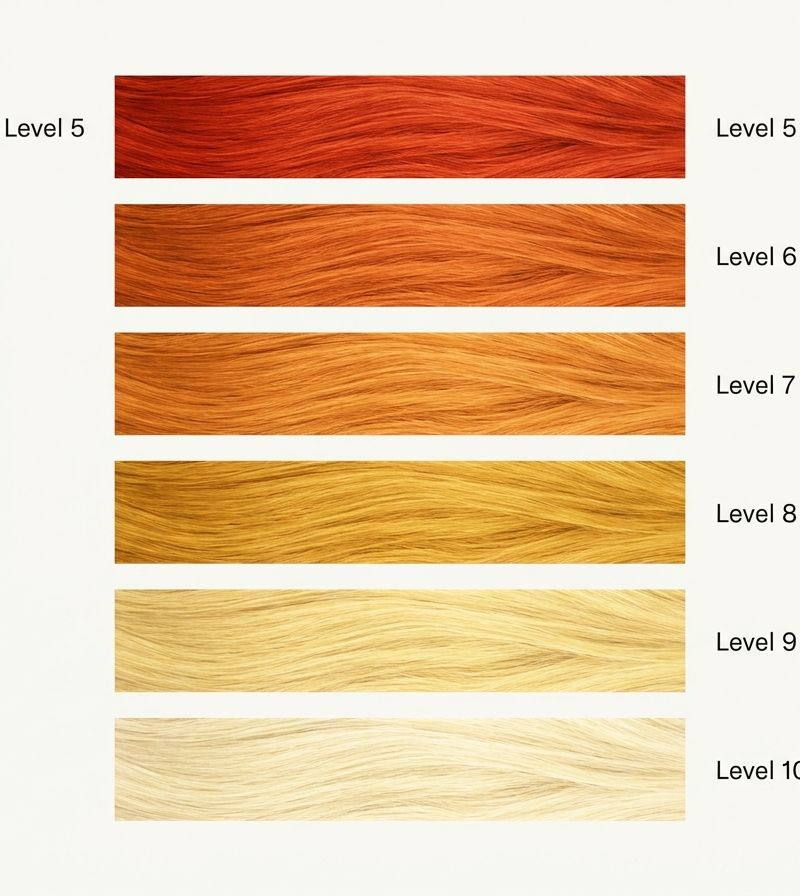
Professional tip: Level 7 is the most problematic. The orange-yellow undertone tempts colorists to use violet because the target result is cool, but violet on orange produces a muddy mauve or dirty gray. Always ash (.1) first at level 7.
For the color theory behind this table, see our complete guide to neutralizing unwanted tones.
Mistake 2: Wrong Toner Family for the Underlying Pigment
This mistake has a specific variant that shows up on TikTok and in real salons constantly: violet on orange.
Violet neutralizes yellow. That’s its function on the color wheel. But when orange is present in the underlying base, violet doesn’t neutralize anything meaningful. The blue that lives in the underlying pigment mixes with the violet of the toner and produces a muddy mauve-gray result.
To neutralize orange, you need blue. Blue is the complementary of orange on the color wheel. In toner terminology, blue corresponds to the ash family (.1).
The rule to internalize before every toning service:
- Orange underlying pigment → ash family (.1), blue
- Yellow underlying pigment → violet family (.2)
- Orange-yellow underlying pigment → blend of ash + violet (adjust ratio based on orange intensity)
The most serious form of this mistake isn’t using the wrong family once. It’s not being able to distinguish between an orange-yellow level 7 base and a yellow level 9 base. These are two completely different situations that require different solutions.
According to Behind the Chair, confusion between violet and ash families on different underlying bases is the toning mistake colorists report most frequently in continuing education surveys.
Mistake 3: Over-Toning from Excess Processing Time
The toner is working. Color is depositing. The colorist leaves it a bit longer because the hair still looks too golden.
Five minutes later: the cool blonde is now a flat, lifeless gray.
Over-toning happens because direct toning pigments don’t stop on their own. They continue to penetrate as long as pigment is available and the cuticle is open. On freshly bleached hair, the cuticle is at its most permeable state and pigment absorbs far faster than normal.
The problem isn’t time in the abstract. It’s that time is not linear on porous hair. Ten minutes on healthy hair is not the same as ten minutes on heavily bleached hair.
Warning signs
If the result looks right at 10 minutes, remove the toner. Don’t wait for the 20 minutes on the technical sheet. Technical sheets are written for standard conditions — not for your specific client’s hair.
If some sections have more processing history than others (mid-lengths and ends, typically), check those zones more frequently. They over-tone first.
How to correct over-toning
A clarifying shampoo with warm water applied for several minutes removes a meaningful portion of excess pigment. If the result came out gray and also darker than intended, follow with a gentle warm-toned bath (diluted gold or light copper) to rebalance the color temperature without affecting the level.
Mistake 4: Overlapping Toners Without Equalizing the Base First
The client comes in with old highlights: some strands at level 9, others at level 7, roots at level 6 with six months of growth. The colorist applies toner uniformly across the entire head.
Result: three zones with three different results, none of which is the uniform ash blonde that was requested.
This mistake has a name: toning over an uneven base. It’s one of the most common errors in blonde maintenance services.
Toner does not equalize the level. It only shifts the tone within the level where each zone already sits. If the base levels differ, the toner results will differ — even if the same toner formula is applied everywhere.
The solution before toning
Before applying any toner, evaluate the hair zone by zone:
- Identify all different levels present
- Decide if the level difference is acceptable or requires correction first
- If the gap is more than two levels between any zones, equalize the level first (targeted bleach pass or pre-color)
- Only when the base is uniform, apply the toner
A two-level gap between roots and ends within a single toning service always produces visible banding.
Mistake 5: Ignoring Porosity
The toner is applied. The formula is correct. The timing is correct. And yet the result at mid-lengths and ends is more intense, cooler, or darker than at the roots.
This is not a formula error. It’s a diagnostic error.
Porosity is rarely uniform in the hair that comes through the salon door. Ends accumulate more processing history, more heat, more wash cycles. The cuticle is more open. They absorb pigment faster and in greater quantity.
High porosity is not a toner problem. It’s a hair condition that must be managed before toning.
If porosity isn’t treated before toning, the result is inevitable: the most porous zones come out over-toned while the less porous zones come out under-toned.
Protocol for high-porosity hair
- Apply a protein treatment or porosity primer before the toner
- Work with a 6-volume developer maximum (higher developer opens the cuticle further and worsens the absorption problem)
- Apply the toner first to roots and healthier mid-lengths
- Wait 3-5 minutes, then extend to the ends
- Check the ends more frequently during processing
For a complete breakdown of how porosity affects every color service — not just toning — see our article on hair porosity and coloring.
Decision Tree: What Toner to Choose Before You Mix
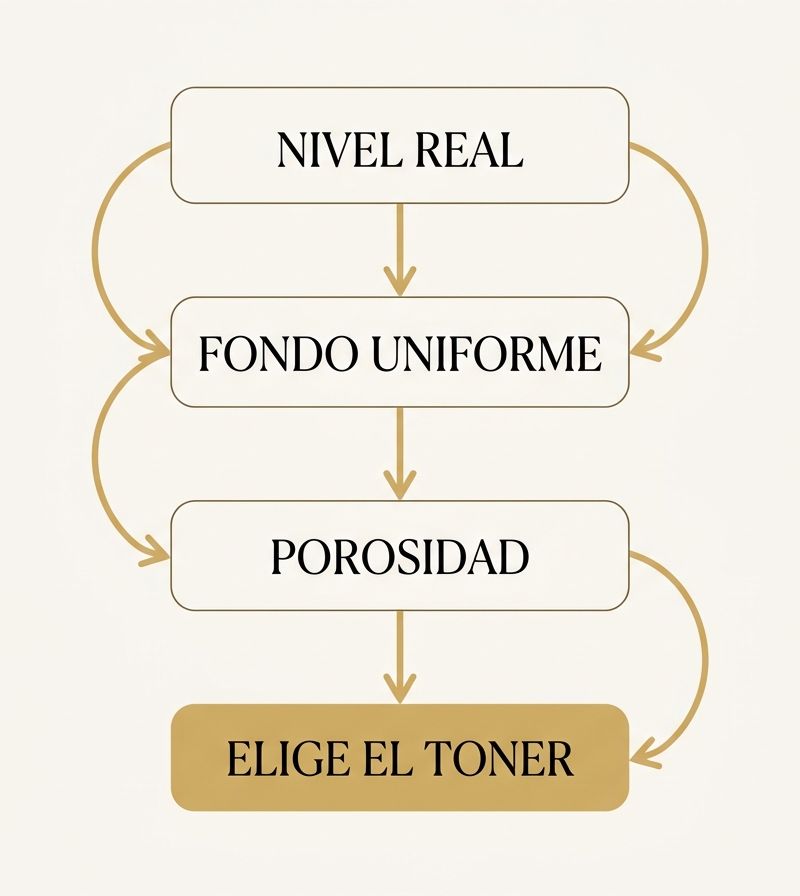
Before mixing any toner, answer these three questions in order:
Question 1: What is the actual underlying pigment level of the hair in front of you?
Use the underlying pigment table from this article. The real level, not the level the client wants. Evaluate under salon lighting — not under the phone screen.
Question 2: Is the base uniform across the entire head?
If multiple levels are present, identify each zone and decide whether the level difference needs to be corrected first, or whether the toning work can be done zone by zone.
Question 3: What is the porosity status?
Porosity test on dry hair: slide your fingers from ends toward the root. If the hair feels rough or textured, the cuticle is raised. If there’s a history of bleaching services, assume medium-high porosity and act accordingly.
Only once you have all three answers, choose the toner.
How to Fix Each Mistake: Quick Reference
| Mistake | Visible signal | Immediate fix | Prevention |
|---|---|---|---|
| Wrong level assessment | Dull result, far from target | Clarifying shampoo + re-tone with correct family | Evaluate underlying base before mixing |
| Wrong family (violet on orange) | Muddy mauve-gray result | Gold-based toner (.3) with 6 vol for 10 min | Memorize: orange = ash (.1) |
| Over-toning | Flat gray, lifeless | Clarifying shampoo + diluted warm gloss | Check at 10 minutes before continuing |
| Uneven base | Visible banding, inconsistent zones | Zone-by-zone correction with separate formulas | Equalize base level before toning |
| Porosity not managed | Over-toned ends, under-toned roots | Re-tone roots and mid-lengths with controlled timing | Protein pre-treatment + 6 vol developer |
Frequently asked questions
Why doesn’t violet toner work on orange hair?
Violet is the complementary color of yellow on the color wheel. It neutralizes yellow, not orange. If the underlying pigment is orange (typical of level 6-7 bleached hair), you need an ash family (.1) toner because blue is the complementary of orange. Using violet on orange produces a muddy mauve-gray result, not a cool blonde.
How long is too long for a toner?
It depends on the hair’s porosity, not just the technical sheet. On freshly bleached or high-porosity hair, 10-12 minutes is often enough. The signal that it’s too long is when the result starts looking gray or flat instead of simply cool-toned. Always check at 10 minutes before deciding to continue.
Can I tone a level 7 base to get a level 9 result?
No. Toner doesn’t lift the level — it only shifts the tone within the level where the hair already sits. To achieve a level 9 result, the hair needs to be lightened to level 9 first. If it’s at level 7, toner can improve the tone of the level 7 base, but the final result will still be darker than intended.
What went wrong if my toner came out uneven?
The most common cause is that the base wasn’t uniform before toning. Different underlying pigment levels across different zones absorb toner differently. Correction requires working zone by zone: identify each area based on its current result and apply the appropriate corrector separately to each zone.
What developer volume should I use for toning?
For most toning services: 10 volume is standard. If the hair has high porosity, drop to 6 volume. 20 volume is appropriate for permanent toners that require some cuticle lift. Higher developer volumes don’t improve toner results — they increase the risk of over-toning and flat gray casts.
Key takeaways
Toning is not the easy step that comes at the end. It’s the technical step that determines whether the blonde service succeeds or fails.
The five hair toning mistakes to keep fully under control:
- Evaluate the underlying pigment you have, not the level the client wants
- Orange needs blue (.1), yellow needs violet (.2): mixing these up is the most common mistake in professional toning
- Check at 10 minutes: timing is never fixed — it depends on porosity
- Equalize the base before toning: toner doesn’t correct level differences, it amplifies them
- Manage porosity first: a protein pre-treatment is the difference between a toner that lasts and one that disappears
Want to calculate the exact toner for every underlying pigment level without guesswork? Blendsor’s AI analyzes the level and base in front of you and suggests the right family, level, and mixing ratio for each specific situation.
Which of these toning mistakes has cost you the most to fix in the salon?
Related articles

Practice with our free tools
Calculators, neutralization wheel, AI consultation...
Master this technique with exact formulas
Blendsor generates the precise formula for each technique with your brand products. Try the mix calculator or download the app.
Download freeWritten by the Blendsor team
Professional hair colorimetry experts with experience in AI-assisted formulation. We combine color science, salon practice and technology to help colorists formulate with precision.