Where Velvet Blonde Longevity Is Decided (Before You Tone)
Why velvet blonde fades: the 4 causes in root-to-secondary order, from bleach base to aftercare. Diagnostic tree and reload gloss protocol for professional colorists.
Blendsor
Blendsor Team
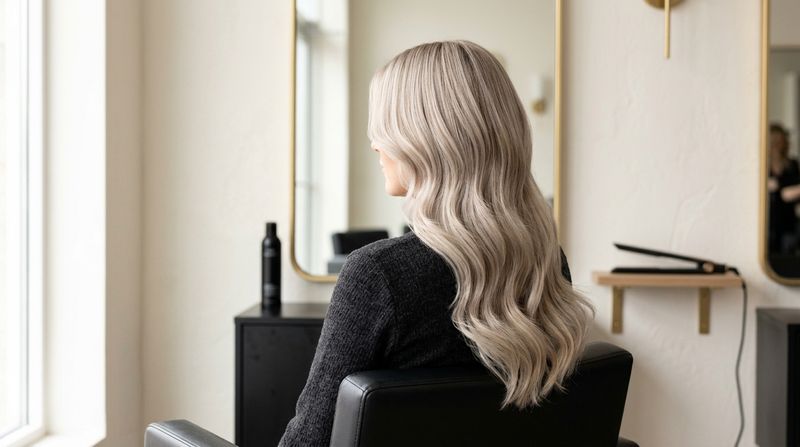
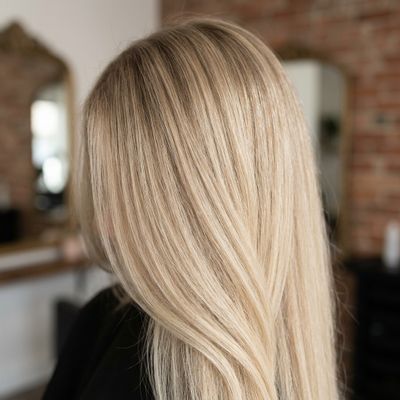
What your client calls velvet blonde —that pearl-satiny blonde that looks like wet velvet— is, in many salons, the result that fades fastest.
Let’s define which velvet we mean: here we’re talking about the cool velvet, the satiny pearl blonde at level 9-10 with a nacreous reflect. There’s also a warm-beige reading of the term, but the version that fades fastest —and the one we’re tackling— is the cool one.
She comes back at six weeks. The blonde is still there, but the satiny finish is gone. The peachy warmth has returned. And you wonder whether the toner failed, whether the shampoo was to blame, whether you should have waited longer.
Here’s the thing: most of the time, the fade was decided long before you opened the toner.
This article covers the causes in root-to-secondary order, a zone-by-zone diagnostic tree, and the reload protocol that actually works. No beginner checklists — this is written for professionals with five or more years behind the chair.
Why velvet blonde fades: the 4 causes in real order
Root cause #1: the bleach base —the problem that existed before you toned
Velvet blonde depends on a neutralized underlying base. When the pearl deposit fades —and it always fades, because no toner is permanent— what’s underneath decides whether the blonde stays beautiful or whether a warm yellow returns and ruins everything.
That is what happens with premature fade in most cases: the toner didn’t fail. The underlying base was never where it needed to be.
Velvet blonde requires reaching level 9-10 with an underlying base at pale yellow (9) or very pale yellow (10). If the base was left at golden yellow (8) or yellow-orange (7), the pearl pigment covers it on day one, yes. But as it washes out, it exposes exactly that: the warmth that never left.
This is a chair decision, not a home-care decision. No maintenance shampoo will correct a base that wasn’t taken far enough. No at-home treatment will sustain a velvet that started from an insufficient level.
If you encounter a velvet that faded in under two weeks, this is the first place to look.
Professional tip: before toning, evaluate the base under natural light. If there’s visible warmth in the mid-lengths or ends, the toner is going to mask the problem for three weeks, not solve it.
Cause #2: over-lightening and excessive porosity —the sieve that won’t hold pigment
Over-lightened hair is like a sieve, not a cup.
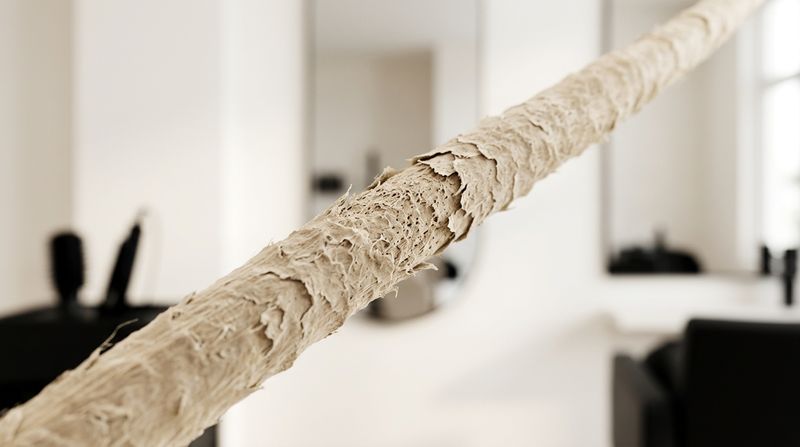
The hyper-porous cuticle absorbs pigment in minutes. Which means it saturates fast in the salon. And releases fast with the first wash.
Healthy hair has a closed cuticle and a compact cortex. The toner’s pigment enters, settles, and takes time to exit. Over-lightened hair has an open cortex and an eroded cuticle: the pigment enters, but it has too much room to move and too many exit routes.
How to identify it before toning: elasticity test. If the wet strand stretches more than 50% without snapping back, or breaks outright, the cortex is compromised.
This is also a chair decision: porosity level is a consequence of lightening choices, not of aftercare.
Cause #3: toner type —concrete numbers to set accurate expectations
This is where many professionals spend time searching for the cause of fade when the answer is, in part, mathematical.
- Demi-permanent toner (low-volume oxidative, 4-6 vol): enters slightly into the cortex thanks to the developer. On healthy hair it lasts approximately 20-24 washes. But over a level 9-10 over-lightened, porous base —exactly the Cause #2 scenario— retention drops to roughly half, and the cool reflects go first.
- Direct or semi-permanent toner (no developer): deposits only on the cuticle surface. Lasts approximately 4-8 washes. Intense on day one, gone within days.
The difference isn’t quality: it’s chemistry. The demi slightly lifts the cuticle to deposit pigment inside the cortex. The semi-permanent stains the surface and nothing more. If your client washes her hair three times a week and you used a direct color, the velvet will be gone in under three weeks. That’s not a failure: it’s the expected lifespan of that product.
When to use each:
| Toner type | When to apply | Expected lifespan (healthy hair) |
|---|---|---|
| Demi-permanent | Well-reached base, normal porosity | 20-24 washes (half that with high porosity) |
| Direct / semi-permanent | Quick reload, very high porosity, time-constrained appointments | 4-8 washes |
If a client is paying for a full velvet service and expects six weeks of longevity, demi-permanent isn’t optional: it’s the minimum.
Time range: when it’s a service failure vs. normal life
Get this clear to set expectations with precision:
Under 2 weeks (with reasonable home care): the velvet faded before reaching the floor of any demi-permanent’s lifespan. That points to a service failure. Review the base reached, the porosity, and whether the toner was actually oxidative. Note: with daily washing, pool, or intense sun, a cool reflect can leave sooner with no technical error.
4-6 weeks: normal lifespan of a velvet blonde with demi-permanent toner on medium-porosity hair with typical washing frequency. At 4-6 weeks the satiny finish has faded and it’s time for a maintenance reload gloss. This is not a failure: it’s the expected service cycle.
Don’t conflate these two when talking to clients. The client who comes back at two weeks with dead velvet has a problem to solve. The one who comes back at five weeks needs a reload: that’s exactly what should happen.
Cause #4: post-service care —accelerant, not root cause
Home care doesn’t create the fade problem. It accelerates or slows it.
There are two distinct mechanisms worth keeping separate:
Mechanism A — alkaline pH and hot water: when the cuticle is exposed to high pH (shampoos with pH above 7) or hot water, it swells. A swollen cuticle lets more pigment escape with every wash. Hot water doesn’t “permanently open the cuticle”: each hot wash is one open-close cycle, and with each cycle the toner loses a little more.
Mechanism B — sulfate surfactants: sulfates (SLS, SLES) are powerful surfactants that drag and extract pigment from the hair fiber. They don’t “open the cuticle” —that would be inaccurate— but their cleaning action is efficient enough to carry deposited pigment away, especially from surface-level toners.
And photo-oxidation is real: under sun exposure (UV), cool-reflect pigments (violets, blues) photo-oxidize before warm ones. A velvet blonde in summer sun loses its satiny finish noticeably faster.
All of this matters. But if the base was well-reached, porosity wasn’t excessive, and the toner was demi-permanent, home care shifts the equation in weeks, not days.
Zone-by-zone diagnostic tree: where the velvet went
When the result comes back uneven, the zone where the satiny finish disappeared tells you exactly what happened.
Fade at roots (first in the new growth zone):
- New growth with a warmer base than mid-lengths/ends
- The toner was covering the transition but the base level was different underneath
- Protocol: re-lighten only the root zone to the correct level before the next gloss
Fade at mid-lengths (the most damaged zone):
- Elevated porosity from accumulated treatments or overlapping lightening sessions
- The toner faded faster in the most porous zone
- Protocol: apply a porosity pre-treatment (protein filler or hyaluronic acid) before toning at the next visit
Fade at ends (tips first):
- Over-lightened ends with heavily eroded cuticle
- Absorb fast and release just as fast
- Protocol: consider trimming compromised length + reload gloss with an acidic toner or minimal developer (≤3 vol at the ends)
If fade is even throughout the whole length: evaluate the toner type and washing habits. The demi likely never entered the cortex due to porosity, or a semi-permanent was used where it shouldn’t have been.
Reload gloss protocol: formulate to the current base, not the day-one goal
The most common error in reload glossing: formulating as if the hair were still exactly where it was right after the initial service.
Your client’s hair at five weeks is not the same hair that left your salon. It has lost pigment, the underlying base has become visible again in varying proportions, and porosity may have changed.
Step 1: re-diagnose the current base under natural light. Don’t assume the level is where you left it. Look at what’s there now.
Step 2: if there’s visible porosity (puffy dry texture, different texture across zones), apply a porosity pre-treatment before the toner. A protein filler or an acidifying treatment (pH 4-4.5) closes the cuticle enough for the gloss to deposit more evenly and last longer.
Step 3: formulate to the current base, not the blonde she had leaving the salon. If the base has returned to show some gold, the mix needs more violet or blue than you’d use if the hair were pristine.
Step 4: low developer, always. Reload gloss works with 4-6 vol on mid-lengths. On eroded ends, drop to an acidic toner or ≤3 vol. Never re-lighten for a reload. If the base needs more work, that’s a separate lightening session, not something resolved by raising the toner’s developer volume.
Step 5: processing time adjusted to porosity. Porous hair = less time (15-20 min). Resistant hair = full product time (25-30 min). Porous hair saturates faster and releases faster: if you leave it the standard time, the day-one result is more intense but fades earlier.
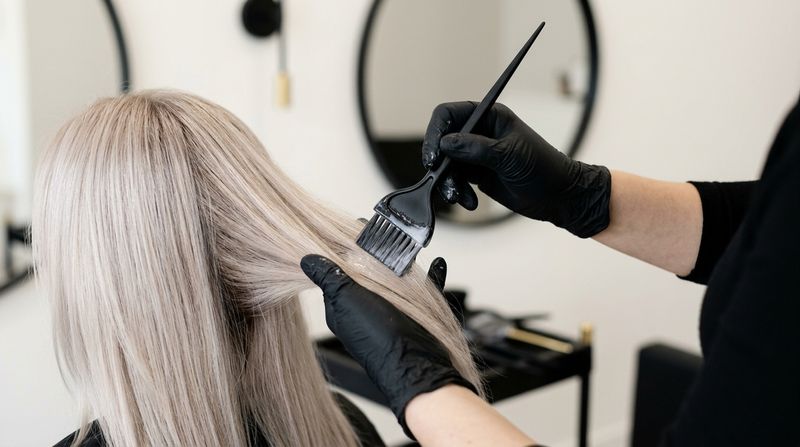
What velvet blonde longevity says to your client about your work
The difference between a velvet that lasts four weeks and one that disappears in ten days is invisible when she walks out of the salon. Both look the same on day one.
The difference shows up at week three, when she looks in the mirror and decides whether it’s worth coming back.
The longevity ceiling is set in the chair: base well-reached, porosity assessed, oxidative toner at the right volume. Home care decides how much of that ceiling she keeps.
Frequently asked questions about velvet blonde longevity
How long does a velvet blonde normally last?
With a demi-permanent toner and normal porosity, the satiny finish holds approximately 4-6 weeks. Under 2 weeks, with reasonable care, points to a service failure. At 4-6 weeks is the typical reload moment.
Is it normal for velvet blonde to fade faster in summer?
Yes. Photo-oxidation degrades cool-reflect pigments (the violets and blues that make up the pearl satin) faster than warm ones. More sun exposure equals faster fade. Reload glossing in summer may be needed every 3-4 weeks.
Does sulfate-free shampoo extend toner life?
It slows fade, yes. Sulfate surfactants extract pigment more efficiently. Switching to sulfate-free can add 3-5 washes of longevity. But if the base wasn’t well-reached or porosity was excessive, the shampoo doesn’t change the underlying equation.
Can I use a direct toner for reload glossing?
It depends on what you need. If the client wants immediate intensity and is coming back in 2-3 weeks, a direct color can work. If she wants 5-6 weeks of longevity, demi-permanent is non-negotiable.
Why did it fade at the ends before the mid-lengths?
Ends are typically the most porous zone (longest exposure to treatments). A more eroded cuticle absorbs pigment fast and releases it just as fast. Consider trimming damaged ends and applying the reload gloss with an acidic toner or minimal developer (≤3 vol) at that zone.
In summary
- The base rules: a velvet that fades early almost always started from a base that wasn’t reached or neutralized correctly.
- Porosity is the second ceiling: over-lightened hair holds half; assess it before toning.
- The toner sets the floor: demi to last, direct only for quick reloads.
- Home care adjusts, doesn’t decide: it speeds up or slows down, but won’t save a poorly planned service.
Calculate professional formulas with AI
Want to formulate the reload of a faded velvet based on the actual base you find zone by zone, without over-lightening again?
Where does your velvet fade first: roots, mid-lengths, or ends?
Why is a velvet blonde's durability decided before toning?
In the app, we ask you a question like this one, but about your own client.
Up for this week’s case? → More on blondes and lightening →Related articles
The Blendsor newsletter
Color techniques and trends for professionals. No spam.
You know the theory. What about today's case?
Send a photo to the Blendsor advisor and get an answer grounded in colour theory: toner, developer and timing, with the brands on your shelf.
Ask about your caseWritten by the Blendsor team
Professional hair colorimetry experts with experience in AI-assisted formulation. We combine color science, salon practice and technology to help colorists formulate with precision.