Blue Toner for Orange Hair: The Pro Guide
Purple toner does nothing on orange hair. Learn why blue neutralizes orange, which professional products to use, and exact formulas by level.
Blendsor
Blendsor Team
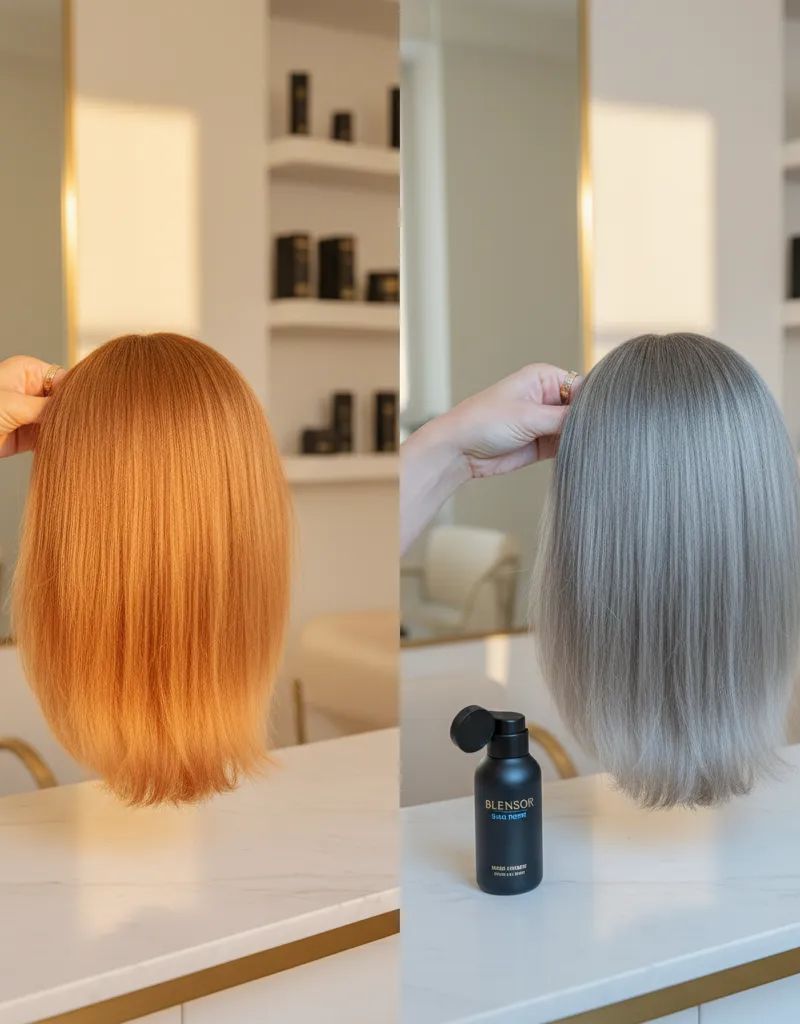
You applied a purple toner on orange hair and nothing happened. There is a specific reason for that.
Blue neutralizes orange. Violet neutralizes yellow. They are not interchangeable. Confusing the two is the single most common toning mistake in professional color work — and once you understand why, your results become predictable instead of unpredictable.
This guide covers exactly when to reach for blue, which professional products deliver real neutralizing power, and how to match your formula to the underlying pigment level in front of you. For the full colorimetry theory behind complementary colors, start with our hair colorimetry basics guide.
Why Blue Neutralizes Orange (and Not Violet)
The answer is the color wheel. Blue and orange sit directly opposite each other — they are complementary colors, meaning they cancel each other out when mixed in the right proportions.
You can verify this instantly with our neutralization wheel tool, which shows any complementary pair in real time.
This is not industry convention. It is optics. According to the Society of Cosmetic Chemists, blue-based artificial hair pigments absorb orange-wavelength light (roughly 590–620 nm on the visible spectrum), visually neutralizing that underlying warmth without adding heat back into the result.
In practical terms: when a client sits in your chair with the classic level 5–7 orange underlying pigment after bleaching, you need a toner with a blue or ash base. Violet simply does not have the right spectral absorption for that job.
Blue vs. Violet: Which One to Use
This is the table that will simplify most of your toning decisions:
| Underlying pigment | Approximate level | Neutralizing color | Tone/reflect to use | Why |
|---|---|---|---|---|
| Red-orange | 4–5 | Pure blue | .1 (ash) | Heavily saturated orange, needs strong blue |
| Orange | 5–6 | Blue | .1 or .01 | Classic brassiness, direct neutralization |
| Orange-yellow | 6–7 | Blue + touch of violet | .01 or .12 | Orange fading into yellow territory |
| Golden-yellow | 7–8 | Mostly violet | .2 with a touch of .1 | Yellow dominates, orange is residual |
| Pale yellow | 8–9 | Pure violet | .2 (iridescent/violet) | Classic purple toner territory |
Pro tip: If you are unsure whether the underlying tone is orange or yellow-orange, hold a sheet of white paper behind the strand. The contrast tells you whether warm orange or golden-yellow is dominant — and that determines your corrector.
For a complete look at neutralizing all unwanted tones (not just orange), see our article on neutralizing unwanted hair tones.
Professional Blue Toner Products by Brand
The professional market offers several well-established options that deliver blue-based pigment. These are the most commonly used references in salon work.
Redken Shades EQ
The most widely used demi-permanent toning line. For orange:
- 09B (Buff): Ash-gold for mild orange at level 9
- 08B (Sheer Mocha): Ash at level 8, ideal for orange-to-yellow underlying pigment
- 07B (Mocha): For more intense orange at level 7
- 06B (Birch): Dark ash for level 6 orange bases
Mixed with Processing Solution at 1:1, processed 5–20 minutes depending on underlying pigment intensity.
Wella Color Touch (.1 Reflect)
Color Touch tones with the .1 (ash) reflect carry blue-based pigment:
- 7/1: Mid blonde ash, for orange underlying pigment at levels 6–7
- 8/1: Light blonde ash, mild orange at levels 7–8
- 6/1: Dark blonde ash, intense orange at levels 5–6
Always mixed with 1.9% or 4% developer. Standard processing time: 20 minutes.
Schwarzkopf Igora Vibrance (Ash Series)
Igora Vibrance tones with the -1 reflect are precise for neutralization:
- 7-1: Orange underlying pigment at levels 6–7
- 8-1: Orange-to-yellow at levels 7–8
- 9-1: Yellow with orange undertone at levels 8–9
Mixed with 1.9% activator at 1:1 ratio.
L’Oreal Dia Light (Ash Series)
Dia Light ash tones work on the same principle:
- 7.1: Ash at level 7
- 8.1: Light ash for level 8
- 8.11: Intense ash, higher neutralizing power
Mixed with 1.8% Révélateur Dia, 20-minute processing time.
To find the exact equivalent of any of these references in your preferred brand, use the Redken chart in the hair color converter.
Blue Shampoo vs. Professional Toner
There is a lot of marketing noise around blue shampoo. This table separates what each tool actually does:
| Blue shampoo | Professional demi-permanent toner | |
|---|---|---|
| Neutralizing power | Low to moderate | High |
| Duration | 2–4 washes | 4–6 weeks |
| Who applies it | Client at home | Colorist in salon |
| Result | Maintenance between appointments | Real tone change |
| Control | Variable (depends on contact time) | Precise (timed application) |
| Best for | Mild brassiness, maintenance | Intense orange, real correction |
| Risk | Pigment buildup over time | Minimal with correct technique |
Blue shampoo is a useful maintenance tool between appointments. It is not a substitute for professional toning when the underlying orange is at level 5–6. A client with real brassiness from an incomplete bleach needs a toner, not a shampoo.
For cases where orange appears after bleaching on previously colored hair, see our guide on toning bleached hair.
Toner by Level: Quick Reference Table
| Underlying level | Orange shade | Recommended toner | Developer | Time |
|---|---|---|---|---|
| 5 | Intense red-orange | 6.1 + 6 (3:1) | 10 vol / 1.9% | 25–30 min |
| 6 | Pure orange | 7.1 + 7.01 (2:1) | 10 vol / 1.9% | 20–25 min |
| 7 | Orange-yellow | 8.01 + 8.1 (1:1) | 10 vol / 1.9% | 15–20 min |
These ratios are a starting point. Adjust the ash proportion based on the actual intensity of the orange: more saturated orange means more weight on the .1 reflect.
Use the Blendsor toner selector to enter the exact underlying pigment level and get a brand-specific formula recommendation.
Application Tips That Actually Change the Result
Developer volume
Always 10 vol (3%) maximum when toning. Using 20 vol on already-bleached hair:
- Continues lifting slightly (more orange becomes visible)
- Damages already-sensitized fiber
- Prevents pigment from depositing correctly
For a deep dive on how developer volume affects every stage of the color process, see our developer volumes guide.
Processing time
- Intense orange: 25–30 minutes for full pigment penetration
- Moderate orange: 20 minutes
- Mild orange: 10–15 minutes (check at 10)
Do not leave ash toners on by eye. Excess blue over a high level (8–9) can produce a grayish or even greenish result if there is yellow residue mixing with the blue.
Pre-application check
Dry a test strand completely before toning. Wet hair always reads one level lighter than it is. If you tone over a wet level 6 believing it is level 7, the result will be darker and colder than expected.
Frequently Asked Questions
Can I use purple shampoo on orange hair?
No. Purple shampoo is formulated to neutralize yellow, not orange. They are different complementary pairs on the color wheel. Applied to pure orange, it will produce an orange with a purple cast, not a neutral. You need a product with blue pigment for orange hair.
What level of orange is too much for a blue toner?
If the underlying pigment is at level 4 or below (red-orange, almost copper), a demi-permanent toner alone will not solve the problem. You will need either a second lightening session to lift the base, or a color correction with 20 vol developer and a heavy ash load. Blue toners work reliably from level 5 upward.
How long does blue toner last on hair?
A well-applied demi-permanent toner lasts approximately 4–6 weeks. Sulfate shampoos, hard water, and sun exposure all degrade the toner faster. For maintenance, blue shampoo once or twice a week extends the result between salon visits.
Does blue toner work on previously colored hair?
Yes, but residual warm pigment from previous dye can interfere. If there is warm artificial color still in the strand, the ash toner may not neutralize completely. In that case, a gentle color removal or a light pre-lightening pass may be necessary before toning.
Can I mix blue and violet toner?
Yes. For orange-to-yellow underlying pigment (level 6–7), it is common to combine a .1 reflect with a .01 or .21 to cover the full spectrum. The key is that the blue reflect remains dominant if orange outweighs the yellow.
Summary
- Blue neutralizes orange. Violet neutralizes yellow. This distinction is non-negotiable.
- Use the neutralization wheel to confirm the complementary color before you formulate.
- Level 5–6: Strong ash (.1) with high concentration. Level 6–7: Ash plus iridescent (.01 or .12). Level 7–8: Violet starts to take over.
- Professional demi-permanent toners (Shades EQ B series, Color Touch .1, Igora Vibrance -1, Dia Light .1) deliver results that blue shampoo cannot match.
- Always use 10 vol maximum developer when toning on post-bleach hair.
- Use the toner selector to get an exact formula by level and brand.
Got a brassy client in the chair right now? Enter the underlying pigment level and intensity into the toner selector and get a formula in seconds.
What is the most difficult orange situation you have had to correct? Level too low, damaged hair, old color underneath?
Related articles
Practice with our free tools
Calculators, neutralization wheel, AI consultation...
Apply this theory with precision
Blendsor analyzes 70+ variables and generates exact formulas based on real colorimetry. Try our free color consultation or download the app.
Download free