Color Correction: How to Fix Failed Hair Dye
Professional guide to fixing hair color that didn't turn out right. Techniques, formulas, and protocols for correcting color mistakes with predictable results.
Blendsor
Blendsor Team
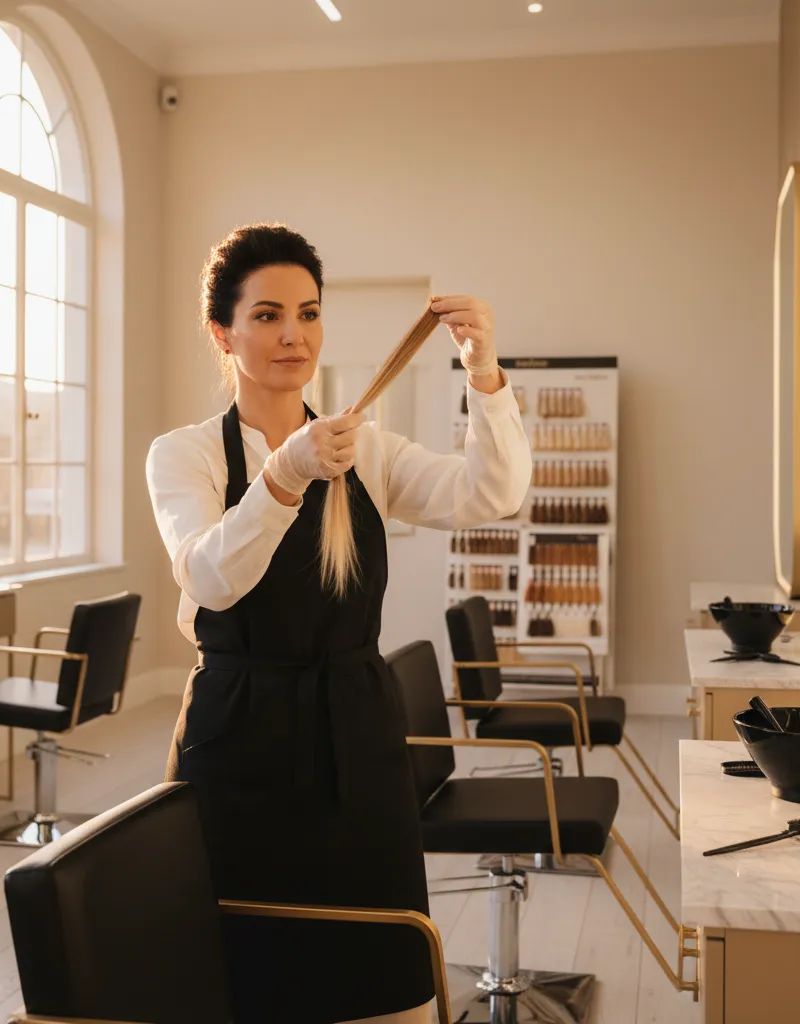
Did your client arrive with hair color that’s nothing like what she expected? Did a previous dye job turn out completely different from the plan? Color correction is one of the most valued skills of a professional colorist, and also one of the most challenging.
Hair color correction involves modifying an unwanted result to achieve the target tone. It requires precise diagnosis, knowledge of colorimetry basics, and a clear action plan. This isn’t about “trying to see what happens”—it’s about applying scientific color principles for predictable results.
In this guide, we’ll cover exactly how to approach the most common corrections, with formulas and protocols that work.
Quick summary: Hair color correction requires a three-step diagnosis (client interview, visual analysis, porosity-elasticity test) before any intervention. The five most common scenarios are: color too dark, unwanted orange, greenish tones, uneven patches, and unwanted red. Core principle: minimal intervention first — damage cannot be reversed, but intensity can always be increased.
When Is Color Correction Needed?
Color correction is needed when the result differs from the target by 2+ levels, there are unwanted tones (orange, green, red), color is patchy or uneven, or roots visibly differ from lengths. It is not correction if a semi-permanent simply faded or the difference is half a tone — those cases are resolved with toning or adjustment, not chemical correction.
Not every imperfect result requires correction. First, identify the real problem:
| Situation | Is it correction? | Action |
|---|---|---|
| Color 1-2 shades darker than expected | Yes | Color remover or gentle lightening |
| Unwanted tones (orange, red, green) | Yes | Neutralize with complementary colors |
| Color too light | Depends | Fill and re-color |
| Patches or uneven color | Yes | Unify with specific technique |
| Roots lighter than lengths | Yes | Even out levels |
| Color that “faded” (semi-permanent) | No | Reapply, don’t correct |
Correction always involves chemically modifying the hair. If you can resolve it with a toner or gloss, it’s not correction—it’s adjustment. For toning mistakes (gray, purple, or green results), see our toner mistakes guide and use the toner selector to choose the right family.
What Is the Diagnosis Protocol for Color Correction?
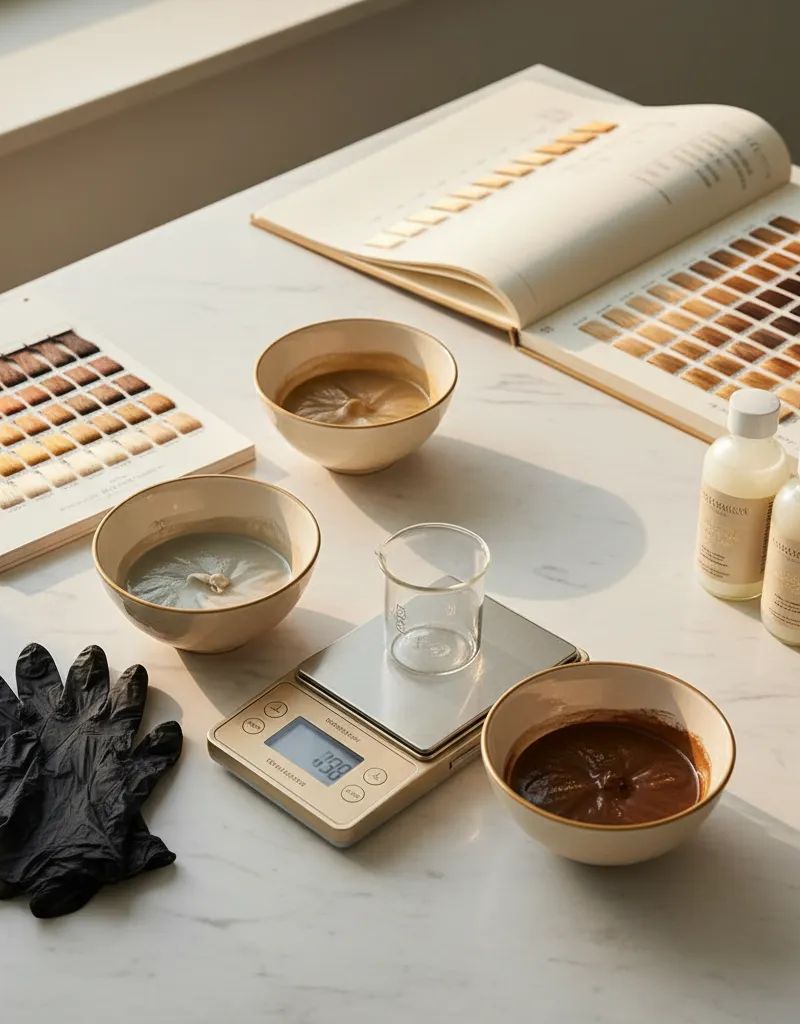
Color correction diagnosis has three mandatory steps: client interview (dye history, brand used, henna, expected vs. actual result), visual analysis under natural light (current level, dominant tones, zone uniformity), and porosity-elasticity test (high porosity = absorbs fast; low elasticity = limits chemical options). According to the Society of Cosmetic Chemists, most correction errors originate in incomplete diagnoses, not application technique.
Before mixing anything, you need information. According to the Society of Cosmetic Chemists, errors in color correction usually originate from incomplete diagnoses, not application technique.
Step 1: Client Interview
Mandatory questions:
- When was the last dye applied? (days/weeks)
- What brand and number did they use? (if known)
- Has anything been applied on top since? (toners, color-depositing masks)
- Have you ever used henna? (critical to avoid disasters)
- What result were you expecting vs. what did you get?
Step 2: Visual Analysis
Examine the hair under natural or neutral light:
- Roots: Natural color visible? How many centimeters?
- Mid-lengths: Uniform color or banding?
- Ends: More porous? Pigment buildup?
- Dominant tones: Orange, red, yellow, green?
- Current level: Compare with swatch book
Step 3: Porosity and Elasticity Test
The hair’s condition determines what you can do:
- High porosity: Absorbs quickly, releases quickly. Be careful with timing.
- Low porosity: Resists penetration. Needs more time or heat.
- Compromised elasticity: Damaged fiber. Limits chemical options.
Pro tip: Highly porous hair with poor elasticity should NOT undergo additional bleaching. Prioritize integrity over perfect results.
What Are the 5 Most Common Color Correction Scenarios?
The five most frequent scenarios are: color too dark (bleach bath 15-20 min for 1-2 levels, or professional color remover for 3+ levels), unwanted orange (neutralize with .1 ash + .01), green hair (neutralize with .43 copper gold), uneven patches (unify by zone), and unwanted red (neutralize with matte ash .1 or .13, never pure green). Each has a specific formula and protocol.
The professional color correction protocol follows these steps:
- Diagnose: Interview the client, analyze visually, and test porosity/elasticity.
- Identify the problem: Determine if it’s excess darkness, unwanted tones, patches, or uneven color.
- Plan the intervention: Choose between color removal, neutralization with complementaries, pigment filling, or a combination.
- Execute with minimal intervention: Start gentle; you can always intensify, but you can’t reverse damage.
- Evaluate and schedule follow-up: Document with photos and book in 2-3 weeks if another session is needed.
1. Color Too Dark
The problem: The client wanted light brown and got dark brown (or black).
Why it happens:
- Base level incorrectly diagnosed
- Pigment buildup in mid-lengths and ends
- Porous hair that absorbed more than expected
The solution: Color remover or bleach bath
Protocol to lift 1-2 levels:
Bleach bath:
- Lightener (20g) + Hot water (40ml) + Shampoo (10ml)
- Apply quickly throughout the hair
- Check every 5 minutes
- Maximum 15-20 minutes
- Rinse when you reach desired level + 1 (it will darken when re-coloring)
Protocol to lift 3+ levels:
Here you need professional color remover or controlled bleaching. Color removers break down artificial pigment molecules without affecting natural melanin as much.
Professional color removal:
- Specific product (Colour B4, ColourOff, etc.)
- Follow manufacturer instructions exactly
- May require 2-3 applications
- ALWAYS tone afterward to close the cuticle
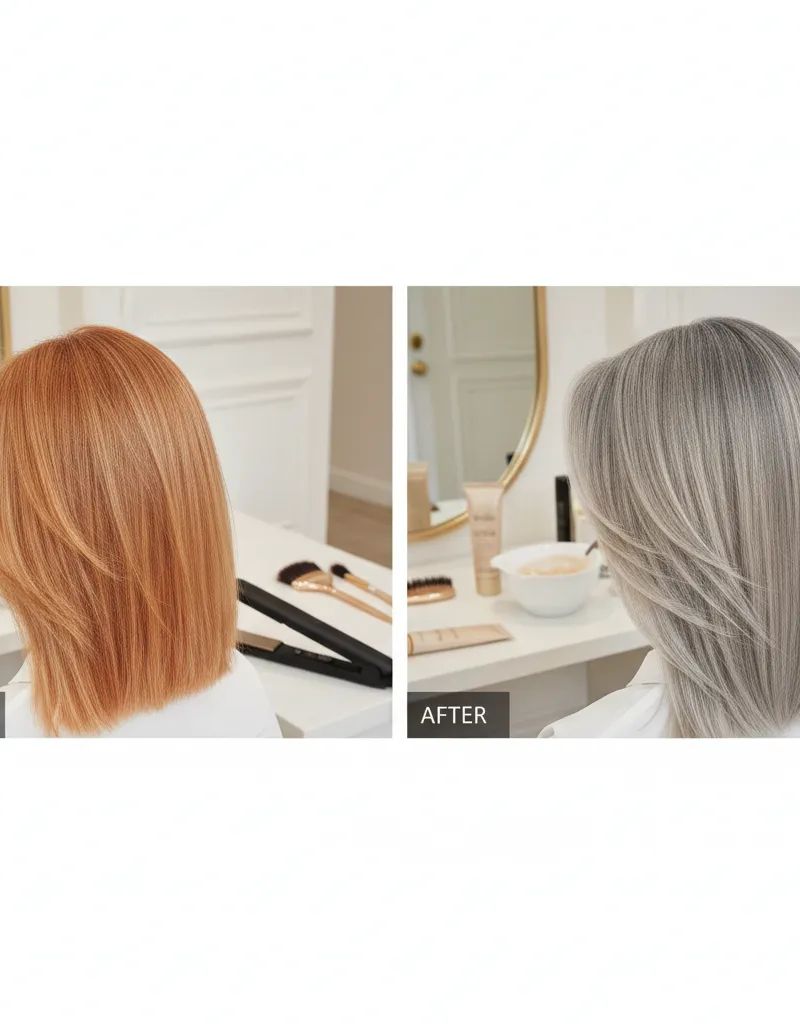
2. Unwanted Orange or Brassy Tones
The problem: Lightening or bleaching left the hair orange instead of the expected blonde.
Why it happens:
- Insufficient lightening (didn’t reach the necessary level)
- Underlying pigment not neutralized
- Hair with history of dark dyes
To understand why orange appears, check our hair color levels guide. Orange is the natural underlying pigment at levels 5-6.
The solution: Neutralization with ash/blue
Formula for intense orange (level 6):
7.1 (30g) + 7.01 (20g) + 7 natural (10g)
10 vol developer (60ml) - 1:1 ratio
Time: 25-30 minutes
The natural (.0) prevents the result from looking too cold or “muddy.”
Formula for orange-yellow (level 7):
8.1 (25g) + 8.21 (25g) + 8 natural (10g)
10 vol developer (60ml)
Time: 20-25 minutes
For detailed neutralization techniques, see how to neutralize unwanted hair tones.
3. Green Hair
The problem: Greenish tones, especially in blondes who went to the pool or had accumulated ash tones.
Why it happens:
- Excess ash from previous applications
- Copper in water (pools, old pipes)
- Mix of residual yellow + ash
The solution: Red/copper neutralizes green
Formula for slight green:
Current level + .43 (copper gold) or .34 (gold copper)
Example for greenish level 8:
8.34 (40g) + 8 natural (20g)
10 vol developer (60ml)
Time: 15-20 minutes
For intense green (pool water):
Pre-treatment:
- Chelating or clarifying shampoo
- Tomato mask (yes, the acid helps remove copper)

Afterward:
- Tone with soft copper
- DO NOT use ash until green is completely removed
4. Patches or Uneven Color
The problem: The color isn’t uniform. There are lighter areas, darker areas, or different tones.
Why it happens:
- Uneven application
- Different processing times in different areas
- Irregular porosity (especially in ends)
- Insufficient product in some areas
The solution: Depends on the type of unevenness
Areas darker than the rest:
1. Apply bleach bath ONLY to dark areas
2. Match to the general level
3. Re-color everything uniformly
Areas lighter than the rest:
1. Fill the light areas with pigment
   - If very light: use a tone 1-2 levels darker than target
2. Process 10-15 minutes
3. Apply global formula on top
Horizontal banding (typical when roots are lighter than mid-lengths):
1. Darken roots first to match mid-lengths
2. Wait 15-20 minutes
3. Pull through and emulsify to blend
5. Unwanted Red or Mahogany
The problem: The hair has a reddish or mahogany tone when a neutral or cool brown was the goal.
Why it happens:
- Previous dye with red base
- Oxidized henna
- Underlying pigment at levels 3-4 (dominant red)
The solution: Ash matte, never pure green
According to studies by the International Association of Trichologists, red pigment is the hardest to remove because it penetrates deep into the hair cortex.
Formula to neutralize red (level 5):
6.1 (30g) + 6.13 (20g) + 6 natural (10g)
20 vol developer (60ml)
Time: 35-40 minutes
The .13 (ash gold) has a matte base that helps without adding visible green.
For henna: Requires special treatment. Henna cannot be removed with normal color removers. Options:
- Cut gradually
- Go darker (never lighten over henna)
- Hot oil treatments to soften over time
When and How Do You Use the Pigment Filling Technique?
Pigment filling is mandatory when hair is at level 7+ and you want to darken it. Without filling, color comes out dull or greenish and fades within days. Protocol: apply filler color diluted 1:2 with water, process 10-15 minutes without heat, do not rinse, and apply the target formula on top. Filler tone selection depends on current and target levels — gold (.3) for level 9-10 going to 7-8, copper (.4) for 9-10 going to 5-6.
When hair has been heavily lightened and you want to go darker, you CANNOT apply dark dye directly. The result would be a dull, greenish color that fades in days.
Why: Very lightened hair lacks the base pigments (red, orange, yellow) that give color depth.
The filler protocol:
| Current level | Target level | Filler color |
|---|---|---|
| 9-10 | 7-8 | Gold (.3) |
| 9-10 | 5-6 | Copper (.4) |
| 9-10 | 3-4 | Red (.6) or mahogany (.5) |
| 7-8 | 5-6 | Copper gold (.43) |
| 7-8 | 3-4 | Red copper (.64) |
Process:
- Apply filler color diluted (1:2 with water or conditioner)
- Process 10-15 minutes without heat
- DO NOT rinse - towel dry
- Apply target formula on top
- Full processing time per manufacturer
What Mistakes Must You Avoid in Color Correction?
The five critical mistakes in correction are: bleaching over recent bleach (wait minimum 2 weeks), using 40 vol to speed things up (maximum 30 vol, prefer 20), skipping the strand test (mandatory for all corrections), mixing color remover with bleach (dangerous chemical reaction), and promising results in one session (some corrections require 2-3 visits and communicating this upfront prevents client frustration).
| Mistake | Consequence | Prevention |
|---|---|---|
| Bleaching over recent bleach | Breakage, extreme damage | Wait minimum 2 weeks |
| Using 40 vol to “speed things up” | Burns, gummy hair | Maximum 30 vol, prefer 20 |
| Not doing a strand test | Unpredictable result | ALWAYS for corrections |
| Mixing color remover with bleach | Dangerous chemical reaction | Use products separately |
| Promising results in one session | Frustrated client | Be honest: may require 2-3 visits |
The common color formulation mistakes multiply in corrections. Caution is your best tool. For precise calculations of correction formulas based on current level and target tone, use the mixing ratio calculator.
How Many Sessions Does a Color Correction Require?
The safest and most lasting corrections require 2-3 sessions. First session: complete diagnosis + gentlest possible intervention + reconstructive treatment + follow-up in 2-3 weeks. Second session: evaluate evolution + next correction step. Third session if needed: final refinement. Charge by session, not by final result — this protects both the client relationship and the hair’s structural integrity.
Not every correction can be resolved in one appointment. In fact, the safest and most lasting corrections usually require multiple sessions.
First session:
- Complete diagnosis
- First intervention (as gentle as possible)
- Reconstructive treatment
- Follow-up appointment in 2-3 weeks
Second session:
- Evaluate how it has evolved
- Next correction step
- Fine adjustments
Third session (if needed):
- Final refinement
- Maintenance protocol
Pro tip: Charge for correction by session, not by final result. Explain to the client that hair health is the priority.
Frequently Asked Questions
Can I correct a dye the same day it was applied?
Yes, but with caution. The scalp may be sensitized and the cuticle open. If the issue is tones (orange, red), you can tone immediately. If you need to bleach, wait at least 48 hours.
How long should I wait between corrections?
Minimum 2 weeks between strong chemical processes (bleaching, color removal). For toners or tone-on-tone, you can make adjustments every 7-10 days if the hair allows it.
Can you correct hair with henna?
This is the most difficult case. Henna cannot be removed with normal color removers. Options are: go darker, cut gradually, or hot oil treatments for months to soften the pigment. Never bleach over henna without a strand test: it can turn electric orange or green.
How should I price a color correction?
Correction requires more time, product, and expertise than a normal service. Charge based on estimated time, not the result. Many salons charge by the hour for corrections. Be transparent with the client about cost from the diagnosis.
What if the client isn’t satisfied after the correction?
Listen first. Sometimes it’s a matter of fine-tuning (a toner). If the result is technically correct but she doesn’t like it, offer realistic options. Document everything with photos to avoid misunderstandings.
In Summary
- Diagnose before acting: 80% of success is in the prior analysis
- Use the principle of minimal intervention: Start gentle, you can intensify later
- Respect recovery times: Hair isn’t indestructible
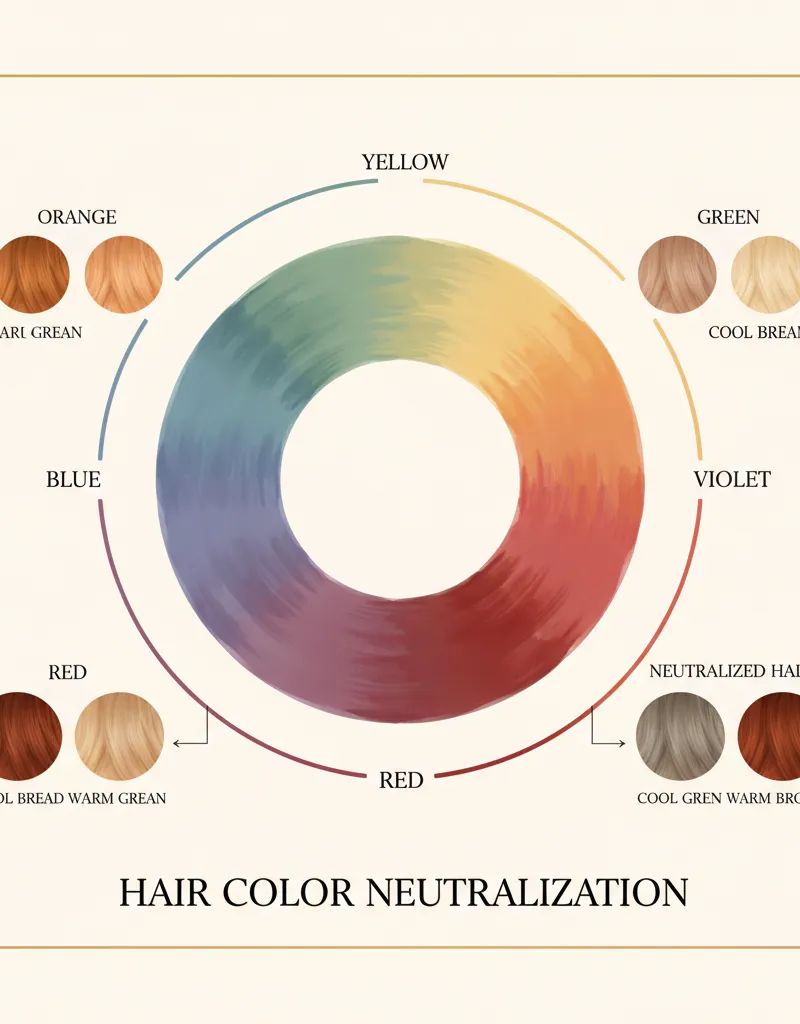
- Neutralize with complementaries: Orange→blue, yellow→violet, red→ash matte
- Fill before going darker: Very lightened hair needs base pigment
- Be honest about expectations: Some corrections require multiple sessions
Color correction is where a colorist’s true knowledge shows. It’s not just about fixing mistakes—it’s about applying color science under pressure, with immediate visible results.
Want correction formulas calculated with precision? Try Blendsor free. Describe the problem and the AI suggests the correction protocol step by step.
Related articles

Practice with our free tools
Calculators, neutralization wheel, AI consultation...
The Monday Briefing
Color techniques and trends for professionals. No spam.
Apply this theory with precision
Blendsor analyzes 70+ variables and generates exact formulas based on real colorimetry. Try our free color consultation or download the app.
Download freeWritten by the Blendsor team
Professional hair colorimetry experts with experience in AI-assisted formulation. We combine color science, salon practice and technology to help colorists formulate with precision.