Developer Volume for Porous Hair: How to Adjust
Using the same developer on damaged, porous hair causes overprocessing and fast fade. Learn which volume to choose based on the real goal of your formula.
Blendsor
Blendsor Team
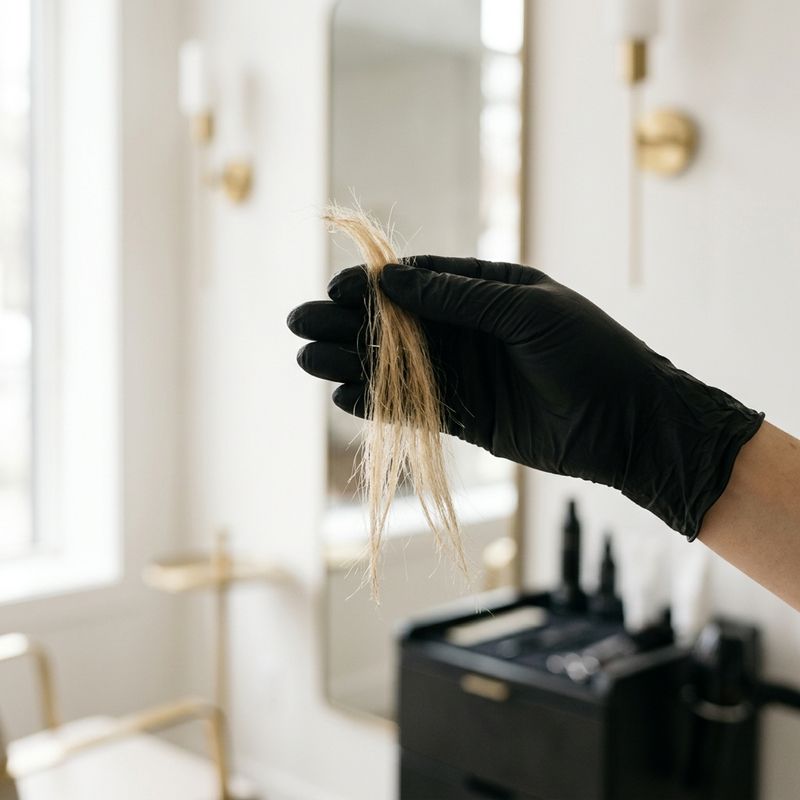
How many times have you applied your usual 20 vol, only to end up with a result that looks washed out or fades in a few washes?
Here’s what happened. The hair already had a raised cuticle and you added more lifting power on top of that.
In this article you’ll understand why porosity changes the rules for developer, when to lower the volume, when you absolutely cannot, and how to build a decision framework you can use at your station starting today.
Quick summary: In porous hair the cuticle is already lifted, so developer penetrates faster and with greater intensity. The rule is to use the minimum volume that achieves your goal: 10 vol for toning or depositing without lift, minimum 20 vol for gray coverage or lifting virgin root. Using your usual developer on porous mid-lengths and ends overprocesses the fiber and accelerates color fade.
What does developer volume actually do to the cuticle?
Developer volume determines how much the cuticle opens and how much lifting power you have available: 10 vol (3% peroxide) deposits with minimal opening, 20 vol (6%) opens the cuticle enough for 1-2 levels of lift, 30 vol (9%) reaches 2-3 levels, and 40 vol (12%) delivers maximum lift possible with oxidative color. Higher volume means more opening and more lifting power; lower volume means more deposit and less structural stress.
On healthy hair, the cuticle starts from a closed position. The developer opens it from zero so that pigment can enter. That makes sense.
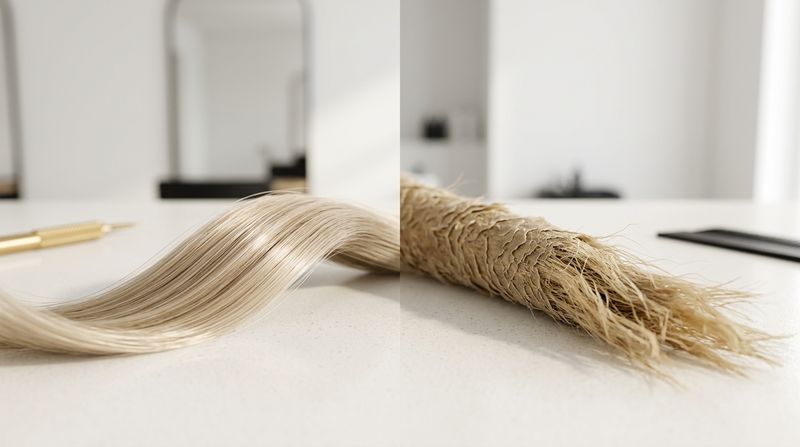
But on porous hair, the cuticle is already raised. From repeated bleaching, from frequent flat iron use, from chlorine in swimming pools, from hard water minerals, from accumulated sun exposure. The summer that’s just starting now will return in the form of porous hair when your client sits in your chair again in the autumn. But damage from bleaching, heat and hard water is something you see today, in June, without waiting.
If you apply 20 vol to those porous mid-lengths and ends, you’re forcing an opening that already existed. The result: pigment enters fast, in excess, but doesn’t anchor. It washes out in a few shampoos and the tone fades before its time.
Porosity is one of the things worth checking before any chemical service: an open fibre doesn’t take product the way healthy hair does, and that changes how the developer works its way in. That’s the reason behind adjusting your volume.
Before formulating, assess the damage level using our guide to sun and chlorine damage diagnosis.
When should you lower the volume on porous hair?
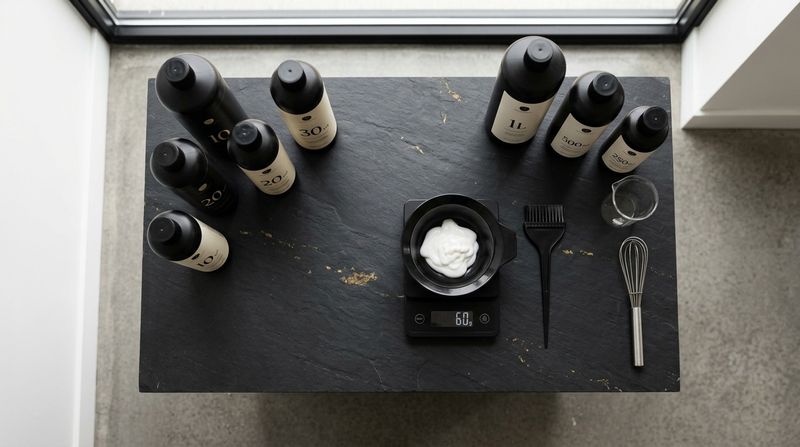
Lowering the volume is the right call when the goal is to deposit tone on hair that already has damage. You don’t need more opening. You need more deposit and less aggression.
Imagine you have a client with old highlights. Mid-lengths and ends are at level 8-9, porous, with a dull, brassy tone. The goal is to refresh the blonde and neutralize that brassiness. You don’t want additional lift. In that case, 10 vol deposits without over-opening the cuticle, the pigment enters in a more controlled way, and the result lasts longer because it has anchored properly.
Another scenario: a client with a previous balayage on mid-lengths and ends, looking to add a gloss or a soft fashion tone. The hair has been stressed by the previous process. With 10 vol or even a low-volume demi (some lines like Wella Color Touch or Redken Shades EQ use their own developers at approximately 1.9-4% depending on the goal) you achieve perfect deposit without stressing the fiber further.
The professional rule that never fails: use the minimum volume that achieves the goal. On porous hair, this rule matters even more because the threshold for overprocessing is lower.
When can you NOT lower the volume?
Here is the exception you should never skip.
For gray coverage, the minimum is always 20 vol. Gray hair is resistant. Melanin has disappeared but the structure of gray hair has a different cortex that, paradoxically, makes it harder to penetrate with artificial pigment. You need the cuticle opening that only 20 vol can provide, plus the full pigment development time. If you drop to 10 vol searching for “less damage”, the result is partial or zero coverage. The gray shows through within days.
For lifting virgin root, you cannot go lower either. The healthy new growth, which has seen no chemical process, needs at least 20 vol for real lift to happen. If you only want deposit without a level change, 10 vol may work. But if you want to move the tone even half a level, 20 vol is the floor.
The mistake you see repeatedly: someone lowers the volume across the whole head “because of the damage” without distinguishing between virgin root, mid-lengths and ends. The result is poor gray coverage at the root and correct mid-lengths and ends. Even worse when the gray is concentrated at the temples and crown.
Reference table: developer volume by goal and hair condition
This is your practical tool. Use it before formulating whenever the hair has any level of previous damage.
| Goal | Healthy hair | Lightly porous | Highly porous |
|---|---|---|---|
| Tone-on-tone deposit (no lift) | 10-20 vol | 10 vol | Low-vol demi |
| Refresh / revive existing tone | 10-20 vol | 10 vol | 10 vol or demi |
| Gray coverage (always) | 20 vol | 20 vol minimum | 20 vol minimum |
| Lift 1-2 levels | 20 vol | 20 vol with care | Consider alternative technique |
| Lift 2-3 levels | 30 vol | Lower to 20 vol | Not recommended without bond treatment |
| Maximum lift | 40 vol | 30 vol maximum | Not recommended without bond treatment |
Technical note: “Low-vol demi” has no universal number because each brand uses its own low-volume developer (approx. 1.9-4%). Always check the instructions for the system you are using. You can review the logic behind the table in our article on the base logic of developer volumes.
Texture also matters. On porous hair, a cream developer tends to behave more consistently on the fiber than a liquid one, because its viscosity slightly slows penetration. For more on that, read about cream vs liquid developer and how texture affects the result.
The 4 most common mistakes when formulating on porous hair
These are the patterns that repeat in the salon over and over.
-
Applying the same volume at root and ends without distinction. The new growth may need 20 vol to cover gray or lift. The porous ends need 10 vol or a demi. These are two different goals and sometimes two different developer volumes in the same application.
-
Confusing “porous” with “more receptive to color”. It is true that porous hair absorbs faster. But it also releases faster. Pigment that hasn’t anchored properly leaves sooner. More absorption does not mean a better final result if the volume was excessive.
-
Lowering the volume for the gray because “the hair is damaged”. Classic mistake. Resistant gray hair needs cuticle opening, full stop. If the hair is damaged AND there is gray, the path forward is to reinforce the fiber with a pre-treatment or simultaneous bond treatment, not to lower the developer volume.
-
Not diagnosing porosity before formulating. Running your fingers along the wet strand, observing how the hair responds to water, reviewing the processing history: all of this takes less than a minute and completely changes your formula.
Frequently asked questions
Can I use 10 vol on the entire head if the hair is very damaged?
Not always. It depends on the goal. If the goal is purely to deposit tone and there is no gray to cover and no lift needed, yes, 10 vol across the whole head can be the right call. But if there is virgin root to lift or gray to cover, the root zone needs at least 20 vol. The key is not to generalize: diagnose each area separately and formulate accordingly.
Is demi always better than standard color for damaged hair?
It is not that it is “better” — it serves a different purpose. Demi-permanent color is formulated to deposit without lift, using very low-volume developers. It is ideal when the only objective is tone or shine on hair that does not need a level change. If you need lift, even minimal, demi will not achieve it. Use the system that fits the goal, not the “gentlest” option by default.
How do I know if my client’s hair is porous before I formulate?
Porosity diagnosis is done dry and wet. Dry: highly porous hair has a spongy feel, tangles easily, and has lost its natural shine. Wet: it absorbs water very quickly but also releases it quickly. When you slide your fingers along the wet strand from tip to root, the porous cuticle creates more friction (a slight snagging feeling). Processing history completes the picture: how many bleaching sessions, what flat iron temperature, whether the client swims in pools or the sea. For a complete protocol, see the sun and chlorine damage diagnosis guide.
Does a bond treatment (Olaplex, Fiberplex, etc.) allow using higher developer volumes?
Bond treatments reduce structural damage during the chemical process, but they do not eliminate pre-existing porosity. Applying 30 vol to highly porous mid-lengths “with a bond additive” is still a risk for overprocessing. Bond treatments allow you to work more safely on borderline hair, but they are not a blank check to increase developer volumes. The minimum-volume rule still applies.
What if the color comes out too dark because I lowered the volume?
Porous hair absorbs more pigment. This can produce more intense results than expected, especially with darker tones. Two possible adjustments: use a shade one level lighter than your target (if you want level 6, formulate with level 7), or dilute the tone with a clear or natural shade according to your color system. With practice, you learn to compensate for the extra absorption of porous hair.
In summary
- Developer volume controls how much the cuticle opens. On porous hair, the cuticle is already open: you don’t need more opening, you need more deposit.
- For tone-on-tone deposit or refreshing tone on porous hair, lower to 10 vol or use a low-volume demi.
- For gray coverage or lifting virgin root, the minimum is always 20 vol, regardless of damage level. No exceptions here.
- The core rule is always the same: use the minimum volume that achieves the goal. On porous hair, this rule becomes critical.
- Diagnose porosity before formulating. One minute of evaluation can save you from an overprocess.
When you have all your client’s information in one place (processing history, porosity level, goals by zone), formulating stops being a guess. Formulate with Blendsor →
What happens if you use a high-volume developer on very porous hair?
In the app, we ask you a question like this one, but about your own client.
Up for this week’s case? → More on global color →Related articles

Practice with our colorimetry tools
Calculators, neutralization wheel, AI consultation...
The Blendsor newsletter
Color techniques and trends for professionals. No spam.
You know the theory. What about today's case?
Send a photo to the Blendsor advisor and get an answer grounded in colour theory: toner, developer and timing, with the brands on your shelf.
Ask about your caseWritten by the Blendsor team
Professional hair colorimetry experts with experience in AI-assisted formulation. We combine color science, salon practice and technology to help colorists formulate with precision.