Summer Sun and Chlorine Damage: Reading Hair Before You Color
Learn to diagnose summer hair damage in the salon: how sun and chlorine alter the cuticle by zone and how to adjust your formula before coloring in September.
Blendsor
Blendsor Team
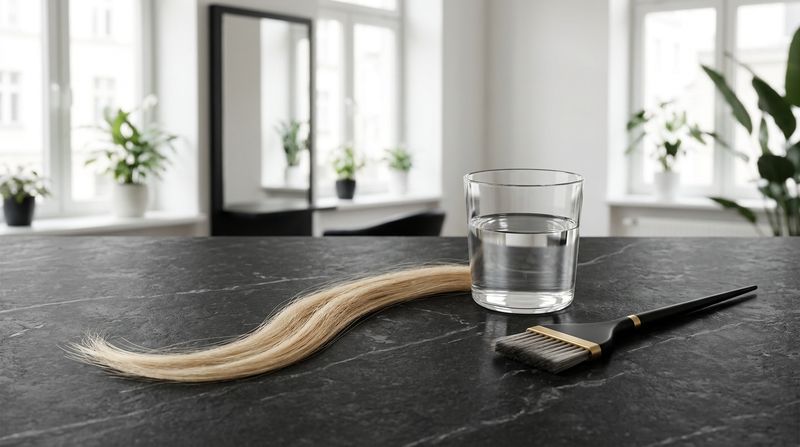
Your client walks into the salon in September. You know her well — level 7, history in your phone, the formula that worked perfectly in March. You mix what has never let you down.
And the result is not the same.
It is not that you made a mistake. It is that the hair in front of you is not the same hair as March. Summer changed it, and you cannot see that just by looking.
Quick summary: Sun and chlorine alter the cuticle differently from bleaching — the damage is external, gradual, and uneven by zone. A level 7 in September can absorb and release pigment very differently from the same level 7 in March. Before coloring after summer, read how the hair actually arrives: wet a strand by zone, and do not rely only on the visual level when dry.
Why Sun and Chlorine Damage Differently Than Bleaching
Sun damage and bleach damage are structurally different. Bleaching works from inside the fiber, in a controlled and relatively uniform way because you decide the concentration and the timing. Sun and chlorine work from the outside, cumulatively, and the result depends on how long the hair has been exposed and in what position.
UV radiation does something similar to what happens when you leave a piece of fabric in the sun for months: it eats the color from the outside and opens the outer layer of the hair. Technically it degrades the cuticle lipids and oxidizes the melanin. In practice, the surface of the fiber loses its natural seal and the cuticle starts to lift. This process is gradual and silent — no visible chemical reaction, no smell, no immediate signal.
Pool water adds another mechanism. Chlorine dries the hair and helps the cuticle open further. But there is an important detail many colorists miss: the greenish tone that appears on platinum blondes after summer is not produced by chlorine directly. It is produced by oxidized copper dissolved in pool water. When the cuticle is open, those metallic particles deposit inside the porous fiber. Chlorine enables the deposit by opening the cuticle, but copper is responsible for the green tone, not chlorine. This has direct consequences before coloring: if there is metallic deposit, you need a chelating treatment before any oxidative process.
Seawater dries the hair, saturates the fiber with salt, and can create a kind of rigid film on the surface. It does not open the cuticle the same way chlorine does, but it weakens the fiber and makes it break more easily.
The key difference from bleaching is this: summer damage is superficial in origin, cumulative, and uneven by zone. Hair that has been in direct sun for three months is damaged mainly at the crown and on exposed lengths. The nape and inner layers, protected by the volume of the hair itself or by a hat, can be completely intact.
We go deeper into this in the article on hair porosity and coloring, which covers the three porosity levels and their general adjustments. Here we focus on what that article does not cover: the specific behavior of summer damage.
How to Read Summer Damage on a Wet Strand
Wet a strand from the crown or the exposed lengths. Now wet another from the nape.
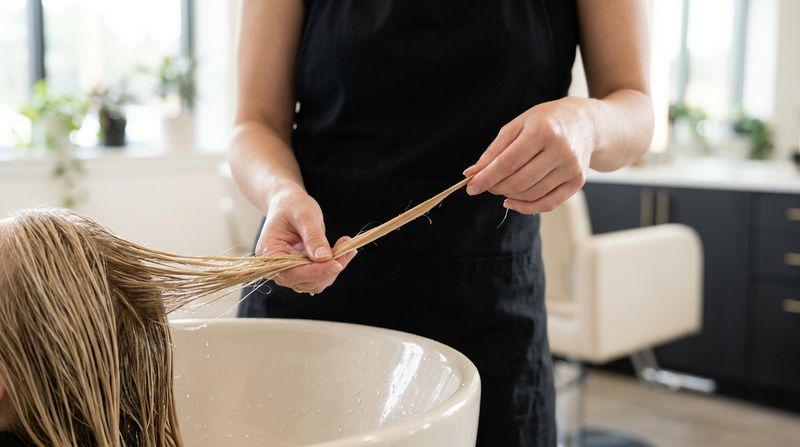
The clearest signal of summer damage is not in dry hair — it is in wet hair. Hair heavily damaged by sun drinks water all at once, almost like a sponge. You feel it between your fingers: it goes soft, almost gummy, with a texture that does not yield evenly but flattens in an irregular way.
Do the tactile test on wet hair: slide the wet strand between your thumb and index finger from root to tip. On healthy hair, the fiber slides with gentle resistance. On hair with summer damage, you will feel zones where it flattens or catches irregularly, especially from mid-length downward. That irregularity tells you the cuticle is not the same along the whole length.
Add the elasticity test: gently stretch a wet strand. Healthy hair holds the stretch and bounces back. Hair with accumulated damage gives too easily or, in more severe cases, breaks without much effort.
These two signals — uneven gummy texture and reduced elasticity at the ends — are the most reliable way to read summer without a microscope.
One detail that prevents surprises: summer damage is not uniform even within the same head. If your client wears her hair up at the beach, the nape and inner layers may be perfectly fine. If she has a side part, the crown area with the most direct exposure will be more affected than the opposite side. If she wears a hat, the lengths may be more damaged than the roots from friction. When you assess, check at least three zones: crown, lengths at the most exposed area, and nape or inner layer.
Why the Same Level Misleads You in September
Picture two situations. You have a level 7 in March: hair colored two months ago, cuticle relatively closed, no recent chemical processes. And you have that same level 7 in September: three months of direct sun, days in the pool, cuticle open in the exposed zones. At a glance, both are a 7. The visual level reading does not change because the level refers to how dark or light the color is, and the sun may even have lightened it slightly, which could lead you to think the formula needs to be more intense.
The problem is not the level — it is the behavior of the cuticle.
With a closed cuticle, the developer needs time to open the fiber and deposit the pigment. Color enters in an orderly way. With a cuticle opened by summer, pigment enters very fast, saturates sooner than expected, and then fades earlier than it should. Longevity suffers. The immediate result may even look more vibrant, but two weeks later it is noticeably more faded than it was in March.
The level tells you nothing about this. That is why the September reading cannot be only visual — it needs the wet strand test.
How to Adjust the Formula by Damage Zone
The most effective adjustment for summer damage is not a global formula change — it is an adjustment by zone. The crown and exposed lengths behave differently from the nape and inner layer, and treating them the same produces uneven results.
| Zone | Typical condition after summer | Suggested developer | Timing | Notes |
|---|---|---|---|---|
| Crown and exposed lengths | High porosity, open cuticle | 10 vol | Reduced. Watch how the color saturates: when the tone is there, that is the moment to remove | Protein filler beforehand only if the gummy texture is very pronounced |
| Mid-lengths (moderate exposure) | Medium-high porosity depending on summer | 20 vol | Standard with monitoring | Apply this zone after the ends |
| Nape and inner layer | Generally intact | 20 vol per history | Standard | Usual formula |
| New root (no sun damage) | Normal | Per lifting or coverage need | Standard | New growth has not seen the sun |
These are starting ratios, not a universal recipe. The precise calculation for each client — real porosity by zone, process history, starting base — is what Blendsor resolves in seconds from the diagnosis you do at the basin.
The signal to remove in porous zones is not the clock — it is your eye. Porous hair saturates visibly faster than healthy hair. When you see the tone is there — when the color has reached where you wanted it — that zone is done. Waiting because “there are still 30 minutes left” on a length with summer damage will leave you with an overprocessed result.
On protein fillers: use them only where you genuinely need them, not preventively across the whole length. In zones with pronounced gummy texture and very compromised elasticity, a filler beforehand helps the fiber receive pigment more evenly. If the lengths are reasonably sound and only the crown is more damaged, reserve the filler for that zone.
The topic of neutral base deserves a practical note: on porous hair, the reflect fades faster than on healthy hair. A neutral base in the formula masks that early fading better because the result stays cleaner as the color starts to give way. It is not a structural solution to the damage, but it helps the result age better.
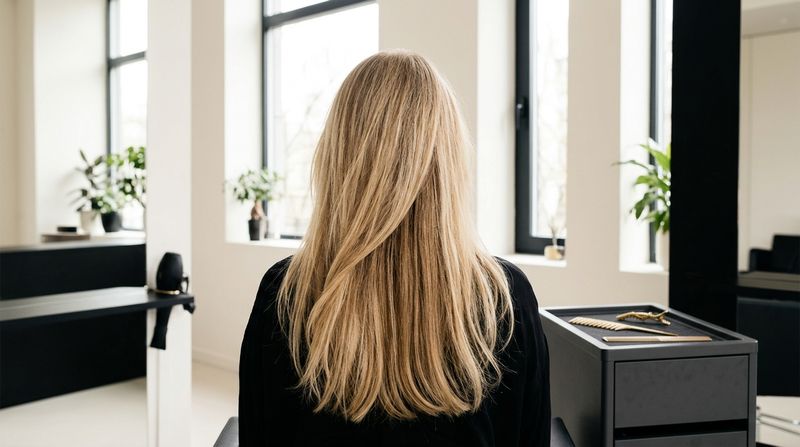
UVB radiation acts mainly on the cuticle: it penetrates poorly, so its morphological damage stays concentrated there. And moisture accelerates the photochemical lightening summer leaves behind (Lee, International Journal of Trichology, 2009). In salon practice, this translates to September being the month with the highest variability when reading hair.
Adjusting by zone is not an added complication — it is what separates a predictable result from an unpleasant surprise.
Two Real September Scenarios
Scenario A. A client with dark brown hair (level 5–6) has been getting balayage for three summers. In March it always works the same: highlights in strategic zones, the usual formula, clean result. In September, the colorist applies the same formula. The balayage turns orange in some zones and more muted than expected in others. The issue: the existing highlights at the crown have accumulated three summers of UV exposure. The cuticle in those zones is much more open than in the nape highlights. The formula that works at the nape does not work the same at the crown. The solution for the next visit: assess the existing highlights by zone before applying, and reduce developer and timing only on the most exposed ones.
Scenario B. A platinum blonde client arrives in August with a light greenish tone in her hair, especially at the ends. She has spent the summer in the pool. The colorist correctly identifies it as copper deposit, not chlorine. She applies a chelating treatment before coloring. Had she formulated directly without the chelating step, the oxidative process could have intensified the greenish tone instead of neutralizing it. The prior reading — wet strand, ends zone, origin of the tone — was what changed the protocol.
Both scenarios share one thing: the correct formula from March was not the correct formula for September. Reading the hair by zone was what made the adjustment possible.
You can go deeper into how the type of developer you choose affects behavior on porous hair in the article on cream vs liquid developer.
Frequently Asked Questions
Does summer damage go away if the client uses masks at home?
Moisturizing and protein masks improve the texture of the fiber’s exterior and can temporarily close the cuticle. But accumulated damage to the internal structure does not disappear with hydration — what you feel at the touch improves, but the behavior against developers does not change in any meaningful way. The September reading is still necessary even if your client has taken very good care of her hair over the summer.
How do I know if the greenish tone on a blonde client comes from copper in the pool?
Copper tone tends to concentrate in the most porous zones — ends and mid-lengths — and has a dull greenish cast, not bright. If the client confirms she has been in pools regularly, metallic deposit is very likely. A simple test: cut a test strand, take it off the head and place it in a bowl in a ventilated area before applying a few drops of hydrogen peroxide. It is positive if the mix heats up, bubbles, smokes or gives off an odour — which is exactly why it is done on a cut strand and not on the client. Use 20 volume peroxide and watch the strand for about 30 minutes. A positive means active metallic deposit. A strand with no visible reaction is not an absolute guarantee either: some metals give no signal and still block or skew the lift, so test your real mix on that same strand before you touch the head. If it is positive, use a chelating treatment before any oxidative process. Cosmetic chemistry documents the interaction between heavy metals and oxidative processes on processed hair as one of the highest-risk factors in coloring.
Can I do a lightening process on hair that is heavily damaged by the sun?
It depends on the degree of damage. If the elasticity test shows the hair gives way and breaks easily, lightening is contraindicated until the structure is stabilized. If elasticity holds but porosity is high, you can consider it with low developer and a reinforcement protocol beforehand — chelating treatment, protein, reduced timing — assessing the response zone by zone. On severely damaged hair, it is better to propose several treatment sessions first and lighten once the fiber has more integrity. The safety of the fiber is non-negotiable.
Summary
- Sun and chlorine damage the cuticle from the outside and unevenly by zone: crown and exposed lengths always take more damage than nape and inner layers.
- The greenish tone on pool blondes is copper deposit, not direct chlorine. It requires chelating treatment before any oxidative process.
- A level 7 in September behaves differently from a level 7 in March: the visual level does not change, but the cuticle behavior does. Reading the wet strand — uneven gummy texture, elasticity at the ends — is what reveals the real condition.
- The most effective formula adjustment is by zone: reduced developer and visual monitoring at the crown and exposed lengths; standard formula at the nape and protected inner layer.
Want to generate professional formulas that adjust developer and timing based on the real condition of each zone? Blendsor calculates for each client taking into account process history, zone porosity, and starting base.
How do you handle the back-to-salon season in your practice? Do you follow a fixed protocol or adapt it case by case?
What happens if you color hair without reading sun and chlorine damage?
In the app, we ask you a question like this one, but about your own client.
Up for this week’s case? → More on global color →Related articles
Practice with our colorimetry tools
Calculators, neutralization wheel, AI consultation...
The Blendsor newsletter
Color techniques and trends for professionals. No spam.
A client in the chair right now?
The Blendsor advisor gives you the precise formula for this technique with your salon's brands — and saves it to your client's card.
Ask about your caseWritten by the Blendsor team
Professional hair colorimetry experts with experience in AI-assisted formulation. We combine color science, salon practice and technology to help colorists formulate with precision.