Foiled Cashmere: The Full Foil Technique Reviving 90s Blonde
What foiled cashmere is, why full foils are back in 2026, and how to formulate them. Step-by-step technique, formulas, and balayage comparison.
Blendsor
Blendsor Team
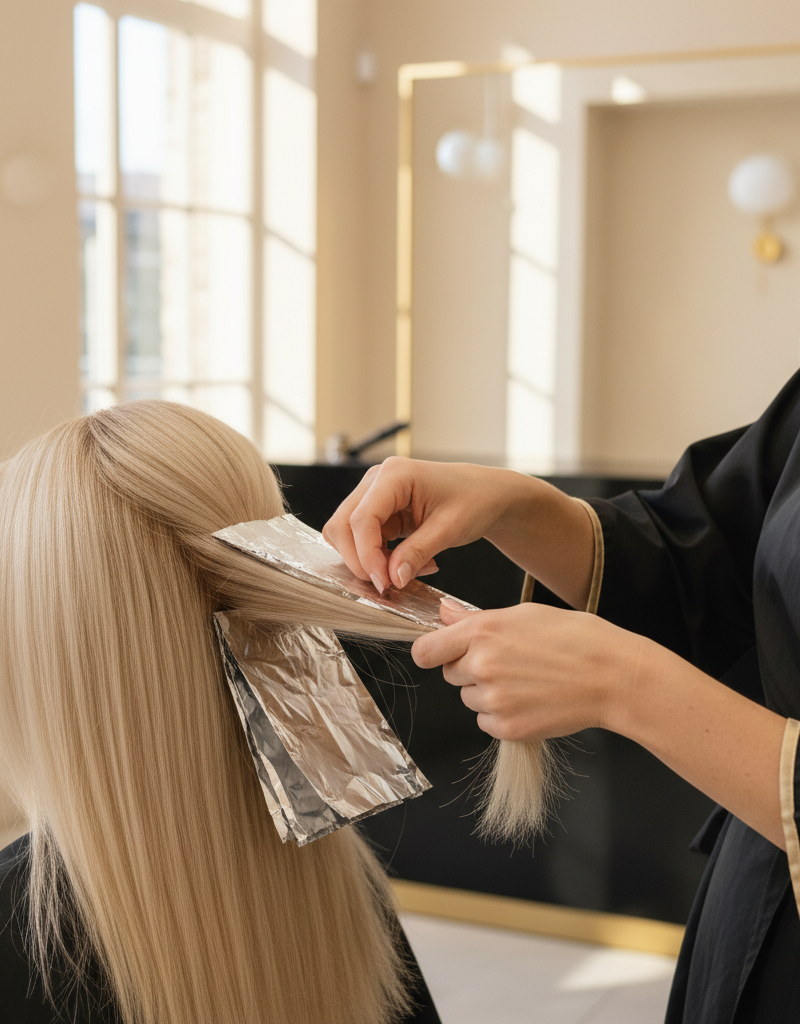
Does your client show up with a photo of a uniform, luminous blonde with no visible roots or chunky highlights, and you suggest a balayage?
If you’re a professional colorist, you know that moment. The client wants a clean blonde from root to tip — no gradients, no variation. The technique you need isn’t balayage: it’s a full foil. More specifically, what 2026 calls foiled cashmere.
According to Behind The Chair, foiled cashmere is the biggest luxury blonde trend of 2026. It’s not a new shade — it’s the comeback of 90s foiling technique, but with modern formulation and chemistry. This article is part of our hair color trends guide.
Quick summary: Foiled cashmere is a full foil technique using 0.5 cm subsections and a 4×4 placement pattern to produce uniform, creamy blonde at level 9+. The defining toner uses a .31 (gold-ash) reflect with 10 vol developer. The finishing gloss accounts for 30-40% of the final shine. Retouching is needed every 6-8 weeks, but it uses 40% less product than equivalent balayage.
What is foiled cashmere and why full foils are back?
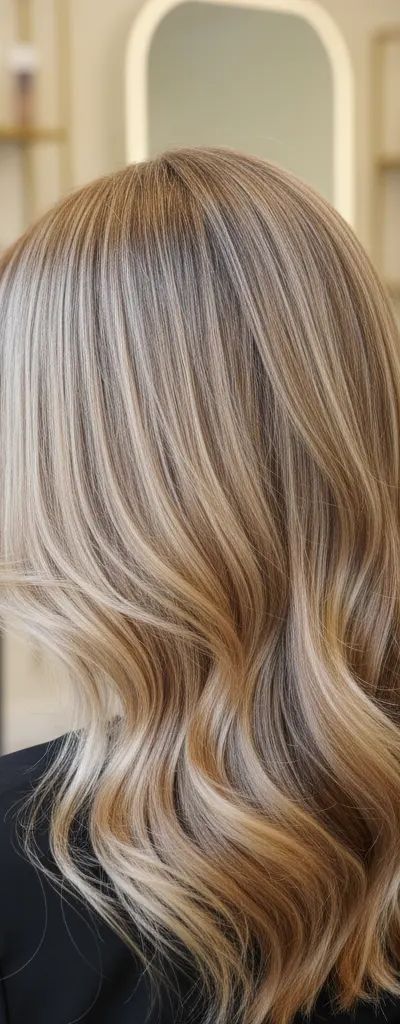
Foiled cashmere is a full foil technique using fine 0.5 cm subsections and a 4×4 placement pattern that produces a uniform, high-shine blonde at level 9+. It is the dominant 2026 luxury blonde trend because clients are moving away from balayage toward cleaner, more “salon-polished” results. The critical difference from 90s full foils is the use of bond-builder lighteners and a mandatory finishing gloss.
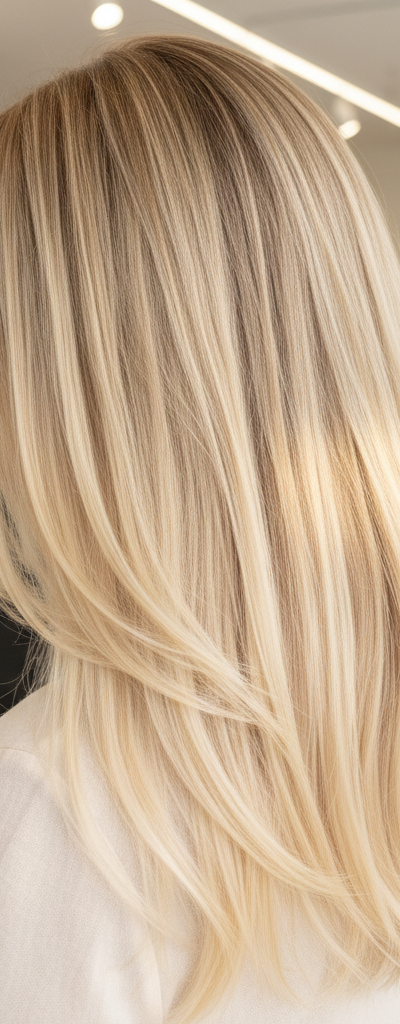
Foiled cashmere is a full foil technique that produces a uniform, creamy, high-shine blonde inspired by 90s blonding. The aesthetic reference is Carolyn Bessette-Kennedy: polished, no visible root, no contrast. Pure elegance.
Why is it back now? After nearly a decade of balayage as the dominant technique, clients are asking for something different. They want cleaner, more uniform, more “salon-perfect” blondes. Full foils deliver exactly that.
The difference from the classic 90s full foil is the formulation. Back then, harsh toners and damaging bleaches were the norm. Today we work with bond-builder-infused lighteners, gentler developers, and finishing glosses that seal the cuticle.
Foiled cashmere vs cashmere blonde: they’re not the same
Cashmere blonde is a shade: creamy, neutral-warm blonde. Foiled cashmere is a technique: full foil with fine subsections and 4×4 placement that produces that shade uniformly.
You can achieve cashmere blonde with balayage, but the result will be more organic with natural variation. Foiled cashmere aims for the opposite: controlled uniformity.
| Concept | Cashmere blonde | Foiled cashmere |
|---|---|---|
| What it is | A shade (creamy neutral blonde) | A technique (4×4 full foil) |
| Result | Can have natural variation | Uniform root to tip |
| Technique | Balayage, foils, or both | Foils only (precise placement) |
| Reference | Contemporary cashmere blonde | 90s Bessette-style blonde |
| Article | Cashmere blonde | This article |
Foiled cashmere vs balayage: when should you use each?
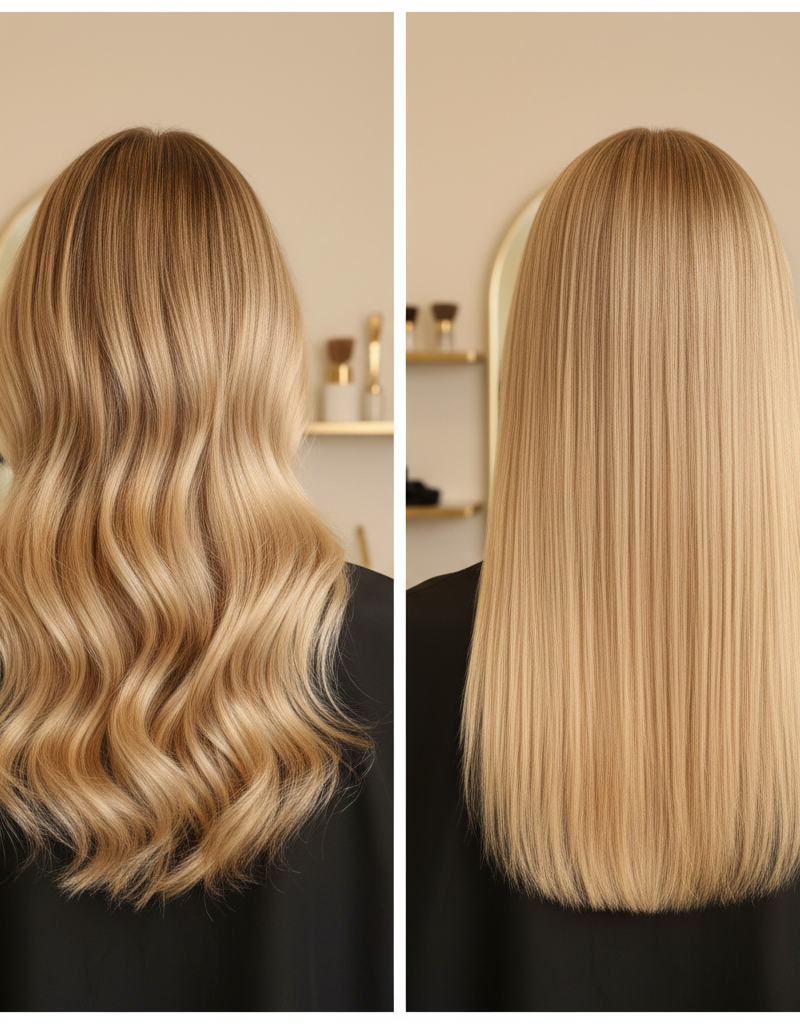
Use foiled cashmere when the client wants uniform, root-to-tip blonde without tonal variation — especially from a base of level 4-6. Choose balayage when she wants a natural, lived-in result with diffused regrowth and longer intervals between appointments (10-14 weeks vs 6-8 for full foil). Foiled cashmere uses 40% less product than balayage due to fine subsection sizing.
This is the key decision. Both are valid techniques, but they solve different problems. Confusing them is one of the most common mistakes.
| Factor | Foiled cashmere (full foil) | Balayage |
|---|---|---|
| Result | Uniform, polished blonde | Graduated, organic blonde |
| Coverage | Root to tip, 100% | Concentrated on mids and ends |
| Product | Less lightener (fine subsections = less hair) | More lightener (broad brushstrokes) |
| Uniformity | High — foil controls temperature | Variable — depends on hand technique |
| Maintenance | Every 6-8 weeks (defined regrowth) | Every 10-14 weeks (diffused regrowth) |
| Ideal for | Clients wanting clean, “salon” blonde | Clients preferring a natural effect |
| Chair time | 2-3 hours | 1.5-2.5 hours |
Pro tip: Foiled cashmere uses approximately 40% less product than an equivalent blonde balayage. Fine subsections within foils wrap less hair per section, and the heat from foils accelerates processing. This translates to lower product cost per service.
When to recommend full foil over balayage
- The client wants uniform blonde with no tonal variation
- The base level is 4-6 and needs full root-to-tip lightening
- She has a balayage history and wants a style change
- She’s after a cool or neutral blonde (foils give more temperature control)
- She wants a more polished, editorial look
When to stick with balayage
- She prefers a natural, lived-in blonde
- She doesn’t want defined regrowth every 6 weeks
- Maintenance budget is limited
- She wants a dimensional blonde with depth
How do you formulate foiled cashmere step by step?
For base level 7-9, use gentle dust-free lightener with 20 vol developer at a 1:2 ratio, maximum 25-30 minutes. For base 5-6, use clay powder with bond builder, 20 vol, 1:1.5 ratio, up to 35-40 minutes. For base 3-4, two sessions are required using violet powder at 30 vol, 1:1.5. The cashmere toner uses .31 reflect with 10 vol developer for 15-20 minutes on pre-lifted level 9 hair.
Pre-service assessment
Before opening a single foil, you need three data points:
- Actual natural level: Not what it looks like — what you measure. Foiled cashmere needs to reach level 9 minimum
- Color history: Previous lightening, permanent dyes, henna. Everything affects the result
- Porosity: Porous hair absorbs toner unevenly — and uniformity is the whole point of this technique
Lightening formulas by base level
| Base level | Lightener | Developer | Ratio | Max time | Sessions |
|---|---|---|---|---|---|
| 7-9 (blonde) | Dust-free gentle powder | 20 vol. | 1:2 | 25-30 min | 1 |
| 5-6 (light brown) | Clay powder with bond builder | 20 vol. | 1:1.5 | 35-40 min | 1 |
| 3-4 (medium brown) | Violet powder with bond builder | 30 vol. | 1:1.5 | 40-45 min | 2 |
The 4×4 placement technique
The 4×4 placement is what separates foiled cashmere from a generic full foil:
- Divide into 4 quadrants: 2 front (ear to part), 2 back (ear to nape)
- 0.5 cm subsections: Finer than classic highlights. This creates uniformity
- 4×4 pattern: Place 4 consecutive foils with lightener, then leave 4 subsections without. Repeat
- Full saturation within the foil: Unlike balayage, you cover all the hair inside each foil, root to tip
- Fold loosely: The foil needs space for heat to circulate
Pro tip: The 4×4 pattern creates lightening that appears uniform but has micro-variations between foiled and unfoiled subsections. That’s what prevents the “wig effect” of old-school full foils.
Cashmere toning formulas
The toner is where the result is defined. The key is the .31 reflect (gold-ash): creamy, neither cool nor warm.
| Result | Toner formula | Developer | Time |
|---|---|---|---|
| Classic cashmere (neutral creamy) | 9.0 + 9.31 (60/40) | 10 vol. | 15-20 min |
| Cool cashmere (90s Bessette) | 9.1 + 9.31 (40/60) | 10 vol. | 15-20 min |
| Sand cashmere | 9.0 + 9.3 + 9.1 (50/30/20) | 10 vol. | 15-20 min |
| Pearl cashmere | 9.0 + 10.21 + 9.31 (40/30/30) | 10 vol. | 10-15 min |
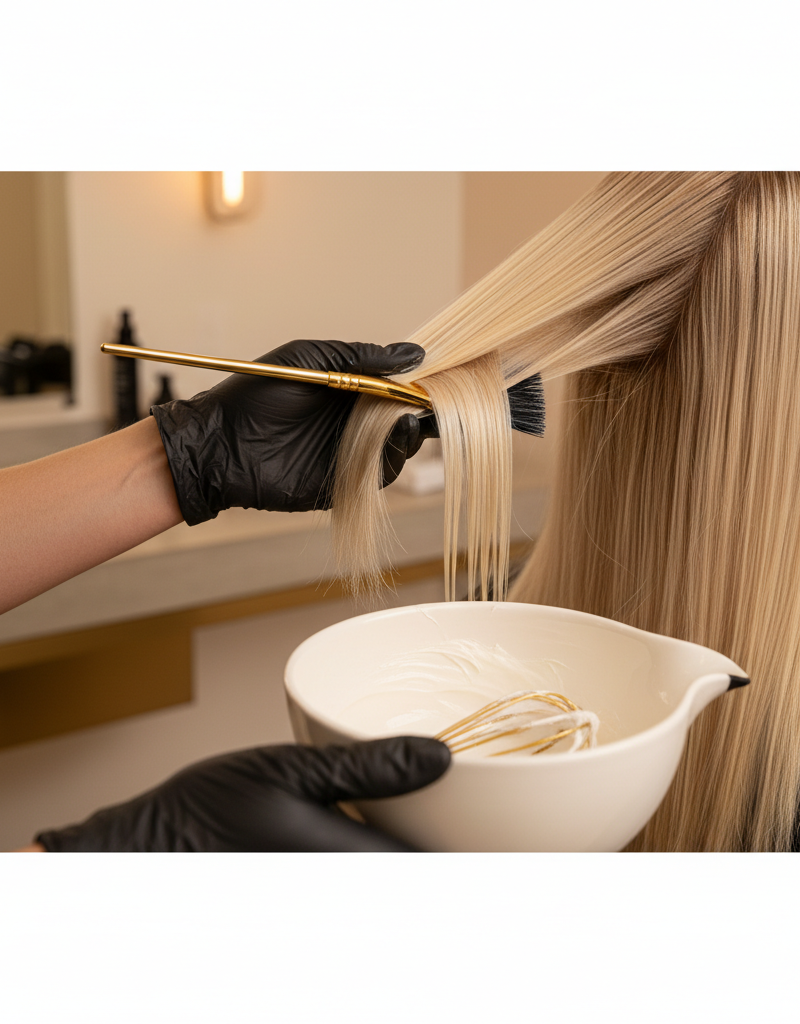
For the authentic 90s Bessette look, the cool cashmere formula is the most accurate: .31 dominates with .1 support to cool slightly without losing creaminess.
Finishing gloss
The gloss seals the cuticle and delivers the silky shine that defines cashmere. It’s not optional.
- Clear gloss or with a touch of .31 (gold-ash)
- 10 volume developer
- Apply on damp hair, 5-10 minutes
- Rinse with cold water to seal
What mistakes ruin a modern full foil?
The five most damaging mistakes are: subsections thicker than 1 cm (destroys uniformity), using only .1 or .21 toner series instead of .31 (cool blonde instead of cashmere), skipping the finishing gloss (losing 30-40% of final shine), opening front and nape foils at the same time (creates level discrepancy), and painting freehand inside foils instead of full saturation root to tip.
-
Subsections too thick: If subsections exceed 1 cm, you lose uniformity. Foiled cashmere needs 0.5 cm for even lightening. Thick sections cause uneven heat distribution and inconsistent results
-
Toner too ashy: If you use only .1 or .21 series, the result is a cool blonde, not cashmere. The .31 reflect (gold-ash) is the key. Pure ash kills the creaminess
-
Skipping the gloss: Without the gloss, the blonde looks matte and loses the cashmere signature. The gloss provides 30-40% of the final shine
-
Not staggering back foils: Nape foils process slower due to lower body temperature. If you open them at the same time as front foils, you’ll get level differences. Solution: start from the nape
-
Applying with balayage technique: Foiled cashmere is NOT freehand painting inside foils. It’s full root-to-tip coverage with complete saturation. Freehand painting inside a foil destroys uniformity
Frequently asked questions
Does full foil damage hair more than balayage?
Not necessarily. Full foil with fine subsections lightens less total hair than balayage with broad brushstrokes. Additionally, modern lighteners with bond builders protect during processing. Damage depends more on developer strength, processing time, and hair history than on the technique itself.
How much does a foiled cashmere service cost?
A complete foiled cashmere service typically ranges from $150 to $400 in the US, depending on length, base level, and number of sessions. It’s comparable to a full balayage in price, but with more foils and less product.
Can I do foiled cashmere over previous balayage?
Yes, but with caution. Previously lightened balayage areas will process faster. You need to use less saturation on the ends (already light) and concentrate the lightener on roots and mids. The cashmere toner will unify everything at the end.
How often does foiled cashmere need retouching?
Every 6-8 weeks for roots. Unlike balayage (which diffuses root growth naturally), full foils create a more defined line of demarcation as hair grows. A root retouch using the same 4×4 technique maintains the result.
Key takeaways
- Foiled cashmere is the full foil technique that produces uniform, creamy blonde inspired by 90s blonding
- The difference from balayage is uniformity vs natural variation. Each has its place
- The technical key is 4×4 placement with 0.5 cm subsections and toner with .31 reflect
- Uses less product than equivalent balayage, with more controlled results
- The gloss is non-negotiable: it provides 30-40% of the final shine that defines cashmere
Calculate professional formulas with AI
Want to generate personalized formulas for full foil and cashmere toning based on each client’s starting level? Use the developer mix calculator to get exact lightener-to-developer ratios for every starting point.
Try Blendsor free — 5 formulas per month, no credit card required.
Related articles
Practice with our free tools
Calculators, neutralization wheel, AI consultation...
The Monday Briefing
Color techniques and trends for professionals. No spam.
Master this technique with exact formulas
Blendsor generates the precise formula for each technique with your brand products. Try the mix calculator or download the app.
Download freeWritten by the Blendsor team
Professional hair colorimetry experts with experience in AI-assisted formulation. We combine color science, salon practice and technology to help colorists formulate with precision.