Mixing Hair Dyes: Professional Ratios and Rules
Learn the correct ratios for mixing hair dyes: when to use 1:1, 1:1.5 or 1:2 with developer, and how to combine shades without mistakes.
Blendsor
Blendsor Team
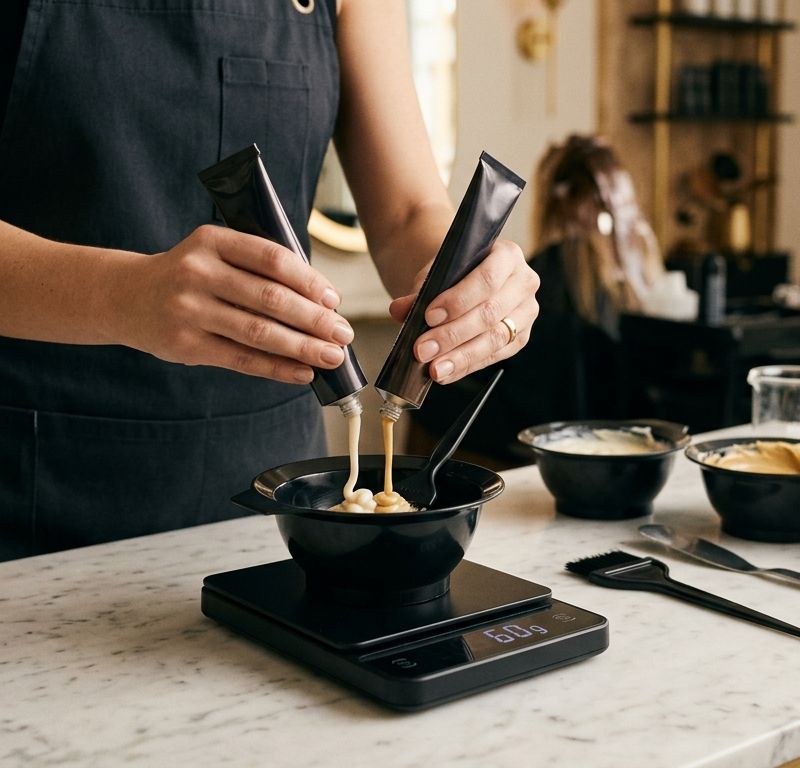
How many times have you mixed dye and developer by eye, only to get a result that wasn’t what you expected?
If you’ve been behind the chair for a while, you know exactly what I mean. That frustration when the consistency is too thin, the color doesn’t penetrate the way it should, or blending two shades gives you something completely unexpected.
The good news: ratios follow clear logic. Once you understand it, formulating with precision becomes a controlled process, not a guessing game.
Quick summary: The standard ratio for mixing hair dyes with developer is 1:1 (dye:developer). The 1:1.5 ratio is used for dense coverage on resistant hair, and 1:2 for highlights and foil-based lightening techniques. Combining two shades requires maintaining those same ratios on the total dye weight. Using incorrect ratios alters the pH, processing time and final result.
What does the dye-to-developer ratio actually mean?
The dye-to-developer ratio tells you how many grams of dye to mix with how many grams of developer. This ratio determines the final pH, application viscosity, and oxidation efficiency. Too much developer dilutes the pigments and reduces color intensity; too little leaves the oxidation process incomplete and coverage uneven.
The dye-to-developer ratio tells you how many grams of hair dye to mix with how many grams of developer. This isn’t an arbitrary recommendation: the ratio determines the final pH of the mixture, application viscosity and the efficiency of the oxidation process.
According to the Society of Cosmetic Chemists, the oxidation reaction in permanent hair color depends directly on the balance between color precursors (in the dye) and hydrogen peroxide (in the developer). Disrupting that balance changes the chemical outcome, not just the texture.
In practical terms: too much developer dilutes the pigments and reduces color intensity. Too little developer leaves the mix thick, coverage becomes uneven and the oxidation process may be incomplete.
When Should You Use Each Ratio?
The 1:1 ratio is the standard for full-head coloring on healthy hair. The 1:1.5 ratio suits resistant greys or low-porosity hair where deeper penetration is needed. The 1:2 ratio is reserved for foil techniques — balayage, foilyage, babylights — where a more fluid mix supports the lightening process inside the foil.
The three ratios you’ll find across most professional brands each have specific applications. This table covers the most common situations:
| Ratio | Main use | Example |
|---|---|---|
| 1:1 | Standard coloring on healthy hair | Shade change, moderate grey coverage |
| 1:1.5 | Dense coverage, resistant hair | Stubborn greys, fine or low-porosity hair |
| 1:2 | Highlights and foil/paper techniques | Balayage, foilyage, babylights |
The 1:1 ratio is the most common for full-head coloring. It produces a mixture with good flow, easy to apply with a brush and with even pigment distribution.
The 1:1.5 ratio uses more developer relative to dye. This is useful when hair has strong natural resistance (thick stubborn greys, very dense hair structure) or when you want a slightly thinner consistency for complete saturation.
The 1:2 ratio produces a more liquid mix, designed for highlighting techniques where the color or bleach is applied in sections wrapped in foil or paper. The higher developer percentage supports the lightening process inside the foil.
Pro tip: Always check the technical data sheet for your specific brand. Professional lines like Schwarzkopf Professional or Wella Professionals have product-specific instructions that may differ from these standard ratios.
How to Mix Two Hair Color Shades Together?
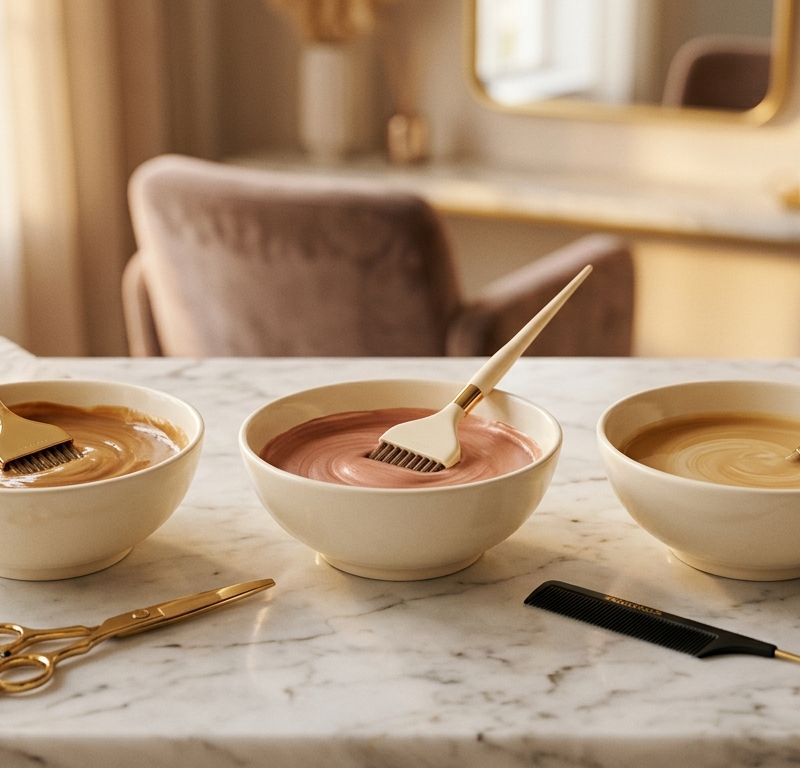
When blending two shades, add both dye weights together and calculate the developer on that combined total. Example: 30 g of shade A + 30 g of shade B = 60 g total dye, so at 1:1 you need 60 g of developer. Always blend the two shades in the bowl first, then add the developer — never the other way around.
This is where many colorists make mistakes. When you combine two different shades in the same application, the total dye-to-developer ratio must still be correct.
The most common error: mixing 30 g of shade A + 30 g of shade B, then measuring the developer only against one of the two shades and eyeballing the rest. The math is right in theory but the execution is off.
Follow this process:
- Decide the final result: how many grams of total mixture do you need?
- Establish the correct ratio (1:1, 1:1.5 or 1:2)
- Calculate the total dye weight (sum of all shades) and the corresponding developer amount
- Mix the shades together first, then add the developer
Practical example: two-shade blend
Imagine a client who wants a warm blonde with depth. You decide to use 50% shade 8.3 + 50% shade 7.3 with 20 vol developer at a 1:1 ratio.
- Total dye: 60 g (30 g of 8.3 + 30 g of 7.3)
- Developer needed: 60 g (1:1 ratio)
- Total mixture: 120 g
You blend the two shades in the bowl first, integrate them well, then add the 60 g of developer. Never the other way around.
What happens when you mix shades at different percentages?
The same rule applies, but you need to think through the resulting tone before formulating. If you mix 60% of a darker shade with 40% of a lighter shade, the result will lean toward the darker tone but carry undertones from the second.
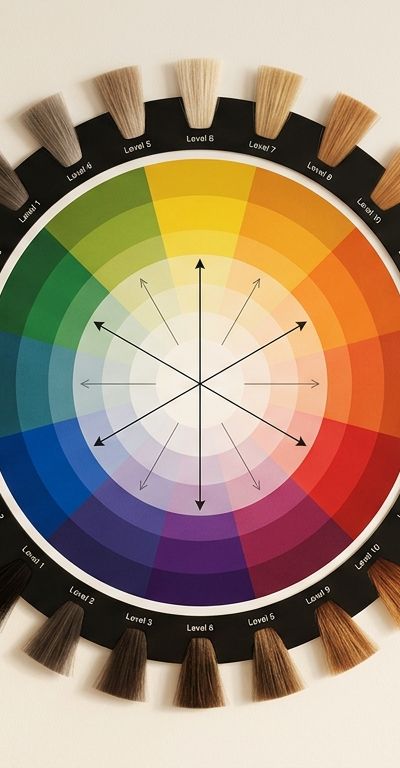
This logic matters especially when blending shades with complementary reflects: understanding the color wheel in hair colorimetry helps you predict which reflect will dominate in the final mix.
How Does the Ratio Affect Processing Time?
Too much developer speeds up the process and raises the risk of over-processing; too little slows it down and can leave oxidation incomplete. Ambient temperatures above 25°C accelerate processing regardless of ratio. The mixture should be applied within 5-10 minutes of preparation to avoid premature oxidation.
This point gets underestimated. An incorrect ratio doesn’t just affect the visual result — it also changes the actual processing time.
| Situation | Effect on processing |
|---|---|
| More developer than indicated | Faster process, risk of over-processing |
| Less developer than indicated | Slower process, incomplete oxidation |
| Mix prepared too far in advance | Developer activates before reaching the hair |
| High ambient temperature (>25°C) | Speeds up the process; reduce waiting time |
In the salon, this variable matters especially in summer or in warm treatment rooms. If your cabin is at 28°C, the mixture will process faster than what’s stated in the technical guide.
Pro tip: Always prepare the mix right before application. The maximum window between mixing and application for most permanent dyes is 5-10 minutes.
What Are the Most Common Mistakes When Mixing Hair Dye?
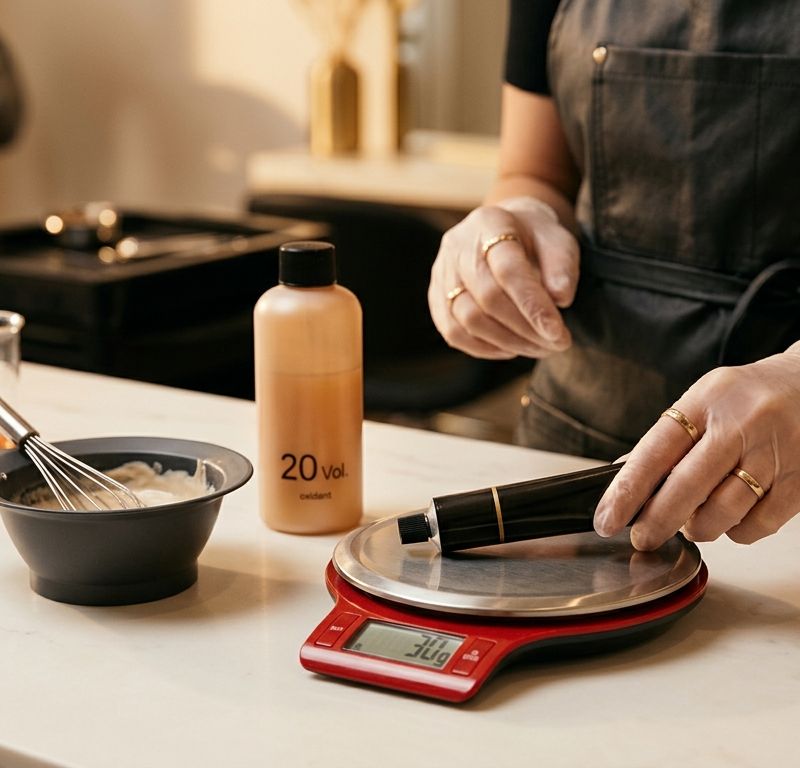
The five most frequent errors are: measuring by volume instead of grams (dye and developer have different densities), adding developer before the dye, over-mixing the bowl (accelerates premature oxidation), reducing developer to stretch the product, and not reading the technical data sheet for each product line, which may specify ratios different from the brand standard.
These are the errors that come up most frequently among professional colorists:
- Measuring by volume instead of weight: Professional brands formulate their ratios in grams. Measuring in milliliters introduces errors because the density of dye and developer differ. Always use a scale.
- Ignoring mixing order: Always dye first, developer second. Never the other way. The developer acts on the dye; reversing the order can cause uneven oxidation.
- Over-mixing: Once dye and developer are fully integrated (30-40 seconds of even blending is enough), continuing to mix adds nothing. It only exposes the mixture to more air and accelerates premature oxidation.
- Changing the ratio to stretch product: Reducing developer to make the mix go further alters the result. If you need more product, prepare a second batch with the correct ratios.
- Not reading the data sheet for each product line: The recommended ratio can vary between lines within the same brand. An intensive color line may require 1:1.5 where the standard line calls for 1:1.
For more context on these errors, the article on common hair color formulation mistakes walks through each one with specific solutions.
What Ratios Should You Use for Specific Techniques?
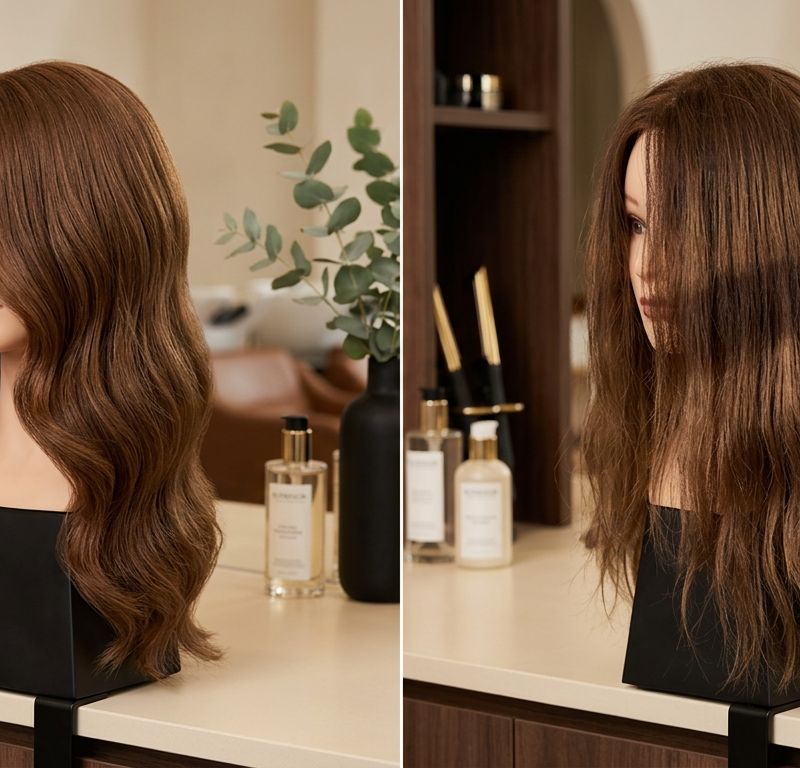
For full grey coverage on resistant hair: 1:1.5. For free-hand balayage requiring dense paste: 1:1.5; for foilyage needing a more fluid mix: 1:2. For toners and ammonia-free color with 5 or 10 vol developer: 1:1.5 or 1:2, since no cuticle opening is required and the diluted mix deposits pigment efficiently.
100% grey coverage
For complete grey coverage, especially on resistant hair, the 1:1.5 ratio often delivers better results than standard 1:1. The technical reason: the higher developer percentage supports penetration into denser hair structures, which is typical of thick grey hair.
This pairs with the right developer volume choice. If you need to go deeper on when to use 20 vs 30 volume for grey coverage, the article on professional developer volumes covers that in full detail.
Lightening and bleaching techniques
In bleaching, the ratio isn’t measured the same way as in color: each bleach brand specifies its own powder-to-developer relationship, typically between 1:1.5 and 1:2 depending on the consistency needed. Free-hand balayage techniques generally require a denser paste (1:1.5) to prevent dripping, while foilyage can tolerate a more fluid mix (1:2).
Toners and ammonia-free color
Toners and semi-permanent or ammonia-free dyes typically work with low-concentration developers (5 or 10 vol) and ratios of 1:1.5 or 1:2. Since they don’t require cuticle opening, the more diluted mixture is sufficient to deposit pigment on the hair surface.
If your work includes neutralizing unwanted tones with toners, check the article on neutralizing unwanted hair tones for guidance on pairing the right shade with the right ratio.
Frequently asked questions
Can you mix hair dyes from different brands?
It’s not recommended. Each brand’s color system is formulated with its own pigment bases and chemical composition. Mixing dyes from different brands can produce unpredictable tone results and potential reactions between components. It may be possible in specific cases, but requires deep knowledge of both brands’ formulations. This topic is covered in detail in the article on switching professional hair color brands.
What if the mixture is too runny?
If the mix has poor viscosity, you’ve likely added more developer than needed or used a low-density developer. A mixture that’s too thin flows off the hair before processing and produces uneven results. Don’t try to fix it by adding more dye — prepare a fresh batch with the correct ratios.
Do ratios change depending on developer volume?
The dye-to-developer ratio doesn’t change based on volume, but volume does determine the degree of lift and processing speed. 30 volume at a 1:1 ratio produces more lift than 20 volume at the same ratio, but the relationship between dye and developer is identical. What changes is the peroxide concentration, not the mixing ratio.
Can I save leftover mixture for another client?
No. Once dye and developer are combined, the oxidation reaction starts immediately. The useful life of a prepared mixture is between 20 and 45 minutes depending on the brand and developer volume. After that, the pigments are oxidized and results become unpredictable. Always prepare only the amount needed for each service.
How do I calculate how many grams I need for a full application?
A general guideline for medium-to-long hair: 100-120 g of total mixture for a full-head color. For short hair, 60-80 g is usually enough. For long, dense hair you may need up to 160 g. Divide that total weight into dye and developer according to your chosen ratio. With time and practice, you’ll learn the exact quantities for each client type.
Summary
- The standard ratio for full-head coloring is 1:1 (dye:developer by weight)
- Use 1:1.5 for resistant grey coverage or low-porosity hair
- Use 1:2 for highlights and foil-based lightening techniques
- When blending two shades, developer is calculated on the total dye weight, not on each shade individually
- Always measure in grams with a scale, never by volume
- Prepare the mixture right before application: maximum window is 5-10 minutes
Use the hair dye amount calculator to calculate the exact grams you need per service before mixing. Blendsor helps you record and calculate every formula with exact ratios, so you never have to rely on memory or guesswork. See how Blendsor works.
What type of service do you find it hardest to keep ratios precise for?
Related articles
Practice with our free tools
Calculators, neutralization wheel, AI consultation...
The Monday Briefing
Color techniques and trends for professionals. No spam.
Apply this theory with precision
Blendsor analyzes 70+ variables and generates exact formulas based on real colorimetry. Try our free color consultation or download the app.
Download freeWritten by the Blendsor team
Professional hair colorimetry experts with experience in AI-assisted formulation. We combine color science, salon practice and technology to help colorists formulate with precision.