Toner for Blonde Hair: Professional Guide
The complete professional guide to toner for blonde hair: types, developer volumes, application technique, and formulas by underlying pigment level.
Blendsor
Blendsor Team
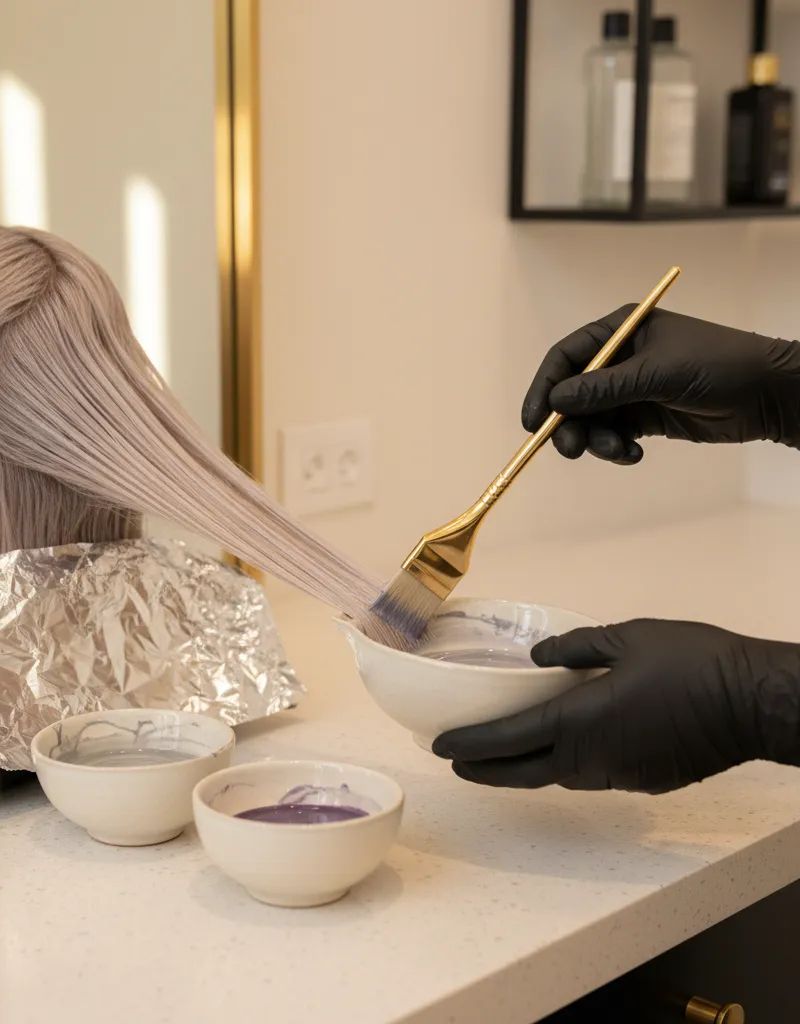
How many times have you applied a toner on blonde hair and the result came out nothing like what you planned?
Too dark. Too grey. A hint of pink you didn’t ask for. Every colorist knows that moment at the shampoo bowl. And the frustrating part: the formula looked right on paper.
Toner for blonde hair is one of the most searched topics in professional colorimetry — and one of the most misunderstood. The difference between an unpredictable result and a controlled one doesn’t come down to the brand. It comes down to understanding the fundamentals: the right toner type, the right developer volume, and the correct underlying pigment at the time of application.
This guide covers everything. For the full color theory behind why toning works, start with our colorimetry basics guide for professional colorists.
What does a hair toner actually do?
Hair toner is a deposit-based coloring product designed to neutralize unwanted warm tones and add or refine a specific shade — without a significant level change.
Toning serves three main functions:
- Neutralize underlying pigment: Cancel brassiness (orange, yellow, red) after bleaching
- Add a specific reflect: Deposit ash, violet, or golden tones
- Even out the result: Balance zones with different degrees of lift
According to the Society of Cosmetic Chemists, deposit-color products act primarily on the outer cuticle layer. This explains both their gentleness on the hair fiber and their shorter lifespan compared to permanent color.
Types of hair toner
Choosing the right toner type matters as much as choosing the right shade.
Demi-permanent (low-oxidative)
The professional standard for most toning services.
- How it works: Activated with 5-10 vol developer. Partially penetrates the cuticle layer.
- Duration: 4-6 weeks with regular washing
- When to use: Post-bleach toning, color adjustment, correcting unwanted warm tones on blonde hair
- Common lines: Wella Color Touch, Redken Shades EQ, Igora Vibrance, L’Oréal Dia Light
Gloss (no or very low developer)
Also called glossing or pigmented shine treatment.
- How it works: Deposits color only on the surface of the cuticle. No developer or 5 vol maximum.
- Duration: 2-4 weeks, fades gradually
- When to use: Color maintenance, highly sensitized hair, subtle results, in-between appointments
- Key advantage: Adds exceptional shine, minimal impact on the fiber
Direct pigment
Direct dyes with no developer — pastels, neons, grays.
- How it works: Adheres to the outside of the cuticle with no oxidative chemistry
- Duration: 1-3 weeks, washes out progressively
- When to use: Fashion shades, temporary color, highlighted sections
- Critical limitation: Requires a very pale base (level 9-10) to show correctly
| Type | Developer | Duration | Penetration |
|---|---|---|---|
| Demi-permanent | 5-10 vol | 4-6 weeks | Partial (cuticle) |
| Gloss | 0-5 vol | 2-4 weeks | Surface only |
| Direct pigment | None | 1-3 weeks | Adheres externally |
Developer volumes for toning: which one to use
The developer volume controls how much additional lift happens during toning and how open the cuticle is when it receives the pigment.
| Volume | H₂O₂ % | Action | Use when |
|---|---|---|---|
| 5 vol | 1.5% | Deposits only, no lift | Very sensitized hair, gloss, pure deposit |
| 10 vol | 3% | Deposits + slightly opens cuticle | Most toning applications post-bleach |
| 20 vol | 6% | Lifts 1 level + deposits | Toning with minor lift needed |
Pro tip: For bleached or porous hair, always stay at 5-10 vol. Using 20 vol on already-sensitized fiber can continue lifting, which shifts the underlying pigment and throws off the final tone.
Toner by underlying pigment level
This is the table that solves most toning questions. The right toner for blonde hair always depends on the underlying pigment at the moment of application — not the desired end result in isolation.
| Level | Underlying pigment | Undertone | Recommended toner family | Examples |
|---|---|---|---|---|
| 5-6 | Red-orange | Intense warm | Ash (blue-based) | .1, .11 |
| 6-7 | Orange | Warm | Ash + hint of violet | .1 + .01 |
| 7 | Yellow-orange | Medium warm | Light ash or ash-pearl | .12, .01 |
| 8 | Orange-yellow | Mild warm | Pearl-ash | .21, .81 |
| 9 | Yellow | Neutral-warm | Violet, pearl | .2, .16 |
| 9-10 | Pale yellow | Near neutral | Soft violet, platinum | .02, .12, .19 |
To find the exact shades in your specific brand, use our hair color converter with brand charts.
Use our Toner Selector to get a formula recommendation based on the current level and undertone you’re working with.
Application technique: step by step
A great formula applied with poor technique gives poor results. Here is the correct process.
Step 1: Assess the underlying pigment
Examine the hair dry under neutral light. Identify:
- The current level at each zone (root, mid-lengths, ends)
- The visible undertone (orange, yellow, golden)
- The porosity (virgin vs. previously treated)
Step 2: Select the toner based on the underlying pigment
You can’t neutralize what you haven’t correctly identified. Use our Neutralization Wheel to visualize which toner family cancels each unwanted warm tone.
Step 3: Prepare the mix
- Standard demi-permanent ratio: 1:1.5 (toner to developer)
- For Shades EQ: 1:1 with its specific processing solution
- For gloss without developer: apply neat or with water if the texture requires it
- Not sure about proportions? The hair color mixing calculator predicts the resulting tone for any ratio.
Step 4: Apply with precision
- Hair slightly damp — not soaking wet, not fully dry
- Work in 1-2 cm sections for even distribution
- Start on the zone with the heaviest underlying pigment concentration
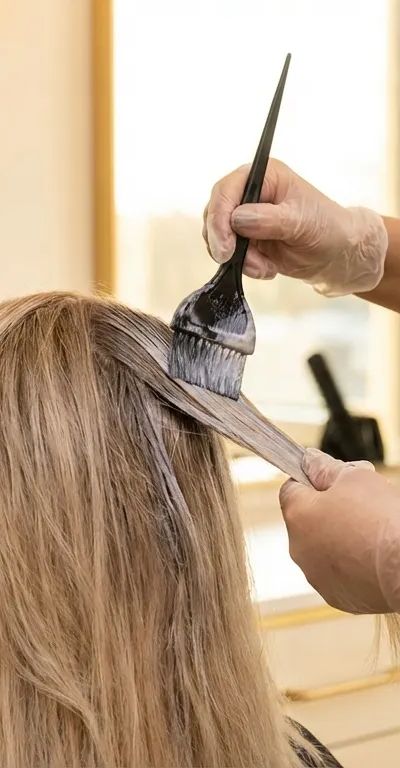
- Apply with a brush or gloved hands depending on product consistency
Step 5: Control timing based on porosity
| Porosity | Recommended time | Control signal |
|---|---|---|
| Low (virgin, healthy) | 20-30 min | Check every 5 min at the end |
| Medium (treated, highlighted) | 15-20 min | Check from minute 10 |
| High (bleached, damaged) | 5-15 min | Constant monitoring |
Pro tip: Highly porous hair absorbs pigment much faster and can over-tone quickly. Check progress by removing a small amount with a damp sponge rather than rinsing the whole head.
Step 6: Rinse and finish
- Rinse with lukewarm water until it runs clear
- Apply conditioner or post-color treatment
- Dry and evaluate the result under neutral light
Brand recommendations for professional toning
These are the professional toning lines most widely used in salons and what makes each one distinct.
Wella Color Touch
The classic demi-permanent reference. Activated with 4% (approximately 13 vol) developer, typically diluted to 10 vol for toning. The 8/xx series is especially popular for cool blonde toning and highlight blending. Find shade equivalences in our Redken color chart.
Redken Shades EQ
Acid gloss with no ammonia, 1:1 ratio with its own processing solution. Highly valued for the shine it delivers and the ease of control during application. The .07 (pearl) and .06 (orange-coral) variants are useful for softening or warming blondes.
Schwarzkopf Igora Vibrance
High-precision demi-permanent with multiple base options. Excellent for technical corrections and custom blends. The ash and violet ranges are particularly strong.
L’Oréal Professionnel Dia Light
Acid gloss with no ammonia. Very gentle on the fiber, ideal for sensitized or fragile hair. Duration is slightly shorter than classic demi-permanents, but the result is notably bright and natural.
If you need to transpose a formula between brands, the hair color converter gives exact equivalences across the main professional lines.
Maintenance: how to extend toning results
Results from the salon last longer when the client understands how to protect them.
Right after the toning service
- Wait 48-72 hours before the first wash to let the pigment set
- Use cool or lukewarm water — heat opens the cuticle and accelerates color loss
- Use pH-balanced shampoo formulated for colored hair
Maintaining a cool blonde tone
- Violet or blue toning shampoo 1-2 times per week (more often risks grey or pink shifts)
- SPF hair protection in summer
- Hydrating treatments without yellow-tinted silicones
When to come back to the salon
- Cool tones (ash, platinum): toning touch-up every 3-4 weeks
- Neutral or slightly warm tones: every 5-6 weeks
- Fashion tones (direct pigment): refresh every 2-3 weeks
Remind clients of this timeline at checkout and point them to our Toner Selector so they can explore maintenance options between appointments.
Common toning mistakes
Most problems in professional toning have specific, avoidable causes.
| Mistake | Consequence | Common cause | Fix |
|---|---|---|---|
| Using violet toner on orange hair | Doesn’t neutralize, muddy result | Confusing orange with yellow | Use blue (ash), not violet |
| 20 vol developer on bleached hair | Continues lifting, pigment is expelled | Not adapting volume to porosity | Maximum 10 vol on sensitized hair |
| Leaving on too long | Over-toning, grey or greenish cast | Not monitoring during application | Reduce time, check every 5 min |
| Applying on soaking wet hair | Washed-out, inconsistent result | Water dilutes the mixture | Apply damp, not dripping |
| Wrong toner level for the underlying pigment | Result darker than expected | Not matching toner level to underlying level | Toner level must match the lifted level |
| Incorrect mixing ratio | Wrong consistency, uneven absorption | Not following manufacturer specs | Always read the specific ratio for each product |
For a deeper look at tone neutralization and color correction errors, see our guide to neutralizing unwanted hair tones.
Frequently Asked Questions
What is the best toner for blonde hair with orange tones?
For orange underlying pigment (typically levels 6-7), use an ash-based toner with blue reflect (.1 or .11). Blue neutralizes orange on the color wheel. Do not use violet — that targets yellow, not orange. Apply with 10 vol developer and check every 5 minutes to avoid over-toning.
How long should you leave toner on blonde hair?
It depends on the toner type and hair porosity. For demi-permanent on average-porosity hair: 15-25 minutes. For highly porous or bleached hair: 5-15 minutes with close monitoring. Acid gloss products typically require 20-30 minutes. Always check progress rather than setting a fixed timer.
Will toner damage my hair?
A demi-permanent toner applied with the correct low developer has minimal impact on the hair fiber — far less than permanent color. Damage happens when developer is too high, processing time is excessive, or toner is applied to already-compromised hair without a pre-treatment. Using 5-10 vol and monitoring timing keeps the service safe.
Can you tone hair that’s already been permanently dyed?
Yes, with expectations managed. Toner won’t lift permanent color — it only adds a shade on top. If the existing permanent color has warm undertones, a toner can soften them. If the base is very saturated or dark, the toning effect will be minimal.
How often should you refresh a toner on blonde hair?
Cool tones (ash, platinum) fade the fastest: plan for a toner refresh every 3-4 weeks. Neutral or slightly warm tones last closer to 5-6 weeks. Frequency of washing directly affects how long the result holds — the more washes, the faster the fade.
What is the difference between Wella Color Touch and Redken Shades EQ?
Color Touch is a classic demi-permanent requiring its own developer and giving longer-lasting results. Shades EQ is an acid gloss activated with its own processing solution, providing more shine and a slightly gentler experience. Both are industry benchmarks — the choice depends on the result you need and the current state of the hair.
Key Takeaways
- Choose the right toner type: Demi-permanent, gloss, or direct pigment depending on hair condition and desired duration
- Match the developer to the hair: 10 vol for most toning, 5 vol for sensitized or bleached hair
- The underlying pigment is the starting point: The correct toner for blonde hair always depends on what undertone you’re working with, not the desired result alone
- Porosity changes processing time: Bleached hair absorbs pigment much faster — monitor closely
- Use the right tools: The Toner Selector calculates formula, developer volume, and timing based on your client’s specific hair
Not sure which toner formula to use? Blendsor analyzes the current level and underlying pigment and recommends the exact toner, volume, and processing time — for any professional brand.
What is the most challenging toning case you have handled in the salon? Share it in the comments or send us a message.
Related articles
Practice with our free tools
Calculators, neutralization wheel, AI consultation...
Apply this theory with precision
Blendsor analyzes 70+ variables and generates exact formulas based on real colorimetry. Try our free color consultation or download the app.
Download free