Color Wheel in Hair Colorimetry: A Practical Guide
Learn how to use the color wheel to formulate hair color with precision. Complementary colors, neutralization, and real salon application.
Blendsor
Blendsor Team
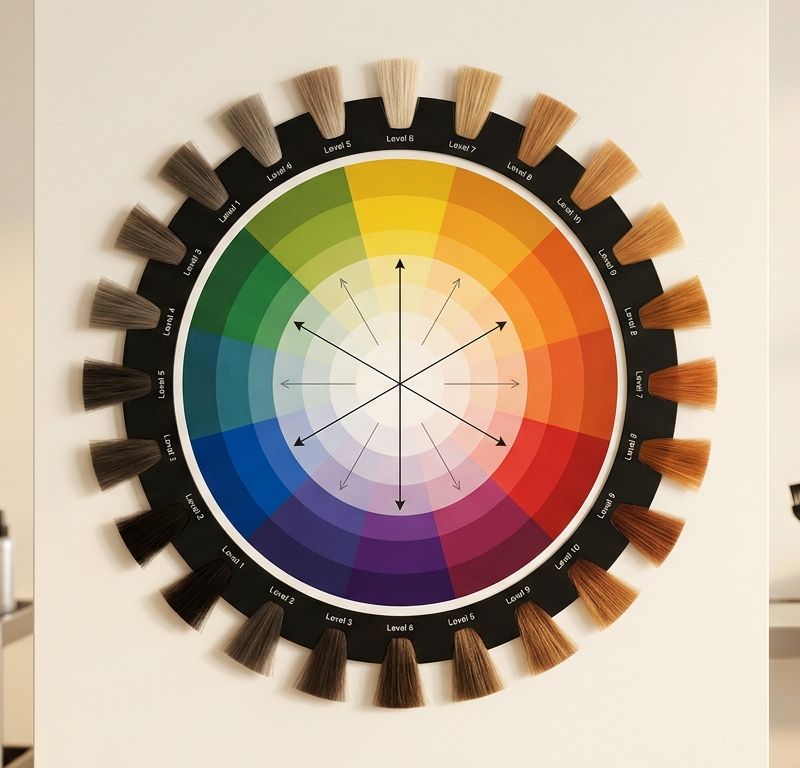
The color wheel is the tool that separates colorists who formulate with precision from those who formulate with luck. It organizes all colors in a circle where each position has direct meaning for your daily work: which tone neutralizes which undertone, why orange appears when you lighten, and how to correct it without repeating the service.
Have you ever applied a violet toner expecting to cancel yellow, only to get a muddy ash result? That happens when you use the wheel without understanding proportions.
For a complete overview of colorimetry fundamentals, check our colorimetry basics guide. Here we’ll dive deep into the color wheel and its real application in the salon.
Quick summary: The color wheel organizes colors in a circle where opposite colors (complementaries) cancel each other out. The key pairs for the salon are: orange→blue (.1 ash), yellow→violet (.2 iridescent), red→green (.1+.2 mixed). Proportion matters as much as choosing the right complementary: subtle undertone = 25%, moderate = 50%, dominant = 75%. Never use pure complementary at 100%.
What Is the Color Wheel and Why Do You Need It in the Salon?
The color wheel is a circular diagram organizing colors by their relationships, based on the Munsell model that classifies each color by hue, value, and chroma. In hair coloring it lets you predict underlying pigments when lightening, neutralize unwanted tones with the correct complementary, formulate precise mixes with intention, and correct failed services. It’s not abstract theory — you use it every time you choose a .1 to counteract orange.
The color wheel is a circular diagram that organizes colors by their relationship. It was developed from Isaac Newton’s theory and refined by systems like the Munsell color model, which classifies each color by hue, value (lightness), and chroma (saturation).
In hair coloring, the color wheel allows you to:
- Predict which undertones will appear when lightening each level
- Neutralize unwanted tones by choosing the correct complementary
- Formulate precise mixes by combining reflects with intention
- Correct services that didn’t turn out as expected
This isn’t abstract theory. Every time you choose a .1 (ash) to counteract orange, you’re using the color wheel. The difference is doing it with knowledge versus doing it by instinct.
What Are the Primary Colors in Hair Coloring?
In the subtractive system of hair coloring (pigments, not light), the three primaries are blue (.1 ash, present as eumelanin in levels 1-3), red (.6, abundant in dark hair at levels 1-6), and yellow (.3 gold, visible as pheomelanin in levels 7-10). Mixed in equal proportions they produce neutral brown — which is why natural tones (.0) contain all three in balance.
Primary colors are the three that cannot be created by mixing others. In the subtractive system used in hair coloring (pigments, not light), they are:
| Primary Color | Reflect in Hair Color | Present in Underlying Pigment | Visual Effect |
|---|---|---|---|
| Blue | .1 (ash) | Levels 1-3 (as eumelanin) | Cool, kills warmth |
| Red | .6 (red) | Levels 1-6 (abundant in dark hair) | Warm, intense |
| Yellow | .3 (gold) | Levels 7-10 (pheomelanin) | Warm, luminous |
According to the Society of Cosmetic Chemists, eumelanin (responsible for blues and browns) predominates in dark hair, while pheomelanin (responsible for reds and yellows) becomes visible as you lighten.
Pro tip: All three primaries mixed in equal proportions produce a neutral brown. That’s why natural tones (.0) contain all three in balance.
What Are Secondary and Tertiary Colors in Hair Colorimetry?
Secondary colors are orange (red+yellow, underlying pigment at levels 4-6), green (blue+yellow, result of over-toning with ash on yellow), and violet (blue+red, toners and violet shampoos). Tertiary colors help you diagnose unexpected results: red-orange at level 3-4 underlying pigment, yellow-orange at level 6-7, and yellow-green when there is excess ash applied over a yellow base.
Secondary Colors
Each secondary color is formed by mixing two primaries:
| Secondary Color | Formula | Where You See It in the Salon |
|---|---|---|
| Orange | Red + Yellow | Underlying pigment at levels 4-6 |
| Green | Blue + Yellow | Result of over-toning with ash on yellow |
| Violet | Blue + Red | Toners and violet shampoos |
Tertiary Colors
Tertiary colors form by mixing a primary with an adjacent secondary:
| Tertiary Color | Mix | Example in Hair Coloring |
|---|---|---|
| Red-orange | Red + Orange | Underlying pigment at level 3-4 |
| Yellow-orange | Yellow + Orange | Underlying pigment at level 6-7 |
| Blue-violet | Blue + Violet | Intense ash shades (.11) |
| Red-violet | Red + Violet | Mahogany reflects (.5) |
| Yellow-green | Yellow + Green | Unwanted result from ash overload |
| Blue-green | Blue + Green | Fantasy aquamarine tones |
Understanding tertiaries helps you diagnose unexpected results. When a client arrives with a “weird green” on her ends, you know there’s excess blue over a yellow base.
How Do Complementary Colors Work for Neutralization?
Complementary colors are the ones diametrically opposite on the wheel: orange→blue (.1 ash), yellow→violet (.2 iridescent), red→green (.1+.2 mixed), green→red (.6 or .4). When mixed together they produce a neutral tone. The proportion is critical: 25% complementary for a subtle undertone, 50% for moderate, 75% or more for a dominant one. Never use the complementary pure — always dilute with a natural (.0) as the base.
Here’s the core of the color wheel applied to the salon. Colors diametrically opposite on the wheel cancel each other out. When you mix them, they produce a neutral tone.
| Unwanted Tone | Complementary | Neutralizing Reflect | Practical Example |
|---|---|---|---|
| Orange | Blue | .1 (ash) | Level 5-6 bleach with orange → add .1 |
| Yellow | Violet | .2 (iridescent/violet) | Brassy blonde level 8-9 → tone with .2 |
| Red | Green | .2 + .1 (cool mix) | Red base level 4 → ash with matte touch |
| Green | Red | .6 or .4 (red/copper) | Green-tinted ends → apply warm reflect |
| Yellow-orange | Blue-violet | .1 + .2 | Level 7 undertone → ash-violet |
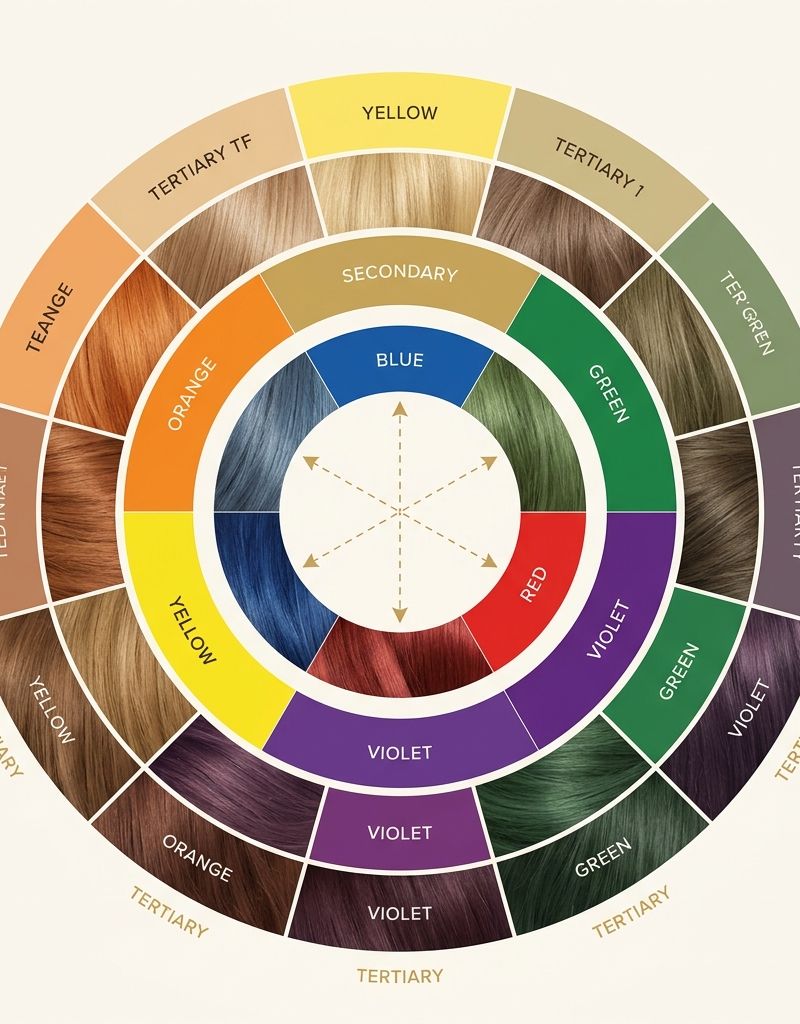
For in-depth neutralization techniques with step-by-step formulas, see how to neutralize unwanted tones.
The Proportion Rule
Neutralizing doesn’t mean adding equal parts of the complementary. The proportion depends on the intensity of the unwanted tone:
- Subtle undertone (noticeable but not dominant): Add 25% complementary to your mix
- Moderate undertone (clearly visible): Use 50% complementary
- Dominant undertone (it IS the main color): You need 75% or more complementary
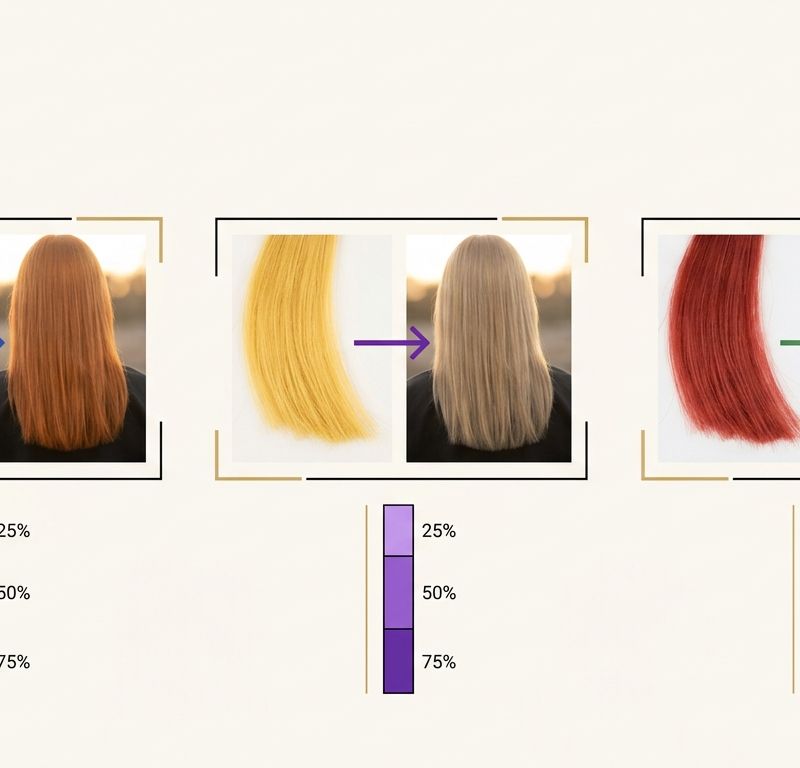
Real-world example: Client with level 7 and yellow-orange undertone. She wants natural ash blonde.
- Base: 7.0 (natural) — 50%
- Complementary: 7.1 (ash) — 25% (counteracts orange)
- Touch: 7.2 (iridescent) — 25% (counteracts residual yellow)
The result is a neutral blonde without warmth but without looking ashy or muddy.
How Do You Apply the Color Wheel Step by Step in the Salon?
Practical color wheel application follows 4 steps: identify the underlying pigment for the starting level (levels 4-5 = orange, 6-7 = yellow-orange, 8-10 = pale yellow), locate the complementary on the wheel, translate it to the hair color numbering system (.1 for blue/ash, .2 for violet, .7 for green/matte), and adjust the proportion based on undertone intensity without exceeding 75% complementary in the mix.
Step 1: Identify the Underlying Pigment
Before thinking about the wheel, you need to know what underlying pigment the hair has. Check the color level guide for the complete table of undertones by level.
| Starting Level | Underlying Pigment | Dominant Color on the Wheel |
|---|---|---|
| 1-3 | Red to red-orange | Red (primary) |
| 4-5 | Orange | Orange (secondary) |
| 6-7 | Yellow-orange to yellow | Between secondary and primary |
| 8-10 | Pale yellow | Yellow (primary) |
Step 2: Locate the Complementary
With the undertone identified, find its opposite on the wheel:
- Red undertone → you need green (blue + yellow)
- Orange undertone → you need blue
- Yellow undertone → you need violet (blue + red)
Step 3: Choose the Correct Reflect
Translate the complementary into the hair color numbering system:
| Complementary Needed | Equivalent Reflect | Number |
|---|---|---|
| Blue | Ash | .1 |
| Violet | Iridescent | .2 |
| Green | Matte | .7 (varies by brand) |
| Red | Red | .6 |
| Orange | Copper | .4 |
Step 4: Adjust the Proportion
Never use the complementary at 100% pure. Always combine it with a natural tone or the desired shade as a base. The proportion depends on the intensity of the unwanted undertone (see previous section).
Pro tip: If you’re unsure between more or less complementary, start with less. You can always tone afterwards, but removing excess ash is much harder.
What Are the Most Common Mistakes When Using the Color Wheel?
The five most frequent mistakes are: using pure complementary without dilution (pure .1 on orange produces a muddy flat result — always dilute with .0), ignoring that complementary intensity varies by level (a .1 at level 5 has far more blue pigment than a .1 at level 9), confusing subtractive and additive systems (in hair color pigments, red+green = brown, not yellow), failing to account for previous artificial color that adds to the natural underlying pigment, and over-toning (excess violet on yellow produces pink or grayish results).
Knowing the wheel doesn’t save you if you apply it incorrectly. These are the most repeated mistakes:
-
Using pure complementary without dilution: Applying pure .1 on an orange undertone produces a muddy, flat result. Always dilute with a natural (.0).
-
Ignoring the level when neutralizing: A .1 at level 5 has far more blue pigment than a .1 at level 9. The complementary’s intensity varies by level.
-
Confusing subtractive and additive systems: On screens (light), red + green = yellow. In pigments (hair color), red + green = brown. In the salon you always work with the subtractive system.
-
Not considering previous color: If the client has a previous copper tint, that artificial pigment adds to the natural underlying pigment. You need to neutralize both.
-
Over-toning: Excess violet on yellow can produce a pink or grayish result. Neutralization aims for the neutral point, not overshooting to the other side of the wheel.
For more common formulation errors, check the 7 most common color formulation mistakes.
Frequently Asked Questions
Is the color wheel the same for all hair color brands?
Color theory is universal, but reflect numbering varies between brands. A .1 is always ash (blue), but pigment intensity changes. Check each brand’s swatch book and do strand tests before applying to the entire head.
Can I use the color wheel for fantasy colors?
Yes. Fantasy colors follow the same complementary rules. If you want a clean pink, you need a base without yellow (level 9-10). If the base has yellow, the pink will turn salmon (pink + yellow = salmon).
How do I know exactly how much complementary to add?
There’s no universal exact formula because it depends on the brand, porosity, and hair history. The general rule is: subtle undertone = 25%, moderate = 50%, dominant = 75%. Start conservative and adjust in subsequent services. With experience, your eye calibrates proportions automatically.
Is neutralizing the same as toning?
Not exactly. Neutralizing means canceling an unwanted tone using its complementary (orange → blue). Toning means adjusting the final shade with a specific product (demi-permanent, gloss) after the main service. You can tone without neutralizing (adding a shade), and you can neutralize within the formula without toning afterwards.
Do cool blondes always need violet complementary?
It depends on the underlying pigment. If the undertone is pure yellow (level 8-9), yes: violet. But if the undertone has residual orange (level 7), you need blue or a blue-violet mix. To achieve cool blondes without orange, first identify the exact undertone.
In Summary
- The color wheel organizes colors and shows which tone cancels which
- Complementary colors (opposites on the wheel) are your neutralization tool: orange→blue, yellow→violet, red→green
- Proportions matter as much as choosing the right complementary: never use pure reflects without dilution
- The underlying pigment determines which complementary you need — always identify it before formulating
- Less is more: start with less complementary and adjust; overdoing it produces muddy results
Calculate Professional Formulas with AI
Want to see in real time which complementary you need for each underlying pigment? Use the neutralization wheel to calculate the correct reflect and exact proportions.
Want to generate personalized neutralization formulas based on each client’s starting level and underlying pigment?
Try Blendsor free - 5 formulas per month, no credit card required.
Related articles



Practice with our free tools
Calculators, neutralization wheel, AI consultation...
The Monday Briefing
Color techniques and trends for professionals. No spam.
Apply this theory with precision
Blendsor analyzes 70+ variables and generates exact formulas based on real colorimetry. Try our free color consultation or download the app.
Download freeWritten by the Blendsor team
Professional hair colorimetry experts with experience in AI-assisted formulation. We combine color science, salon practice and technology to help colorists formulate with precision.