Hair Color Mixing Chart: What Two Shade Codes Make
What you get mixing two shade codes like 6.0 + 7.1 or 7.1 + 8.3: a chart by level and by code, how to read the notation, and when the estimate stops holding.
Blendsor
Blendsor Team
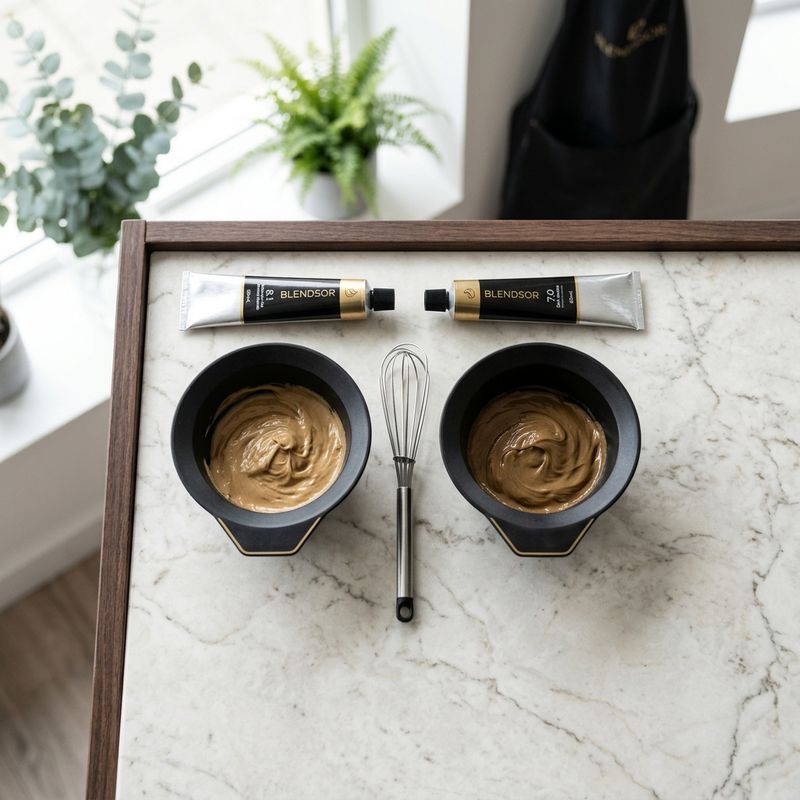
Mix a level 7 with a level 9, 50/50, and you get an 8. Right? Almost. And that “almost” is exactly where the service can go sideways.
If you’re behind the chair, you know the moment: two tubes open, a client asking for something in between, and the question that never goes away — what does this actually look like once it’s dry and out of the bowl?
Mixing two shades follows a logic you can estimate. It also has hard limits worth knowing before you ever pick up the bottle. Here’s both: the chart, and the fine print that goes with it.
Quick answer: when you mix two hair dyes from the same brand and line, the resulting level is roughly the weighted average of the two — a level 7 and a level 9 mixed 1:1 land around an 8. In practice, expect the result to come out up to about half a level darker, and slightly duller, because the darker pigment always wins. Matching tones reinforce each other; opposite tones cancel each other out into mud. And one rule never bends: mixing doesn’t lift — lifting is the developer’s job, not the tube’s.
Want to see it before you mix? The hair color mixing calculator estimates level and tone when you combine two shades from the catalog, at whatever ratio you’re working with.
What should you check before mixing two dyes?
Before you even think about the mix, the outcome is already shaped by four things: the base you’re working on (virgin or previously colored, and its underlying pigment), gray percentage, hair porosity, and residual pigment from past color services. These aren’t small adjustments to the estimate — they override it. A perfect mix on top of the wrong diagnosis is still the wrong result.
Specifically:
- Virgin vs. previously colored hair: on virgin hair, the dye behaves the way the chart says it will. On previously colored hair, residual pigment shows up in the result whether you accounted for it or not.
- Gray percentage: gray hair contributes zero pigment. Once white hair passes half the head — the drift is gradual — the chart below stops applying: that’s a coverage formula, with its own ratio and base shade.
- Porosity: porous hair grabs more pigment and comes out darker and duller than the math predicted.
- Dye type: both shades need to be the same type — both permanent, or both demi/tone-on-tone. Mixing a permanent with a demi-permanent breaks any estimate, since each works at a different pH with a different pigment load.
How do you estimate the level when mixing two dyes?
The starting estimate is straightforward: weight the two levels by their ratio. Half a 7 and half a 9 lands you around an 8. Two parts 6 to one part 9 lands around a 7. It’s the same math the mixing calculator runs, rounded to the nearest half level.
Now, the fine print every colorist learns the hard way: the darker pigment wins. In practice, the result tends to land up to about half a level darker than that clean average — you notice it most when the math falls on a whole number, which on real hair settles into the half-step below. And a separate effect: the bigger the gap between the two shades and the more porous the hair, the duller the result reads. The calculator gives you the clean average; that touch of darkness and dullness is the eyeball correction worth adding in your head before you commit.
And the rule that saves you from the expensive mistake: this is a deposit calculation, not a lift calculation. Mixing a 6 with a 10 doesn’t “pull the 6 up” — lift comes from the developer volume working on the base, not the number printed on the box. The developer volume guide breaks down how much lift each strength gives you; Wella’s documentation for Koleston Perfect puts a 6% (20 vol) developer at coverage plus roughly one level of lift — mixing two shades in the bowl doesn’t change that physics.
What happens to tone when you combine two dyes?
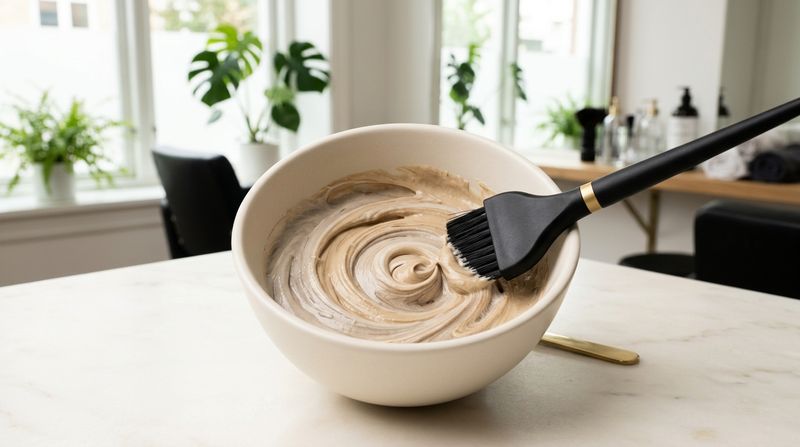
Matching tones reinforce each other: a .3 gold mixed with a .34 gold-copper gives you a richer, more coherent warm family than either shade alone. Opposite tones cancel each other out — and here’s the nuance that separates the color wheel from the bowl: they don’t cancel into a clean neutral, they cancel into something dull that can drift muddy.
The color wheel predicts the direction: violet against yellow, blue against orange, green against red. But neutralizing a tone on the hair — where there’s a specific underlying pigment to correct — is a different situation from mixing two opposite tones in the bowl. In the bowl, gold and ash at equal parts don’t produce a perfect natural. They produce a directionless, flat result that reads as dirty on the wrong base. My HD Hair’s mixing guide keeps it blunt: warm and cool counteract each other. And in the bowl, that counteraction without a plan doesn’t read as a clean neutral — it drifts muddy, with a greenish edge.
The practical takeaway? Mix tones from the same family, or neighbors on the wheel. If what you actually need is to kill a tone, that’s neutralization on the base — a different technique, covered in its own guide: neutralizing unwanted tones.
Hair color mixing chart: common combinations and results
This chart is a starting point, not a recipe. It assumes four fixed conditions — same brand and line, both shades permanent, 20-volume developer, 1:1 ratio between the two colors — and a natural base at or above the resulting level. Change any one of those and the cell changes with it. If the starting base is darker than the mix, expect the result to land darker and warmer — 20 vol won’t lift that natural pigment. Keep in mind, too, that tone numbering varies between brands: a .5 from one line isn’t the .5 from another.
| Mix (1:1) | Estimated level | In practice |
|---|---|---|
| 7 + 9 | 8 | Reads closer to 7.5, a touch flatter than an 8 straight from the tube |
| 6 + 8 | 7 | A 7 with body — deeper than luminous |
| 7 + 8 | 7.5 | The most predictable in-between, true to the math |
| 6 + 9 | 7.5 | Pulls toward 7 and loses shine — three levels apart shows in the dullness |
Watch out for 6 + 10: that pair isn’t in the chart because it isn’t a deposit mix — it’s a lift attempt in disguise. Four levels apart is territory where averaging stops meaning anything: the 10 isn’t going to pull the 6 up, and the real result comes down to the developer working on the base, not the level math. If the target is an 8, formulate an 8 with the right developer strength — don’t ask the mix to do the developer’s job.
What do you get mixing two specific shade codes?
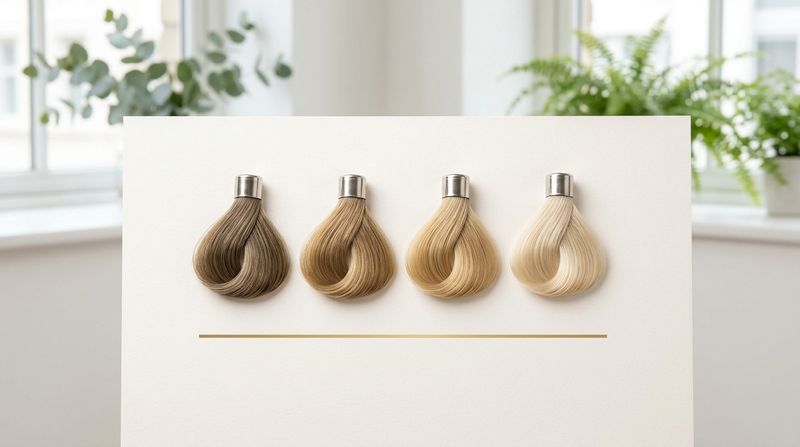
Level math only answers half the question. Behind the chair you’re not mixing “a 7 and a 9” — you’re mixing a 6.0 and a 7.1, and the tone digits decide whether the result reads clean or muddy.
Read the code left to right: the number before the point is the level (how light), and the digits after it are the tone. The catch — and it’s the one that ruins cross-brand formulating — is that the tone digits are each manufacturer’s own alphabet, not a shared standard.
This chart uses the L’Oréal-style legend: .0 natural, .1 ash, .2 iridescent, .3 gold, .4 copper, .5 mahogany, .6 red, .7 matte, .8 mocha. Wella writes the same idea with a slash and a different legend — its own shade names spell it out: Koleston Perfect 8/2 Light Blonde/Matte, 7/7 Medium Blonde/Brown. So in Wella a /4 is red (6/45 Dark Blonde/Red Red-Violet), a /6 is violet, not red, and a /7 is brown, not matte. Schwarzkopf’s IGORA Royal sits further away still: there a 5 is gold and a 7 is copper (7-57 Medium Blonde Gold Copper). Check the legend printed on your own line’s chart before you read a single row below — same digit, different colour family. Our brand shade charts translate between them.
With that fixed, the two rules already covered do the work: the level lands on the weighted average, and the tones either survive intact or neutralise each other.
| Mix (1:1) | Estimated result | What the tone does |
|---|---|---|
| 6.0 + 7.1 | Around level 6.5, natural with the warmth pulled back | The .0 brings no dominant reflect, so a half dose of ash works as a brake on warmth rather than turning the result ash. On a virgin base expect little visible cooling; on porous or previously lightened mid-lengths the same mix can overshoot and read grey-green |
| 7.1 + 8.1 | Around level 7.5, ash | Same family, so nothing counteracts the ash and the direction survives intact — an intermediate ash, not a stronger one than either tube. Pushing ash past what the tube carries is a mixtone’s job, dosed exactly as your own line’s instructions state — the ceiling drops as the base gets lighter |
| 7.3 + 8.3 | Around level 7.5, gold | Same family again: the warm direction survives intact and reads richer than the level alone suggests, not lighter — and no more gold than the 8.3 was |
| 6.0 + 8.0 | Around level 7, natural | Two clean naturals two levels apart: the most predictable pair in this table |
| 7.1 + 7.3 | A level 7 in neutral-beige territory | Ash and gold pull in different directions and largely neutralise each other — which is exactly how beige shades are built (L’Oréal sells that exact pairing as a shade of its own: the 6.13, a dark ash-gold blonde). Note this isn’t the same as a factory 7.13, where the gold sits at a fraction of the ash by design. On a clean base expect flat rather than muddy; on porous or previously coloured hair it’s where a dull or greenish cast shows up |
| 5.5 + 6.6 | Around level 5.5, deep red-mahogany | Neighbouring warm reflects in this legend, so the red direction holds and reads deep. Plan the refresh: Wella explains that red molecules “sit closer to the surface of the hair, making it easier for them to escape” |
| 8.3 + 9.0 | Around level 8.5, soft gold | The .0 brings no competing reflect, so it dilutes the gold rather than fighting it — a softer version of the 8.3 |
Every row assumes the legend above, same brand and line, both shades permanent, 20 volume, and a natural base at or above the resulting level. In practice expect each result to settle up to half a level below the figure shown — the same darkening effect as the level chart.
One limit hits this table harder than the level chart above: naturals are your gray coverage. Cutting a .0 with a fashion shade at 1:1 halves the pigment doing the covering. As the white percentage climbs, this stops being a 1:1 from this table and becomes a coverage formula — more natural, not less, in whatever natural-to-fashion proportion your own line publishes.
Two things this table is not. It is not brand-portable — beyond the legend warning above, some manufacturers write the tone as a slash (7/1) and use a second digit for a secondary direction: 7.13 is ash with gold behind it, and that ash-plus-gold pairing is a named family in its own right, not a mistake. And it is not a lift calculation — same as the level chart above, these pairs deposit tone; the developer does the lifting.
Can you mix hair dyes from different brands?
We’re talking about two oxidative colors in the same bowl — not using another house’s developer, and not toning afterwards with a different brand, which are separate conversations. With that scope, the short answer is that it isn’t reliable, and the reason goes beyond “every brand is its own world”: crossing two houses costs you both of the references you work from.
The first is the developer ratio, which each line publishes on its own terms: Koleston Perfect’s permanents run 1:1 and Majirel’s run 1:1.5. The second is the tone key, and here the nuance matters: the same digit doesn’t always mean the same thing from one chart to the next. A 3 is gold on both, but a 7 reads matte at L’Oréal (.7) and brown at Wella (/7) — note they don’t even write it the same way.
And doing the math separately doesn’t fix it. Even if you mix each dye with its own developer at its own ratio and combine the two creams afterwards, you still don’t know which tone will come out: that result isn’t published on either chart. What you lose isn’t the arithmetic — it’s being able to repeat it six weeks from now, or hand it to someone else on the team.
What to do instead. If the shade you need isn’t in your line, first check whether you can build it by mixing two shades from your own brand — which is exactly what this article is about. And if what you want is one specific shade from another house, find its equivalent within your own chart using the shade converter and confirm it with a strand test, rather than crossing them in the bowl. Switching brands altogether is a different conversation, and it lives in switching professional hair color brands.
When does this chart stop applying?
The chart stops working the moment any of its conditions change: shades from different lines, mismatched dye types, ratios other than 1:1, a high percentage of resistant gray, heavily porous hair, or a base carrying residual pigment. Heat moves it too — a hot salon on a summer day, heat applied from a tool — and so does processing time that isn’t respected.
This isn’t a list meant to scare you off — it’s the list a solid diagnosis already accounts for before the tubes come open. The base ratios live here and in the dye mixing ratios guide; the exact math for your specific case — porosity, gray, base, the client’s color history — is exactly what Blendsor works out in seconds once you feed it the full diagnosis.
What mistakes keep coming up when mixing two shades?
- Mixing brands or lines: every manufacturer formulates with its own alkalinity, its own developer ratio, and its own pigment load. Cross them and pH, timing, and deposit all become unpredictable — manufacturer instructions call for staying within the same line. If you’re transitioning brands, the guide on switching professional hair color brands will save you some grief.
- Calculating developer off one shade only: developer gets calculated against the total dye weight, not one of the two colors. At 30g + 30g of dye in a 1:1 mix, that’s 60g of developer — and check your line’s ratio first: Koleston Perfect runs 1:1, but Majirel runs 1:1.5.
- Asking the mix to lift: worth repeating because it’s the costly one — the mix deposits, the developer lifts.
- Skipping the strand test: never skip it on a new mix — it’s the only way to see the real result on that specific hair before you commit the whole head. And don’t confuse it with the patch test: that one goes on skin, 48 hours out, and checks for sensitivity to ingredients like PPD. Two different tests, two different jobs.
- Applying over henna or metallic salts without knowing it: oxidative color doesn’t mix well with henna residue or metallic dye — the reaction can generate heat and damage the hair. When in doubt, strand test and ask about color history.
FAQ
What color do you get mixing a level 7 and a level 9 dye?
The estimate points to an 8, and in practice it usually lands between 7.5 and an 8 that’s a bit flatter than straight from the tube. Same brand, same line, 1:1, and strand test before you apply.
Can I mix a level 6 and a level 8 dye?
Yes, as long as they’re from the same brand and line. At equal parts, the working estimate is a 7 that tends to read a touch deeper. It’s one of the most common mixes for building an in-between shade the catalog doesn’t carry.
Does mixing a light dye with a dark one lift the hair?
No. The mix determines the tone that deposits, but lift depends on the developer volume and the base you’re working on. A 10 mixed with a 6 doesn’t pull up to a 6 — to gain levels, you choose the right developer strength or consider lightening the hair first.
What happens if you mix two dyes from different brands?
You lose your reference: each house calibrates its developer ratio and its tone key separately, so neither the ratio nor the code on the tube tells you what will come out any more. Mixing each dye with its own developer separately doesn’t fix it either, because that result isn’t published on either chart. If you need a shade your brand doesn’t carry, build it within your own line or find its equivalent on your own chart, and confirm it with a strand test. The full answer is above, in can you mix hair dyes from different brands?.
What do you get mixing a 6.0 and a 7.1?
A result around level 6.5 that stays natural, with the warmth pulled back rather than turned ash. The .0 brings no dominant reflect of its own, so at half dose the .1 works as a brake on warmth instead of imposing a cool tone. Same brand and line, 1:1, and strand test it first — and check that your line reads .1 as ash, because the tone digits aren’t standardised across manufacturers.
What happens if you mix an ash and a gold shade, like 7.1 and 7.3?
You get a level 7 that lands in neutral-beige territory rather than a clear direction. Ash and gold pull opposite ways and largely neutralise each other — which is exactly how beige shades are built: L’Oréal sells that exact pairing as a shade of its own — the 6.13, a dark ash-gold blonde. What you don’t get is a strong tone. On a clean base it reads flat; on porous or previously coloured hair it’s where a dull or greenish cast shows up. And if the goal is to kill warmth already in the hair, that’s neutralisation on the base, not a mix in the bowl. Strand test either way.
How many levels apart can you mix and still trust the result?
Up to two or three levels apart, the estimate holds up. Past four, the average stops making physical sense and the result is no longer a predictable mix.
The bottom line
- The resulting level is roughly the ratio-weighted average of the two shades — and usually comes out up to about half a level darker, and a bit duller
- Matching tones reinforce each other; opposite tones cancel out into something dull, not neutral, in the bowl
- The chart holds for same brand, same line, same dye type, 20 volume, and 1:1 — change one condition and the cell changes
- Mixing doesn’t lift: lift is the developer volume’s job, working on the base
- Base, gray, porosity, and residual pigment override any chart
- Never skip the strand test, and don’t skip the 48-hour patch test either
Test your combinations in the hair color mixing calculator before you open the tubes, and check the dye-to-developer ratios to get the grams exactly right.
From estimated tone to full formula
The chart gives you the direction. In the Blendsor app, the AI runs the whole calculation: it diagnoses the base from a photo, factors in porosity, gray, and color history, and returns the formula with the exact shades and ratios for your brand — including mixes of up to three tones when the case calls for it. Formulate with Blendsor.
So, behind your chair — what’s the two-tone mix that never lets you down?
What happens if you mix two dyes without knowing the resulting code?
In the app, we ask you a question like this one, but about your own client.
Up for this week’s case? → More on global color →Related articles

Practice with our colorimetry tools
Calculators, neutralization wheel, AI consultation...
The Blendsor newsletter
Color techniques and trends for professionals. No spam.
You know the theory. What about today's case?
Send a photo to the Blendsor advisor and get an answer grounded in colour theory: toner, developer and timing, with the brands on your shelf.
Ask about your caseWritten by the Blendsor team
Professional hair colorimetry experts with experience in AI-assisted formulation. We combine color science, salon practice and technology to help colorists formulate with precision.