How Much Hair Dye Do I Need? Grams by Length and Service
How many grams of color each service takes by length, density and technique, how much developer to add, and where product waste eats your margin.
Blendsor
Blendsor Team
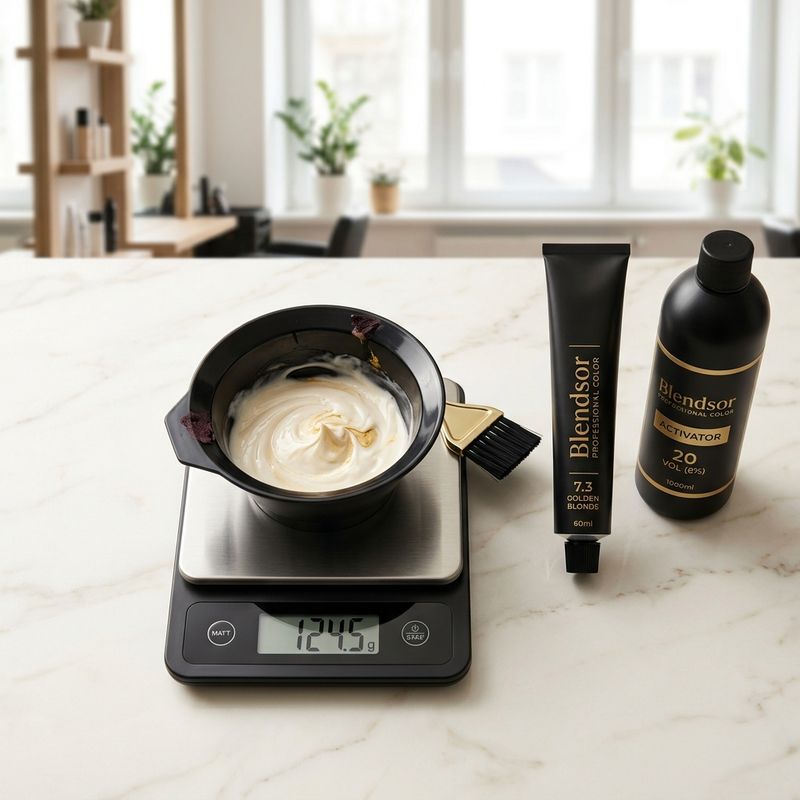
Every mix that ends up in the sink is margin down the drain. And every mix that runs out mid-application is worse: eyeballing a second batch, in a hurry, with the client waiting in the chair.
If you’re behind the chair every day, you know “how much do I prep” gets answered by gut feeling more often than it should. And with what a professional tube costs, gut feeling gets expensive fast.
Here are the amounts with actual logic behind them: grams of color by length, density, and service type, how much developer your line calls for, and where the money quietly disappears without you noticing.
Quick answer: to figure out how much hair dye you need, start with grams of color by length — 30 g for short hair, 60 g for shoulder-length, 90 g for long, 120 g for extra-long, at average density — then adjust for hair thickness (from ×0.75 on fine hair to ×1.5 on very thick) and for the service itself (partial highlights run ×0.5; a root touch-up sits around 20-30 g whatever the length). Developer gets added afterward based on your line’s mixing ratio — there’s no universal 1:1.
Want the calculator to do the math for you? The hair dye amount calculator runs on this exact model — length, thickness, service, and ratio — and gives you the result in grams, milliliters, and tubes.
How many grams of color does each service take?
The starting amount depends on two variables that move together: length and thickness. This table gives our estimate of grams of color (color only, no developer) at average density: it’s the model behind Blendsor’s calculator (except the root row, adjusted by hand for the reason explained below), not an amount published by a manufacturer. Thickness can move it from 25% less to 50% more, so use it to start the math and adjust to the hair in front of you.
| Service | Short | Shoulder-length | Long | Extra-long |
|---|---|---|---|---|
| Full color | 30 g | 60 g | 90 g | 120 g |
| Root touch-up only | ≈20-30 g | ≈20-30 g | ≈20-30 g | ≈20-30 g |
| Partial highlights | 15 g | 30 g | 45 g | 60 g |
| Full highlights | 21 g | 42 g | 63 g | 84 g |
| Toner / gloss | 18 g | 36 g | 54 g | 72 g |
| Color correction (single-step) | 39 g | 78 g | 117 g | 156 g |
Three things the table can’t tell you on its own:
-
Roots don’t scale with length: a touch-up depends on the scalp perimeter and the centimeters of regrowth, not the total length; that’s why its row stays flat, around 20-30 g unless the head is very dense. (The calculator approximates it as 40% of full color; on long hair, that approximation tends to overshoot.) If that touch-up is on gray, the guide to what developer to use for a gray root touch-up has the natural-shade ratio and the developer Wella assigns to that service in Koleston Perfect.
-
The correction row is for single-step corrections only (neutralizing one off-tone, adjusting one shade). A real multi-phase correction (pre-pigmentation, fill, final color) gets calculated phase by phase, and total consumption can end up well above the table figure.
-
In highlights, technique outweighs the number: babylights use very little product per strand but eat through a lot of foils; chunky sectioned highlights concentrate more product per foil. The multiplier is a purchasing guide, not an application rule.
How does thickness change the amount?
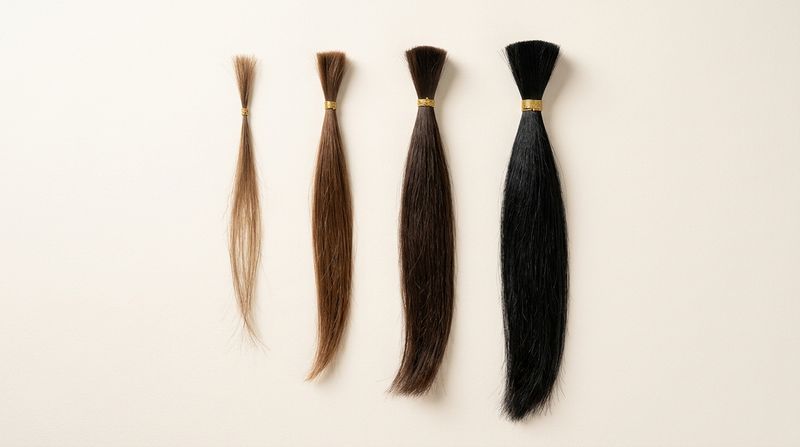
Thickness isn’t a footnote — it’s a co-lead with length. A fine-textured, shoulder-length head gets by on 45 g of color where a very thick one at the same length needs 90 g — double, same length. Here’s the adjustment the amount calculator applies:
| Hair thickness | Adjustment to the table |
|---|---|
| Fine | ×0.75 |
| Medium | ×1 |
| Thick | ×1.3 |
| Very thick / very dense | ×1.5 |
How do you know which row your client falls into? Density and strand diameter aren’t the same thing, but for product amount what matters is total hair mass: if gathering it into a ponytail surprises you with how thick it feels in hand, work off the row above.
How much developer do you add for your line?
Developer gets calculated on top of the color grams, based on your line’s mixing ratio — and here’s the priciest silent mistake in the business: there’s no universal 1:1. The ratio runs by product line, not by brand. These are common reference values — always confirm them on the specific product’s data sheet:
| Line | Color-to-developer ratio |
|---|---|
| Wella Koleston Perfect | 1:1 |
| Schwarzkopf Igora Royal | 1:1 |
| L’Oréal Majirel | 1:1.5 |
| Alfaparf Evolution of the Color | 1:1.5 |
| Revlonissimo Colorsmetique | 1:1.5 |
Wella’s documentation for Koleston Perfect sets it at 1:1 with its Welloxon developer, and that number doesn’t carry over to every brand: Igora Royal is also 1:1, but Majirel, Evolution of the Color and Revlonissimo run 1:1.5, where developer is 60% of the mix. Assuming a straight half-and-half throws your whole dose off.
And watch this even within the same brand: super-lightening series and tone-on-tone lines play by different rules — Wella Color Touch mixes at 1:2, Majirel High Lift runs 1:2, and some super-lightening series go up to 1:2 or beyond. Confirm the ratio on the actual product’s data sheet, not from memory. The guide to hair dye mixing ratios breaks down what changes between 1:1, 1:1.5, and 1:2, and the developer volumes guide covers the other half of the decision.
How much total mix do you get, and how many tubes does that burn through?
Total mix is color plus developer, and it’s worth reading as a ballpark figure — this whole guide is really arguing for weighing each component separately, not the sum. A shoulder-length head at average density mixed 1:1 lands around 120 g of total mix (60 g color + 60 g developer); the same head at 1:1.5 runs about 150 g. Long, thick hair pushes past 230 g at 1:1 — more than double what “just one more scoop” intuition would suggest.
In tubes? A professional tube is usually 60 ml, though not always: even within one brand, L’Oréal’s Spanish site lists Majirel Hair Color at 60 ml and Majirel Cool Cover at 50 ml. How many grams a tube gives depends on the cream, so the quick math for ordering assumes tubes that give about 60 g:
- Shoulder-length, full color: about one tube
- Long, dense hair: roughly two tubes
- Root touch-up: under half a tube — the rest of a well-sealed tube is your margin
Is one 60 ml or 100 ml tube enough?
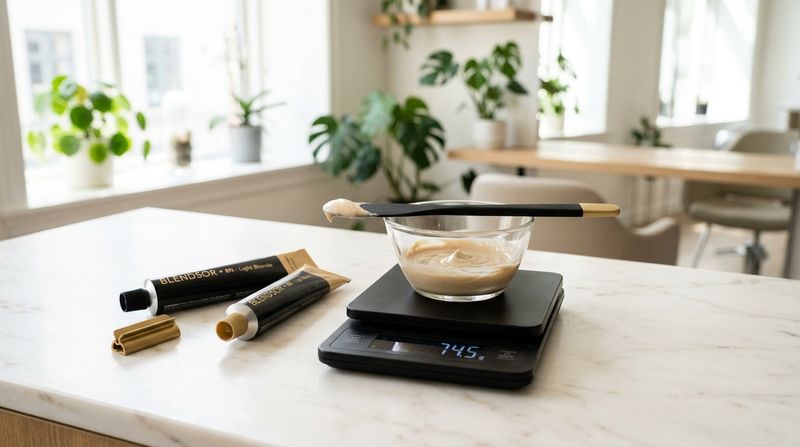
The table counts grams of color, developer not included, while tubes are sold in milliliters, so the exact answer depends on what your tube actually weighs out (how to check that once is just below). If your tube gives about 60 g, it just covers a full color on shoulder-length hair at average density and falls short on long hair, which takes 90 g (about 3.2 oz): a tube and a half.
A 100 ml tube (about 3.4 fl oz) that gives around 100 g reaches that long, average-density head. On extra-long hair (120 g, about 4.2 oz) or long, thick hair (around 117 g, about 4.1 oz), it falls short. If you’d rather read the result in ounces, the amount calculator switches between grams and ounces.
How do you measure hair dye without a scale?
Weighing is what makes a formula repeatable, so without a scale you want the unit that moves least: the tube itself. A whole tube or half a tube is easy to repeat, and some manufacturers write their mixes that way: in the Majirel how-to-use sheet it publishes for the US, L’Oréal talks about half a tube of one shade plus half a tube of another. The smaller the fraction you eyeball (a third, a quarter), the more the day’s steadiness of hand shows, and that’s where the second mix stops matching the first.
Until you have a scale, developer goes in a graduated cup or applicator bottle, which is the unit Wella uses for it in the standard ratio on its Koleston Perfect fact sheet: 60 g of color plus 60 ml of developer (about 2 fl oz). And the day you do have a scale in front of you, empty one tube of your brand into the bowl and note how many grams it gives. With that number, the table turns into tubes without guesswork.
What amount mistakes actually cost you money?
- Measuring in milliliters instead of weighing: a scale is more precise and more repeatable. Not every texture — cream, liquid, gel — weighs the same at equal volume, and measuring cups invite “close enough.” If you’re torn between developer textures, here’s the cream vs. liquid developer comparison.
- Mixing extra “just in case”: color starts oxidizing the moment it meets developer, and Wella, for one, is blunt about it in its Koleston Perfect leaflet: “Apply the coloring mixture immediately.” Leftover mix doesn’t keep. It’s a straight loss.
- Running short mid-application: forces you to eyeball a second mix in a hurry, with real risk the second batch won’t match the first. Between mixing a bit too much and running short, running short is the expensive mistake.
- Not building product cost into your service price: if you don’t know how many grams a service actually uses, you don’t know what it actually costs you. The table figure, multiplied across your monthly service count, is the difference between guessing your margin and knowing it — the hair coloring service pricing guide picks up that thread.
- Carrying over the ratio from your last line: you switched brands and the new one runs 1:1.5 where the old one ran 1:1. Always check the specific product’s data sheet.
When do you need more than the table says?
Two cases the table doesn’t capture, and both show up at the consultation, not mid-mix:
- High porosity: porous hair absorbs more product to saturate evenly. Working on compromised hair, budget extra and adjust the developer too — the developer for porous hair guide goes into detail.
- Resistant gray: this is less about extra grams and more about strategy — full processing time and, often, leaning on the natural base within the formula. The professional gray coverage guide covers how to formulate those cases.
That same consultation is where the checks no amount table replaces come in. An allergy test, 48 hours ahead: Wella asks for one before any color service in its Koleston Perfect leaflet (Wella PDF), and the guide to the 48-hour allergy patch test covers how to fit it in without losing the appointment. And on compromised hair, a strand test and an elasticity check before you commit the whole head: the strand shows you how that fiber takes color, and if elasticity fails, the question stops being how much dye to mix.
The table gets you to a starting point; the per-client adjustment — porosity, gray resistance, color history, technique — is exactly the math Blendsor runs in seconds with the consultation data in front of it.
Frequently Asked Questions
How many grams of hair dye do I need for shoulder-length hair?
About 60 g of color for average density on a full-color service — with developer added, the total mix runs around 120 g at a 1:1 ratio. For fine hair, drop to around 45 g of color; for very thick hair, go up to 90 g.
How much hair dye is used for a root touch-up?
The regrowth band is the same whatever the length, so a root touch-up runs about 20-30 g of color, unless the head is very dense. The calculator approximates it as 40% of full color — on long hair, that approximation tends to overshoot, so adjust down.
How much developer goes with hair dye?
It depends on your line’s ratio: at 1:1, the same grams as color; at 1:1.5, one and a half times as much. With 60 g of color in a 1:1.5 line, that’s 90 g of developer. The exact ratio lives on the specific product’s data sheet.
Can I save leftover mixed color for the next service?
No. Oxidation starts the moment you mix, and Wella, for one, asks for the Koleston Perfect mix to go on right away (“Apply the coloring mixture immediately”). Prep the exact amount you need: that’s the only way leftover mix doesn’t turn into waste.
Is it better to weigh hair dye or measure it in milliliters?
Weigh it, every time. A scale is more precise, more repeatable, and lets you log the exact formula for the next appointment. Volume measurements shift with product texture and with how steady your hand is that day.
Key takeaways
- Start from grams of color by length: 30 / 60 / 90 / 120 g at average density
- Thickness is a co-lead, not a footnote: from ×0.75 on fine hair to ×1.5 on very thick
- Adjust for service type: highlights ×0.5-0.7, toner ×0.6, single-step correction ×1.3 — multi-phase corrections phase by phase; and roots run about 20-30 g, because the regrowth band doesn’t scale with length
- Developer runs by line, not by brand: Koleston 1:1, Majirel 1:1.5 — always confirm on the specific product’s data sheet
- Weigh in grams on a scale; tubes are usually 60 ml, and emptying one into the bowl tells you how many grams yours gives
- Leftover mix doesn’t keep: calculating before you mix is a cost decision, not just a technical one
Run the numbers for your next service on the hair dye amount calculator and check the exact developer amount on the developer mix calculator.
From estimated grams to a formula that pays off
The table tells you how much to prep. In the Blendsor app, the AI factors in the full consultation — length, density, porosity, gray, color history — and returns the formula with amounts and ratios for your own brand, so every mix pays for itself. Formulate with Blendsor.
What service throws off your product math the most?
What happens if you miscalculate how much dye you need?
In the app, we ask you a question like this one, but about your own client.
Up for this week’s case? → More on global color →Related articles

Practice with our colorimetry tools
Calculators, neutralization wheel, AI consultation...
The Blendsor newsletter
Color techniques and trends for professionals. No spam.
You know the theory. What about today's case?
Send a photo to the Blendsor advisor and get an answer grounded in colour theory: toner, developer and timing, with the brands on your shelf.
Ask about your caseWritten by the Blendsor team
Professional hair colorimetry experts with experience in AI-assisted formulation. We combine color science, salon practice and technology to help colorists formulate with precision.