Is Your Color Fading? What to Tell Your Colorist
Color fade isn't something you diagnose by eye alone. What to tell your colorist, in what order, and which signs skip the queue entirely.
Blendsor
Blendsor Team

Color fade isn’t something you diagnose by eye alone. Before deciding something went wrong, one question comes first: what did they actually do to your hair, and how many washes ago? With that answer and a couple of specific photos, whoever colored it can tell what’s really going on — and until then, the one thing that matters is not buying anything.
Quick summary: color rarely fades for just one reason. Maybe the tone faded but the base stayed, maybe what was lightened is showing through again, maybe it’s just new growth, or maybe something outside — sun, chlorine, or metals in the water — changed it. Several of these can be happening at once. You don’t need to nail down which one: noting what you see and when it started is enough — and telling your colorist before you touch anything.
Has this happened to you? The color that looked perfect walking out of the salon, two or three weeks later, isn’t quite the same. And the appointment you’d planned for next month suddenly feels a long way off.
You didn’t do anything wrong. Hair doesn’t sit still between appointments — and before deciding what to do about it, it’s worth looking at what’s actually happening.
If what you’re prepping for is your NEXT appointment — and nothing’s gone sideways yet — the article you want is what to tell your colorist before coloring: what to bring to that first conversation. This one is for after: when something’s already changed and the appointment feels far off.
Before you get to shade at all, two things that aren’t a color question and don’t wait on anything:
- If you notice itching, stinging, or swelling on your face, eyelids, or scalp after a color service, that’s a doctor first — tell your colorist after. If your throat or tongue swells, you’re having trouble breathing, or you feel faint, don’t wait for any appointment: that’s an emergency, call 911 (999 in the UK).
- If your hair stretches like gum when wet, feels gummy, or snaps when you comb it, say that in the first line of whatever message you send — before the shade, before the photos.
Ruled those out? Here’s what to look at, in what order, and what not to touch until whoever colored it sees it.
Why might your color be fading?
It’s rarely just one thing. Two words you’ll see a few times here: tone is the shade laid on top — the cool, the gold, whatever you asked for; base is what’s underneath, what shows once that tone fades. The most common patterns:
| What you’re seeing | What it might be |
|---|---|
| Faded, less shiny, but the underlying color is still there | The tone faded, not the whole color |
| Yellow or orange showing through where it wasn’t before | Usually it was always there: lightening uncovers it, toning covers it, and toning washes out. If it reads more rusty-orange and lines up with a move or a change in your water, iron in the water can stain hair orange too — mention it the same way you’d mention copper |
| New growth at the root looks different | Just new growth — a normal touch-up |
| Grays showing that used to be covered | Gray coverage has worn off — a different service from a color touch-up |
| Greenish, especially at the ends or on very lightened hair | Could be copper from water (pool or plumbing), or the toner that was used if it was ash-based — telling those apart is a job for whoever colored it, so mention both the water and the toner either way |
| Generally dull with no clear pattern | Could just be everyday wear |
Notice “the color job was bad” isn’t on that list. Before you go there, there’s a question that comes first.
The color that was designed to fade
Before anything else, a question worth asking: what did they actually do? A gloss — a shine-and-tone service that doesn’t use a strong developer — or a demi-permanent color are built to fade gradually, and their life is measured in washes, not weeks: Redken lists up to 28 shampoos for its Shades EQ Gloss. That’s the manufacturer’s ceiling, not what happens every time — on very lightened or porous hair it can be well short of that, and that doesn’t mean it was done wrong.
That’s why “how long should this last” depends on your hair and your wash routine — and whoever colored it can give you a much better answer than a search engine.
Ruled that out? Keep reading — what follows is for when the change doesn’t match what you were told to expect.
What to report, and in what order
Five things, in this order — not because one matters more than the others, but because this is how the full story reads:
- What was done, and when — even if you don’t remember the exact date. Even better if you know how many washes it’s been.
- What you’ve put on it since: purple or blue shampoo, a box dye, a color-depositing mask, an oil.
- Photos — a specific way, covered below.
- Your wash routine: how often, what water temperature, whether you use heat without protection.
- Whether you’ve been in the sun a lot, in a pool, or if anything’s changed with your water — a move, a new water softener.
That last point deserves its own section, because it’s the one that trips people up the most.
Chlorine doesn’t turn hair green on its own
Chlorine doesn’t dye hair green by itself. What actually causes it is copper dissolved in the water — copper alone is enough, even with no chlorine involved. What chlorine does is speed it up: it oxidizes the hair fiber, and that more porous fiber lets in more copper. That’s why green isn’t just a swimming-pool problem.
As Magdalena Wajrak, senior lecturer in chemistry at Edith Cowan University, explains in The Conversation, hair soaked in water with copper — even without chlorine — turns green too.
In a pool, that copper usually comes from the algaecide used to keep algae down. At home, if it shows up, it usually comes from the plumbing. What’s worth reporting isn’t whether your water feels hard or soft, but what’s changed about it: a move, renovation work, a new water softener.
So there are two things worth mentioning if this sounds like your situation: whether you’ve been in a pool, with the date, to pin down when it started, and whether you swim regularly, because copper builds up with every swim. Mention it even if you don’t see any green yet, if you swim often — accumulated metal reacts with the developer in a color service, the result can come out uneven, and the hair goes into that service more fragile than it looks. That’s information that changes how your next appointment gets planned, and only you have it. This is exactly why purple toner doesn’t fix metal-related green — it needs a different kind of product, and that’s a call for whoever colors your hair.
The three photos that actually help
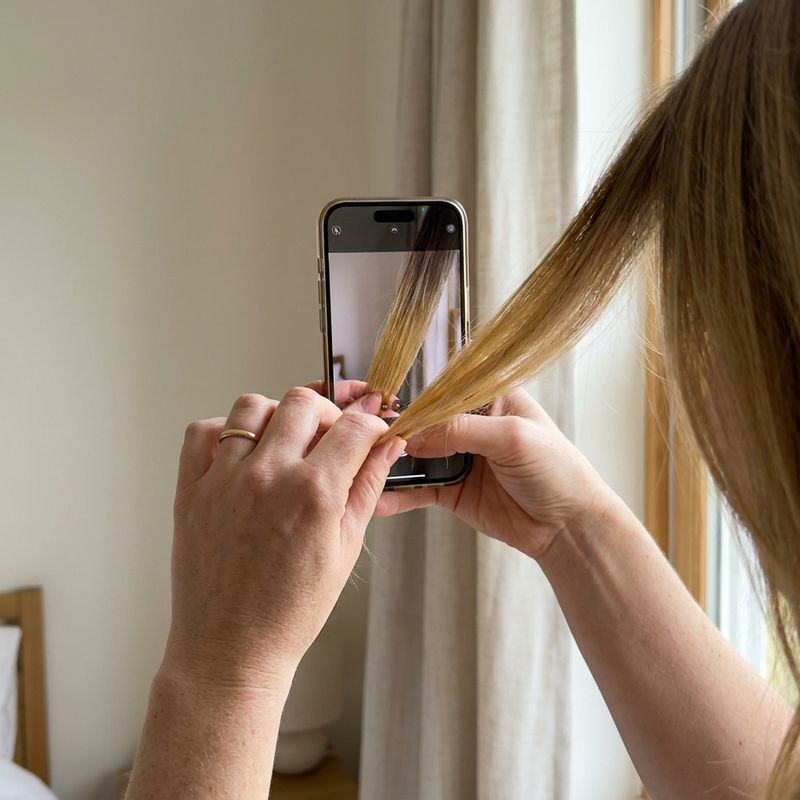
The comparison that doesn’t need words.
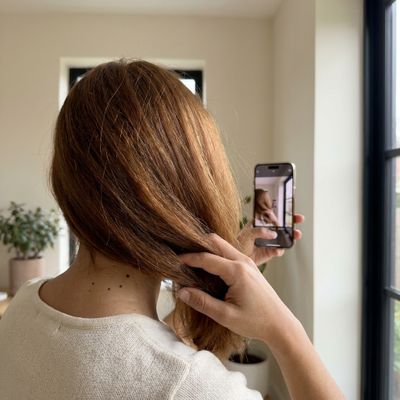
Dry, loose hair, facing a window — never flash, never the warm light of a bathroom — no filters, no portrait mode. You don’t need a white reference next to it: most white things at home — printer paper, towels — carry optical brighteners that tint photos blue, which is exactly the cast you’re trying to rule out.
With that: two photos. One of your hair loose, full length, and one the same way but lifting it to show the nape.
And a third, the most useful one and the one almost nobody sends: the photo from the day you left the salon, straight from your camera roll, so there’s something to compare against instead of guessing.
One more thing that helps and costs nothing: notice whether what you’re seeing changes when your hair is wet, and just report it as-is — “looks fine wet, dull dry” is useful information on its own. You don’t need to interpret what it means.
The message: what to include, not how to phrase it
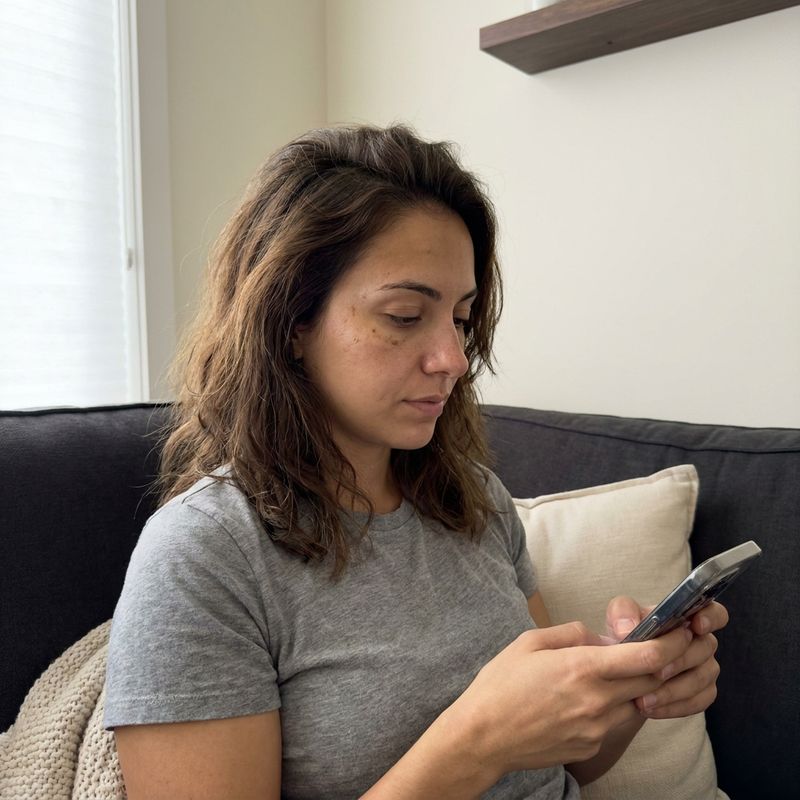
Everything together, in one message.
You don’t need to copy a script word for word — it reads like someone else’s message. What matters is that these pieces travel together, through the same channel you use to book, not a personal number:
- The three photos above.
- How many washes since the service, better than the exact date if you can’t remember it.
- What you’ve used since: purple or blue shampoo, box dye, a color mask, an oil.
- Whether henna, keratin, or a straightening treatment is anywhere in your hair’s history, even from a while back.
- Whether you’ve had a lot of sun, been in a pool, or anything’s changed with your water or routine.
And a line that never gets left out: don’t buy anything until they’ve seen it. If you book through an app where photos don’t always come through well, ask first where to send them. If you already have an appointment, close with a decision to make: “should we look at it at my [day] appointment, or does it need to happen sooner?” If you haven’t booked yet, swap that for something just as concrete: “when can I come by so you can see it?”
While you wait to hear back, there are things you can do without buying anything: use lukewarm water instead of very hot when you wash, skip heat styling if you can, cover your hair if you’re going to be in the sun, and if you’re getting in a pool or the sea, wet it with tap water first and rinse as soon as you’re out.
The products already in your bathroom
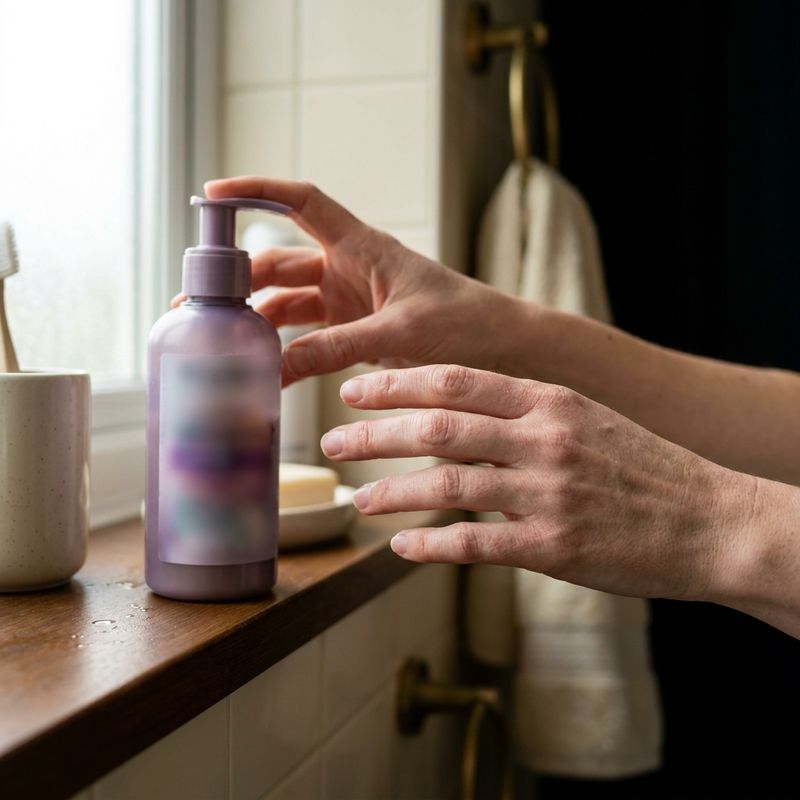
What’s already in your bathroom isn’t the problem — not mentioning it is.
The products you already have — a clarifying shampoo (which removes product buildup) or an over-the-counter chelating shampoo (which pulls out minerals and metal) — aren’t dangerous on their own. They’re made for home use, and how often you use them is on the label, not a fixed rule.
There are two moments to hold off and ask first before using them, though: the first week after a color service, because a clarifying shampoo can strip out what you just paid for; and if what you’re seeing is the very first thing on the table above — the tone faded, the base showing through — because a clarifying wash there strips out what little tone is left and you show up with less color than you started with. And if your hair is white or has no pigment, check what the label says: some specific treatments warn they’re not formulated for that.
And for the shampoo you use the rest of the time, between appointments: we read what eight color-safe shampoos actually promise and what the numbers on the front leave out. Short version: sulfate-free says which detergent is in the bottle, not that the bottle is gentle.
There’s a third case, different from those two: if what you’re seeing is greenish, or an orange that showed up after a move or a change in your water, say so before you use anything. A chelating shampoo is built for exactly that — but how much metal is actually there decides whether it’s a bathroom job or a salon one, and that’s worth letting your colorist weigh in on before you reach for it yourself.
What actually wrecks the result isn’t which product you use. It’s not mentioning it. Say it even if you don’t think it’s relevant — what matters isn’t that you used it, it’s that it’s on the record.
If you use purple or blue shampoo
According to Get the Gloss, color educator Jimmy Green (education manager for Pureology and Redken) recommends pausing purple shampoo before an appointment, so your colorist can see the real color underneath, not what’s masked by the pigment. In wash terms — which is really how hair tracks time — that’s the last two or three washes before your appointment, and mention it when you go.
If you already use it as-needed — when the yellow starts showing, not on a fixed schedule — keep doing that the rest of the time; the pause is only right before the appointment. And if your ends are more porous, pigment can build up there more than elsewhere — worth mentioning too if you notice a dull, faintly purple cast that won’t wash out normally.
You can see the full protocol, with loads by hair type, in purple shampoo for blonde hair: how much and how often.
If what you’re after is longer-lasting color overall, washing less often, rinsing with lukewarm water instead of very hot, and a sulfate-free shampoo all help — the change you’ll notice soonest is usually washing less, but neither of the other two is optional. The full picture is in how long does hair color last. If what you have is a gloss, its life is measured in washes — up to 28 for a Shades EQ, though on very porous hair it can be well short of that — so every extra wash costs it some of that lifespan: spacing them out is what shows the most in that case.
Frequently asked questions
Can I fix it myself while I wait for my appointment?
Don’t try to correct the color yourself. Any product with developer (the activating liquid mixed with dye) or bleach can react badly with what’s already on your hair, and your colorist normally needs to see exactly what’s going on before touching it. A clarifying or chelating shampoo is a different story — see above for when those are fine. What you can do, without touching the color, is what’s in the section above — protecting it from sun and heat — and gathering the information to report it. And a reminder: the allergy patch test is meant to happen 48 hours before every application, not just the first one — that’s the instruction on the product itself.
What if I don’t remember the exact date of my last service?
Say exactly that: “I don’t remember the day, but I think it was about a month ago,” or count the washes since then. An honest, approximate answer is useful; a made-up one isn’t.
Could purple shampoo be the reason it looks off?
It could be part of it, especially if you used it in the days right before checking your hair. The pigment it deposits reads as part of your color until it washes out. That’s why it helps to say when you last used it, not just whether you use it.
Do I have to wait for my appointment if I suddenly see green?
Depends on how much and where it’s coming from. If it’s a light tint, mention it through your usual channel and follow the guidance above. If it’s intense, shows up suddenly after a swim, or your hair is white or very light, don’t wait for the scheduled date — reach out right away and ask if the appointment needs to move up. Even if they can see you sooner, the color itself may still have to wait: any color service needs the 48-hour allergy patch test done first.
Does this apply if you colored it yourself with a box dye at home?
Report the same things if you’re bringing it in to be corrected: what product you used, when, and what you’ve put on it since. But don’t assume it’s the same service or the same price as a salon color touch-up — it may need a strand test first, and sometimes more than one session. The more your colorist has to work with, the fewer surprises for both of you.
Bottom line
- First, what’s not a color question: itching, swelling, or scalp irritation is a doctor’s call; hair that breaks or feels gummy goes in the first line of your message.
- Then, what was done and how many washes ago: a gloss or demi-permanent fades gradually by design, not by mistake.
- It’s rarely just one cause: tone, base showing through, new growth, gray coverage, sun, chlorine, or metals in the water can be happening together.
- Photos matter more than the exact date: dry, loose, window light, no filters, plus the day-of-salon shot to compare.
- Don’t buy anything until they’ve seen it.
One more thing before you send that message
If what’s on your hair is a professional brand and you want its name in another line’s terms, translate it in the hair color converter →. If it’s a box dye or a drugstore shampoo, no translation needed — just say it exactly as it’s labeled, name and brand. That’s enough.
Related articles
Practice with our colorimetry tools
Calculators, neutralization wheel, AI consultation...
The Blendsor newsletter
Color techniques and trends for professionals. No spam.
You know the theory. What about today's case?
Send a photo to the Blendsor advisor and get an answer grounded in colour theory: toner, developer and timing, with the brands on your shelf.
Ask about your caseWritten by the Blendsor team
Professional hair colorimetry experts with experience in AI-assisted formulation. We combine color science, salon practice and technology to help colorists formulate with precision.