Purple Shampoo for Blonde Hair: How Much and How Often
Purple shampoo holds the cool blonde you paid for — it doesn't create it. How much pigment your hair needs, how often, and how to avoid dull hair.
Blendsor
Blendsor Team
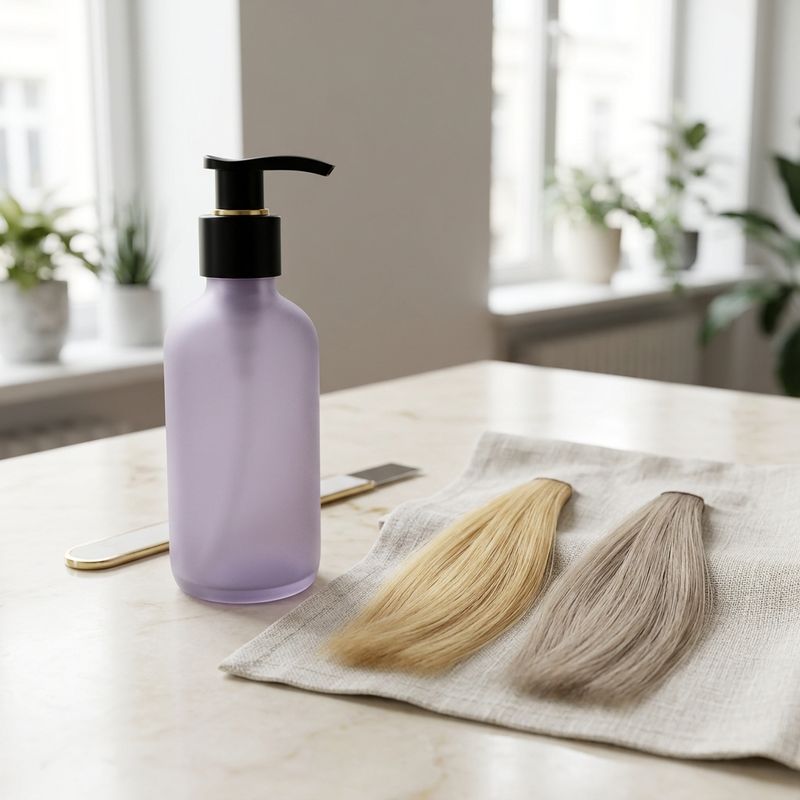
You left the salon with a clean, cool blonde — exactly what you asked for. Three or four washes later, the mirror hands you back a straw-yellow cast that wasn’t there on day one. So you buy the purple shampoo and the questions start: which one, how long, how often?
First, the sentence that puts everything else in order: purple shampoo holds a blonde, it doesn’t create one. It deposits violet pigment and mutes the yellow cast while it lasts, but it doesn’t lighten, doesn’t truly dye, and can’t stand in for the work you paid for. Used well, it’s what keeps a fresh blonde looking fresh for weeks longer than it otherwise would. It will not turn any hair cool blonde from scratch.
And the second sentence — the one almost nobody tells you: you don’t pick the bottle by brand, you pick it by your hair. Two people looking at the same blonde in the mirror can need opposite pigment loads. That’s what this guide is about. If you’d rather compare the bottles themselves first, we put what eight brands actually publish about their own products into one table — and their timings turn out not to measure the same thing.
The quick version: purple shampoo carries direct violet pigment that sits on the hair and washes out over time. It neutralizes the yellow cast of lightened blonde hair; against an orange cast it’s the wrong product. The more porous your hair — more lightening sessions, more open ends — the more pigment it grabs, so it needs less load and less frequency. Use it by signal (when yellow starts to show), not by schedule.
What purple shampoo actually does
It carries direct pigment: pre-formed color, no developer, nothing that changes the structure of your hair. The pigment itself doesn’t lift, doesn’t react with your color, and neither repairs nor damages the fiber. It deposits, and it washes away. Some bottles pair that pigment with conditioning or bond-building ingredients; that’s the rest of the formula working, not the violet.
Why purple? It’s yellow’s optical opposite: they sit across from each other on the color wheel and, as Wella Professionals’ color theory lays out, they cancel each other visually when layered. The pigment doesn’t erase the yellow in your hair — it offsets it while it’s there. That’s why the effect lasts exactly as long as the deposit, and why the warmth creeps back when you stop.
One detail changes how you should use it. According to Goldwell’s technical documentation on direct dyes, these pigments sit mostly in the outer layers of the hair — but they gain intensity in more porous structures, where they can travel deeper. Translated to your shower: on a heavily lightened blonde with open ends, the risk isn’t too little effect. It’s too much.
If your blonde also fades unusually fast between appointments, that’s a separate conversation — water, sun, wash frequency — and you can run your case through the color longevity calculator.
Purple or blue? Read the cast, not the bottle
The rule comes straight from color theory 101: purple cancels yellow, blue cancels orange. The deciding factor isn’t the blonde you want — it’s the cast you can see right now, on dry hair, in window light. The warm bulb in your bathroom pushes every head toward yellow and will make you choose wrong.
The test you can actually run in the mirror: hold a sheet of white paper or a white towel next to the strand, dry, in window light. Against pure white, the cast gives itself away.
- Seeing lemon yellow, butter, straw, light gold? → purple. It’s your product. Keep reading.
- Seeing honey, caramel, peach, a muted or “dirty” gold? → stop here. That gold has orange mixed in underneath, even if you’d call it gold. Purple would only cover the yellow part and leave the orange showing, muddied. Yours is blue — or an appointment: we walk through it in blue shampoo for brunette hair.
- Seeing carrot, brick, copper? → outright orange, blue territory, same guide as above.
- Seeing green? → there are two possible culprits, and it’s worth telling them apart before buying anything. If you swim or have very hard water, it’s usually copper and mineral buildup — a chelating shampoo’s job. But green also shows up from too much cool toner over residual yellow — Wella lists it among the symptoms of over-toned hair — and in that case a chelating wash would strip your good toner too. If you don’t come from the pool, let whoever does your color take a look.
Still unsure? Use your history: if you were lifted to light blonde or platinum, you’re almost certainly in yellow (purple). If you started dark and sit at dark blonde or lightened brunette, you almost certainly keep orange underneath (blue) — however “gold” it reads in the mirror.
One strand can hold two answers at once: mids still brassy-orange and ends already straw-yellow. No single bottle solves that case — it’s a ten-second conversation with whoever does your color, not a blind purchase.
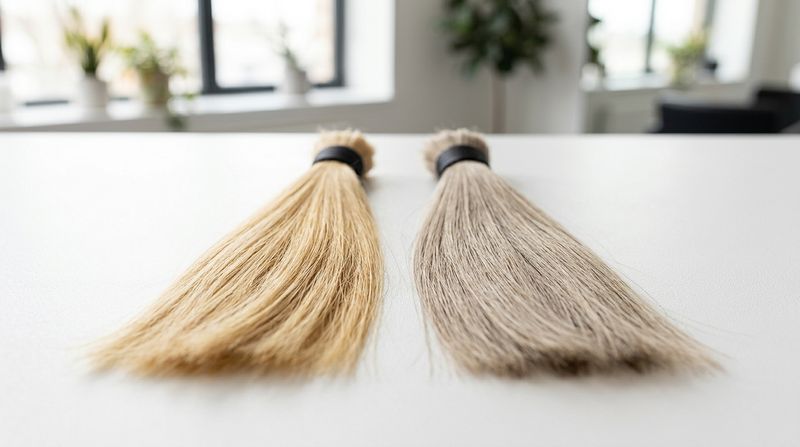
Left, straw yellow: purple territory. An orange or greenish cast calls for a different product.
The load rule: pick the bottle for your hair
Here’s what the “10 best purple shampoos” lists never tell you: the variable that matters isn’t the brand, it’s how much pigment the bottle carries versus how much your hair needs. That need is set by porosity, through a rule salons apply instinctively and almost nobody applies at home:
Your most porous section sets the ceiling. Usually, your ends. If a bottle is too loaded for them, it’s too loaded for you — even if the rest of your hair could take it.
Three takeaways follow from that rule, and they prevent most disasters:
- Platinum and heavily lightened blondes grab MORE, not less. The intuition of “my blonde is very light, I need the strongest bottle” is exactly backwards: you need less load or less time. And sharpen the criterion, because it isn’t how light it looks — it’s how many times, and how many levels, that section has been lifted. The lightest section is usually the most porous, but not always: mids carrying three years of overlapping highlights can be more open than a recent platinum done in one pass over an already-light base.
- Gray hair and fine highlights play by their own rules. Gray has no background pigment to hide behind: whatever you deposit shows at full strength. Though grays aren’t all alike either — there’s a fine, soft gray that tips into lilac first, and a thicker, wiry gray that barely takes anything. If yours is the second kind, don’t push with more minutes: move up a tier. And the highlights that have been through the most lightening rounds — usually your finest and lightest — are the most porous section on your head: the first to tip while everything else looks fine.
- A strong, minimally lightened blonde barely registers the gentle bottles. If your hair is closed and healthy and the yellow is timid, a low-load shampoo may do almost nothing — and moving up one step is fine.
With that rule, the market sorts itself. These are the load tiers, with an example in each:
| Pigment load | Who it’s for | Example |
|---|---|---|
| Gentle | Porous ends, platinum, gray hair, first purple shampoo | L’Oréal Blondifier Cool — the only one in the range that declares violet pigment on its official page; Gloss is sold on shine |
| Medium | Regular upkeep — pick by the state of your hair, not by which bottle sounds stronger | Redken Color Extend Blondage, whose official page works with a 3-5 minute second lather, if your blonde is healthy — or Olaplex No.4P, a single application at 1-3 minutes, if it’s also over-processed |
| High | A stubborn yellow the medium bottles won’t shift — and only on hair that isn’t porous | Fanola No Yellow. The genuinely heavy one: its pigment is progressive-release, so it keeps getting stronger the longer it sits |
Notice the Blondifier detail: only the Cool variant declares violet pigment on its official page — Gloss is sold on shine. It’s the perfect example of why “just buy brand X” is bad advice — a toning shampoo and a shampoo sold on shine live inside the same product line.
And watch a detail nobody checks: not every bottle declares a time. Redken says 3-5 minutes on the second lather; Fanola only says “a few minutes.” When the bottle gives you no number, the hidden-strand test stops being optional.
How to use it: three rules and one signal
The whole protocol fits in four lines:
- First time, run a test: a hidden strand of your ends, underneath at the back, diluted with your regular shampoo. It costs you one wash and tells you how hard that bottle hits YOUR hair.
- Wash first, tone second — following your bottle’s protocol. On hair with buildup, pigment grabs unevenly, so the first wash is your regular shampoo. The toning pass depends on the product: Redken tones on a brief second lather, Olaplex in a single application. The timing: the minimum on the label, with a clock.
- Check your ends first when you rinse. They’re your most porous section — the first to signal that’s enough.
- Frequency runs on signal, not schedule: use it when yellow starts to show, not “every Monday.” Wella says it plainly in its guide on purple shampoo use: overuse, or leaving it too long, ends in dull hair with a purple tinge.
One prosaic detail straight from the manufacturers’ own directions: gloves — or at least a quick hand rinse. The pigment stains nails too.
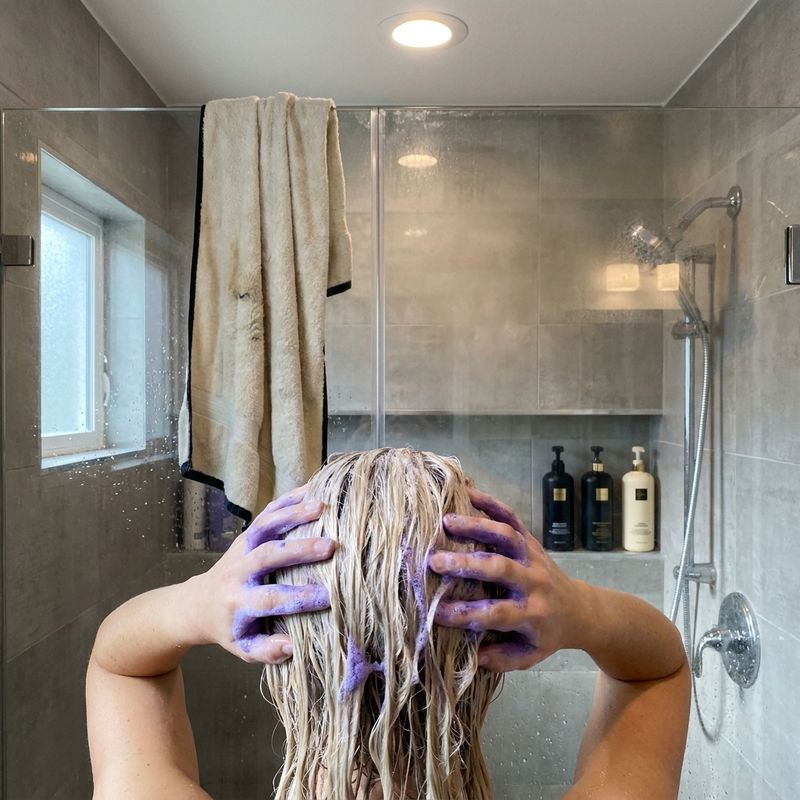
Purple shampoo isn’t applied — it’s distributed. The lather is the pigment’s vehicle.
And the golden rule for when it doesn’t seem to work: longer doesn’t neutralize more, it over-deposits. Once the yellow is offset, the leftover pigment has nothing to cancel — it just builds up, right where you’re most porous. If diluted at the minimum time isn’t moving it, that cast is past what a shampoo can do. That’s an appointment, not a stronger dose.
When it goes wrong: the four failure modes
The purple-shampoo disaster is almost never “purple hair.” It shows up in four ways, in order of how often:
- Your blonde goes flat. It loses light and shine, looks dirty, like a film of ash. This is the first sign of over-depositing and the most ignored one, because nobody connects it to the toning shampoo. Wella describes it the same way in its guide to over-toned hair: flat, dull, with a purple tinge.
- A muddy, grayish-brown cast. That’s the signature of purple used on an orange base: they don’t cancel, they muddy. If this is you, purple wasn’t the call — scroll back two sections.
- Outright lilac. It shows up in your most porous spots: very open ends, grays, fine highlights. The rest of the head can look perfect.
- A patch map. From applying the product concentrated and not distributing it: the pigment stays where it landed.
What to do depends on which one is yours. For flat hair or outright lilac (1 and 3): stop using it — the step everyone skips —, give it two or three normal washes, and only then consider ONE clarifying wash, knowing its price: it also strips the professional toner you paid for; with an appointment coming up, better to let your colorist see it first. For the muddy grayish-brown (2), no wash fixes a wrong pigment: that’s an appointment. For the patch map (4), the fix is in the application: next time, emulsify and comb the product through. Wella explicitly advises against home remedies for reversing over-toning, and the full map of these mistakes is in the most common toning mistakes.
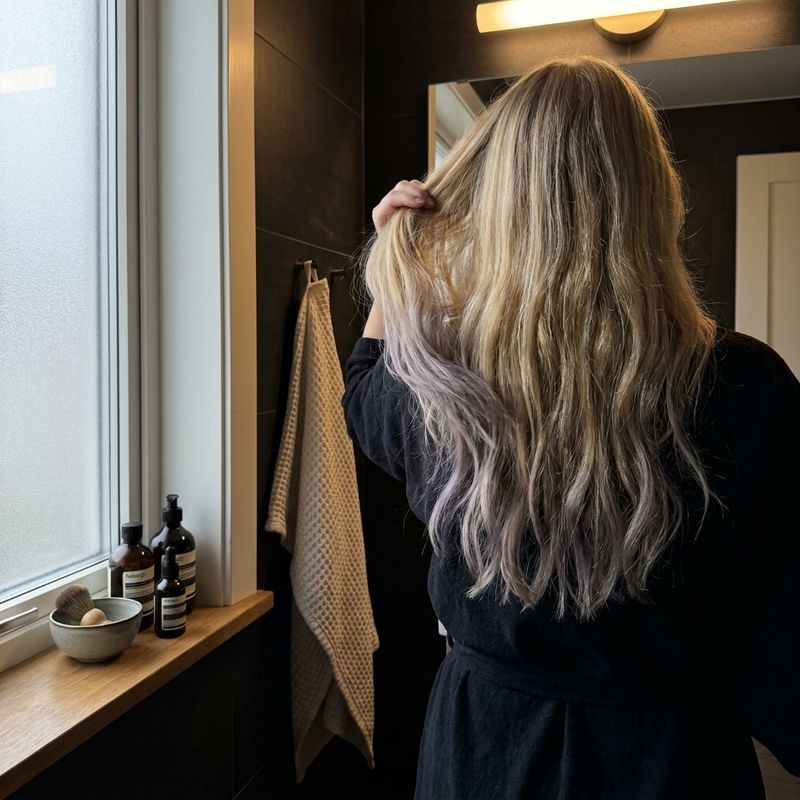
Overload starts as lost shine; the lilac tint is the confirmation, and it shows first wherever hair is most porous.
What salons know and rarely say out loud
- Stop the purple shampoo 5-7 days before your appointment, and say so. Hair loaded with violet reads cooler than it is; the formula gets built on that false reading, and three weeks later — when the pigment washes out — the real yellow surfaces. It’s the most common involuntary sabotage there is.
- Purple pigment can’t tell your cast from your gloss. It deposits on top of everything — including the toner you just paid for, clouding it.
- The first 48 hours after your service: nothing. Let the color settle before layering pigment on top.
- If you want to know what shade you actually have before debating it from memory: the hair color converter gives you your shade’s equivalent in any brand, and the full logic of why blondes drift yellow is in how to get a cool blonde without orange.
Frequently asked questions
Does purple shampoo remove yellow from blonde hair?
It offsets it while you use it — it doesn’t remove it. If the yellow cast is mild, it mutes it and keeps it from building. If your blonde has drifted to a deep yellow, a shampoo’s pigment falls short and the job belongs to a professional toner. And if what you’re seeing reads orange rather than yellow, purple isn’t a weaker fix — it’s the wrong pigment. That cast belongs to blue.
How often should I use purple shampoo?
By signal: when you notice yellow starting to show. On porous blonde hair, once a week is usually plenty; on strong hair with a gentle formula you may need a bit more. If you see no difference at the minimum time, that’s past what a shampoo can do — that’s an appointment, not a stronger dose.
Does purple shampoo work on gray and silver hair?
Yes — the yellowing of gray hair is exactly its territory, with two caveats. Gray has no background pigment, so it shows everything you deposit at full strength: start with a gentle load and minimum timing. And grays aren’t all alike: a fine, soft white fiber takes pigment first and tips into lilac, while a thick, wiry gray barely takes any — if yours is the second kind, more minutes won’t help; a higher load tier will. That mix is also why the result can come out patchy rather than uniform.
Why did my hair turn dull or lilac?
Pigment buildup: too much time, too much frequency, or too much load for your porosity. Stop using it and give it two or three normal washes. Before reaching for a clarifying shampoo, remember it also strips part of your professional toner — with an appointment close, wait.
Does purple shampoo damage hair?
The violet pigment itself doesn’t: it deposits and washes out without touching the fiber’s structure — Wella is explicit on this. What can dry hair out is the same thing as with any shampoo: a strong cleansing base used too often. If your lengths feel rough, space it out and alternate with your regular routine; the pigment isn’t the culprit.
Does it work if my blonde is natural, never lightened?
Barely. The yellow that purple shampoo offsets is the undertone exposed when hair gets lightened. A natural, unbleached blonde has a more closed cuticle and no exposed undertone — you’ll notice the effect far less, and it rarely needs it at all.
Recommended products, by pigment load
What you need at home is one bottle — the one in the right tier:
- Gentle load — porous ends, platinum, grays, or your first toning shampoo: L’Oréal Blondifier Cool. Make sure it says Cool: it’s the only one in the range that declares violet pigment; Gloss is sold on shine.
- Medium load — regular upkeep. Two bottles, and the choice is about your hair, not the label: Redken Color Extend Blondage with its brief second-lather ritual if your blonde is in good shape, or Olaplex No.4P — one application, 1-3 minutes — if your hair is also over-processed and you’d rather have bond-building ingredients working alongside the pigment. Different protocols, so follow the bottle you buy.
- High load — a stubborn yellow that the medium bottles won’t move, on hair that isn’t porous: Fanola No Yellow. Heavily pigmented, and the dilute-it advice counts double here: the pigment is progressive-release, so it keeps intensifying for as long as it sits — and its bottle declares no exposure time, so on open ends the margin is a very few minutes. Strand test first, no exceptions.
- Prefer to browse and compare: see purple shampoos for blonde hair — and choose by load tier, not by the bottle’s marketing.
This article contains affiliate links. If you purchase through them, we receive a small commission at no additional cost to you. We link categories and products that fit what the article explains; the final pick is yours and your colorist’s.
The short version
- Purple shampoo holds a blonde, it doesn’t create one. It offsets yellow for as long as the deposit lasts.
- Purple for yellow, blue for orange. Decide by the cast you see, on dry hair in daylight. Orange or greenish = different guide.
- Pick the bottle for your hair, not the brand: your most porous section sets the ceiling, and the lighter and more processed your blonde, the less load it needs.
- By signal, not by schedule. Longer doesn’t neutralize more: it over-deposits.
- Stop 5-7 days before your appointment and mention it. Hair loaded with violet gets formulated wrong.
If you’re a colorist: the handoff that prevents most rescues fits in two sentences. Prescribe the load tier by the strand’s most porous section — usually the lightest, not always; never by the level of the formula you just applied — and hand over the bottle with its explicit ceiling: signal over schedule, the bottle’s own protocol, minimum time. And build the 5-7 day stop before the appointment into the handoff itself: so the color you read at the next visit is the real one.
Find your exact shade without guessing
Want to know what shade you actually have — and its equivalent in any brand — before your next appointment?
Check it in the hair color converter →
What’s your experience with purple shampoo: does it hold your blonde, or dull it?
Related articles
The Blendsor newsletter
Color techniques and trends for professionals. No spam.
The second opinion, in your pocket
Photo, question, an answer grounded in colour theory. And every formula saved to your client's card.
Start with BlendsorWritten by the Blendsor team
Professional hair colorimetry experts with experience in AI-assisted formulation. We combine color science, salon practice and technology to help colorists formulate with precision.