Liquid Noir hair color: vinyl black without red reflection
Liquid Noir: the reflective vinyl-effect black dominating 2026. Cross-brand formulas, pre-pigmentation technique and oxidation control for professional colorists.
Blendsor
Blendsor Team
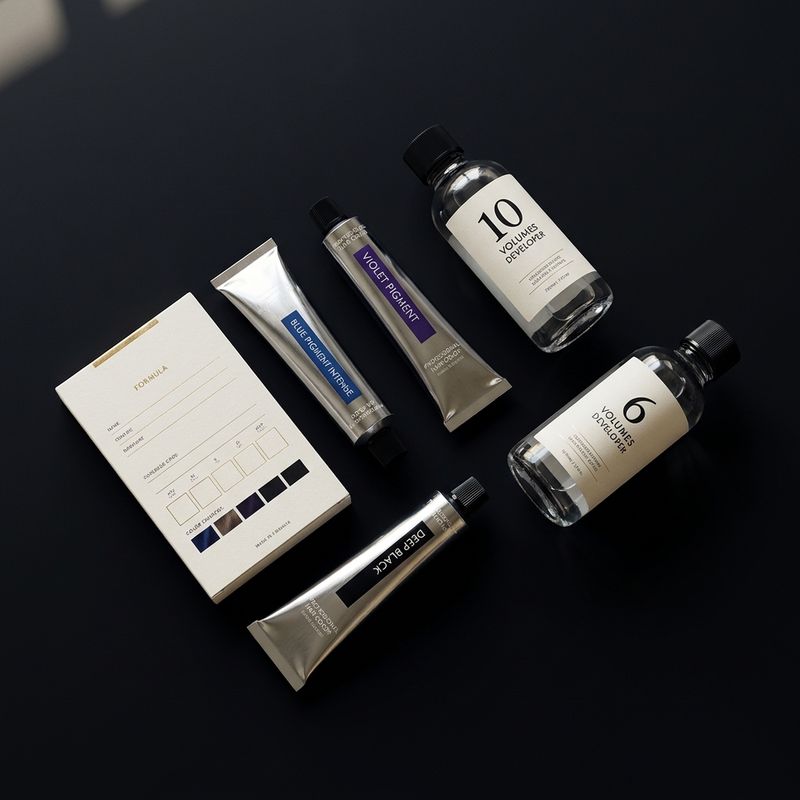
How many times have you applied black over a lightened base — everything by the book — only to step outside and see that red-brick reflection that was absolutely not part of the plan?
If you work as a professional colorist, you know exactly what this is. The client arrives with a reference image of a black that looks almost like wet vinyl, metallic and deep. You formulate with your best tools. And the result, under natural light, shifts toward a red-copper that nobody planned for.
The trap is not in the tint. It is in the lifting base that was left underneath it.
Today we are breaking down Liquid Noir: the vinyl-reflective black that has held its place through 2026, why the central contradiction of this trend is that to achieve the deepest black you apply less blue pigment — not more — and how the chemistry of the process explains everything.
Quick summary: Liquid Noir is a deep black with a vinyl reflective finish formulated with blue-violet pigments (codes 1.10/1-1/0.88) over a base pre-pigmented with 4N (20 vol). The fatal error is applying black directly over bleached hair: the oxidation of the yellow-orange base activates warm reflections that shift toward red. The correct protocol uses two steps in the same session and closes with 6-10 volume developer in the final black step.
What is Liquid Noir and why is it not a conventional black?
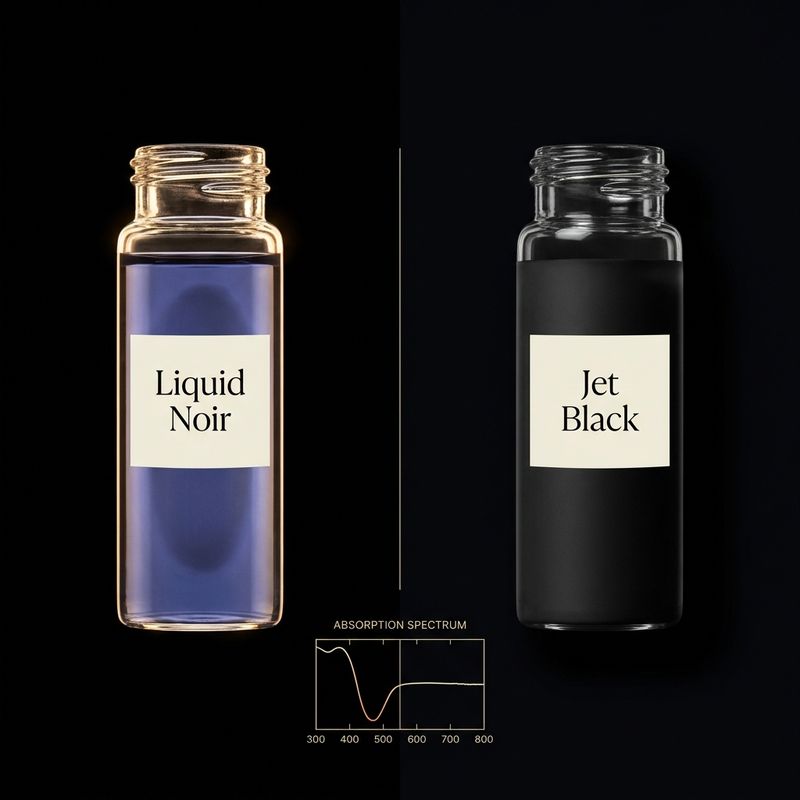
Liquid Noir (liquid black) is a 2026 macrotrend that redefines black hair color. This is not the flat, heavy black of classic jet black. Liquid Noir has its own signature: a vinyl almost-metallic reflective finish that absorbs red light and returns a high-definition, dark shine.
It started as a winter shade and it did not stay there: by mid-2026 it has carried into spring and summer, with the emphasis moving from “how dark” to “how reflective”. That shift matters in the chair, and we come back to it further down.
The technical difference is in the pigment composition:
- Matte jet black: neutral or brown-base pigments. Absorbs all reflections relatively evenly.
- Liquid Noir black: high-concentration blue-violet pigments (.10/.1/-1/0.88 depending on brand). These actively absorb light in the orange-red spectrum (the complementary of blue) and return a cold, dark, almost liquid shine.
It is exactly the effect you see on the high-fashion editorial references that keep filling Pinterest boards: a black that under light appears wet, alive, with zero warm reflection.
Demand in the salon has risen sharply. And with it, the errors.
The chemical trap: why red reflection appears
This is the core technical point every color professional needs to understand before formulating.
When hair is lightened, melanin degrades progressively following the standard colorimetry lifting sequence: red → orange → yellow → pale yellow. Each level of lightening leaves a residual underlying tone.
A base that has reached level 7-9 (lightened blonde) has a yellow or yellow-orange underlying tone in the cortex. It is not “clean”: there is residual oxidized eumelanin and partially decomposed pheomelanin.
When you apply Liquid Noir black directly over that base — using a 20 or 30 volume developer — here is what happens:
- The developer activates the blue-violet pigments in the tint.
- Simultaneously, that same developer keeps working on the residual orange underlying tone in the cortex.
- Blue from the tint + orange from the underlying tone = partial neutralization toward red-brown (complementary colors that produce a warm tertiary when mixed).
- Under warm light (sunlight, amber LED), that red reflection becomes prominent.
The solution is not adding more blue pigment. Adding more blue only intensifies the reaction in both directions. The solution is to neutralize the underlying tone before the black reaches the cortex.
That is where pre-pigmentation comes in.
Technical note on developer volume: The intensity of the red reflection is directly related to the developer volume used in the final step. A 20 volume (6% H2O2) developer over an un-pre-pigmented blonde base activates enough residual orange tone to produce visible red reflection. A 10 volume (3%) or 6 volume (1.9%) developer over a correctly pre-pigmented base deposits the black pigment without additional activation of the underlying tone, resulting in a cold, vinyl finish.
Before you mix: the two tests you never skip
Liquid Noir is built with permanent colour, and blacks carry some of the highest loads of paraphenylenediamine (PPD) and related dyes on the chart. This is the colorant group that causes most sensitisation reactions, and a client can react during one service even after years of colouring without incident.
- Allergy test, 48 hours before the service. This is not paperwork: it is the only way to anticipate a reaction. Do it every time, including with regular clients, and all the more so with an intense black formula.
- Strand test, on the day. Especially if the base has been lightened or has chemical history: run the full protocol (pre-pigmentation included) on a strand from the most processed area and check the real result before touching the whole head.
If the base is bleached, also assess the elasticity of the fibre before stacking two processes: if the hair stretches and does not spring back, postpone the service. No vinyl finish is worth a mid-length breakage.
The correct protocol: two steps in one session
Step 1: Pre-pigmentation with 4N base
The goal of this step is not to deliver the final color. It is to fill the cortex with artificial neutral-dark eumelanin so that the lifting base does not interfere with the final black.
Universal pre-pigmentation formula:
- 4N base (dark neutral brown) from any brand
- 20 volume developer (6% H2O2)
- Standard 1:1 ratio
- Application root to ends on dry hair
- Time: 20-25 minutes without heat
Do not rinse. Do not wait for a final result. When the time is up, remove excess with a tissue without rinsing with water (or with a very fast rinse depending on the brand protocol), then move directly to step 2.
The 4N base leaves a dull dark brown visible on the hair. That is exactly the correct starting point for the Liquid Noir black.
Step 2: Final Liquid Noir black
With the underlying tone neutralized by pre-pigmentation, now apply the target black.
The central contradiction principle: the higher the blue pigment concentration in the final formula, the lower the developer volume needed. With the base prepared, a 6-10 volume developer is sufficient to deposit the pigment and generate the vinyl effect. The low volume guarantees pure deposition without aggressive activation of any residual underlying tone.
Processing time: 25-35 minutes depending on the brand and the percentage of gray hair.
Cross-brand table: Liquid Noir formulas by brand
| Brand | Liquid Noir Black Formula | Recommended Developer | Reflection Code |
|---|---|---|---|
| Wella Koleston Perfect | 1/0 + 0/88 (4:1 ratio) | 10 vol (3%) | 0/88 = intensive blue-violet |
| L’Oréal Majirel | 1.10 | 10 vol (3%) | .10 = blue-ash |
| Schwarzkopf IGORA Royal | 1-1 | 6-10 vol (1.9-3%) | -1 = blue-ash |
| Alfaparf Milano | 1NB (Natural Blue) | 10 vol (3%) | NB = natural blue base |
Important note on the Wella ratio: the 4:1 ratio (1/0 + 0/88) is not arbitrary. The 1/0 contributes dense black mass; the 0/88 contributes the blue-violet intensifier that generates the vinyl effect. More than 25% of 0/88 on a non-pre-pigmented base can accentuate a red-violet reflection rather than suppress it. With prior pre-pigmentation, the ratio works cleanly.
According to Wella Professionals technical protocols, mixing reflection intensifiers (0/ series) over dark bases always requires evaluation of the prior lifting base to predict the result under natural light.
Why the central contradiction is real: less blue, more effect
This is the most counterintuitive point — and the one that separates an editorial result from an uncontrolled red reflection.
When you apply Liquid Noir over a base already pre-pigmented with 4N:
- The underlying tone is neutralized: the 4N has deposited artificial eumelanin that blocks interference from the yellow-orange base.
- The black deposits over a uniform dark substrate: the cortex receives the blue pigment without any “competition” from warm underlying tones.
- A low developer (6-10 vol) deposits without activating: the pigment enters the hair structure through affinity, not through aggressive oxidation.
The result: the Liquid Noir black reaches the cortex with its entire blue-violet signature intact, uncorrupted by the underlying tone toward red. The vinyl effect appears because the pigment is pure — not because you saturated the formula with more blue.
If instead you saturated the tint with more 0/88 or -1 without pre-pigmentation over lightened blonde, what you would get is more developer activity over an increasingly interfered orange base, and the final result would be a black with more intense violet-red reflection, not a colder one.
That is the trap. And the solution is in the substrate, not in the formula.
Scenarios by starting base: protocol by level
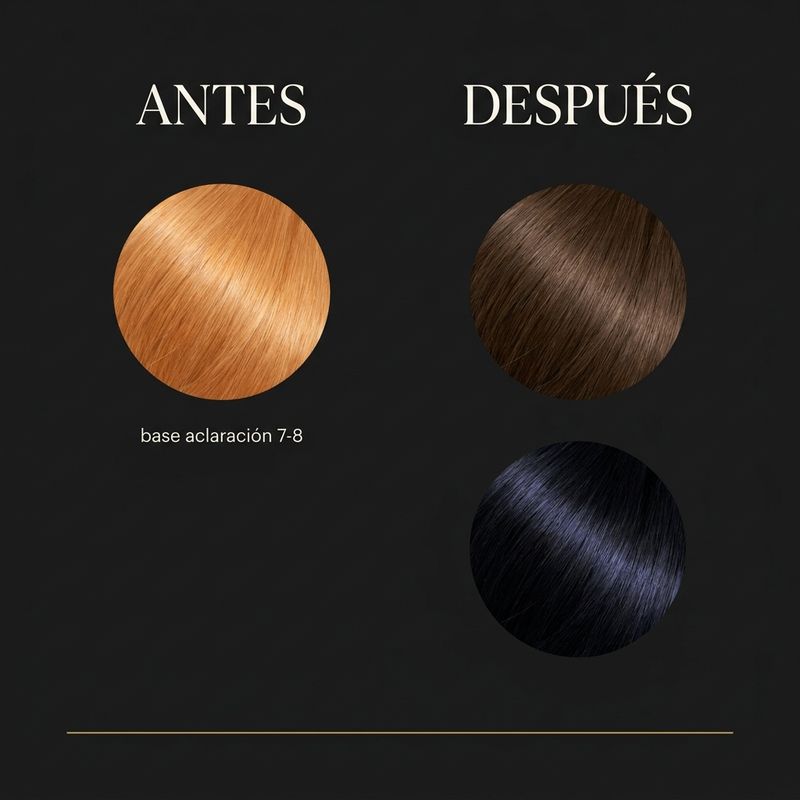
Not all bases require the same level of preparation. The decision depends on the lifting base you have in front of you.
Base level 4-5 (dark brown to medium brown)
Natural eumelanin is still present in significant quantity. The lifting base is red-orange. In this scenario:
- Necessary but brief pre-pigmentation: apply 4N base with 20 vol for 15-20 minutes
- Final black: any Liquid Noir formula from the table with 10 vol, 25 min
- Expected result: black with high coverage and clean vinyl reflection
Base level 6-7 (light brown to dark blonde)
Transition zone. The lifting base is orange-yellow. Risk of red reflection is medium-high without pre-pigmentation.
- Standard pre-pigmentation: 4N + 20 vol, 20-25 minutes
- Final black with reduced developer: 10 vol, 30 min
- Check under natural light before finishing: under cool LED the result looks correct; under warm light a copper reflection may appear if pre-pigmentation was insufficient
Base level 8-10 (bleached blonde to platinum)
Maximum risk zone. The lifting base is yellow to pale yellow. The cortex has minimal eumelanin.
- Mandatory pre-pigmentation: 4N + 20 vol, 25 minutes. Non-negotiable.
- Final black with minimum developer: preferably 6 vol (1.9%). If the brand does not offer 6 vol, mix 10 vol with distilled water at a 1:1 ratio to obtain approximately 5-6 effective volumes.
- Extended processing time for final black: 35-40 minutes for maximum deposition without active oxidation of the underlying tone
- Key tip: if starting from a highly lightened base (level 9-10), consider pre-pigmenting with 3N instead of 4N to create a darker, more controlled substrate
Maintaining the vinyl effect
Liquid Noir is not just an application technique: it is a result that requires an active maintenance protocol to preserve the vinyl effect over time.
Factors that dull the vinyl shine:
- Sulfate shampoos: open the cuticle and release the blue pigment faster than the black base. Result: a black that shifts to brown-ash within weeks.
- Hard water: mineral deposits from hard water build up on the cuticle and diffuse the reflection. Recommend a shower filter or acidified water (pH 4.5-5.5).
- Heat without protection: flat irons and curling irons on blue-pigmented black accelerate pigment oxidation and the shift toward red on bases with residual underlying tone.
Recommended maintenance protocol:
- Sulfate-free shampoo from the first wash
- Blue/violet color-depositing mask every 2-3 washes
- In-salon maintenance gloss every 6-8 weeks: a cold demi-permanent gloss with its own low-volume activator (Color Touch + Emulsion 1.9%, or Dia Richesse/Dia Light + DIActivateur 6 vol), 15 minutes. If you want extra blue, add 0/88 as a mix into the base — never use it on its own
This periodic gloss protocol is equivalent to what is applied for espresso brunette to maintain the shine on deep brown tones, and can be adapted the same way using low-oxidation demi-permanent products.
How the trend has shifted through 2026: the gloss carries the look
Liquid Noir arrived as a winter shade and has stayed in the chair through spring and summer 2026, but what clients ask for has moved. The request is less “as dark as possible” and more “as reflective as possible”: a deep black that reads luminous under summer light instead of heavy. That changes the priority in the service.
What this means when you formulate:
- The gloss is no longer optional maintenance — it is part of the result. Plan the in-salon gloss at 6-8 weeks from the first appointment and tell the client so. The vinyl finish is what fades first; the depth stays.
- Condition drives the reflection. A cuticle roughened by lightening scatters light and kills the vinyl effect no matter how correct the pigment is. Bonder in the pre-pigmentation step and an acid closing treatment (pH 4.5-5.5) do more for the finish than any extra blue.
- On a naturally dark base (level 1-3), a clear or blue-violet gloss with no developer can already deliver the look — no permanent black needed. Reserve the full two-step protocol for lightened bases, where the underlying tone is the real problem.
Frequently asked questions about Liquid Noir
What is Liquid Noir and how is it different from jet black hair color?
Liquid Noir is a deep black with a vinyl reflective finish, formulated with blue-violet pigments that absorb red light and return a cold, almost metallic shine. Matte jet black absorbs all reflections evenly and lacks the liquid dimension of Liquid Noir.
Why does red reflection appear when applying black over bleached hair?
When blue pigment oxidizes over a yellow-orange lifting base (levels 7-9), the developer partially activates that warm underlying tone. Blue and orange are complementary colors that neutralize toward red-brown under warm light. Pre-pigmenting with 4N before the final black neutralizes that interference.
What developer volume should be used for Liquid Noir?
Pre-pigmentation: 20 volume (6% H2O2), 20-25 minutes. Final Liquid Noir black over pre-pigmented base: 10 volume (3% H2O2) or 6 volume (1.9%) for very light starting bases. Never 30 volume in the final step.
Can Liquid Noir be applied in one session from a bleached level 8?
Yes, in one session but in two consecutive steps: 4N pre-pigmentation (20 vol, 20-25 min) and, without rinsing, Liquid Noir black (6-10 vol, 25-35 min). Total processing time approximately 50-60 minutes.
Does Liquid Noir cause more damage than conventional black?
No, less. Low-volume developers (6-10 vol) are less aggressive than permanent black with 20 volume. The main aftercare priority is protecting the vinyl shine with sulfate-free products and keratin treatments.
Does a 6-10 volume developer cover gray hair in the final Liquid Noir step?
Not on its own. A 6-10 volume developer deposits pigment but does not open the cuticle enough to cover resistant gray, so with more than 30% gray the roots will fade to a washed grayish tone within a few weeks. The fix is in the substrate, not in the final black: pre-pigment the gray with a 4N base at 20 volume for 20-25 minutes (this is where coverage happens), then close with the Liquid Noir black at 10 volume. With very resistant, glassy gray, add a natural base (N series) at 10-20% to the pre-pigmentation mix and apply the roots first, giving them 10 extra minutes.
How do you retouch Liquid Noir at 6-8 weeks without the lengths going brown-ash?
Treat the roots and the lengths as two different services in the same appointment. Apply the black only to the regrowth (10 volume, 25-30 minutes) — if the regrowth is coming in from a lightened base, pre-pigment that band with 4N first, exactly as in the first session. On the lengths, do not repeat the permanent black: refresh with a cold demi-permanent gloss and its own low-volume activator (Color Touch + Emulsion 1.9%, or Dia Richesse/Dia Light + DIActivateur 6 vol), 15 minutes. Repeating permanent black over the lengths builds up pigment, flattens the reflection and is what turns Liquid Noir into a dull, opaque black after three or four services.
Conclusion: the deepest black needs the most controlled base
Liquid Noir is, technically, one of the most demanding blacks to formulate. Not because it is complex in itself, but because it makes visible something that many coloring processes can hide: the substrate is everything.
An un-pre-pigmented lightened blonde is a base that will fight against any black you apply over it. The brand does not matter. The blue ratio does not matter. The chemistry of the lifting base always wins if you have not neutralized it first.
With the correct protocol — 4N pre-pigmentation + final black with low developer — Liquid Noir delivers exactly what it promises: a black that appears wet, alive, with a vinyl reflection that has nothing in common with the flat black of ten years ago.
Want formulas for deep blacks without red reflection adapted to your client’s exact starting level? Blendsor gives you the complete protocol in seconds.
And if you are starting from a lightened base and need to understand the real starting point before formulating, the hair color level guide gives you the foundation to read any lifting base without error. For a broader look at how complementary colors are used to cancel unwanted tones in other contexts, neutralizing unwanted tones covers the full spectrum.
Article based on technical protocols from Wella Professionals, L’Oréal Professionnel, Schwarzkopf Professional and Alfaparf Milano. Developer volume and processing time information follows the standard ranges of professional hair colorimetry.
What's the difference between liquid noir and a regular black?
In the app, we ask you a question like this one, but about your own client.
Up for this week’s case? → More on brunettes and coppers →Related articles
Practice with our colorimetry tools
Calculators, neutralization wheel, AI consultation...
The Blendsor newsletter
Color techniques and trends for professionals. No spam.
You know the theory. What about today's case?
Send a photo to the Blendsor advisor and get an answer grounded in colour theory: toner, developer and timing, with the brands on your shelf.
Ask about your caseWritten by the Blendsor team
Professional hair colorimetry experts with experience in AI-assisted formulation. We combine color science, salon practice and technology to help colorists formulate with precision.