Espresso Martini Brunette: 2026 Trend Guide
Espresso Martini Brunette: a level 3-4 deep brown with a mirror-like shine. Step-by-step formulas, variations, and gloss technique for professional colorists.
Blendsor
Blendsor Team
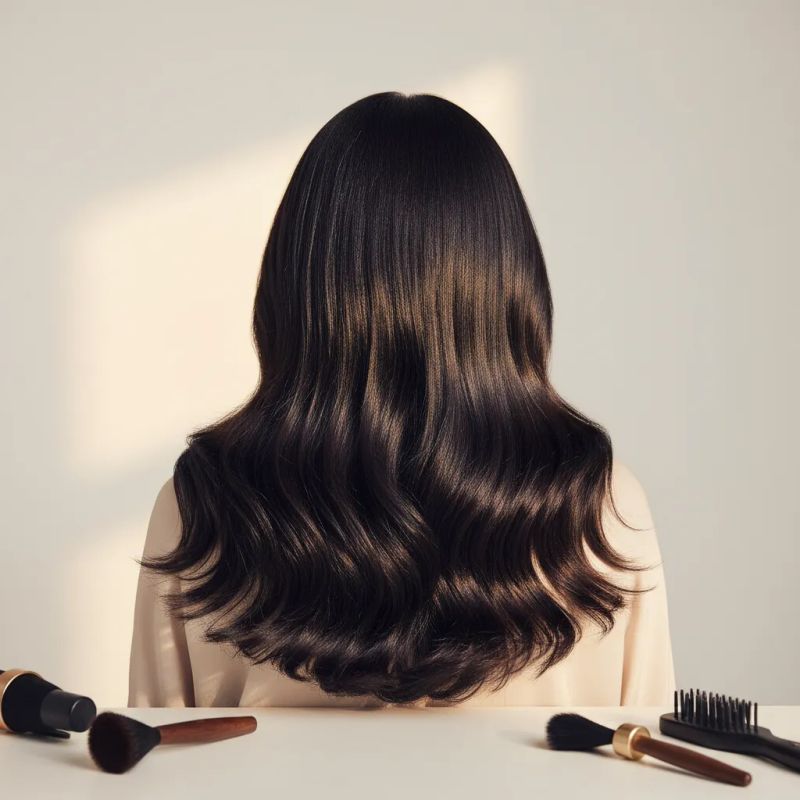
Have clients asked you for that “celebrity brunette” without knowing exactly how to describe it?
If you work as a professional colorist, you’ve surely noticed the shift: clients no longer want flat browns or lifeless chestnuts. They want that deep, glossy brown that looks fresh from a photo shoot. And it has a name: Espresso Martini Brunette.
Here’s what this color is, how to formulate it from your brand’s chart and what sets it apart from an everyday dark brown.
Quick summary: Espresso Martini Brunette is a level 3-4 dark brown with a cool-neutral undertone and intense dimensional shine. As a rough starting point, mix a level 3 natural with a smaller share of level 4 ash, using the developer, mixing ratio and timing on your brand’s chart, and finish with a clear gloss or one with a touch of violet for the signature mirror-like shine. The ash shade’s code changes from brand to brand, so look it up by name on the chart.
What Is Espresso Martini Brunette?
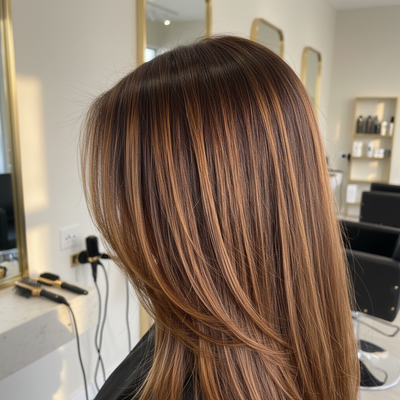
Espresso Martini Brunette is a level 3-4 dark brown with a cool-neutral undertone and dimensional shine. As a starting point it is formulated with a level 3 natural and a level 4 ash, finished with a clear gloss or one with a touch of violet. Its defining feature is the mirror-like shine and subtle violet-ash reflections that catch light. It differs from traditional dark browns through multitonal depth rather than flat pigment deposit.
Espresso Martini Brunette is a level 3-4 dark brown with a cool-neutral undertone and intense dimensional shine. It differs from traditional browns through its multitonal depth and subtle violet-ash reflections that catch light without being obvious. Clients ask for it because it is versatile and looks editorial.
The name comes from the cocktail: dark, intense, with that creamy shine on the surface that catches the eye.
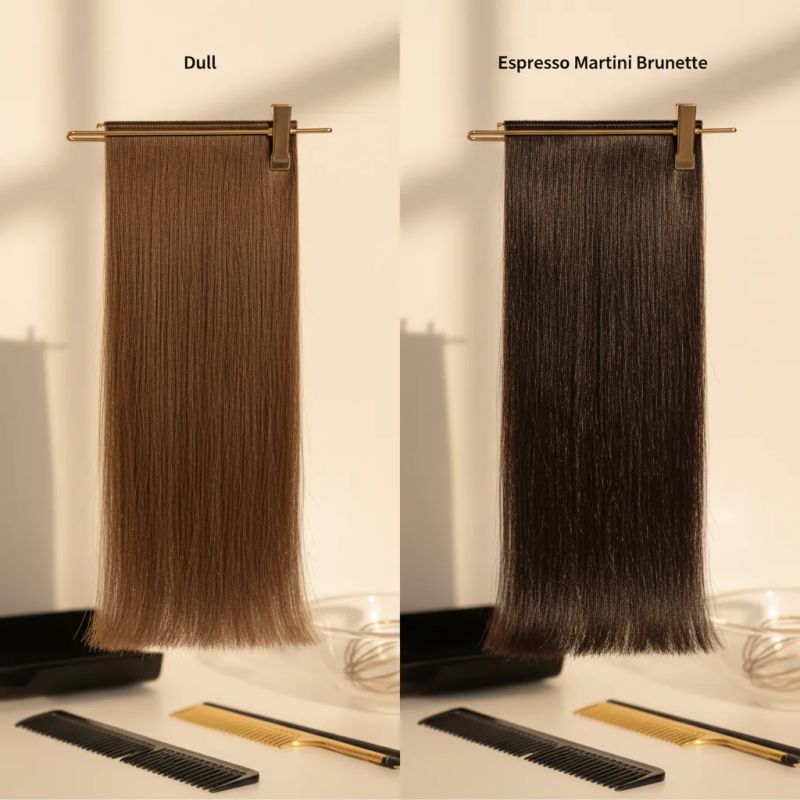
Defining characteristics:
| Aspect | Espresso Martini Brunette | Traditional Brown |
|---|---|---|
| Level | 3-4 | 4-6 |
| Undertone | Cool-neutral with ash touch | Variable, often warm |
| Shine | High, dimensional | Medium, can be dull |
| Reflections | Subtle violet/ash | Generally absent |
| Maintenance | Low-medium | Low |
Why It’s Trending
Espresso Martini Brunette connects with several macro trends of 2026:
- Quiet luxury: Elegant without being flashy
- Low maintenance: If the natural base is close to that level, it grows out without a marked demarcation line
- Universally flattering: Works with almost all skin tones
- Editorial look: Runway aesthetic, made accessible
As we detail in our color trends guide, this year marks the return of rich browns with dimension.
Who Does Espresso Martini Brunette Flatter?
Espresso Martini Brunette works best on cool and neutral skin tones. It pairs well with olive skin and creates striking contrast with light eyes. On very warm or golden skin tones, add a touch of gold to prevent the cool undertone from clashing. The only profile to avoid: severely damaged hair that cannot retain dark pigment. For clients coming from platinum blonde, the strand test decides whether it fits in one visit or needs several.
Espresso Martini Brunette is one of the most universal colors, but certain combinations make it shine especially.
Ideal Skin Tones
Works especially well on:
- Cool skin (pink, porcelain): The cool undertone of the color harmonizes
- Neutral skin: The color’s balance adapts perfectly
- Olive skin: Contrasts elegantly without yellowing
Works well but requires adjustment on:
- Very warm skin (intense golden): Add a touch of gold to warm slightly. Look it up by name: on Wella’s Koleston Perfect chart gold is /3, but on the IGORA ROYAL chart -3 is Matte and gold is -5
Eye Colors
- Dark eyes (brown, black): Intensifies the gaze
- Light eyes (green, hazel): Creates dramatic contrast
- Blue eyes: Striking effect, very editorial
Who Should Avoid It
- Clients wanting a radical change from blonde (long process)
- Those seeking obvious highlights or very marked dimension
- Very damaged hair that doesn’t retain dark color
Pro tip: Espresso Martini Brunette is perfect for clients coming in with failed copper or red color jobs. The cool undertone neutralizes warm residues.
How to Achieve Espresso Martini Brunette Step by Step
For virgin hair at level 5-6, the starting point is a level 3 natural with a level 4 ash, using the developer and timing on your brand’s chart. On bleached hair, you fill first. The finishing step, a clear gloss or one with a touch of violet, is what delivers the mirror-like shine that defines this color.
Materials Needed
- Level 3 natural permanent dye
- Level 4 ash or matte permanent dye, from the chart you work with
- The developer your chart assigns to going darker or tone-on-tone work
- Clear gloss/shine treatment
Prior Analysis
Before formulating, assess:
- Starting level: What is the natural or current level?
- Color history: Is there previous bleaching? Warm residues?
- Hair condition: Porosity? Damage?
- Client expectation: How dark do they want?
- Pre-service tests: the allergy test goes 48 hours ahead, following the dye manufacturer’s instructions (on its Koleston Perfect fact sheet, Wella asks for it before every coloration), and our guide to scheduling the 48-hour patch test shows how to fit it into your schedule. If the hair carries color or bleach, add a strand test before you go for the whole head.
For deeper level analysis, check our colorimetry basics guide and our hair color level guide from 1 to 10.
Base Formula
The mixes in this article are written by level and by the name of the reflect, not by code, because the reflect digit changes from one brand to another. On Wella’s Koleston Perfect chart, /1 is Ash, /2 Matt and /3 Gold. On the English IGORA ROYAL chart, -1 is Cendré, -2 Ash and -3 Matte. We break it down in Cendré vs. Ash in Igora and what the 8 means in hair color. Look up each shade by its name on the chart you work with. To see the espresso palette and jump to your brand’s chart in the converter, its page in our trending hair colors tool has both.
Virgin hair level 5-6 (light brown to dark blonde), rough starting point:
Larger share: level 3 natural
Smaller share: level 4 ash (adjust it with the test strand)
Developer, mixing ratio and time: from your chart
The split between the two shades is a rough guide; the ratio with developer is not, because each manufacturer sets it. For Koleston Perfect, Wella mixes 60 g of color with 60 ml of developer, lists 6% (20 vol) for working on the same depth or darker, gray coverage included, and 4% for going deeper on natural hair with no gray to cover, with 30-40 minutes without heat (Koleston Perfect fact sheet). L’Oréal publishes Majirel at 1:1.5, with 20 or 30 vol developer and 35 minutes (US how-to-use sheet). And the IGORA ROYAL technical manual for Spain mixes its natural shades 1:1, with 30-45 minutes. The numbers don’t match across brands, so they don’t carry over from one to another.
Previously colored hair (no bleaching): the same mix. If the previous color left warm residue, strengthen the ash share with a test strand in front of you. If your brand has concentrates to intensify a reflect, the dose comes from its instructions, not a fixed percentage: Wella doses Koleston Perfect Special Mix by the level of the base shade, and the lighter the shade, the less concentrate it takes (Koleston Perfect usage guidelines).
Bleached or lightened hair at level 7 or above:
Step 1: Fill with a warm shade, semi-permanent or deposit-only depending on your brand
Step 2: The base mix, with the developer and time on your chart
Wella recommends filling when hair has ended up too light and the target is more than two levels darker than the starting level, and notes that its Color Touch filling chart is a guideline only, to be adjusted for porosity (Wella, filling with Color Touch). The IGORA ROYAL technical manual for Spain (p. 28) pre-pigments with semi-permanent color on the lightest, most porous areas, pairs target levels 1 to 4 with red and, depending on the condition of the hair, picks the permanent shade at the same level or one level lighter than the desired result, so it doesn’t end up darker. The why behind the fill is in our guide to pre-pigmentation when going darker.
Formulation by Starting Level
Bleached hair loses a good share of its lipids. A study published in Dermatology Research and Practice (2025), which tested a lipid treatment on untreated natural black Asian hair bleached twice in the lab, measured total lipid content dropping from 8.7% to 5.5% of fiber weight, and notes that more than 80% of 18-MEA (the lipid that gives the cuticle its water-repellent layer) is removed in a single bleaching process, leaving a surface that attracts water (study). Behind the chair, the IGORA ROYAL technical manual for Spain describes it like this: on porous hair, red and orange pigments fade quickly while cool pigments get absorbed, and the result can come out dark, flat, muddy or, at worst, green. This table sums up what each starting point calls for:
| Starting Level | Mix | Pre-Step Required |
|---|---|---|
| 3-4 (dark to medium brown) | Base mix: the level is already there, the work is reflect and shine | None |
| 5-6 (light brown to dark blonde) | Base mix | None if it’s the natural color |
| 7-8 (medium to light blonde) | Base mix; over the fill if the hair has been lightened | Fill if the hair has been lightened: the target sits more than two levels darker |
| 9-10 (very light blonde) | Base mix over the fill; ash grabs harder on porous fiber | Fill and strand test |
| Bleached | Base mix over the fill; watch that it doesn’t overload with pigment | Fill and strand test |
Application Process
Step 1: Preparation
Work on dry, unwashed hair: the IGORA ROYAL technical manual for Spain says to apply on dry hair, and the US IGORA chart says to avoid pre-shampooing and not to apply the product on a damaged or irritated scalp. If there’s a fill, follow your brand’s protocol: Wella applies its Color Touch fill to pre-shampooed, towel-dried hair.
Step 2: Sectioning
Divide into 4 quadrants and work from nape to crown. Where to start, root or lengths, is in step 3.
Step 3: Application
- On virgin hair, the order depends on the brand. For the same depth or darker, Wella applies the Koleston Perfect mix right away, from roots to ends (Koleston Perfect leaflet). The IGORA ROYAL technical manual for Spain (p. 8), on natural hair, starts on mid-lengths and ends, processes for 10 minutes (15 for its fashion shades) and then applies to the root area. Follow the one for the brand you use
- On previously colored hair: Assess porosity; porous ends may grab darker
Step 4: Processing
Total time is the one on your brand’s chart (for Koleston Perfect, 30-40 minutes without heat). Watch a control strand: on porous hair, dark color grabs faster.
What to Watch by Hair Type
The manufacturer sets the time; what changes with hair structure and history is what you need to watch:
| Hair Type | Porosity | What to Watch | Control Signal |
|---|---|---|---|
| Virgin fine | Low | It may take the color sooner than you expect | Even shine without patchiness |
| Virgin coarse | Low-medium | It usually needs the chart’s full time | Complete strand saturation |
| Previously colored | Medium-high | Porous ends load up before the roots | Uniform color root-to-tip |
| Bleached | High | Dark color goes in fast: check the strand from the start | No excessive darkening |
Step 5: Rinse and Treatment
Rinse until water runs clear. Apply conditioning treatment. For the characteristic Espresso Martini shine, consider a final gloss.
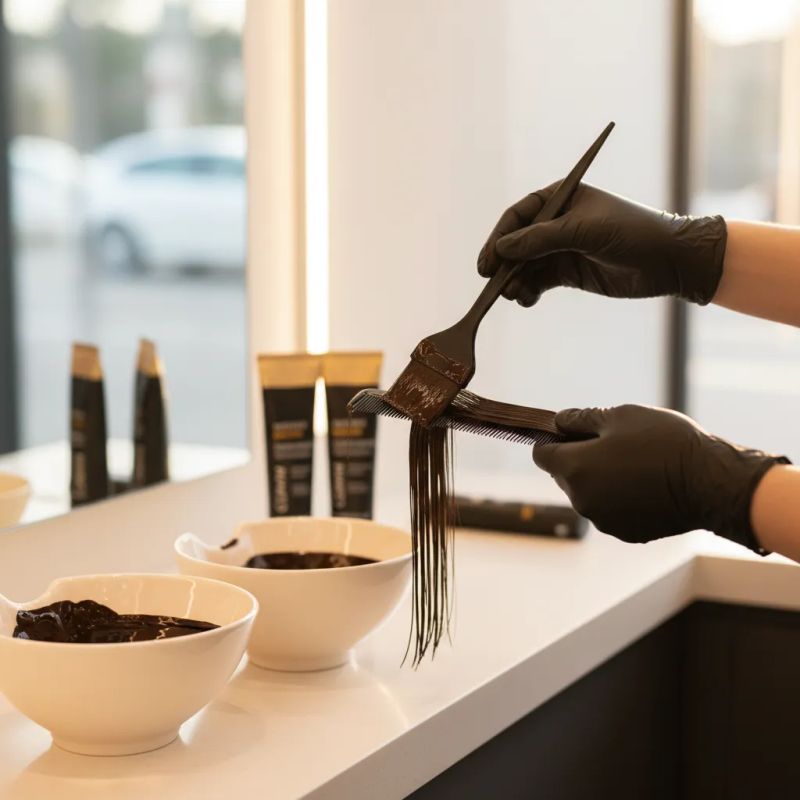
The Secret: The Final Gloss
What sets a good brown apart from an Espresso Martini Brunette is the shine. After coloring, apply:
Clear gloss or with violet touch
Activator and time: from that gloss's manufacturer
Every gloss line comes with its own activator and timing. Wella, for example, describes a shine service on the Koleston Perfect fact sheet (Pure Glossing) with equal parts color, Welloxon Perfect Pastel 1.9% developer and post-color treatment, for 5-10 minutes. What a gloss is and how to choose one is in our professional hair gloss guide.
This step adds mirror-like shine and, if it carries a cool touch, tempers residual warmth.
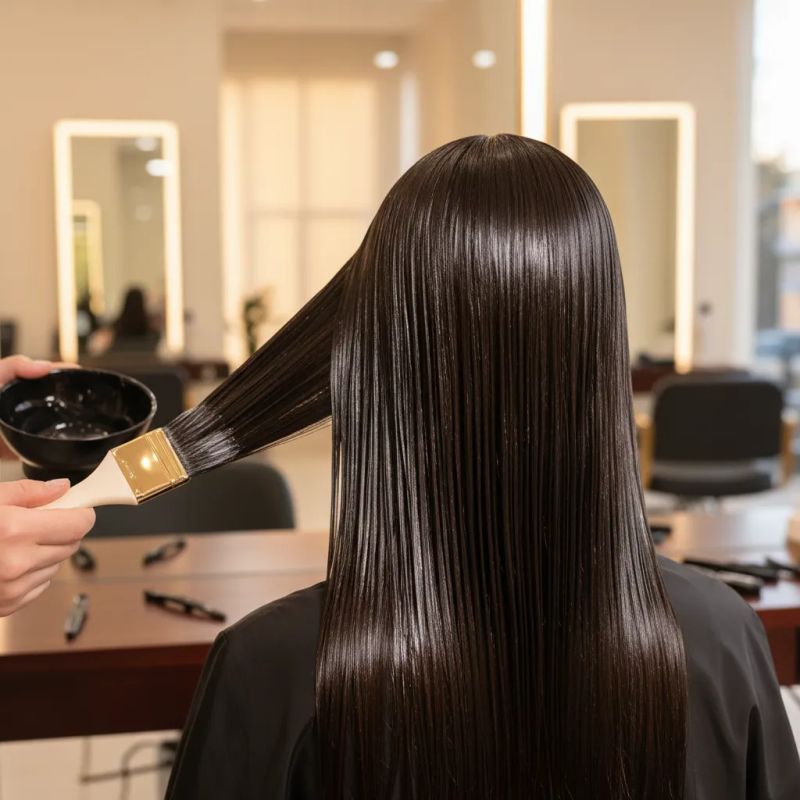
What Espresso Martini Variations Exist?
There are four main variations: classic (level 3 natural with level 4 ash, cool-neutral undertone), intense cold (levels 2 and 3 ash with a violet-touch gloss, for very fair skin), chocolate highlights (level 5 golden chocolate babylights on the classic base for visible dimension), and red touch (with a share of mahogany, for warm skin tones). All variations share the dimensional shine signature but differ in undertone direction and maintenance.
Espresso with Chocolate Highlights
For clients wanting a bit more dimension:
Base: The base mix
Subtle highlights: Level 5 golden chocolate
Technique: Very fine babylights only on top layers
If they prefer a lighter, warmer take on the dimensional brunette trend, consider chai latte hair or glazed pecan brunette as natural stepping stones.
Intense Cold Espresso
For a more dramatic, editorial look:
Larger share: level 2 ash (if your chart has one)
Smaller share: level 3 ash
Final gloss: With violet pigment
If what they want is a true black with no red reflect, that’s a different color: liquid noir.
Espresso with Red Touch
For very warm skin tones that need adjustment:
Larger share: level 3 natural
Smaller share: level 4 mahogany
A touch: level 4 ash
Watch the code: on Wella’s chart mahogany is /5, but on the IGORA ROYAL chart -5 is Gold and its legend has no reflect called mahogany. And if the red has to show, not just warm things up, that’s dark cherry territory, where the level is decided in the light.
Espresso Variation Comparison
Not sure which variation to recommend? This table helps you match the right option to each client profile:
| Variation | Result Level | Undertone | Best For | Maintenance |
|---|---|---|---|---|
| Classic | 3-4 | Cool-neutral | Cool and neutral skin tones; editorial look | Low if the natural base is close |
| Chocolate highlights | 3-5 | Neutral-warm | Clients wanting visible dimension | Medium (babylights need their own touch-up) |
| Intense cold | 2-3 | Cool ash | Dramatic look; very fair skin | Low (violet-touch gloss to refresh) |
| Red touch | 3-4 | Neutral with mahogany | Warm and golden skin tones | Medium (on porous hair, red fades sooner) |
How to Maintain Espresso Martini Brunette?
Root touch-ups depend on contrast: the further the natural base sits from level 3-4, or the more gray there is, the sooner regrowth shows. The mirror-like shine needs its own care: without a maintenance gloss, the visual impact can fade even when the base color holds, and the pace is set by washing, sun and each person’s porosity. If warm reflects show up, choose the toning shampoo by the color you see: blue for copper, purple for yellow. Avoid clarifying shampoos and hot water washing, which strip pigment faster.
Espresso Martini Brunette is relatively easy to maintain, but there are key products:
Recommended Products
- Sulfate-free shampoo: Preserves color longer
- Toning shampoo, only if warm reflects show up: blue for copper, purple for yellow. On a brunette this dark the effect is subtle; we explain why in blue shampoo for brunette hair
- Hydrating mask: Maintains characteristic shine
- Shine serum: For daily mirror finish
Touch-Up Frequency
- Roots: When regrowth contrasts with the color; sooner with gray
- Maintenance gloss: When the shine fades, if they want maximum shine
- Deep treatment: Depending on the condition of the fiber
What to Avoid
- Frequent clarifying shampoos (strip pigment)
- Very hot water when washing
- Heat tools without protector
How to Sell Espresso Martini Brunette in the Salon?
The best candidates are clients asking for “a brown with shine” or “something dark but not flat.” The strongest selling points are low maintenance when the natural base is close (roots grow out without a marked line), photogenic editorial finish, and versatility. The complete service with gloss justifies pricing one tier above a standard all-over color.
Spotting Candidates
Pay attention when you hear:
- “I want a brown but not boring”
- “I’d like to go darker but with shine”
- “Something elegant but easy to maintain”
- “That celebrity brown”
Sales Arguments
- It’s the most photogenic brown: Always looks great in photos
- Low maintenance: If the natural base is close, roots grow out without a marked line
- Flattering: Works with almost all skin tones
- Trending: It’s a brunette you see a lot on social media
Suggested Pricing
| Service | Complexity | Range |
|---|---|---|
| Espresso from medium brown | Low | €€ |
| Espresso from blonde (with fill) | High | €€€ |
| Espresso + shine gloss | Medium | €€-€€€ |
| Maintenance | Low | € |
To put a number on each row for your salon, our guide to hair coloring service pricing walks through the rate calculation.
What Are the Most Common Espresso Martini Formulation Mistakes?
The four most frequent mistakes are: skipping the final gloss (the brunette comes out flat), not filling bleached hair before darkening (causes green reflects), letting porous hair overload with pigment (results in black instead of espresso), and applying color to ends first on high-porosity hair (creates uneven root-to-tip color). All four are preventable with proper consultation and strand assessment.
Mistake 1: Too Flat Result
The problem: The brown comes out dull, lifeless.
The solution: Always include the final gloss step. The difference between a common brown and an Espresso Martini is the shine. For more on formulation errors, check our color correction guide.
Mistake 2: Green Tones
The problem: On previously bleached hair, green reflects appear.
The solution: Always fill before darkening bleached hair. The red and orange pigments removed by bleaching need to be replaced.
Mistake 3: Too Dark Result
The problem: Hair ends up black, not espresso brown.
The solution: On porous or fine hair, dark color grabs faster, so pick a level with some margin from the start. Over pre-pigmented hair, the IGORA ROYAL technical manual for Spain picks the permanent shade at the same level or one level lighter than the desired result, depending on the condition of the hair, and the strand test tells you which. Better to fall short and do a second pass than to go too far.
Mistake 4: Ends Darker Than Roots
The problem: Ends absorb more color and become uneven.
The solution: On porous hair, apply to roots and mids first and leave the ends for last, with the same formula or a lighter one depending on what the control strand tells you.
Frequently Asked Questions
How Long Does Espresso Martini Brunette Last?
There is no fixed figure: it depends on washing, sun exposure and each person’s porosity. The characteristic intense shine may call for a maintenance gloss before the color itself needs a touch-up, to keep the “mirror” effect.
Can I Achieve It from Platinum Blonde in One Session?
It can be planned that way. Wella and the IGORA ROYAL technical manual for Spain chain the fill and the color in the same service: in its Color Touch filling protocol, Wella rinses the fill, towel-dries and then applies the target shade, also in Color Touch, and the IGORA manual applies the permanent color over the pre-pigmented hair. The hair fiber decides: run a strand test with the fill and the color first, and if it comes out dark, flat or greenish, or elasticity fails, spread it over more than one visit. And tell the client that even if it looks right on day one, on hair that was platinum the brunette can turn flat or greenish sooner: the same IGORA manual explains that on porous hair, red and orange pigments fade quickly while cool pigments get absorbed.
Is It the Same as “Expensive Brunette”?
They’re similar but not identical. Expensive Brunette includes obvious dimensional highlights. Espresso Martini Brunette is more uniform, with shine but without marked highlights. Espresso is the “cleaner” version.
Does It Work on Gray Hair?
Yes, and the base mix already accounts for it: most of it is a natural shade, more than the charts ask you to add when covering gray with a reflect shade. Wella, for Koleston Perfect, adds 1/3 of a natural at 30-50% gray and 1/2 above 50%; L’Oréal, for classic Majirel (not Cool Cover), goes half and half above 50% when the target is cool (US instructions); and the IGORA ROYAL technical manual for Spain mixes its fashion shades 2:1 with the natural from 70%. If you shift the split toward the ash (the intense cold variation is all ash), check your brand’s threshold again. What gray does call for is the full time on your data sheet and, on a regrowth application, starting where the percentage of gray is highest, as the Koleston Perfect usage booklet says. On a brunette this dark, white regrowth also shows early. Each chart’s proportions are in our gray hair coverage guide.
Can It Be Done with Semi-Permanent Products?
For the authentic result, you need permanent dye for pigment depth. A semi-permanent can give a similar effect but will last less and the shine will be different.
In Summary
- Espresso Martini Brunette is the star brown of 2026: deep, glossy, and elegant
- The key is the cool-neutral undertone and final gloss: this differentiates it from common browns
- Works on almost all skin tones: it’s one of the most universal colors
- Low maintenance if the natural base is close: roots grow out without a marked demarcation line
- Easy sell: it’s what many clients are looking for even if they don’t know the name
Want to calculate personalized formulas for Espresso Martini Brunette based on each client’s starting level? Use the hair color mixing calculator to preview exact proportions before you start. Or try Blendsor and let AI suggest precise formulas for every client.
Article updated September 2026.
What's the difference between espresso brunette and a regular dark brown?
In the app, we ask you a question like this one, but about your own client.
Up for this week’s case? → More on brunettes and coppers →Related articles
Practice with our colorimetry tools
Calculators, neutralization wheel, AI consultation...
The Blendsor newsletter
Color techniques and trends for professionals. No spam.
A client in the chair right now?
The Blendsor advisor gives you the precise formula for this technique with your salon's brands — and saves it to your client's card.
Ask about your caseWritten by the Blendsor team
Professional hair colorimetry experts with experience in AI-assisted formulation. We combine color science, salon practice and technology to help colorists formulate with precision.