Cendré vs. Ash in Igora: Why They Get Mixed Up
Igora's English chart lists Cendré at -1 and Ash at -2; the Spanish chart calls the same shades Ceniza and Humo. Translating ash as ceniza shifts one shade.
Blendsor
Blendsor Team
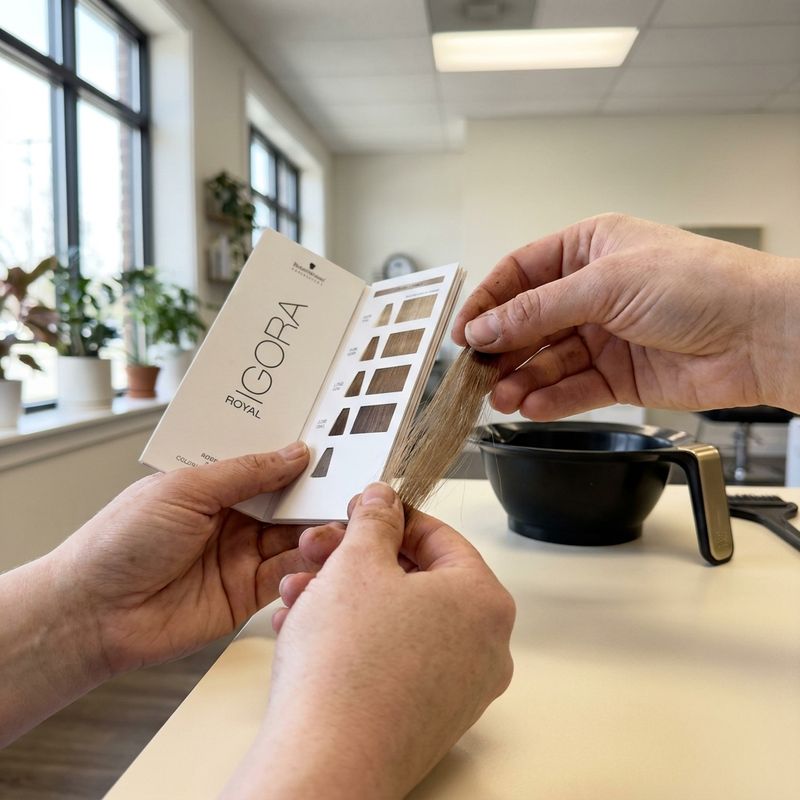
Is a -1 just a softer version of a -2, same cool direction, one shade quieter? On Igora’s chart, not exactly — and the mix-up doesn’t come from the tone. It comes from which language you’re reading it in.
If you work in a multilingual salon, or you’ve ever taken a formula from a client card written in Spanish, this has probably happened to you: you read “ceniza” and your brain autotranslates it to “ash.” It feels like a direct swap. It isn’t.
Here’s exactly which box each name lives in on Igora’s reflect scale, in each language, and where the slip actually costs you a shade in real work — not on the wall chart.
Quick summary: on Igora’s English reflect chart, -1 is named Cendré and -2 is named Ash. On the same brand’s Spanish chart, those same two boxes are Ceniza (-1) and Humo (-2). Read “ceniza” and translate it straight to “ash,” and you shift the result one box — from -1 up to -2. It’s the same brand, read in a different language.
What does Cendré mean, and why does Spanish call it Ceniza?
Cendré is the English-language name Igora’s reflect chart uses for shade direction -1. It’s a soft cool tone, the first step before you move into more pronounced neutralization territory. On the same brand’s Spanish-language chart, that exact box is called ceniza — the word a Spanish-speaking colorist would use for it every day.
So far, no issue: two names, one box, two languages. The trap sits one box over.
Why do colorists confuse Ash with Ceniza?
Ash is the English name for reflect direction -2 on Igora’s chart — one step cooler than Cendré (-1), which Spanish calls ceniza. The problem is that “ceniza” is the literal Spanish word for ash, and that dictionary translation is not the same thing as the chart’s translation.
Put another way: if a formula written in Spanish reads “ceniza” and you read that as “ash,” you haven’t just swapped languages — you’ve swapped boxes. You’ve moved the result one shade cooler than what the original formula called for, from -1 up to -2.
According to Igora’s technical reflect chart, the full English-language scale reads:
| Box | English name | Spanish name |
|---|---|---|
| -0 | Natural | Natural |
| -1 | Cendré | Ceniza |
| -2 | Ash | Humo |
| -3 | Matte | Mate |
| -4 | Beige | Beige |
| -5 | Gold | Dorado |
| -6 | Chocolate | Chocolate |
| -7 | Copper | Cobre |
| -8 | Red | Rojo |
| -9 | Violet | Violeta |
It’s the same brand, read in a different language: the name changes with the language, but the box — and the result it produces on hair — doesn’t move. The error only shows up when someone translates the word instead of checking the number.
Where does this actually bite in a real salon?
Here’s the nuance that turns a language curiosity into a real problem: the mistake almost never happens in front of the tube. With the physical chart next to the product, most colorists read the printed label, not their mental translation of a word. The slip creeps in through the written order and the formulas that arrive from someone trained in a different market.
Think through three scenarios that come up constantly in any salon with international clients or training:
- A client card brought from a salon abroad, with the formula noted in Spanish.
- A certification or course taught in English, where the formula is given verbally and someone transcribes it by ear into Spanish.
- A consult with someone trained in a different market, where the reflect is mentioned by name rather than by number.
In every one of these, the paper says “ceniza” or it says “ash,” and whoever reads it assumes they know which box it points to. If they default to the literal translation instead of checking the number, what comes out of the bowl is a different cool direction than the one that was actually intended — and that shows up on the hair, even though on paper it looked like a simple language swap.
Pro tip: whenever a formula arrives in a language different from your usual chart, always check the box number (-1, -2…), never just the name. The name travels badly between languages; the number doesn’t.

Does the same thing happen between other brands?
Yes, in the sense that every brand has its own alphabet for labeling reflects, and that alphabet isn’t standardized across manufacturers. We cover this in detail in our hair color mixing chart guide: the same digit can point to a completely different color family depending on the house. What makes the Igora case different is that the confusion isn’t between brands — it’s inside the same brand, across languages.
If you regularly convert formulas between lines — Redken to Schwarzkopf, for example — the Redken to Schwarzkopf conversion guide has the shade-by-shade equivalents. And if your salon is switching brands entirely, the guide on switching professional hair color brands walks through the steps to keep results consistent through the transition.
To understand what comes before the dash — the level, 1 through 10 — and not just what follows it, the hair color level guide fills in the rest of any brand’s shade code.
Common mistakes when reading a formula in another language
- Translating the word instead of checking the number: “ceniza” is not “ash” on Igora’s chart, even though the dictionary says it is. Always check the box (-1, -2), not the loose word.
- Assuming every brand names the same digit the same way: Igora, Wella, and L’Oréal don’t share a reflect alphabet. The same number or the same word can mean something different depending on the house.
- Copying a formula from memory without checking it against the physical chart: a formula heard in a course or passed along between colleagues gets verified against the swatch chart before it’s applied, never trusted from memory alone.
- Trusting the name on a client card from abroad without translating it against your own line’s chart: if the card says “ash,” find out which box that is on your chart — don’t assume the Spanish word that sounds closest is the right one.
Frequently asked questions
What does Cendré mean on Igora’s reflect chart?
Cendré is the English-language name for box -1 on Igora’s reflect chart. On the same brand’s Spanish-language chart, that box is called ceniza.
Are Ash and Ceniza the same reflect?
No, not on Igora’s chart. Ash is the English name for reflect -2; in Spanish, that same box is called humo. The Spanish word “ceniza” instead maps to -1, which is called cendré in English. Translating “ceniza” straight to “ash” shifts the result one box.
How do I avoid the mistake when a formula arrives in another language?
Always check the box number, not just the reflect name. If you have your line’s chart in front of you, physically locate the -1 or -2 before treating the formula as understood — the name changes with the language, but the number doesn’t.
Does this kind of mix-up happen only with Igora?
The mechanism — reflect names that don’t line up literally between languages or between brands — repeats elsewhere, though each house has its own vocabulary. That’s why it’s worth checking against your line’s physical chart before trusting a translation, whether it crosses a language or a brand.
In summary
- On Igora’s English chart, -1 is Cendré and -2 is Ash
- On the same brand’s Spanish chart, those boxes are Ceniza (-1) and Humo (-2)
- Translating “ceniza” as “ash” literally shifts the result one box, not two
- The mistake rarely happens with the tube in hand — it slips in through the written order and formulas arriving from another market
- When a formula arrives in another language, always check the number, never just the name
Formulate without translating a reflect name from memory
In the Blendsor app, the AI works directly with your brand’s tones and ratios — so you never have to translate a reflect name that arrived from another language or another line. Formulate with Blendsor.
Has a translated formula ever given you a different result than you expected?
What's the difference between ash and smoke reflect in Igora?
In the app, we ask you a question like this one, but about your own client.
Up for this week’s case? → More on global color →Related articles

Practice with our colorimetry tools
Calculators, neutralization wheel, AI consultation...
The Blendsor newsletter
Color techniques and trends for professionals. No spam.
You know the theory. What about today's case?
Send a photo to the Blendsor advisor and get an answer grounded in colour theory: toner, developer and timing, with the brands on your shelf.
Ask about your caseWritten by the Blendsor team
Professional hair colorimetry experts with experience in AI-assisted formulation. We combine color science, salon practice and technology to help colorists formulate with precision.