Professional Color Consultation: The 5 Readings That Separate Your Formula From a ChatGPT Prompt
How to run a professional color consultation when your client arrives with an image or ChatGPT prompt. 5 technical readings: zone porosity, conversation, three directions, chemical compatibility, exact grams.
Blendsor
Blendsor Team
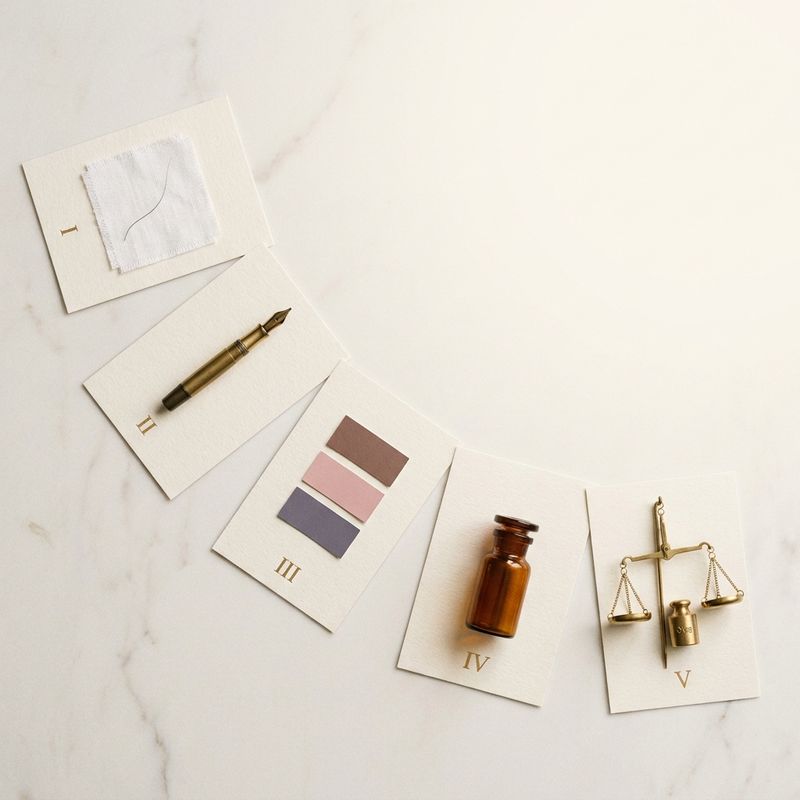
A professional color consultation covers five technical readings that a ChatGPT prompt cannot deliver: zone porosity, conversation that translates intent into chemistry, three directions with real cost, prior chemical compatibility, and the exact grams. When a client arrives with an image on their phone, the professional colorist closes these five pieces before the first brushstroke.
Quick summary: the 2026 client walks into the salon with a mental image formed in two minutes online — sometimes generated by ChatGPT. That image contains a result, not a process. The professional color consultation covers five readings the image doesn’t include — and they’re what prevents a thirty-minute appointment from turning into two hours of correction. Each reading has a technical manual behind it (Wella, L’Oréal, Schwarzkopf, SCCS) and a decision that’s only made with the actual hair in front of you.
The 2026 client walks into the salon with a phone in hand. They’ve spent two minutes, maybe five, looking at references or asking ChatGPT to formulate a color change. They have a very clear idea of how they want to walk out. What they don’t have is the information that separates that idea from the real result.
The difference is what the professional color consultation does, and it fits into five readings. Before the first brushstroke.
If you want to dive deeper into the technical context of any of these readings, the seven most common color formulation mistakes cover the chemical substrate that supports this article.
Reading 1: Zone porosity, not average porosity
The first piece of information the image doesn’t contain is the hair of the person bringing it.
Porosity is not a single value. The roots may sit in low porosity after six months untouched, the mid-lengths may be open from previous color baths, and the ends may be highly porous after three washes with blue shampoo. None of this shows in the mirror — it shows in the professional’s hand when they touch the wet hair.
To this you add residual pigment: the color the hair has today is not the color that came out of the bowl last time. It’s six months of oxidation, a summer of UV, and the client’s home maintenance products. The formula either compensates for that or compensates for nothing.
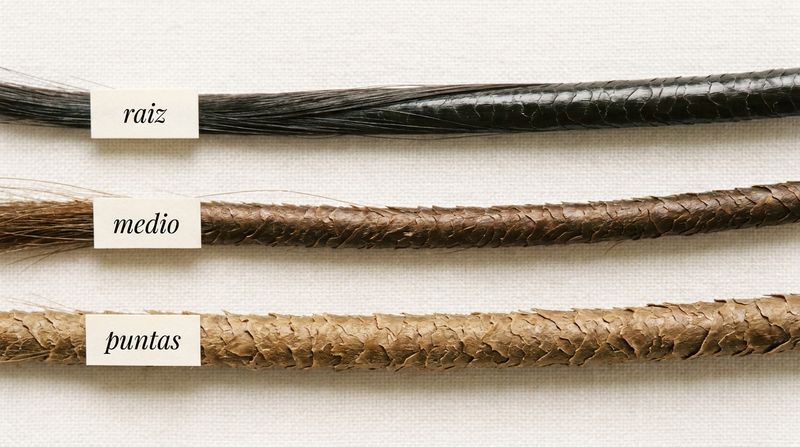
A complete reading before formulating includes:
- Level by zone (roots, mid-lengths, and ends read separately)
- Porosity by zone, not averaged
- Prior chemical state (last service, brand, ratio)
- Visible residual pigment (unwanted warmth, demarcation band)
- Gray coverage if relevant, and where it concentrates
- Previous damage, elasticity, and cuticle state
Diagnosing the base level is where any viable formula begins, and where most errors start when you assume “around there.” A ChatGPT prompt works with the information the user gives it in text. And most users don’t know their porosity differs by zone — because that’s professional knowledge, not information the client can self-report.
Reading 2: Professional conversation vs. ChatGPT prompt
The image on the phone says what the client wants to see. It doesn’t say how to get there.
The professional conversation translates intent into chemical parameters: is the client looking for a visible change or something that grows out discreetly? Do they want low maintenance or accept coming back every four weeks? Is their skin warm or cool, and how does that harmonize with the tone they’re requesting? How receptive are they to an additional session if the first one doesn’t reach the goal?
These questions aren’t courtesy. They decide whether the formula in the bowl is 5.18 + 5/5N or 6.0 + 9.82, and whether the developer goes at 6 vol or 9 vol. They change the entire piece. They also change application time, post-service care, and service price.
Conversation is also where the information surfaces that the client doesn’t know is relevant: that they applied henna two years ago, that they take medication affecting the scalp, that their last coloring was done at home because they couldn’t make the appointment. A ChatGPT prompt doesn’t ask these questions because it doesn’t know they have chemical consequence.
When a client arrives with an AI-generated formulation, the professional colorist doesn’t debate the formulation — they ask the six points above and, if any are blank, the formulation is invalidated by default. Not from technological distrust, from method.
Reading 3: Three directions, not one
This is where professional consultation separates most visibly from the prompt.
A prompt delivers an answer. The consultation delivers three directions with their consequences.
On the same hair, the same skin undertone, and the same initial intent, there are typically three viable routes:
| Direction | Maintenance | Sessions | Relative cost |
|---|---|---|---|
| Subtle — modern gradient over current base | High | 1 | $$$ |
| Editorial — clear change anchored in undertone | High | 2 | $$$$ |
| Statement — bold, high-impact change | High | 2 | $$$$ |
All three are technically possible. All three leave the client well. The difference is cost, maintenance, sessions required, and presence of the change. The choice doesn’t belong to the professional or the prompt — it belongs to the client, once they see the three with their real numbers in front of them.
An isolated phone image doesn’t give this table. The consultation does.
Reading 4: Prior chemical compatibility (metallic salts, henna, patch test)
This is the piece a prompt can never deliver, and the one with the most legal responsibility behind it.
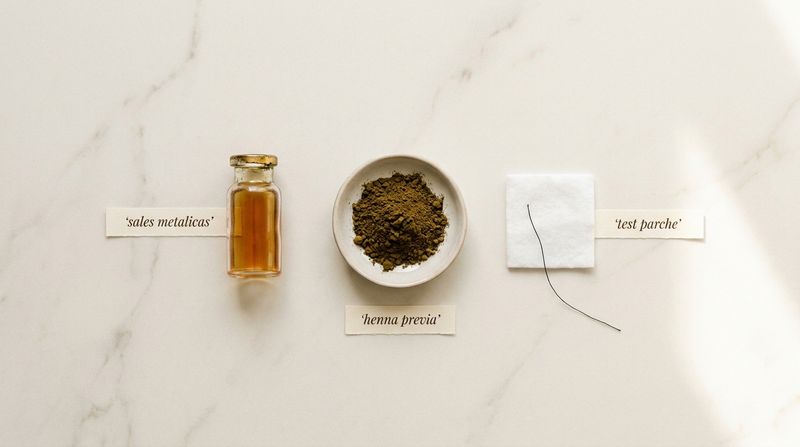
Before mixing anything, you verify:
- Metallic salts: if present, peroxide developer reacts violently. Metallic henna sold as natural in unregulated markets is the most frequent cause.
- Prior henna: pure henna isn’t incompatible with dye, but most commercial hennas contain salts. Without a test, you don’t know.
- Patch test: 48 hours before every application, including long-standing clients and the same brand you’ve always used. Hair dye allergy can show up late — someone colors twenty times with no reaction and reacts on the twenty-first — so a clean history is no substitute for the test. And the other way round: if the client has ever reacted to a dye or to a temporary black henna tattoo, the patch test is not the answer — you don’t colour, you refer them to a doctor or an allergist, because repeating a patch on already sensitised skin can trigger a worse reaction. Follow the timing and method set out in the manufacturer’s instructions.
- Informed consent: the client understands the chemical risks and signs. It’s not optional under the EU Cosmetics Regulation 1223/2009 or the SCCS guidance on hair dye safety.
The professional consultation closes this piece with a concrete answer — compatible, incompatible, or requires prior testing. And it leaves a written record.
If hair with metallic salts comes in and developer is applied without verification, the result ranges from a minor green smoke to a scalp burn. Metals in hair during bleaching get their own chapter because incompatibility deserves dedicated treatment.
ChatGPT doesn’t know the client has henna, nor can it order a patch test. That information only appears in professional consultation, and only validates with real chemical product.
Reading 5: The exact grams and the technical why of the formula
The fifth reading is the formula itself. But “formula” is not “the tone.”
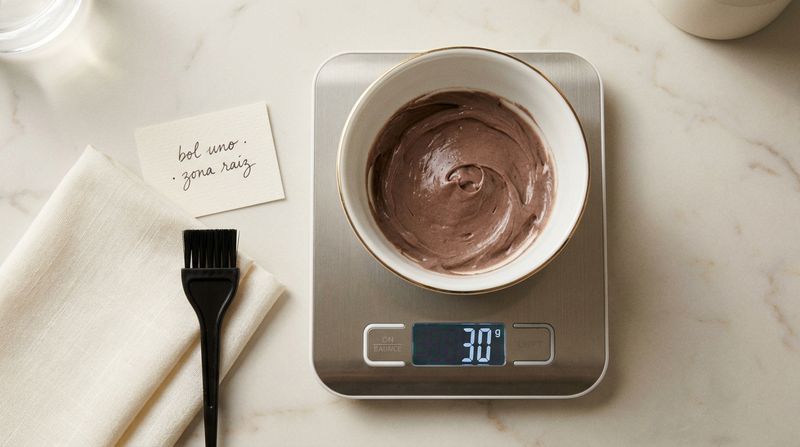
A complete formula includes:
- Pre-treatment if Reading 4 requires it (Metal Detox or equivalent, no rinse)
- Numbered bowl(s) with real products from the client’s country (the Wella catalog in Spain is not the Wella catalog in the US)
- Exact grams per bowl and zone (root may carry 30 g of one and 15 g of another; mid-lengths may carry 20 + 15 + 10)
- Developer with volume calibrated to porosity (golden rule: more porosity, lower volume — L’Oréal Professionnel and Wella Blondor manuals)
- 1:1 or 1:1.5 ratio depending on toner type
- Application time with a realistic range (20-25 minutes is not the same as 30-35)
- Application sequence zone by zone, with explicit instruction (“load more on parting and temples due to gray presence”)
- Post-service care (salon water pH affects color longevity)
- Technical reasoning: why this formula and not another for this specific case
The difference between “rose pink level six dye” and the real formula is approximately four chemical decisions and a proportions calculation. The prompt delivers the first. The professional delivers all five.
Applied case: client Sara Martín → Rose Cocoa Veil
So the five readings don’t stay abstract, here’s how they apply to a real case.
Diagnosis: female client, olive skin, light brunette level 5/10, virgin hair at roots (low porosity), mid-lengths level 6/10 with golden reflection and bleach base level 7 orange, ends with semi-open cuticle and medium porosity. No grays. No documented prior coloring in the last twelve months.
Reading 1: stepped porosity — root low, mid-lengths medium, ends medium-high. Implication: developer cannot be uniform across all hair.
Reading 2: client seeks editorial change, high maintenance accepted, single session, medium cost. Cool undertone. Total change, not subtle.
Reading 3: three directions presented — Rose Cocoa Veil (translucent pastel rose over cool moka, best option + trending, one session, $$$), Smoky Blush Melt (more visible smoky rose, two sessions, $$$$), Icy Rose Statement (high-impact pastel rose, two sessions, $$$$). Client chooses Rose Cocoa Veil.
Reading 4: chemical compatibility COMPATIBLE. No metallic salts detected, no prior henna, patch test with no reaction.
Reading 5 — the complete formula:
| Session | Bowl | Zone | Product | Grams | Developer |
|---|---|---|---|---|---|
| 1 (toner) | Bowl 1 | Root | L’Oréal Dia color 5.18/5BM + 5/5N | 30 g + 15 g | DIActivateur 9 vol, 68 g, ratio 1:1.5 |
| 2 (toner) | Bowl 1 | Mid-lengths | L’Oréal Dia light 7.8/7M + 7.12/7BV + 9.82/9MV | 20 + 15 + 10 g | DIActivateur 6 vol, 68 g, ratio 1:1.5 |
Application time: 20-25 minutes in session 1. Stop signal: root level 5 cool-neutral, integrated band and softened gray without going opaque.
Aftercare: Metal Detox Pre-Treatment on dry hair before applying (3-5 minutes). Metal Detox Shampoo at home. Metal Detox Mask post-service + 1× per week.
Why it works (technical reasoning): the shadow root with 5.18/5BM + 5/5N provides a cool brown-violet base sufficient to integrate the rose later without making the root green or flat. The natural sustains partial coverage on the visible grays at part and temples and avoids an overly smoky result. Prior neutralization on mid-lengths with blue-violet base shuts down the gold and slight copper at level 6, allowing the pastel rose afterward to settle clean without going salmon.
This level of detail doesn’t come out of a prompt. It comes out of a professional color consultation with the five readings closed.
Why the order of the readings matters
The five readings are not interchangeable.
Reading 1 (zone porosity) conditions everything else. Reading 2 (conversation) requires Reading 1 to make sense. Reading 3 (three directions) needs 1+2 to be properly dimensioned. Reading 4 (chemical compatibility) can invalidate Reading 3’s three directions — and forces reformulation. Reading 5 (exact grams) is only calculated when the previous four are closed.
Skipping a reading doesn’t mean the formula goes wrong immediately. It means the formula goes well sometimes and goes wrong other times, without a pattern you can use to improve.
The professional color consultation covers all five in order, and that’s why a thirty-minute appointment stays a thirty-minute appointment.
How you close the gap without doubling consultation time
The five readings are described as if they take time. They can take time if each one is done separately on paper.
Or they can be done simultaneously if the system integrates all five before touching the first product.
From photo to formula with Blendsor. Reading 1 is read from four photos of the actual hair. Reading 2 is a typed conversation with quick replies. Reading 3 delivers three directions with cost and maintenance, each with a before/after AI preview. Reading 4 detects metallic salts and henna before continuing. Reading 5 comes out with exact grams, developer calibrated to each zone’s porosity, application sequence, and technical reasoning — real products from the country.
It doesn’t replace the consultation. It accelerates it.
Frequently asked questions
What do I do if the client arrives with a formula generated by ChatGPT?
Treat it as a reference image, not a formula. Apply the five readings in order. Most likely the prompt’s formula won’t account for zone porosity (Reading 1) or prior chemical compatibility (Reading 4). That alone invalidates the formulation. Communicate to the client with technical respect, not as disqualification: “the model suggests X, let’s verify first with four pieces of information from the actual hair it couldn’t have known.” Document your own formula in the client’s file.
Are the five readings required in every service?
Readings 1, 2, and 4 are required in any service involving chemistry — first visit, retouch, correction. Reading 3 (three directions) makes more sense on first visit or for major change; in maintenance retouch it doesn’t apply. Reading 5 (grams) is always — without grams, there’s no reproducible service.
What if the client brings an image but their hair can’t reach that result in one session?
That’s where Reading 3 protects the consultation. You explain to the client that the image is viable in two sessions, and you deliver both the first session plan and the second one with their maintenance and cost. The alternative — forcing the result in one session — usually ends in chemical damage and later correction.
Is a patch test always required, even if the client has been with the same brand for years?
Yes: 48 hours before every application, including the brand you’ve used forever. The reason is that hair dye allergy appears late — someone can tolerate the product for years and react on the next application, so a history with no incidents protects no one. Follow the timing and method set out in the manufacturer’s instructions; in the EU, SCCS guidance points the same way.
How long does a complete five-reading consultation take in a salon without a system?
Between 20 and 35 minutes on first visit if the professional notes each reading separately. With an integrated system it drops to 5-8 minutes without losing any reading, which frees time for the service itself or for handling more appointments per day.
Why isn’t the professional’s expert eye enough for Readings 1 and 5?
The expert eye solves repetitive cases. The consultation documents each case, and the documentation is what makes a new client six months later (with another professional in the salon) receive the same consistent result. The salon’s memory is worth as much as the individual professional’s eye.
Before the first brushstroke
An image is not a formula. The distance between the two fits into five readings, and all five are professional competence — not the client’s, and not the prompt’s.
What's the difference between a professional consult and a ChatGPT prompt?
In the app, we ask you a question like this one, but about your own client.
Up for this week’s case? → More on global color →Related articles


Practice with our colorimetry tools
Calculators, neutralization wheel, AI consultation...
The Blendsor newsletter
Color techniques and trends for professionals. No spam.
You know the theory. What about today's case?
Send a photo to the Blendsor advisor and get an answer grounded in colour theory: toner, developer and timing, with the brands on your shelf.
Ask about your caseWritten by the Blendsor team
Professional hair colorimetry experts with experience in AI-assisted formulation. We combine color science, salon practice and technology to help colorists formulate with precision.