Bleaching Curly Hair: The Straightener Nobody Mentions
Before bleaching curly hair, what decides the service isn't the curl pattern — it's the straightener nobody mentions. Keratin and lye don't fail the same way.
Blendsor
Blendsor Team
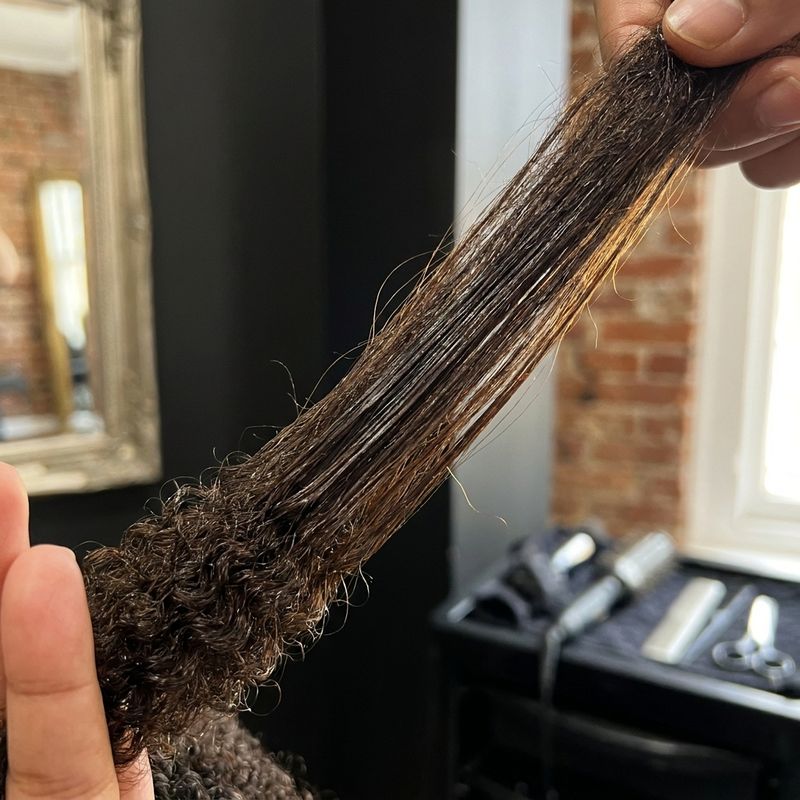
They walk in with a photo on their phone: a gorgeous blonde on pin-straight hair. The head sitting in your chair is curly.
If you’ve spent any time behind the chair, you already know that photo isn’t an expectations problem. It’s a diagnosis problem. Nine times out of ten, that picture-perfect length is straight for a reason — and whoever is sitting in your chair is carrying that same reason around, without having mentioned it.
Today we’re covering why chemical history hides specifically on curly heads, how to ask so it actually surfaces, and why a keratin treatment and a lye relaxer do not hand you the same problem once lightener goes on.
Why does curly hair hide more chemical history than straight hair?
When you’re bleaching curly hair, the piece of information that goes missing most often isn’t the starting level — it’s a prior chemical straightening treatment that never came up. It’s not withheld out of distrust. It gets left out because whoever received it doesn’t file it under “color”: nothing stained, the shade didn’t shift, and in their mind, “that wasn’t a dye job.” And yet it’s the single treatment that most determines what you can safely do once an oxidizer touches that hair.
Anyone with tight curls looking to go lighter has likely spent years inside the straightening world — keratin treatments, Brazilian blowouts, relaxers. That exposure runs far higher than it does for straight-haired clients. Ask “have you ever colored your hair?” and you can get a sincere, completely useless “no” — because the question never touched what’s actually sitting in that hair shaft.
There’s a second, more uncomfortable reason: curl hides the evidence. A section that was relaxed eight months ago and has since curled back up doesn’t show a demarcation line the way a dye job does. There’s no visible band tipping you off. What you see is just curly hair.
One thing “curly hair” as a catch-all label erases: alkaline relaxer risk concentrates in Afro-textured and very tight curl patterns — that’s where relaxers actually get used. Acid smoothing treatments show up across the whole curl spectrum. A 2C head and a 4C head aren’t the same story, either in prior exposure or in the margin you’re working with.
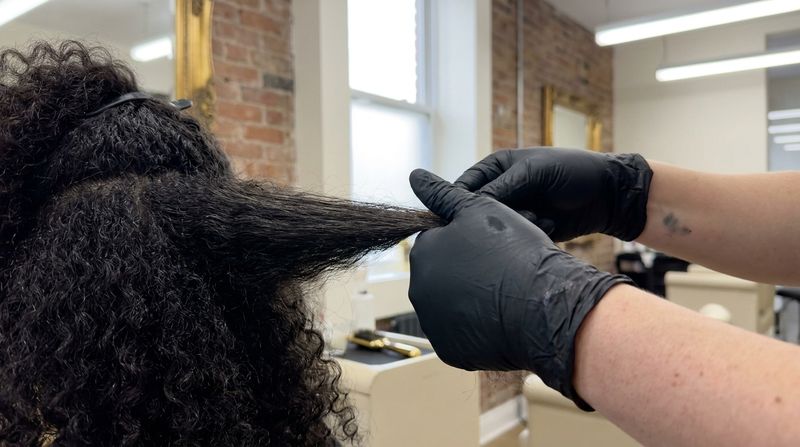
Pro tip: do the assessment dry and backlit before you shampoo. Uneven shine along the same strand — sections that catch light like plastic next to sections that look matte — is one of the few visual tells an old straightening treatment leaves behind.
This article is part of the Hair Coloring Techniques Guide, where you’ll find the full context for every lightening service.
What’s the difference between a keratin treatment and a lye relaxer before bleaching?
They don’t hand you the same problem, and mixing them up costs you the service. An alkaline relaxer (lye, guanidine hydroxide) breaks disulfide bonds irreversibly: your risk is breakage. An acid smoothing treatment — the kind sold as a “keratin treatment” or Brazilian blowout — doesn’t break those bonds, it deposits a coating and changes how the hair takes color: your risk is unpredictability. Writing “had a straightener” on the client card and leaving it at that is recording half the data.
The chemistry backs this up pretty cleanly. Per the comparative study published in the International Journal of Trichology (2023) on the differential impact of acid and alkaline straightening on the hair shaft:
- Alkaline relaxers work through lanthionization: the hydroxide ion penetrates the shaft and converts cystine into lanthionine. That conversion doesn’t reverse. In the study, they significantly reduced breaking strength versus virgin hair and left visible cuticle damage.
- Glyoxylic acid worked differently: it doesn’t break disulfide bonds — it alters them and forms a hydrophobic polymer film over the cuticle. Its tensile strength came out statistically equivalent to virgin hair — but it lost the most protein of anything measured (3.56 μg/g versus 1.12 μg/g for virgin hair; lye, guanidine hydroxide, and ammonium thioglycolate all landed around 2.5 μg/g).
That last figure is the one that gets misread behind the chair most often. “Keratin doesn’t damage the hair” is false — it loses protein, and quite a bit of it. What happens is the damage doesn’t show up as an immediate loss of strength; it shows up as a shaft with a coating on the outside and a depleted matrix underneath. Translated to your bowl: lightener isn’t going to penetrate evenly.
| Variable | Alkaline relaxer (lye, guanidine hydroxide) | Acid treatment (“keratin,” glyoxylic) |
|---|---|---|
| Mechanism | Lanthionization: breaks disulfide bonds | Alters bonds + forms a film over the cuticle |
| Reversible | No, permanent | The smoothing effect fades with washing; no data shows the film fully clears |
| Dominant risk when lightening | Structural breakage | Uneven uptake, unpredictable result |
| Measured breaking strength | Lower than virgin hair | Equivalent to virgin hair in this study; other reviews report lower resistance |
| Measured protein loss | ~2.5 μg/g | 3.56 μg/g |
| Tell behind the chair | Poor elasticity, ends that give | Recent: plasticky feel, patchy lift. Old: high porosity, lifts fast and unevenly |
One honest caveat on that breaking-strength row: the equivalence to virgin hair comes from a small lab assay, and in that same assay the glyoxylic treatment also came out equivalent to the alkaline treatments — which were measurably weaker. Other reviews report flat-out lower breaking resistance for acid treatments. Translation for your chair: don’t treat keratin-treated hair as untouched — the film fools your fingers, it doesn’t replace an elasticity test.
Read those numbers with the fine print attached: they were measured in a lab, on curly hair swatches, with a small number of fibers per treatment — not on real heads walking into your salon. They’re useful for ranking risk, not for predicting one specific head of hair.
And there’s a third group that doesn’t fit into two columns: ammonium thioglycolate — the active in Japanese straightening, also known as thermal reconditioning — isn’t a hydroxide and doesn’t lanthionize. It reduces disulfide bonds, and an oxidizing neutralizer re-forms them in the new position. Still, don’t file it as the gentle option. In that same International Journal of Trichology assay, thioglycolate’s breaking strength and protein loss came out equal to lye and guanidine hydroxide; and the reference literature describes both hydroxides and thioglycolate as incompatible with bleached hair (“both are incompatible with bleached hair,” Hair Cosmetics: An Overview) — an incompatibility worth reading in both directions. Behind the chair, it belongs on the same track as alkaline treatments: strand test, elasticity check, and manufacturer interval before you decide anything. If you can’t pin down which active was used, same rule applies.
For the full mechanism of the alkaline process on the shaft and scalp, the reference piece is Effects of chemical straighteners on the hair shaft and scalp.
How do you ask so the straightener nobody mentioned actually surfaces?
With a narrow question and a cutoff rule that doesn’t rely on memory. The formulation that works is direct: “Have you ever put anything on your hair to straighten it?” followed by “Is that same length still on your head, or have you cut it off since?” The cutoff isn’t a date — it’s whether the treated length is still there. A relaxer from two years ago on hair that hasn’t been cut sits on that head exactly as present as one from March.
Notice what that second question does: it kills the most common, most misleading answer — “yeah, but that was ages ago.” Time only matters if the treated hair actually came along with it. On long curly hair, two years of growth might be six or seven inches; the rest of the length is still treated material.
And here’s the nuance that changes your bowl: a recent acid treatment and one from two years back both count, but they fail in opposite directions. The recent one resists — the film is still active, lightener sits on top of it and lifts patchy. The old one has already lost its smoothness, and what dominates now is the depleted matrix plus two years of flat-iron heat: that length lifts faster than you expect and blows past your target on the ends. Same history, opposite margin.
Then there’s the part that gets skipped when you’re rushed: what it actually was. “A straightener” isn’t enough. You need to know whether it was done in a salon or at home, whether there was a sharp smell while it was being flat-ironed, and what name it was sold under — “keratin treatment,” “hair Botox,” “Brazilian blowout,” “progressive brush,” “relaxer,” or “permanent straightening.” If there’s no way to find out, treat it as the worst-case scenario and say so out loud before you start.
There’s also a high-value question almost nobody asks: “Did your scalp sting? Did they apply a barrier cream or cotton along the hairline before starting?” That separates hydroxide from keratin better than smell does, because relaxers require scalp protection before application, and clients remember that.
Pro tip: ask this at the consult, not on service day. And bill that consult — deduct it from the service if it goes ahead. The real reason strand tests don’t happen isn’t ignorance, it’s that nobody charges for them. On the day the answer turns out to be “we can’t do this,” the work of getting to that “no” is still worth paying for.
This is the same conversation that already backs up diagnosing hidden color history — just a different ghost. In Oxidation Diagnosis Before Bleaching a Box-Dye Black you’ll find the equivalent for accumulated dye buildup. And don’t cross gates: the metallic salt test covers progressive dyes and compound henna, not straighteners. A straightening history doesn’t call for that test — it calls for a strand test, an elasticity check, and the interval your manufacturer specifies.
What changes in the bleach protocol depending on what surfaces?
Before you mix, two things that have nothing to do with history: check the scalp. An alkaline relaxer leaves flaking, redness, or small lesions more often than clients volunteer, and you don’t bleach over compromised scalp — you reschedule. If you see shiny patches or thinning density, suspect scarring alopecia and refer out before an oxidizer touches that head. And if the service ends in an oxidative gloss, the 48-hour patch test is still mandatory — the toner requires it, not the lightener.
The base protocol doesn’t change: it’s still the one from the Hair Bleaching Stages & Time Chart guide — mids and ends first, roots 15-20 minutes later, visual checks every 10 minutes, never more than 50-60 minutes total processing. What changes is your margin, and what you decide before you ever pick up the bowl.
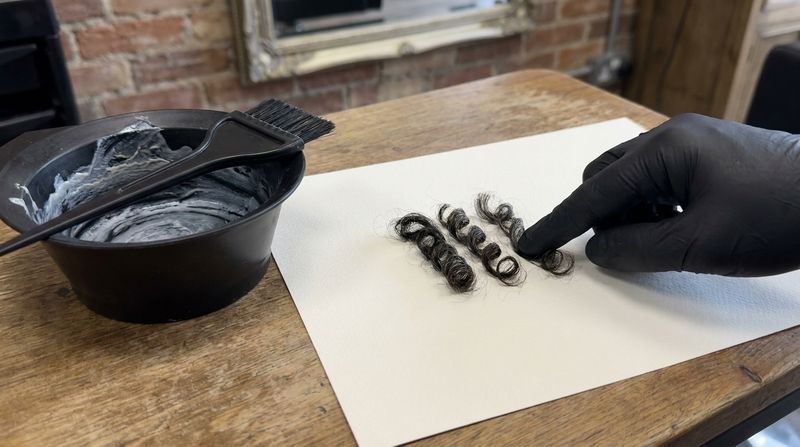
One note on the strand test, which this article treats as a go/no-go call rather than a formality: pull it from the treated zone — not from virgin nape hair — process it for the full intended time, and evaluate it both wet and dry, including styled. The stopping rule is binary: if it stretches wet and doesn’t spring back, or it snaps when styled dry, you already have your answer.
If an alkaline relaxer surfaces
- The strand test and elasticity check stop being a formality — they’re the decision. If the strand gives or stretches without rebound, the answer is no bleach today, not “drop the volume.”
- Bond builder from the bowl, not after. Prior chemical history is already a mandatory trigger in the base guide. And it goes in from minute zero — add it later and it’s already too late. Know what to actually expect from it: it works on free sulfur bonds, and a bond already converted to lanthionine doesn’t offer any.
- The default call on that length is don’t bleach it. With cystine already converted to lanthionine, lifting toward light shades over hydroxide-relaxed hair is described in the literature as incompatible, and what gets described is shaft breakage: “Highlights or light shades are absolutely incompatible with chemical relaxers” (Hair Cosmetics: An Overview). The three honest options are letting the treated section grow out, cutting it off, or working the color without lift (deposit-only, demi-permanent, going darker). Splitting the target into stages doesn’t make it viable — bond-rebuilding between sessions restores feel, not strength, because a converted bond doesn’t re-form. Only when the treated section is short, the strand test holds up under stretch, and the target is one or two levels do you even consider a phased lift — and you say out loud that the risk floor doesn’t drop below that.
- Check your brand’s interval. Manufacturer technical sheets set minimum wait times between a relaxer and an oxidative service. That number comes from the manufacturer, not from instinct.
If an acid treatment or keratin surfaces
- The problem is the read, not the strength. The film fakes what you see and feel — a shaft that looks healthy can still take lightener in patches.
- Strand test by zone, not just one. Virgin curl at the root, mid-lengths, and treated ends all lift at different speeds because the film isn’t distributed evenly. A thirty-second check before anything else: wet the length and watch whether the water beads up or soaks in. The film is hydrophobic.
- Clarify beforehand — for the right reason. A clarifying shampoo strips silicones, oils, and product buildup — not the straightening treatment itself. Don’t expect that length to behave like virgin hair afterward. What it does do is even out your starting point, which is why the strand test and the actual service need to happen at the same condition: clarify after you’ve already pulled the strand test and your test is worthless.
- Watch the accumulated heat. That treatment was done with a high-heat flat iron on a shaft that had already lost protein.
One important distinction so you don’t conflate two problems: patchy uptake caused by distribution on a curly head — sections too thick, the interior of a curl not getting product — is a different phenomenon with its own article, in Uneven Color on Curly Hair. Before you pin a patchy lift on chemical history, rule out an application miss.
Common mistakes when bleaching curly hair with a straightening history
- Only asking about dye jobs: “Have you colored your hair?” doesn’t cover straighteners, and whoever answers isn’t lying. The question is the one that’s broken.
- Writing “had a straightener” without specifying which one: half a client card is half a decision. Six weeks from now, that incomplete note is worthless.
- Using the date as your cutoff: if the treated length is still on the head, the treatment is still active. What expires is cut-off hair, not the calendar.
- Trusting how film-coated hair feels: the coating from an acid treatment gives a false sense of health that doesn’t match what’s happening underneath.
- Bumping to 40 volume to “make up for” slow lift: on hair with a straightening history, raising volume raises risk. And 40 volume never touches the scalp, period.
- Treating “we can’t do this” as a lost sale: over hydroxide-relaxed length, saying no is the job done right. And if the person in your chair pushes back, get the signed consent form and before photos anyway — but be clear about what those actually do: they document that you warned them, they don’t lower the breakage risk by one point. A signature doesn’t change the chemistry. If you move forward anyway, it only happens inside the narrow scenario above: short treated section, strand test holds under stretch, one or two levels.
- Not logging what you asked: today’s conversation only helps the visit two months from now if it’s written down.
Frequently asked questions
Can you bleach hair with a recent keratin treatment?
You can assess it — you can’t assume it. The film from an acid smoothing treatment interferes with lightener uptake, so a zone-by-zone strand test is mandatory, not optional. Plenty of manufacturers also set a minimum interval between the treatment and an oxidative service — check the technical sheet for the product used before you book the date.
How long do you need to wait after a lye relaxer before bleaching?
That question is usually framed wrong, because waiting doesn’t fix the problem on that specific length. The conversion from cystine to lanthionine doesn’t reverse — what improves over time is the virgin hair that’s grown in, not the treated section. Over hydroxide-relaxed length, lifting to light shades is described as incompatible with a real risk of shaft breakage, so the honest conversation is grow it out, cut it, or work the color without lift.
Is curly hair inherently more fragile when you bleach it?
The fragility doesn’t come from the curl pattern itself — it comes from the bend points, where the cuticle sits more raised, and from the accumulated history that tends to travel with curly hair: straighteners, heat, manipulation. Diagnose the hair shaft in front of you, not the stereotype.
How do I tell an acid treatment from an alkaline one if the client can’t tell me?
By indirect signals. A plasticky feel and plastic-like shine point to a film (acid). Poor elasticity with ends that give when stretched points to broken bonds (alkaline). Needing scalp protection before application points to hydroxide. If the story includes a sharp smell and smoke while flat-ironing, all you actually know is that a flat iron was used: hydroxide relaxers process without heat styling. But a flat iron doesn’t mean keratin — Japanese straightening also uses one and also smells strong, and that treatment runs on thioglycolate, not a film. If heat was involved, you still need to separate acid from thioglycolate, and if you can’t, default to the more restrictive scenario. That smell usually points to formaldehyde or its relatives, but don’t read it backwards: glyoxylic acid itself releases formaldehyde when heated. No smoke doesn’t rule anything out, for the hair or for what you breathed in. Classify it by these signals without putting a label on it in front of the person in your chair. When in doubt, treat it as the most restrictive scenario and say so before you start.
Key takeaways
- Asking about color doesn’t cover straighteners: whoever received one doesn’t file it as a dye job, so you have to ask about it separately.
- The cutoff isn’t the date, it’s the length: if the treated hair is still on the head, the treatment still counts — and recent versus old fail in opposite directions.
- Keratin and lye don’t hand you the same problem: acid treatments compromise predictability; alkaline compromises structural integrity.
- Over hydroxide, the default call is don’t lift that length: grow it out, cut it, or work the color without lift.
- Writing “straightener” alone isn’t enough: the client card needs to know what it was, for today and for the visit two months from now.
Calculate Professional Color Formulas With AI
Want to set the bleach protocol with each person’s full chemical history in front of you, visit after visit?
How do you bill the consult when the answer ends up being that it can’t be done?
What happens if you bleach curly hair without checking for a relaxer?
In the app, we ask you a question like this one, but about your own client.
Up for this week’s case? → More on blondes and lightening →Related articles
Practice with our colorimetry tools
Calculators, neutralization wheel, AI consultation...
The Blendsor newsletter
Color techniques and trends for professionals. No spam.
A client in the chair right now?
The Blendsor advisor gives you the precise formula for this technique with your salon's brands — and saves it to your client's card.
Ask about your caseWritten by the Blendsor team
Professional hair colorimetry experts with experience in AI-assisted formulation. We combine color science, salon practice and technology to help colorists formulate with precision.