Bottom-Up Gray Blending: How to Eliminate the Demarcation Line
Covering gray from the root doesn't cover — it marks. Learn the bottom-up technique: diagonal sectioning, softened deposit, and acid gloss to break the demarcation line.
Blendsor
Blendsor Team
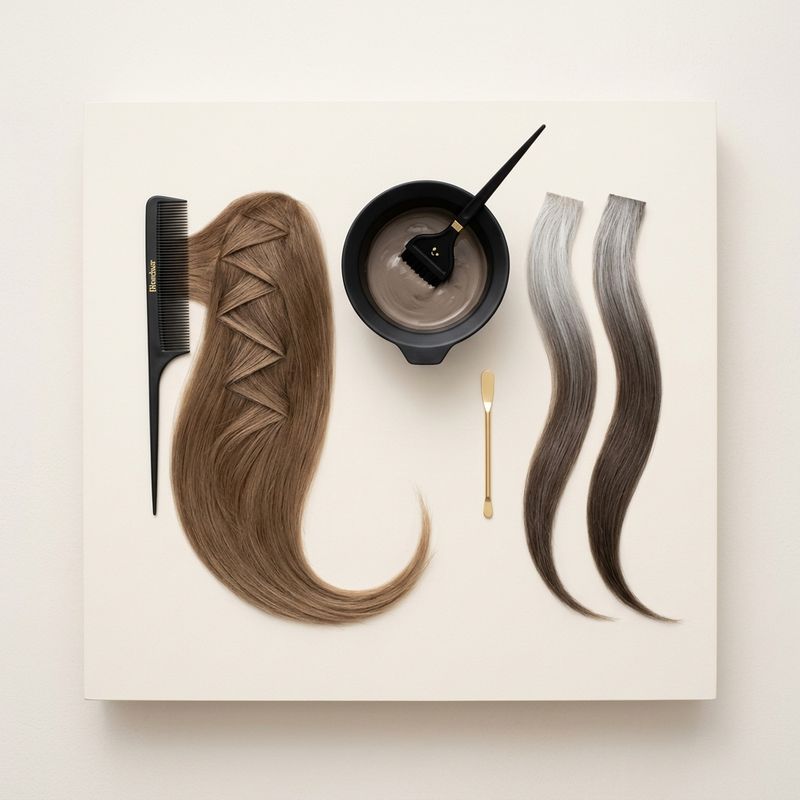
Covering gray from the root doesn’t cover. It marks.
That line showing up before the following month isn’t a maintenance issue. It’s a technique issue.
Standard formulation — applying color from the scalp downward — deposits the most saturated tone exactly where it creates the most contrast. The result: a sharp line that reveals the retouch long before natural regrowth justifies it.
The technique that changes this result is called bottom-up gray blending — the approach that begins the blending process at the mid-lengths and works upward. It has become one of the most discussed topics among professional colorists in recent weeks. For good reason.
Quick summary: the bottom-up technique reverses the classic application order. Instead of depositing color from the root, it starts at the mid-lengths and works upward with a softened shade. The result: the transition between gray and color is gradual, not a hard cut. The demarcation line takes longer to appear and is less visible as it grows.
Why does the demarcation line come back before the first month?
The demarcation line occurs because hair grows continuously but color is applied at fixed intervals. Every millimeter of new root contrasts with the color deposited at the previous appointment.
The problem intensifies when that previous color sits at full saturation in the most visible area: the root. The transition between new gray and applied tint is abrupt because both endpoints are maximally saturated within their categories — the gray strand without pigment, the tint at full load.
Three factors accelerate the appearance of the line:
- High gray percentage — more gray means more contrast between new root and applied color.
- Dark destination shade — dark tones on light base create more visual difference than medium tones.
- Uniform root application — depositing the same saturation from scalp to tip erases what should be a natural gradient.
The bottom-up approach addresses all three: it works with the gradient instead of against it.
According to Behind the Chair, one of the professional color industry’s leading technical resources, blending the demarcation line requires active technique in the transition zone, not just standard coverage.
For a deeper look at the fundamentals of gray hair colorimetry, see the complete colorimetry basics guide.
The bottom-up technique: three variables that determine the outcome
The technique isn’t a single recipe. It works across three decisions that adjust to each individual case.
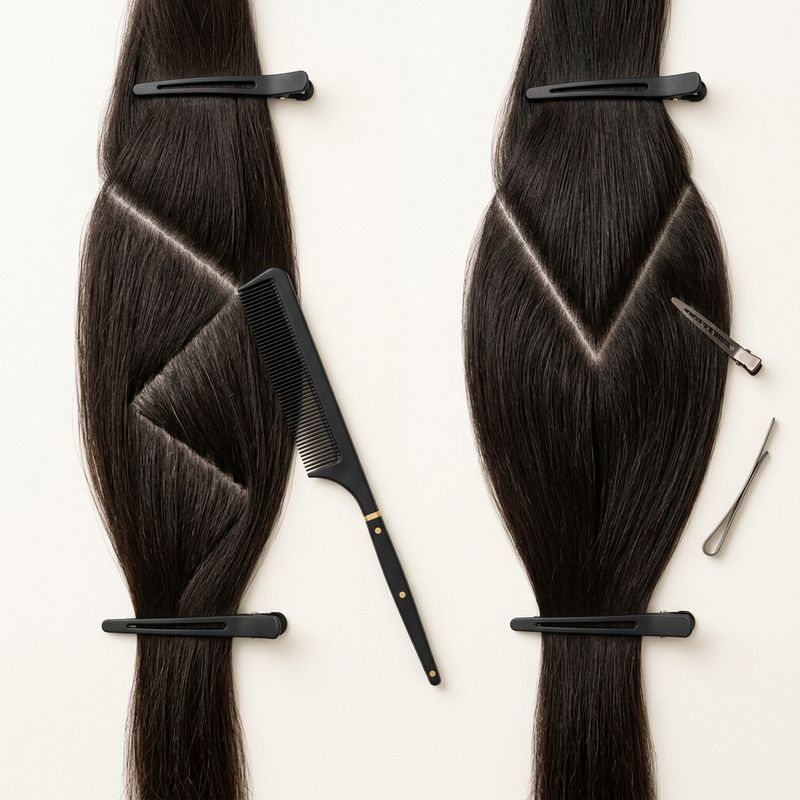
Variable 1: Sectioning — diagonal zigzag instead of classic V
The V-shaped sectioning from balayage works well for free-form highlights. For blending gray at retouch, the diagonal zigzag changes the result for a specific mechanical reason.
The diagonal zigzag distributes the application boundary as an irregular line. When hair falls over itself, that irregularity prevents the transition zones from aligning at the same visual point. The result: regrowth doesn’t appear as a uniform horizontal band but as a set of dispersed contrast points that the eye processes as a natural gradient.
The classic V, by contrast, creates a straight or slightly curved boundary that follows the shape of the head. As hair grows, that boundary becomes visible as a line.
The most effective partition angle varies between 30 and 45 degrees from horizontal, adapting to hair density and the gray percentage in each zone.
Variable 2: Deposit — softened color in the transition zone
The application doesn’t deposit the same shade from root to tip. The transition zone — the first 3–4 centimeters from the scalp — receives a softened version: the destination color emulsified or blended with a fraction of the natural gray shade.
The goal is to create a saturation gradient. The root closest to the scalp receives less pigment; the mid-length receives full load. When hair grows, the new untreated root continues that gradient instead of interrupting it with an abrupt cut.
This is qualitative, not a fixed formula. The degree of softening depends on the gray percentage, the destination shade, and the distribution of white hair. The criterion is visual: if the transition zone looks like a natural blend, the application is correct. If it looks like an artificial gradient, there’s too much softening.
To better understand when and how to use pre-pigmentation on highly resistant gray hair, read Pre-pigmentation for Gray Hair: When and How to Do It.
Variable 3: Gloss — acid or alkaline, depending on the objective
The final step defines the result as much as the application.
An acid gloss (pH between 3.5 and 4.5) seals the hair cuticle. By closing the cuticle scale, it locks in the deposited color, adds shine, and — most importantly — preserves the gradient achieved through the application. The blending worked in variable 2 isn’t lost: the cuticle anchors it. Acid glosses don’t penetrate the cortex; they act on the surface. Hair color science confirms that low pH compacts the cuticle scale and reduces color loss through washing.
An alkaline gloss (pH above 7) opens the cuticle slightly to deposit tone in the cortex. Useful when final-tone adjustment is needed, but they require care on gray hair: the cuticle opening can alter the worked gradient if the application isn’t precise.
The choice between them depends on hair condition, desired outcome, and whether any tone correction is still needed. In most gray blending cases, the acid gloss is the option that protects the technical work done.
For more detail on glosses and finishing techniques, see Hair Gloss: What It Is, When to Use It, and Professional Technique.
Adjustments by gray percentage
The technique doesn’t work the same across all cases. Gray percentage determines what adjustments are needed.
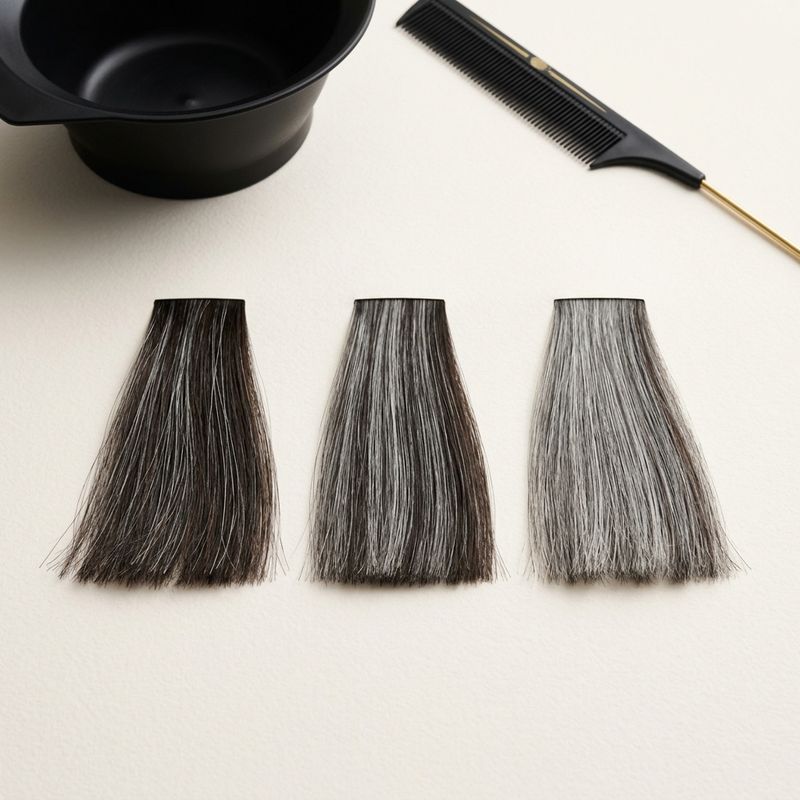
| Gray percentage | Sectioning | Deposit in transition zone | Notes |
|---|---|---|---|
| 30–50% | Standard diagonal zigzag | Moderate softening | Most predictable result; pigmented hair supports the transition well |
| 50–70% | Diagonal zigzag with finer sections | More pronounced softening, apply in two passes if needed | Gray distribution affects result consistency; review section by section |
Scope note: This technique applies where there is natural pigmented base to blend — hair with a real mix of gray and pigment. On heads with complete gray coverage (fully white hair or with more than 90% evenly distributed gray), the gradient principle changes: there is no pigmented base to serve as a reference for the transition. In those cases, the technical approach is different.
The technique pairs well with other integration approaches. If you work with clients who want to maintain part of the natural look of their gray hair, professional gray hair coverage and french blending offer complementary angles.
Step-by-step on a typical case: level 4 base with 50% gray
A level 4 base with approximately 50% gray concentrated mainly in the temples and crown provides the most common context for this technique.
Initial assessment:
- Natural base level: 4 (dark brown)
- Gray percentage: ~50%
- Distribution: temples and crown more affected than nape
- Regrowth since last retouch: approximately 4 weeks
Application plan:
First, divide the hair into working sections with diagonal zigzag partitions at 40 degrees. The zigzag doesn’t need to be perfect or symmetrical — the irregularity is part of the result.
Second: prepare two versions of the destination shade. The main blend goes at full saturation for mid-lengths and ends. The transition blend for the root zone is visually softened.
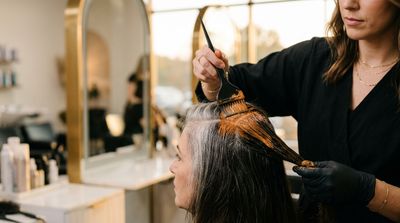
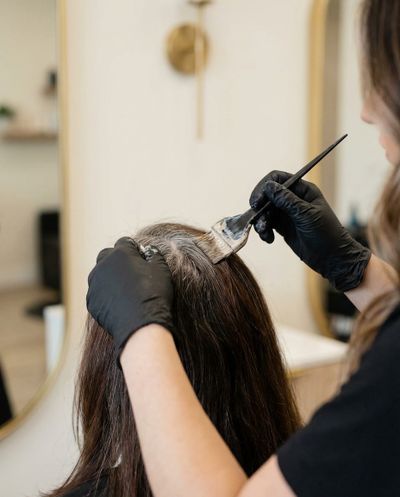
Third: apply from mid-lengths toward the root. Mid-lengths and ends receive the main blend. The first centimeters of root zone receive the softened blend, working the hair so the boundary is not a line but a diffuse zone.
Fourth: standard processing time based on the destination shade and chosen developer.
Fifth: complete rinse and acid gloss seal to preserve the gradient and add shine.
Expected result: real gray coverage with an outgrowth gradient that takes longer to become visible as new root grows in.
Common mistakes when starting this technique
Those applying this technique for the first time tend to encounter the same obstacles.
Mistake 1 — Applying the softening too far from the root. Softening works in the 3–4 centimeter transition zone. Applying it at the mid-lengths creates an unwanted effect: an inverted gradient where the softest zone is the middle of the length. Softening goes near the root, not halfway down the length.
Mistake 2 — Working the zigzag too regularly. The irregularity of the zigzag is functional, not decorative. A very regular or symmetrical zigzag reproduces the same problem as the classic V: it creates a reference line that the eye follows. Variation in the amplitude and angle of each point of the zigzag is what produces the dispersed effect.
Mistake 3 — Skipping the sealing gloss. The application may be technically correct, but without the final acid gloss the gradient achieved at the scalp deteriorates faster. An unsealed cuticle loses surface color before the color that penetrated deeper, which can create visible inconsistencies within weeks.
Mistake 4 — Not adjusting for gray percentage zone by zone. Gray distribution is rarely uniform across the whole head. Temples and crown usually have a higher percentage than the nape and occipital area. Applying the same softening across the whole head produces inconsistent results. The technique requires reading the distribution and adjusting deposit section by section.
Related to this point, the shadow root technique specifically addresses how to work the root zone to achieve natural transitions, with a complementary angle to bottom-up.
When NOT to apply the bottom-up technique
The technique has honest limits worth knowing.
Hair with complete gray coverage. As noted earlier, when hair has insufficient pigmented base to anchor the transition, the gradient has no reference. In those cases, full-coverage standard technique or transition to a silver shade are more appropriate options.
When the client wants complete coverage with no visible gray. The bottom-up technique is for integration, not concealment. If the expectation is that not a single gray hair shows, the technique doesn’t meet that objective. Aligning expectations before applying is essential.
Very damaged or highly porous hair with irregular porosity. Irregular absorption in severely damaged hair can produce inconsistent gradients that don’t respond to the application plan. In those cases, address hair health first before attempting the technique.
Frequently asked questions
Does the bottom-up technique work for any gray percentage?
It works primarily on hair with between 30% and 70% gray with sufficient pigmented base. Below 30%, gray is sparse enough that the demarcation line tends to be subtle on its own. Above 70%, and especially near 90–100%, the gradient loses its base reference and the technique requires deeper adaptations or a different approach.
How much longer does the result last without visible line?
It depends on individual growth rate and gray percentage, but the gradient achieved with the technique typically delays visible line appearance by two to four weeks compared to standard application. It doesn’t eliminate the retouch — it makes it less visually urgent.
What’s the difference between bottom-up gray blending and french blending?
Both address gray blending, but with different approaches. French blending uses a two-shade system (coverage shade plus a lighter blending shade) applied in alternating sections. Bottom-up works primarily with application order and the gradient of the same shade. They are complementary techniques — sometimes combined.
Is acid gloss safe for all hair types?
Acid glosses are generally safe across all hair types, but their effect is most noticeable on hair with some chemical service history. On very dense virgin hair, the sealing is also effective but the visual impact of shine may be more subtle. Always consult the specific gloss product manual for timing and compatibility.
In summary
- It’s a technique issue, not a maintenance issue: the demarcation line appears early because standard color deposits maximum saturation exactly where it creates the most contrast.
- Bottom-up reverses the order: working from mid-lengths to root with a softened shade in the transition zone creates a gradient that takes longer to become visible.
- Three adjustable variables: diagonal sectioning (not classic V), softened deposit at root (3–4 cm), acid gloss seal.
- Applies where there is pigmented base: the gradient needs a reference. With complete gray coverage, the approach changes.
Calculate gray blending formulas with AI
Want to generate the full formula for each gray retouch based on base level, gray percentage, and each client’s chemical history?
Why does covering gray from the bottom up remove the demarcation line?
In the app, we ask you a question like this one, but about your own client.
Up for this week’s case? → More on gray coverage →Related articles
Practice with our colorimetry tools
Calculators, neutralization wheel, AI consultation...
The Blendsor newsletter
Color techniques and trends for professionals. No spam.
You know the theory. What about today's case?
Send a photo to the Blendsor advisor and get an answer grounded in colour theory: toner, developer and timing, with the brands on your shelf.
Ask about your caseWritten by the Blendsor team
Professional hair colorimetry experts with experience in AI-assisted formulation. We combine color science, salon practice and technology to help colorists formulate with precision.