How to Cover Gray Hair with Igora Royal: The Exact Ratio
Igora Royal's US wall chart adds 1 part natural per 2 parts shade over 50% gray; Schwarzkopf's Spanish technical manual sets the cut at 70%.
Blendsor
Blendsor Team
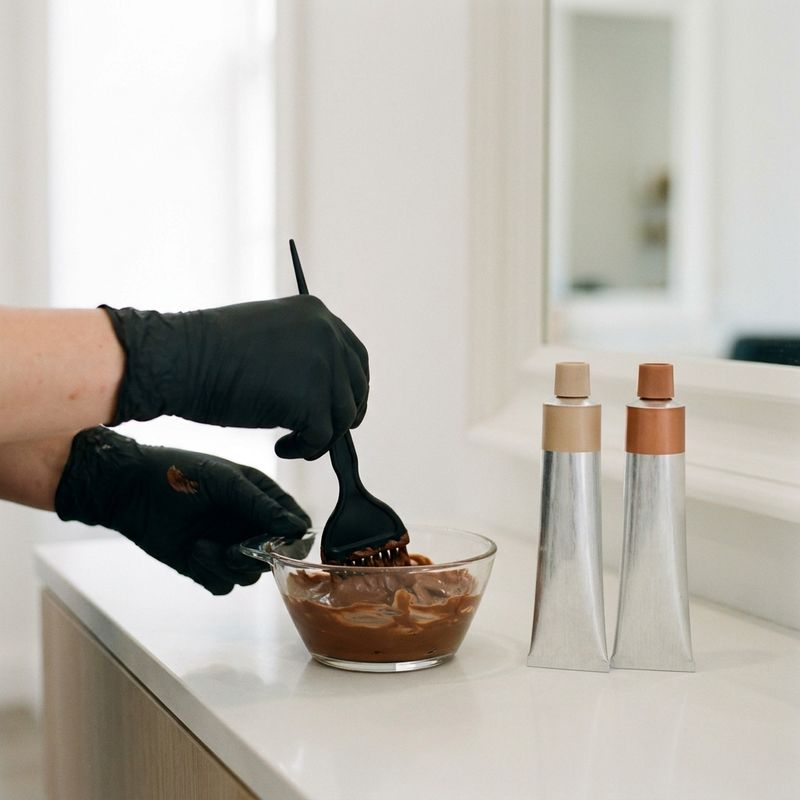
Base 6, plenty of gray already showing, and the Igora Royal shade in your hand isn’t one that covers on its own. How much natural goes in the bowl?
If you formulate with Igora Royal every week, the answer depends on which Schwarzkopf document you’re holding. The wall chart used in the US and the technical manual Schwarzkopf distributes in Spain don’t set the same cutoff.
Here’s what both say: the ratio, the gram example, and which shades fall outside the rule in each one.
How much natural does a partial-coverage Igora Royal shade need?
The US wall chart adds 1 part of a Natural (-0) or Beige (-4) series for every 2 parts of shade, on hair with more than 50% gray and a partial-coverage shade. Schwarzkopf’s Spanish technical manual sets the cutoff at 70%: up to that point, the fashion shade goes on pure; from 70% to 100%, it’s mixed 2:1 with a Natural shade of Igora Royal. On thick, resistant hair, both sources drop to equal parts. The US chart’s example: 40g of 6-65 + 20g of 6-4 + 60g of developer.
The US chart states it as a condition: “When shades with up to 70% coverage are used on more than 50% white hair, add 1 part of a Natural (-0) or Beige (-4) series in a 2:1 ratio to achieve 100% coverage. Mix 1:1 for thick and resistant hair.” It’s the IGORA Color System wall chart, Schwarzkopf Professional’s US edition.
Spain’s technical manual puts it this way (translated from the original Spanish): “How to cover gray hair: 0-70% Use the IGORA ROYAL fashion shade pure. 70-100% Mix 2:1 with an IGORA ROYAL Natural shade. On thick, color-resistant hair mix 1:1.” It’s Igora Royal’s Spanish technical manual (03/2025), p.14.
One detail worth clarifying before quoting either figure: the Spanish-language page of that same US wall chart (not the Spain technical manual, which is a separate document) translates “up to 70% coverage” as “coverage above 70%”, the opposite meaning. Spain’s technical manual doesn’t have that error: it describes fashion shades as covering “up to 70% gray hair”. That’s why this article cites the English original for the US chart, and Spain’s manual as its own document, with its own cutoff.
Which shades fall outside this rule
The ratio above doesn’t apply to the whole range. Here’s how each document splits it:
| Group | What it covers | Needs a natural shade |
|---|---|---|
| Full coverage, US chart: series -00, -0, -1, -4, -63 | Up to 100% gray on their own | No |
| Full coverage, Spain manual: Natural shades (-0, -1, -4) and Intense Naturals (-00) | Up to 100% gray on their own | No |
| IGORA ROYAL Absolutes | Up to 100% gray, ready to use (Spain manual, p.16); the US chart places it on hair with more than 50% gray | No |
| Fashion shades (partial coverage) | Pure below your document’s threshold; above it, 2:1 with a Natural shade | Only above the threshold: more than 50% gray (US chart) or 70% to 100% (Spain manual) |
To tell whether the shade in your hand covers alone, check which family it belongs to, not just its code ending. On the US chart, full coverage comes from series -00, -0, -1, -4 and -63. On Spain’s manual, it comes from the Natural shades (-0, -1, -4, up to level 9) and the Intense Naturals (-00); there, -63 appears in the fashion shade list, with an asterisk the manual doesn’t explain, so if you work from Spain’s manual, don’t assume it covers on its own. Watch for false friends: the high-lift series (10- and 12-), the pastel shades (9.5-), which give a translucent tint (the manual says they tint gray hair, not cover it), the 0-00 diluter, and Fashion Lights aren’t coverage shades even though part of their code matches. Absolutes is its own category and covers without a natural in both markets: the general gray hair coverage guide covers it.
This split between families is specific to Igora Royal. Other lines solve the same question differently: Wella sets its own brackets by gray percentage in Koleston Perfect, and L’Oréal splits its Majirel instruction at 50% white depending on whether the target shade is warm or cool. The general gray hair coverage guide brings all three charts into the same table if you work across brands.
The gram example, step by step
The US chart doesn’t stop at the ratio: it prints an example with quantities. On a 6-65 shade (Dark Blonde Chocolate Gold), with gray above your document’s threshold and normal-density hair:
- 40g of 6-65 (the chosen shade)
- 20g of 6-4 (the Beige of the same level the chart uses in its example)
- 60g of developer
The 40g and 20g keep the 2:1 ratio. With another partial-coverage shade, the same logic applies with a Natural (-0) or a Beige (-4); in its example, the chart takes it from the same level as the shade. Processing time and developer ratio are set by each document: Spain’s technical manual specifies 1:1 with the Activating Lotion and 30 to 45 minutes.
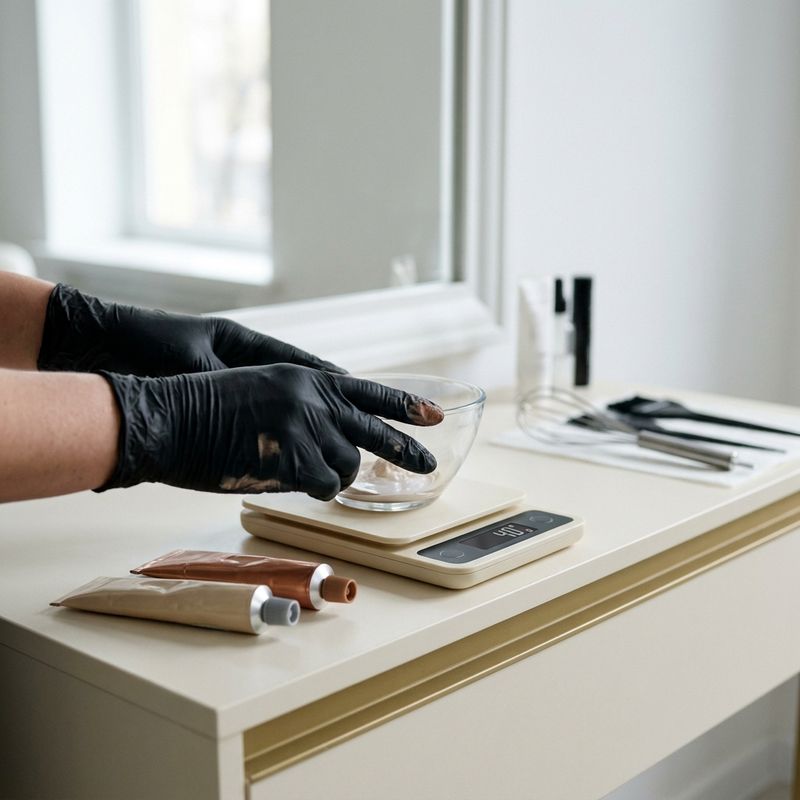
Weigh it, don’t eyeball it.
Pro tip: Beige (-4) isn’t available at every level. In the shade matrix of Spain’s technical manual (p.34), -4 runs from level 5 to 9. At levels 4 and 3 the only Natural shade is -0; at level 1 there are 1-0 and 1-1. The US wall chart has no shade matrix.
What changes on thick, resistant hair
On thick, resistant hair, both sources drop the ratio to equal parts (1:1 instead of 2:1). Neither prints an example for this case: keeping the same 60g of mix, that works out to 30g of 6-65 + 30g of 6-4 with 60g of developer.
Neither document explains why it’s 1:1. The closest thing is the hair-diameter section of Spain’s manual (p.26, translated from the Spanish): “the same amount of pigment on very thick hair can give a lighter and more translucent result than intended. Reaching the target color on different bases takes a different amount of pigment.” Raising the natural share points in that direction. For the thickest, most resistant gray, Schwarzkopf also offers the Intense Naturals (-00), with up to 25% more colorants than the regular Natural shades.
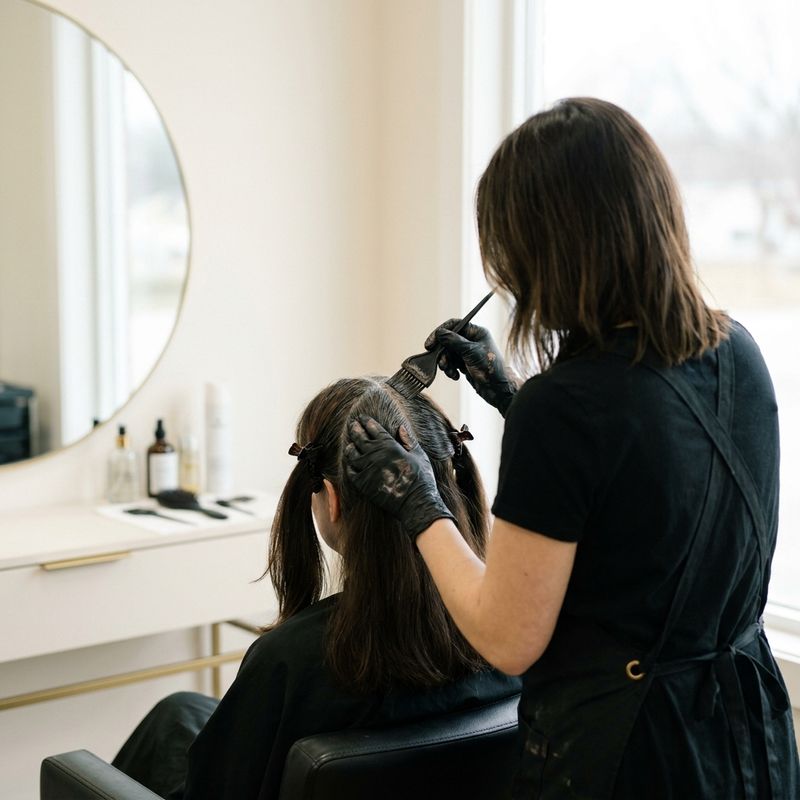
Root by root, section by section.
Before you mix
Spain’s technical manual gives three tips for covering 100% of gray (p.12): always apply to dry hair, start right at the hairline, and work in small sections with a generous amount of product. On regrowth, color goes only on the new area, and mid-lengths and ends are treated separately with the Dual Application, for 10 to 20 minutes. If previously colored hair is porous, it “will absorb more color and the result may be darker than required” (p.26, translated from the Spanish). The same manual warns that different gray percentages may need different mixes: the number on the client card decides the formula.
Outside what the manual covers: before any service, run whatever allergy test Schwarzkopf specifies.
Common mistakes when formulating with this rule
- Applying the 2:1 ratio to a full-coverage shade. If the shade belongs to a series or family your document marks as full coverage, the chart doesn’t call for adding natural.
- Always defaulting to 2:1 on thick hair. Both the US chart and Spain’s manual call for 1:1 in that case; keeping 2:1 departs from that instruction on exactly the fiber that needs the most pigment.
- Applying the wrong market’s threshold. The US chart cuts at 50% gray; Spain’s technical manual, at 70%. Before mixing, check which Schwarzkopf document applies to your market.
Frequently asked questions
Which Igora Royal shades don’t need natural to cover gray?
It depends on the document. On the US chart, the series -00, -0, -1, -4 and -63 (only on this chart; Spain’s manual lists -63 among the fashion shades), plus the entire Absolutes range: they reach up to 100% coverage without mixing in a natural shade. On Spain’s technical manual, the Natural shades (-0, -1, -4) and the Intense Naturals (-00) cover the same way, without needing the mix.
How much natural goes into a partial-coverage Igora Royal shade?
Per the US chart, above 50% gray; per Spain’s manual, from 70% to 100%. In both cases, 1 part of a natural shade for every 2 parts of shade. The US chart illustrates it with 40g of shade + 20g of natural + 60g of developer.
Does the ratio change depending on hair type?
Yes. On thick, resistant hair, both sources drop from 2:1 to 1:1 between shade and natural. For the most resistant gray, Schwarzkopf also offers the Intense Naturals (-00) series.
Is the cutoff at 50% or 70% gray?
It depends on the document: the wall chart used in the US applies the mix from 50% gray onward; the technical manual Schwarzkopf distributes in Spain sets it between 70% and 100%. Before formulating, confirm which one matches your chart.
In summary
- Threshold by document: more than 50% gray (US chart) or 70% to 100% (Spain manual); in both cases, 1 part of a natural shade for every 2 parts of shade.
- Thick, resistant hair: the ratio drops to 1:1.
- Full coverage without natural: series -00, -0, -1, -4, -63 (US) or Natural shades -0/-1/-4 and Intense Naturals -00 (Spain), plus Absolutes in both markets.
Calculate the exact coverage formula with AI
Want Blendsor to propose the natural ratio with your manual’s rule already applied to the gray percentage, starting level, and each client’s history?
Which partial-coverage Igora Royal shade do you formulate with most often?
Do the US wall chart and Spain's technical manual still agree on this ratio?
In the app, we ask you a question like this one, but about your own client.
Up for this week’s case? →Related articles
Practice with our colorimetry tools
Calculators, neutralization wheel, AI consultation...
The Blendsor newsletter
Color techniques and trends for professionals. No spam.
You know the theory. What about today's case?
Send a photo to the Blendsor advisor and get an answer grounded in colour theory: toner, developer and timing, with the brands on your shelf.
Ask about your caseWritten by the Blendsor team
Professional hair colorimetry experts with experience in AI-assisted formulation. We combine color science, salon practice and technology to help colorists formulate with precision.