Why Gray Hair Coverage Varies Every Visit
Same tint code, and the coverage doesn't come out the same. Above 50% white there are two possible mixes, and the client record saves the code but not the target tone.
Blendsor
Blendsor Team
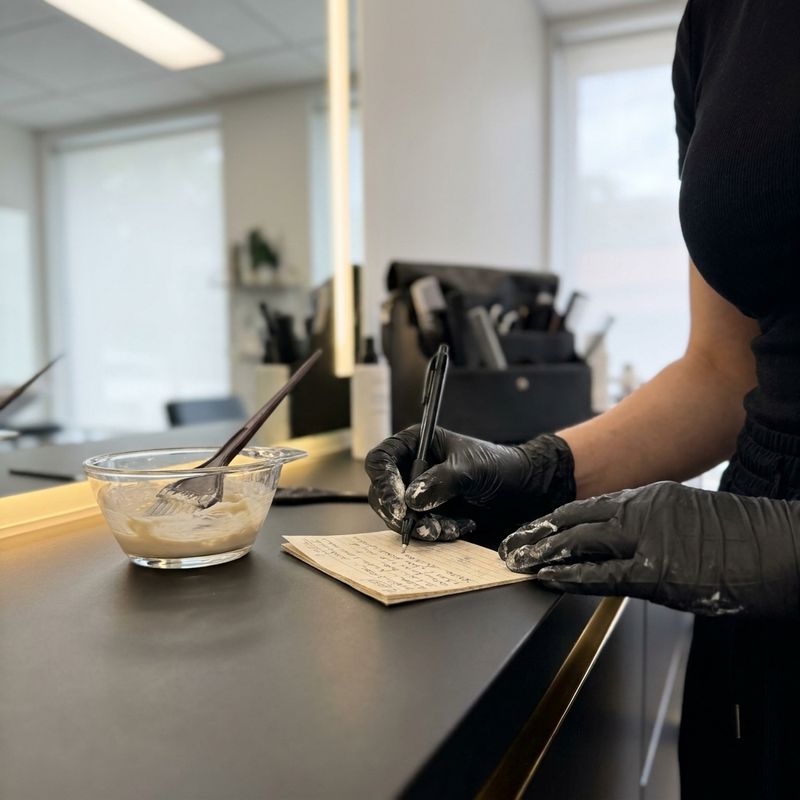
Same tint code logged on the client record. Same ratio. And the coverage doesn’t come out the way it did last time.
When that happens, suspicion usually lands on the product — the tube, the developer, the batch. It’s rarely there. Today’s mix and last time’s mix match on everything that got written down, and they diverge exactly where nothing did.
Because a coverage formula has two halves, and the client record usually keeps only one.
Quick summary: Gray percentage drives the formula, but on its own it doesn’t decide it. The Majirel usage chart from L’Oréal Professionnel splits the instruction in two above 50% white: half a tube of the desired shade plus half a tube of the corresponding level Gold shade for a warm target, or half a tube of the desired shade plus half a tube of the corresponding level Natural shade for a cool target. Below 50%, it’s just the chosen shade, applied as is. That’s the detail that matters: the same percentage supports two different mixes, and which one applies depends on where you’re trying to land. That’s why two visits with the same client record can produce different coverage. The record saves the tint code. It doesn’t save the target tone or the day that percentage was read, and without those two pieces the next appointment copies the mix without knowing which of its two halves was a decision. Log the percentage with its date, and next to the code, note which way the mix was aiming.
Does the gray percentage decide the formula?
It drives it, and it still doesn’t decide it alone. The Majirel usage chart from L’Oréal Professionnel splits its instruction right at 50% white. Below that line, it resolves in one sentence: choose the desired shade and apply it. Above it, the instruction forks into two branches — half a tube of the desired shade plus half a tube of the corresponding level Gold shade (.3/G) when the target is warm, or half a tube of the desired shade plus half a tube of the corresponding level Natural shade (N) when the target is cool.
It’s worth reading that slowly. At the same white percentage above 50%, there are two correct mixes, and the desired shade sits on the first half of both. What decides which of the two branches applies is where the tone is headed: the chart names its rows by target, warm or cool.
The brand writes this for its Majirel, Majirel Cool Inforced and Majirouge lines, in its US document. It’s not worth reading as a sector-wide “gray rule” — other brands resolve it differently, and what matters here is checking the document for the line sitting on your own shelf.
Why can the same hair give two different numbers?
The percentage you log doesn’t come out of a device. It comes out of how you look. The reading depends on the light and on whether the hair is dry or wet, as covered in the professional gray coverage guide: two readings taken under different conditions return different figures for the same hair, with nothing having actually happened to that hair.
There’s also a difference that’s mechanical, not perceptual. The root that’s grown in since the last appointment is new hair, with no prior treatment on it. The mid-lengths and ends are fiber you already covered. They read differently on the very same day, and a single number for the whole head erases that information before it ever reaches the client record.
And there’s a third reason, the most everyday of the three: color can fade unevenly and let gray show through that used to be hidden. The white showing through was already there; the color simply stopped covering it.
| What the client record usually saves | What’s needed to repeat the mix |
|---|---|
| The tint code and the ratio | The target tone the mix was chosen for |
| A bare white percentage | That percentage with the date and conditions it was read under |
| One number for the whole head | Root and the rest logged separately, when they read differently |
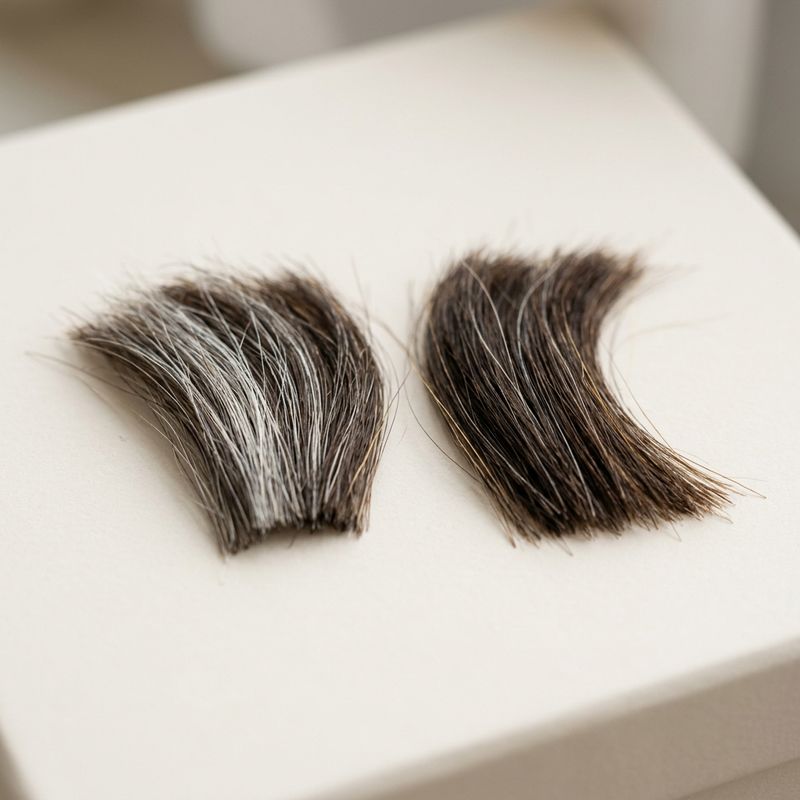
Same day, two different numbers.
What the client record keeps, and what gets left out
Most client records keep the part that can be copied down: the code, the ratio, the developer volume, the timing. That’s the half that writes itself, because it’s printed on the tube.
The other half lives in the conversation, and that’s why it evaporates. Which way the tone was meant to go that day. What conditions the percentage was read under. Whether root and the rest of the head were read as one number or two. None of that is on the packaging, so no one copies it down.
The same principle already applies to what gets logged after a color correction: the field that actually helps the next appointment is the one describing the decision and the fiber’s exact state at that moment. Coverage works the same way. The code says what was applied; the target tone says why that half and not the other.
What happens when the record gets copied without the reason behind it
Whoever handles the next visit opens the record and finds both tubes written down. They can copy them exactly as they are, and that works as long as nothing moves. The problem arrives the moment something does: the person asks for a warmer result, the white reads differently, or the desired shade is no longer the same. Then you have to decide which half to change, and for that you need to know why it was there.
Because that half tube of Natural can mean two very different things: that the target was cool that day, or that whoever formulated it reaches for Natural out of habit. The record writes both down the same way. Treat a decision as a habit and you swap out the tube that was holding the result together; treat a habit as a decision and you carry over a coolness nobody asked for today.
That’s why the comment afterward usually isn’t “it didn’t cover.” It’s usually “this isn’t the same color as last time.” And the record, read back later, seems to back you up: the code’s there, the ratio’s there, everything was followed. What was never written down can’t be broken.
Pro tip: before repeating a formula from the record, look for where the tone was headed. If the desired shade was a Natural, the code won’t tell you: that same Natural gets completed with the corresponding level Gold shade for a warm target and with the Natural for a cool one. Re-read the percentage and settle the target with the person in the chair, the same way you did the first day.
How to log it so the next appointment doesn’t run on memory
Three data points per chemical service, not one:
- The white percentage read today, with the condition you read it under: dry hair, neutral light. The condition matters as much as the figure, because it’s what lets you compare today’s number against last time’s.
- The date of that reading, so you know whether you’re looking at this appointment’s number or one inherited from another.
- The target tone, next to the code: warm or cool. That’s the word that decides the second half of the mix once white crosses 50%.
And a fourth when it applies: if root and the rest read differently, log it as two figures instead of averaging them into one in your head.
Compare these two records for the same client:
- Weak record: “Gray 50%. 5.0 + 5.3 at 50%, 20 vol developer.”
- Useful record: “May 12, 2026, read dry under neutral light: root 55% white, rest 48%. Target tone: warm. 5.0 (desired shade) + 5.3 (corresponding level Gold) at 50%, 20 vol developer.”
The second one doesn’t take longer to write. It takes the habit of logging the decision next to the product, instead of trusting you’ll remember it by the time that person sits down again.
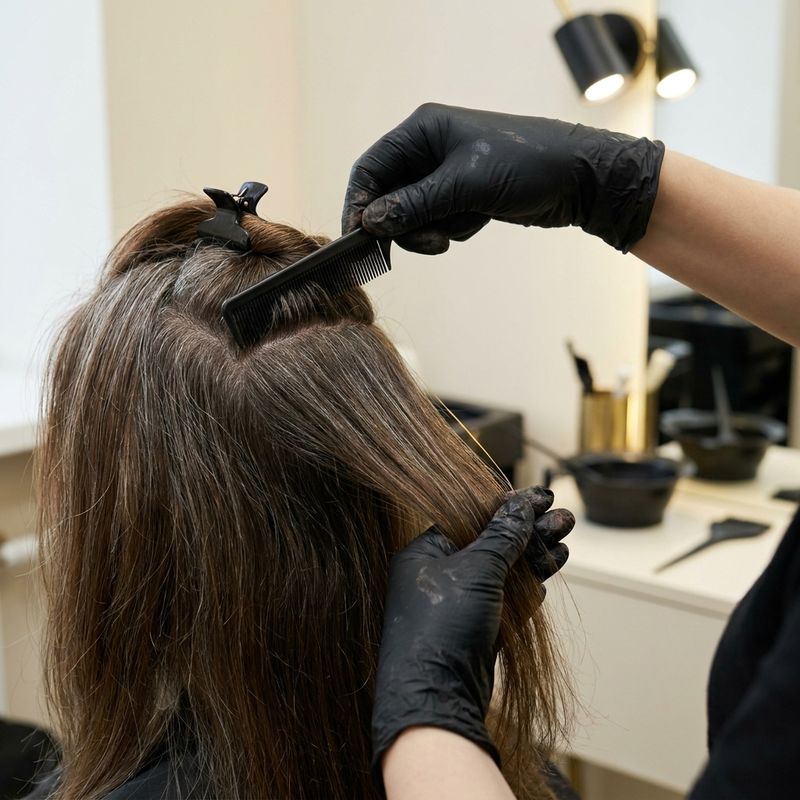
Separate before you decide.
Common mistakes when logging gray coverage
- Logging the code and assuming the rest. The tint code is the half anyone can copy off the tube. The half that gets lost is the one that only ever existed in your head while you were deciding.
- Reading the percentage under different conditions each time. A wet reading under the sink light and a dry one by the window aren’t comparable, even when both end up written as a bare number on the same record.
- Writing the percentage with no date. A stray “50%” doesn’t distinguish between data from this appointment and data inherited from the first consultation — and that distinction is exactly what decides whether it’s time to look again.
Frequently asked questions
If the white percentage is the same, why can’t the mix be the same?
It can be, as long as you know which of the two it was. Above 50% white, the Majirel chart keeps the desired shade on the first half and changes the other one based on the target: the corresponding level Gold shade for a warm result, the corresponding level Natural shade for a cool one. With the percentage alone, you have half the instruction; with the target noted alongside it, you have the whole thing.
How do I read the white percentage so the number still holds up next time?
By fixing the condition and writing it down. Dry hair and neutral light works well as a salon standard — the gray coverage guide walks through the evaluation step by step — and what matters is repeating it: a figure read the same way every time can be compared against the last one; a figure read however it happens to fall that day can’t. The condition gets written next to the number, not left to memory.
If root and the rest of the head read differently, do I log them separately?
Yes, when the difference is visible. The root is new hair that’s never been through color; the mid-lengths and ends are fiber that’s already covered, which is why the white doesn’t show up the same way in both. Logging “root: X%, rest: Y%” preserves information that an averaged number destroys.
Why isn’t it enough to just ask the client how much gray they think they have?
Because their perception and the professional reading rarely line up, and because a home mirror doesn’t show the root with the technical reference point you have. The client’s estimate is useful as conversation; the data point that goes on the record is the one you set yourself, on dry hair under neutral light.
In summary
- Percentage drives the formula, but it doesn’t close it: above 50% white, the Majirel chart opens two branches and the target tone decides which one.
- The same hair can give two different numbers depending on the light, whether it’s dry or wet, and whether you’re reading the root or the mid-lengths and ends.
- The client record saves the code and loses the decision, so the next appointment repeats the mix without knowing which part of it was a tone choice and which part was habit.
- The fix is three data points: the percentage read today with its condition, the date of that reading, and the target tone next to the code.
Calculate gray coverage formulas with AI
Want to calculate the exact ratio from each client’s white percentage and target tone, with the decision saved from visit to visit?
What do you log on the client record besides the tint code?
Why does gray coverage change from one visit to the next?
In the app, we ask you a question like this one, but about your own client.
Up for this week’s case? → More on gray coverage →Related articles

Practice with our colorimetry tools
Calculators, neutralization wheel, AI consultation...
The Blendsor newsletter
Color techniques and trends for professionals. No spam.
A client in the chair right now?
The Blendsor advisor gives you the precise formula for this technique with your salon's brands — and saves it to your client's card.
Ask about your caseWritten by the Blendsor team
Professional hair colorimetry experts with experience in AI-assisted formulation. We combine color science, salon practice and technology to help colorists formulate with precision.