What Developer to Use for a Gray Root Touch-Up
6% (20 vol) is what Wella specifies for gray coverage on a root touch-up. Formula by bracket, exact grams, and what to do about the buildup band eight touch-ups leave behind.
Blendsor
Blendsor Team
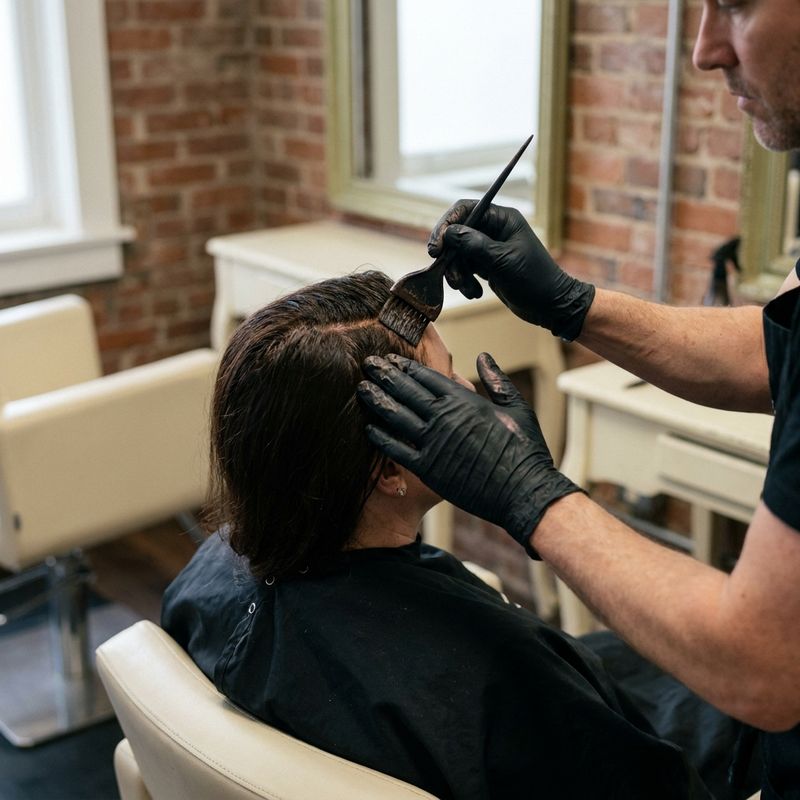

You grab the same tube, the same developer as last month, and the touch-up still doesn’t quite sit right. The root covers fine, but the band underneath it — those two or three centimeters that already carry several touch-ups — looks denser, flatter, different from the new growth.
If you’re formulating gray touch-ups every week, you already know that band. Here’s the developer choice the manufacturer actually specifies for this exact service, the formula by gray percentage done right, and what really builds up that band — and what to do about it.
What developer should you use for a root touch-up with gray coverage?
For a root touch-up with gray coverage, Wella specifies Welloxon Perfect at 6% (20 volume) for Koleston Perfect: one level of lift plus gray coverage, working at the same depth or darker. That’s what the manufacturer’s own chart prints for this exact service: the 6% you’ve always reached for has its own row.
| Welloxon Perfect | Volume | What Wella lists it for |
|---|---|---|
| 1.9% (Welloxon Perfect Pastel) | 6 vol | Color balancing, blonde toning, glossing |
| 4% | 13 vol | Same depth or darker, no gray coverage |
| 6% | 20 vol | 1 level of lift + gray coverage |
| 9% | 30 vol | 2 levels of lift |
| 12% | 40 vol | 3 levels of lift |
These are the five concentrations Koleston Perfect’s chart specifies within this range; Welloxon Perfect also exists at 3% (10 vol), which Wella doesn’t list for this particular service. Every brand builds its own scale, so check the bottle in your hand before translating percentage to volume — the guide to developers and volumes covers the generic market table if you’re working with another line.
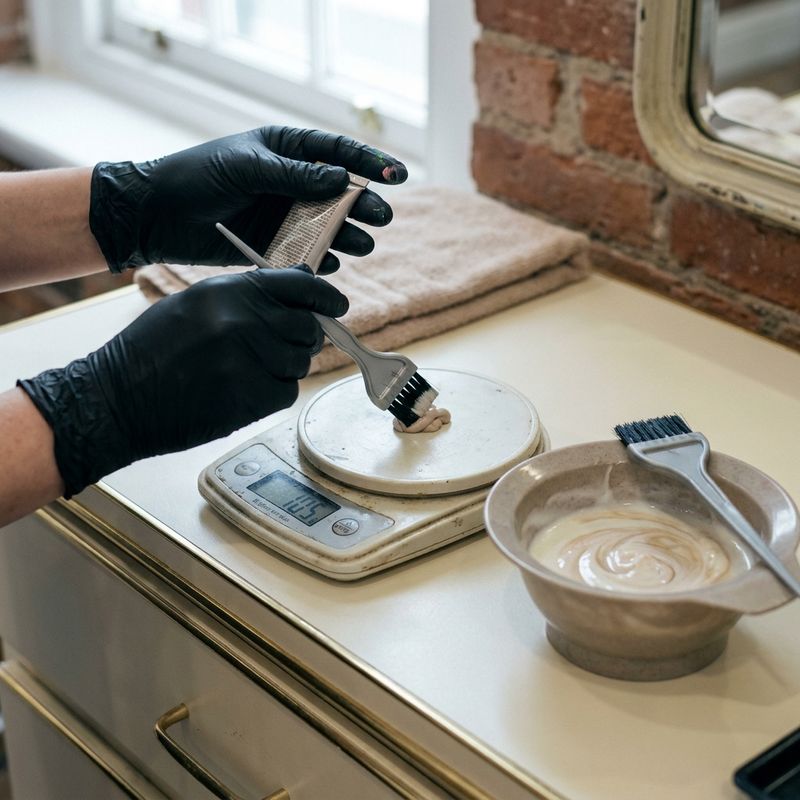
The mix follows the ratio in Koleston Perfect’s usage guidelines: 1:1, 60g of color to 60g of developer. Weighing both, not eyeballing them, is what makes today’s formula repeatable next month. And 1:1 isn’t universal even within the brand: Special Blonde goes 1:2, and Intense Balance, one of the mid-length services below, is pictured with its own mix. If you work with another line, the chart for how much dye you actually need per service is a reminder that the ratio changes by product line, not by habit.
How do you calculate the formula by gray percentage?
The proportion of natural base you add depends on the gray bracket of the zone you’re formulating — not the average across the whole head. Wella publishes two brackets, each with its own printed example in grams:
| Gray in the root | What Wella says | Printed example |
|---|---|---|
| 30-50% | Add 1/3 of a Pure Naturals shade | 15g of 7/0 + 45g of 7/75 + 60g Welloxon Perfect 6% |
| 50-100% | Add 1/2 of a Pure Naturals shade | 30g of 7/0 + 30g of 7/75 + 60g Welloxon Perfect 6% |
In this chart, below 30% gray there’s no published bracket. In-house rule for that case: the target shade goes on its own, no Pure Naturals added.
Worth being upfront about: the two fractions don’t quite line up with each other. In the 30-50% bracket, those 15g are a third of the 45g of target shade, not a third of the 60g of color cream. In the 50-100% bracket, the half really is half of the color cream. Wella doesn’t clarify what each fraction is measured against and only publishes these two examples — so the practical rule is to copy the printed grams, not redo the math yourself.
Example with a reflect (Wella doesn’t print this one — it’s their own ratio applied to a different shade): natural level 6, target 6/43 (light copper-golden brown). At 30-50% gray in the zone: 15g of 6/0 + 45g of 6/43 + 60g Welloxon Perfect 6%. At 50-100% gray in that same zone: 30g of 6/0 + 30g of 6/43 + 60g. Pure Naturals isn’t a cosmetic add-on: Wella requires it so the gray actually gets covered. There’s something else you notice at the chair on top of that — once gray hair has yellowed with age, a warm reflect like this one on top tends to read orange, because it’s missing the neutral base that Pure Naturals provides. The example amounts are there to explain the proportion, not a fixed dose: scale them to your actual root size — a short root works out to half.
When the percentage isn’t the same across the whole head
The key here is not to treat a single percentage as if it applied to the whole head when it doesn’t. It’s common to have 70% gray at the hairline and 25% at the nape. Formulating the whole head to the high bracket overloads the nape. And since 6% works at the same depth or darker, there’s no way to “lift” that excess afterward: every touch-up that takes the high bracket back to the nape stacks density on top of density in that zone.
The fix doesn’t cost much more: two bowls. One for the hairline with its Pure Naturals ratio (50-100% bracket). One for the nape with the target shade alone, no addition, if it’s below 30%. Start applying where there’s the most gray — that’s what Wella recommends.
No need to rush here. If you’re working with two bowls, it’s not just application that gets staggered: rinsing does too. What Wella prints is the frame: for a regrowth application with gray coverage, 30-40 minutes of development. Our rule: check before rinsing, at 30 and at 40, and don’t go past 40. Professional judgment call to work within that frame solo: apply the hairline first and the nape fifteen or twenty minutes later, and each zone reaches its own rinse point (the hairline at its 40, the nape at its 30-40) without either going over the ceiling. That’s two trips to the backwash, not a race against the clock: compressing the application to rinse everything at once either shortchanges the last zone or blows past 40 minutes on the first. One thing that comes with this approach: if you’re rinsing in two passes, Soft Balance can’t be done in one sweep across the whole head anymore. Rinse each zone clean without dragging toward the lengths, and use Intense Balance on any mid-lengths that need it: it has its own bowl, but Wella has it applied during the final stretch of the root’s development time and removed with the root, so in each zone it goes on before that root is rinsed. And mix the second bowl right before you need it: an oxidative mix starts developing the moment it’s mixed, not when it touches hair.
The root’s clock and the mid-length comb-through run on different timers
Wella sets development time for root gray coverage between 30 and 40 minutes without an accelerator, or 15-25 minutes with Climazon, which it authorizes with no further conditions. The more resistant the gray, the longer it takes to develop: that’s why it’s worth checking at 30 and at 40 minutes, not before. Still, professional judgment call: cutting that time short with heat on gray hair that needed the full window is betting it develops earlier than it’s going to. The accelerator pays off on gray you already know responds well, not on gray that resists.
That clock belongs to the root. Mid-lengths and ends don’t share it, and Wella has two separate protocols for them — neither one is “apply the fresh coverage mix down the lengths”:
- Pure Soft Balance: once the root’s development time is up, wet the hair well with water and emulsify the color already on the head through lengths and ends, 5-10 minutes. No new product goes in. Professional judgment call: skip it when mid-lengths already carry a marked buildup band or ends are porous: there it doesn’t add shine, it adds deposit exactly where you’re trying to remove it.
- Intense Balance (only when mid-lengths have genuinely lost tone, not on every visit): Wella’s usage guidelines apply it to the lengths for the last 10-15 minutes of the root’s development time and say to comb it through to distribute it evenly. On that page it’s pictured next to a 1:2 mix of 30g Koleston Perfect and 60g Welloxon Perfect Pastel 1.9%. This isn’t the root mix. Professional judgment call: place it starting below the buildup band and work it toward the ends, not from the root downward.
Mixing these two up with the 6% root formula is what leaves mid-lengths darker than you meant them to be. The guide to hair color processing time covers the general chemistry of development if you want the full grounding.
What to do about resistant gray, according to the manufacturer
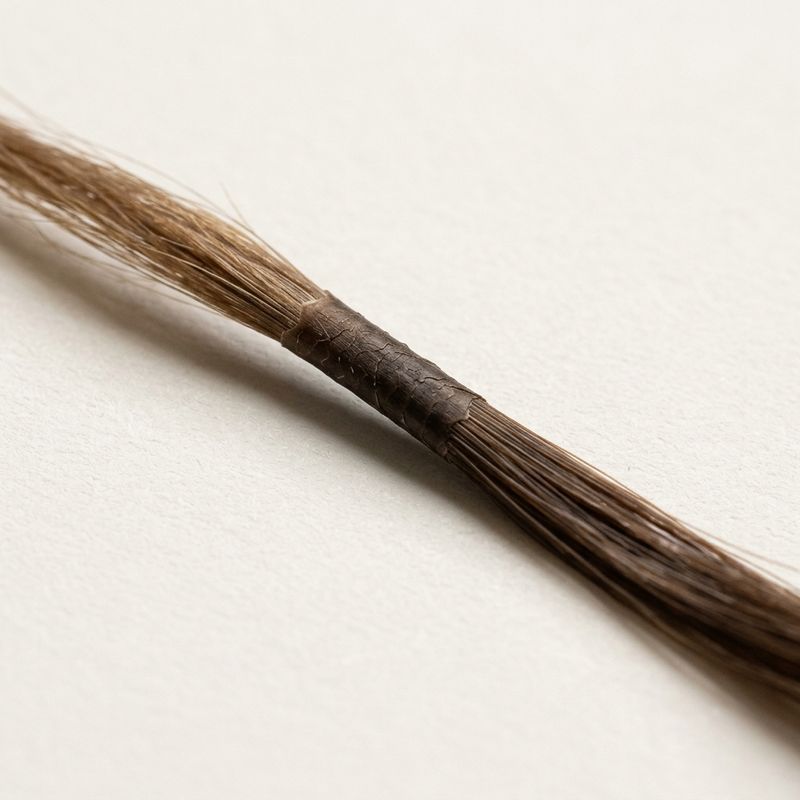
With resistant gray, Wella advises against two practices in writing in its UK gray coverage tip sheet for Koleston Perfect: “pre-softening” it with pure developer before applying color, or changing the mixing ratio, with more color cream, to get more coverage. Either one can lead to unpredictable results, and neither complies with its safety guidelines.
What Wella asks for is the right bracket’s formula: start at the zone with the most gray, place the product with a heavy placement instead of stretching it thin so it saturates properly. As our own rule, check at 30 and at 40 minutes, with 40 as the ceiling. If the gray still isn’t covered at 40 minutes, the problem isn’t time: that formula isn’t enough for that gray. That’s where the chart’s resistant-coverage shades come in (66/0, and 66/02 if you also need to tone down warmth), built specifically for very resistant gray, instead of stacking more minutes onto a formula that isn’t going to change its result.
The buildup band: what accumulates over eight touch-ups
A touch-up never starts on neutral hair. It starts on a zone that already carries eight, ten, fifteen visits of chemical history — the band that separates today’s root from the rest of the length. Since oxidative color doesn’t lift what’s already deposited, every touch-up that overlaps a little more than it needs to in that band doesn’t get corrected by the next one — it adds up. The result, over months, is a band denser and flatter than either the new root or the lengths, even though every individual touch-up looked correct at the time.
Two other things wreck that band without the formula being to blame:
- What happens between visits. A drugstore box dye changes the zone’s porosity and, with it, the real development time next time around. Henna is a different category of risk: if it contains metallic salts — common in henna that isn’t cosmetic-grade — those salts react with the developer’s peroxide and can damage the fiber and disrupt the color result. Before coloring over it, run a strand test the classic way, which is the sensitive one: in a bowl, 20-volume developer with a few drops of ammonia; inside, a strand cut from that zone, 20-30 minutes. If it bubbles, heats up, changes color, or gives off a smell, that zone doesn’t get oxidative color until it’s cut off or grown out. One caution worth saying out loud: a clean result lowers the risk, it doesn’t rule it out — with low metallic load, the test can come back negative anyway. If the client confirms they’ve used non-cosmetic henna, trust their word over the strand test.
- Yellowed gray. With years, water, and product, gray loses its whiteness and yellows. A warm reflect — a /43, say — on top of that yellowed background tends to read orange, not because the shade failed but because it was missing the neutral base Pure Naturals provides.
A good part of that band gets prevented at application, not after. Fine sections, and in each one the brush starts at the scalp and stops right where already-colored hair begins: that line is the limit. Product goes on placed, not stretched thin — Wella asks for it that way: place the color on rather than spreading it, because a heavy placement allows better absorption. If a strand needs more to saturate, you give it more right there, at the root; what stains the band is dragging downward and combing the mix through at the end. It’s the same discipline behind any properly done touch-up — the guide to why root touch-ups come out uneven goes into more detail.
What to do about the band that’s already there
What follows isn’t Wella’s instruction — it’s professional judgment, and worth treating as such. The band doesn’t disappear in one session: you stop feeding it. If the new growth has a different real level than the band, formulate that growth to its real level instead of forcing the same old formula to “match.” If the band needs unifying with the rest of the hair, handle it as its own service — a gloss or a diluted toning service over that zone — rather than repeating the 6% coverage mix over something that’s already covered.
Before you mix: what Wella puts in writing
Allergy alert test, 48 hours ahead. The manufacturer asks for it before any color service, even with clients you’ve seen for years. If redness, burning or itching shows up during those 48 hours, the color isn’t applied and the client seeks medical advice before coloring again. And if they’ve ever had an allergic reaction to a dye, they don’t get colored, full stop.
Check the fiber’s elasticity in the band before deciding whether that zone can take another touch-up. (This one isn’t from Wella’s guide — it’s professional judgment.)
The ceiling is 40 minutes. Wella’s Koleston Perfect usage guide gives a regrowth application 30-40 minutes without heat (15-25 with Climazon). Our rule: at 40, you rinse, and if the gray hasn’t fully covered, what changes is the formula, not the clock (see resistant gray, above). And checking is a concrete gesture the Wella gray coverage tip sheet describes: gently remove the color off with the end of your tint brush, lift the hair up slightly to visibly check coverage, always before rinsing. The mixing ratio, the gray brackets, and the allergy alert test are in Koleston Perfect’s official usage guide (Wella PDF).
Frequently asked questions
What volume of developer do you use for a gray root touch-up?
6% (20 volume) is what Wella specifies for Koleston Perfect for this service: one level of lift plus gray coverage, and it’s the only row in its guide with gray coverage. It specifies 9% for two levels of lift and 12% for three. If the same root needs gray coverage and more than one level of lift, its guide has no row for that: check with your educator or your distributor.
Can you pre-soften resistant gray so it covers better?
Wella advises against it in writing in its UK gray coverage tip sheet: no pure developer beforehand, no bumping the color cream ratio in the mix. If the gray is still resisting at 40 minutes, what needs to change is the formula’s natural tone: a Resistant Cover shade (66/0 at level 6) goes in where the natural you were already adding used to sit. 66/02 is its cool version, for when you also need to hold back warmth. Wella confirms these shades can be intermixed with all other shade families, but it doesn’t publish grams for this variant: keep the ratio of the bracket you were already working with, and test it on a strand before you take it to a full head. Bear in mind too that 66/0 only exists at a few levels of the chart: at a high level this particular shade may not exist, and that’s a conversation with your educator or your distributor, not something to improvise.
Why does my touch-up come out denser in the buildup band than in the new root?
Because that band already carries several touch-ups with some accumulated overlap, and oxidative color doesn’t lift what’s already deposited. Every pass that steps over a little more stacks density on density. It’s fixed by no longer feeding it, not with a heavier session of product.
Can I apply the same root mix over mid-lengths to refresh the color?
Not with the fresh 6% mix. What you actually do is wet with water and emulsify, through mid-lengths and ends, the color already on the head after the root’s development time (Pure Soft Balance); or, if mid-lengths have genuinely lost tone, use a separate mix with a very-low-volume developer (Intense Balance). Never the freshly mixed coverage formula.
In summary
- 6% is what Wella specifies for a touch-up with gray coverage, one level of lift.
- 30 to 50% gray: 15g natural + 45g your target shade + 60g Welloxon Perfect 6%. 50 to 100%: 30g + 30g + 60g. These are the grams Wella prints.
- A head with uneven gray needs two bowls, each zone with its real proportion.
- The root’s clock is 30-40 minutes. Mid-lengths get one of two options: Pure Soft Balance, 5-10 minutes once the root is done; Intense Balance, during the last 10-15 minutes of the root’s time, not the root mix combed downward.
- Resistant gray gets fixed by changing the formula’s natural tone. Pre-softening is something the manufacturer advises against in writing.
- The buildup band gets starved gradually. No single session erases it.
- 48-hour allergy alert test before any service, and checking the result before rinsing, with 40 minutes as the ceiling.
Calculate the exact formula for every touch-up
Want the real gray percentage, the starting level, and each person’s history to arrive already calculated into the day’s formula, instead of eyeballing last month’s again?
How long does it take for the buildup band to show up in your salon: three touch-ups, six, more?
Manufacturer sources
Manufacturer documents consulted for this article. A copy of each one is kept, and the passages noted from it are checked against that copy.
Note each one's country: the same line's instructions can differ from one market to another, so follow the directions for the product you use.
What happens if you use the wrong developer on a gray root retouch?
In the app, we ask you a question like this one, but about your own client.
Up for this week’s case? → More on gray coverage →Related articles
Practice with our colorimetry tools
Calculators, neutralization wheel, AI consultation...
The Blendsor newsletter
Color techniques and trends for professionals. No spam.
A client in the chair right now?
The Blendsor advisor gives you the precise formula for this technique with your salon's brands — and saves it to your client's card.
Ask about your caseWritten by the Blendsor team
Professional hair colorimetry experts with experience in AI-assisted formulation. We combine color science, salon practice and technology to help colorists formulate with precision.