How to Quote a Color Correction Session by Session
How to quote a color correction without promising the final result: consultation and strand test first, a price per session and a written stopping point.
Blendsor
Blendsor Team
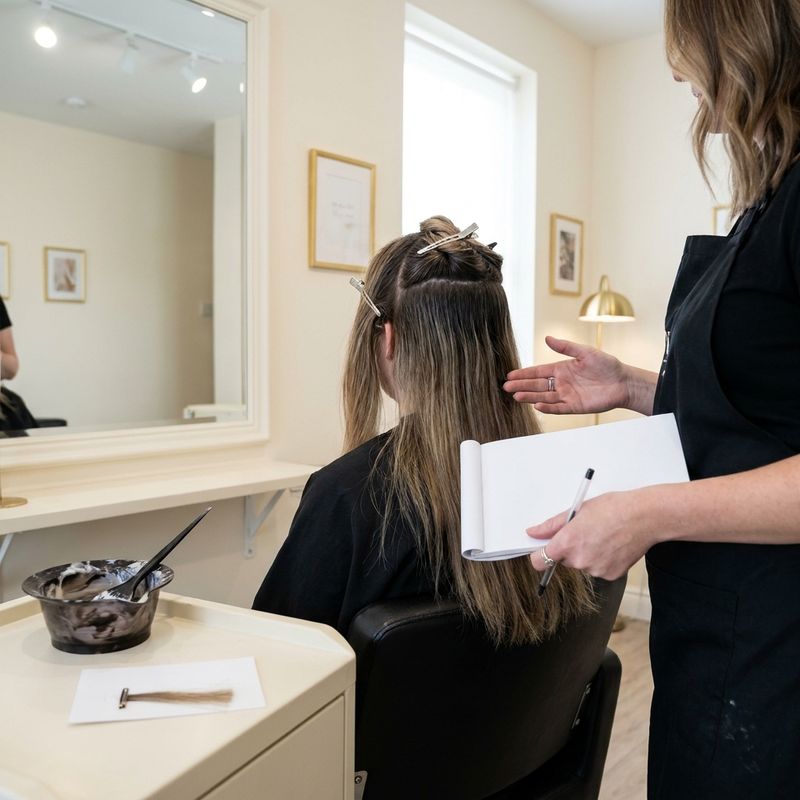
The question comes before you have touched the hair: “How much is it going to cost to fix this?” The person asking has a color that is not the one they wanted, and you do not yet know what is underneath.
That question is the trap of a correction. A regular color service is quoted before you start because you can see the result you are heading for. A correction is quoted with half the information, and if you give a fixed price for something you have not seen, either you pay for it or the hair does.
In this article you will see how to quote a correction without promising the end result: what you charge for first, how to price each session and how to put it in writing so nobody feels misled halfway through.
Quick summary: A correction is not quoted in one piece, it is quoted in stages. You charge for the consultation and the strand test first, because that is what gives you real information. After that, each session gets its own price, its own scope and its own stopping point. The final result is never promised: you agree how far you go at each step and when the next one gets decided.
Why Is a Correction Not Quoted Like a Regular Color Service?
Because the price of a regular color service depends on what you can see, and the price of a correction depends on what you do not know yet: the chemical history, how much pigment has built up in the mid-lengths and ends, and how the fiber responds. Until you have done the consultation and the strand test, any fixed price is a bet.
If you want to review what counts as a correction and what is only an adjustment, it is covered in professional color correction. Here we stay on the business side: how to turn that uncertainty into a quote that does not leave you out of pocket and does not scare off the person receiving it.
Three things set a correction apart:
- Unpredictable chair time. A session can run long because the hair needs you to go slowly, not because you work slowly.
- Product that does not get used up cleanly. Test mixes, adjustments on the fly and touch-ups that do not exist in a regular service.
- A result built in steps. Each step shapes the next one, and you cannot decide the next one until you have seen how the last one turned out.
A quote that ignores those three things feels comfortable for the person receiving it and is a problem for the person giving it.
What Goes Into a Color Correction Quote?
Four parts, and each one becomes known at a different moment: the consultation with the strand test, the first session, the following sessions and the maintenance afterwards. Only the first two can be priced on the day of the consultation; the rest gets settled once you have data.
| Part | What it covers | When you know it |
|---|---|---|
| Consultation and strand test | History interview, assessment under neutral light and the test strand | On the day of the consultation |
| First session | The gentlest step that moves the color in the right direction | After the strand test |
| Following sessions | The step that the previous session’s outcome decides | At the end of each session |
| Maintenance | What it takes for the result to hold | Once the color is stable |
The idea behind the table: you do not forecast the price of what you do not know, you postpone it with a decision date. With a date attached, postponing stops sounding evasive, and the person receiving the quote knows when they will have the price.
How Do You Quote the Consultation and the Strand Test?
As a service with its own name, and you charge for it even if the person decides not to continue. It is judgment work: interviewing, looking at the hair under neutral light, understanding the history and checking on a cut strand how it reacts before you touch the rest of the head. If the first session is going to use an oxidation color, or the product’s instructions ask for an allergy test, that test is also done at this visit, with that product and as far ahead of the appointment as its instructions say; if they don’t say, at the very least, not on the same day as the color appointment.
A consultation you give away sends the wrong message: that the important part starts when you mix, not when you look. And it leaves you working for nothing in exactly the part where your reputation is most at stake.
How to frame it so it is accepted well:
- Say it before you start. “First I look at the hair and do a strand test. That has its own price, and with it I will tell you what is possible.”
- Present it for what it is. It is not a test to see whether you are any good: it is the work that prevents surprises.
- Tie the result to the plan. If the person continues with you, that work is already part of the process. If they do not, they leave with a written assessment.
For what to look at and how to read the exposed underlying pigment, there is how to diagnose the underlying pigment, and for deciding what to do with the strand, the strand test and the choice between remover and lightening.
How Do You Price Each Session?
With the same formula as any service, but with room for the unexpected: product, chair time and salon overhead, plus what your work is worth per hour. The full formula is in coloring service pricing and the salon pricing calculator does the sums for you. What changes in a correction is what goes into each box.
If you build the correction formula in Blendsor, the View costs option splits it by session: the products in each one, what they cost and how long it takes. That’s your starting point for pricing each stage. The price it suggests at the end is a guide for the whole correction, so you set each session’s price yourself from that time and your rate.
- Product: count what you really use, not what a regular service would use. Test mixes and adjustments are product too.
- Time: count chair time and the time the slot blocks your schedule. If a correction takes the whole slot, the slot is what you charge for.
- Length and density: more hair means more product and more time, as in any service. In a correction it weighs even more, because you cannot save product without compromising the result.
- Risk: fragile hair forces you to go slower and stop earlier. That pace is part of the service, not a discount you give anyone.
And one rule that simplifies everything: you charge per session, not per result. If you charge per result, the chemistry risk is yours. If you charge per session, the person pays for the work done and decides the next step with information.
Pro tip: If someone asks for a total price, don’t give a fixed one. Offer the price of the session you’re about to do, a rough range of how many sessions it may take (making clear it depends on how the hair responds) and a way to decide the next ones: “Today we get this far for this price. Once we see how it turns out, I will tell you what comes next and what it costs.”
How Do You Explain It to the Person in Your Chair?
Out loud and in writing, in three sentences that leave no room for two readings: what happens today, how far it goes and when the next step gets decided. A conversation with nothing written down is remembered differently by each side, and corrections are exactly the service where memories differ the most.
An example of how it sounds, with no figures:
“Today we do the consultation and a test strand. With that I will tell you which session comes first and what that session costs, not the total. When the first one is done we look at how the hair responded and decide the next step together.”
What should be in writing, even as a short note:
- What this session includes and what it does not.
- The stopping point: what level or tone you reach today and why you stop there.
- When the next one is decided and what would make it unnecessary or different.
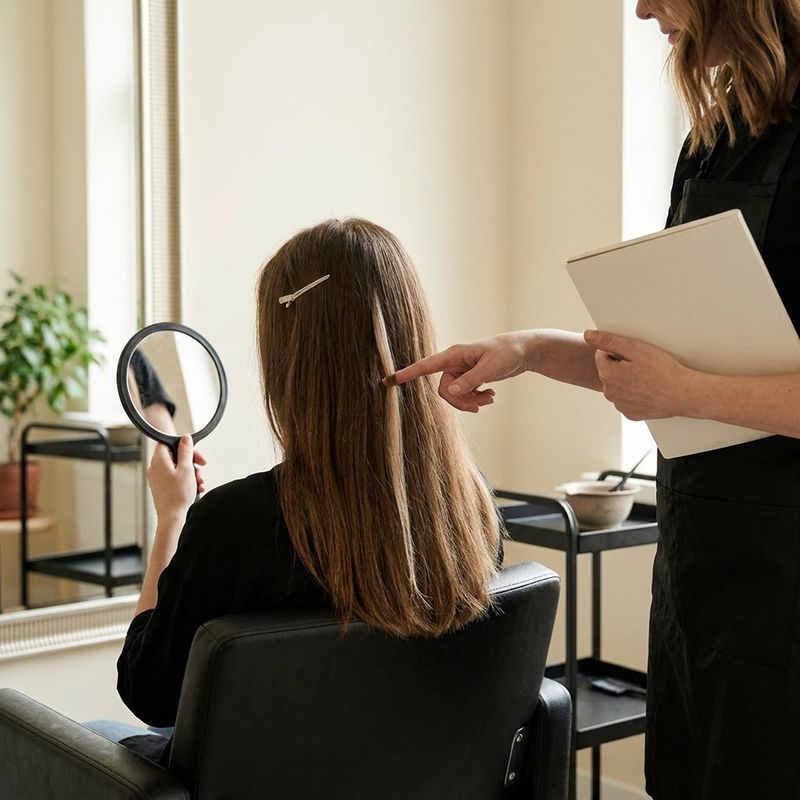
That note is the same one that later works as your record after the correction: what was agreed and what was observed live in the same place, and the next session does not start from zero.
What Do You Do If the Strand Test Changes the Plan?
You change the quote before you continue, not after. That is exactly what the strand test is for: if it shows the fiber can take less than it looked like, or that there is more history than the person mentioned, the plan gets redone and the price gets redone with it.
Three common outcomes, and how each one shows up in the quote:
- The strand responds as you expected: you carry on with the plan and the first session goes ahead as set.
- The strand responds worse: the quote moves to a different order. Reduce the risk first, color afterwards. The first session may be about caring for the fiber without touching the tone.
- The strand does not give what was asked for: you say clearly that this result cannot be promised and you offer what is possible.
Saying “with this I cannot promise you that result” may cost you that day’s service, but it’s usually the sentence that builds the most trust, because it shows the quote isn’t just a sale.
Common Mistakes When Quoting a Color Correction
- Giving a total price before the strand test: if the plan changes afterwards, you have to choose between losing money and breaking your word.
- Giving away the consultation: you work unpaid in exactly the part that asks for the most judgment.
- Charging only for the color and not for processing time: a correction occupies the schedule even when you are not applying product every minute.
- Leaving the agreement only spoken: by the third session nobody remembers what was promised.
- Copying another salon’s price: their costs, training and schedule are not yours. With the minimum price formula you get your own.
Frequently Asked Questions
Can You Give a Fixed Price for a Complete Correction?
Only if you already know how many steps it takes and how the hair is going to respond, and that is almost never known before you start. The safest approach is to give the price of the session you are about to do and fix when the next one gets decided, rather than committing to a total.
Should I Charge for the Consultation and Strand Test if the Person Does Not Go Ahead?
Yes. It is work done, with time and product, and it serves the person even if they do not continue with you: they leave with an assessment. If you give it away whenever there is no follow-up, you end up financing other people’s doubts with your schedule.
What If Someone Compares My Quote With Another Salon’s?
Ask what the other one includes: whether it covers the consultation, the strand test and what happens if the plan changes. A lower price that leaves those parts out is not the same service. Explain calmly what yours covers and let the person decide with that information.
How Do I Explain That the Result May Take More Than One Session?
With the staged plan: in each session the person sees a concrete step forward and knows when the next one gets decided. Promising the final result in a single appointment is what creates frustration; explaining the path in advance prevents it.
In Summary
- A correction is quoted in stages: consultation and strand test, first session, following sessions and maintenance.
- The consultation and the strand test are charged for: they are the work that makes the rest of the quote honest.
- You charge per session, not per result: the person pays for the work done and decides the next step with information.
- The agreement is written down: what the session includes, how far it goes today and when the next one is decided.
- If the strand test changes the plan, the quote changes: you redo it and agree on it before you go on with the session.
Calculate Color Corrections With AI
Want to plan a correction step by step according to each client’s starting level and chemical history?
How do you present a correction when you do not yet know what is underneath?
Manufacturer sources
Manufacturer documents consulted for this article. A copy of each one is kept, and the passages noted from it are checked against that copy.
Note each one's country: the same line's instructions can differ from one market to another, so follow the directions for the product you use.
Related articles



The Blendsor newsletter
Color techniques and trends for professionals. No spam.
Every client, one tap from their history
Formulas, hair health and evolution saved on their own. You and your team open the card and pick up where you left off.
See how it worksWritten by the Blendsor team
Professional hair colorimetry experts with experience in AI-assisted formulation. We combine color science, salon practice and technology to help colorists formulate with precision.