Restoring Hair Color After Summer
Summer doesn't leave you with one faded color — it leaves you with three. Roots, mid-lengths and ends aged at different speeds, and that June photo no longer matches your hair.
Blendsor
Blendsor Team
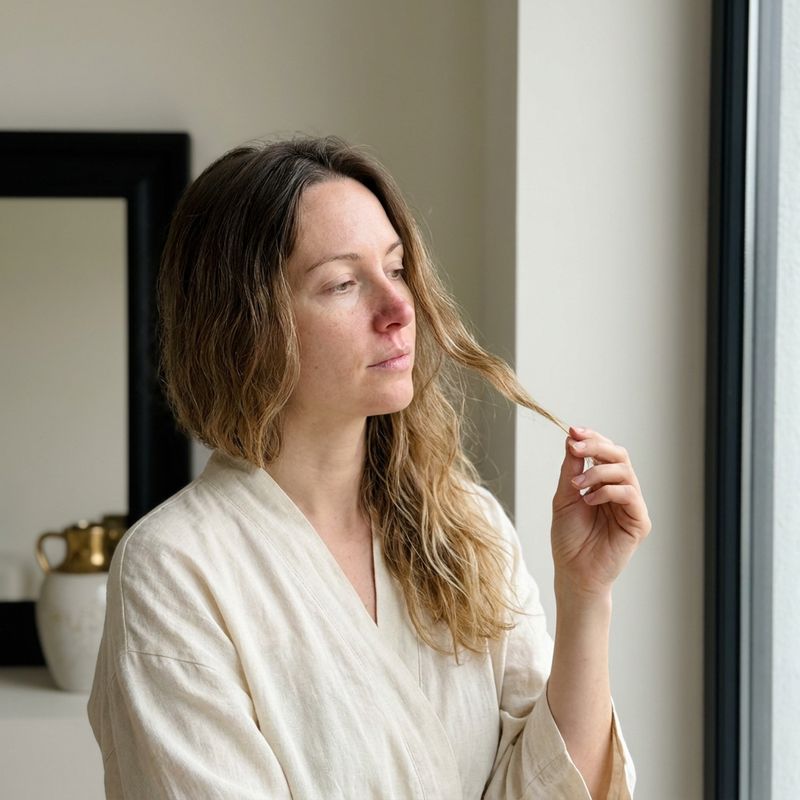
You’ve been back from vacation for a week. You’re looking at hair you should recognize, and something still feels off. What is it?
It’s not in your head, and it’s not that your color simply “faded” the way a t-shirt fades in the wash. What you’re looking at in September isn’t one washed-out color. It’s three, and each one lived the summer differently.
Quick summary: your roots are the newest hair on your head — they grew in July and August and barely saw the sun. Your mid-lengths took the sun head-on for months. Your ends carry all of that plus salt, chlorine, and months of towel-drying. That’s why a June photo, even one of your own hair, no longer describes what’s actually there in September.
Why doesn’t hair color come back the same after summer?
It doesn’t come back the same because it’s not one fiber that spent the summer exposed — it’s three segments with three different histories, all attached to the same head. Your roots are the youngest part, grown during summer itself. Your mid-lengths have been out in the open since day one of vacation. And your ends, the oldest part of your hair, carry that exposure plus the extra wear of salt, chlorine, and towels.
Three different starting points on one head. That’s what needs reading before anyone decides anything — and it’s exactly what a June reference photo can’t tell you.
Why have your roots changed the least?
Your roots come through mostly intact for a simple reason: they’re literally the newest hair you have, and the sun hasn’t had time to damage them. The hair closest to your scalp grew during summer itself, so it’s only had a few weeks of exposure — not the full stretch of months your mid-lengths lived through.
This isn’t a guess. Research on hair photodamage backs it up. An open-access study comparing segments of the same hair after continuous UV exposure found that segments with longer growing time — meaning longer exposure time to sunlight — showed more severe photodamage than the root segment (Scientific Reports, PMC5374528). The damage is cumulative: it’s not just whether hair has seen the sun, it’s how long it’s been seeing it.
There’s one exception worth mentioning, without turning it into a rule: if you always part your hair in the exact same spot, that line has been catching direct sun all summer, unshielded by the rest of your hair. It’s a visible exception, not the norm for the rest of your crown — which is why whoever checks your hair looks at that line separately instead of assuming the whole area is the same.
What actually happened to your mid-lengths and ends?
Your mid-lengths took the sun head-on, week after week, from the first day you turned your back to it on a towel. There’s no “shield” protecting them the way the hair’s own volume protects your nape — they were out there, exposed, the whole summer.
Your ends go a step further. They’re the oldest part of your hair — the first section you colored, the one that’s been through the most blow-drying, flat-ironing, or previous color — and on top of that, they pick up everything specific to summer: salt that dries the fiber and leaves a stiff film on the surface, chlorine that opens the cuticle and lets particles deposit inside it, and the plain mechanical wear of towel-drying, over and over, at the beach or by the pool.
Put those three sections side by side, and you’d see three genuinely different fiber conditions — even though, dry and at a glance, they might look like the same color.
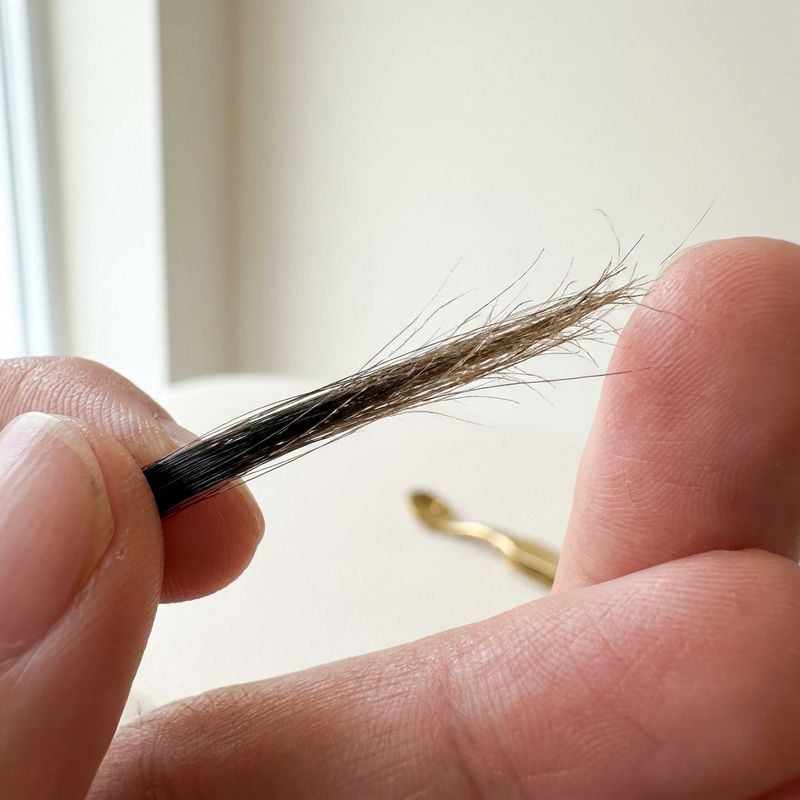
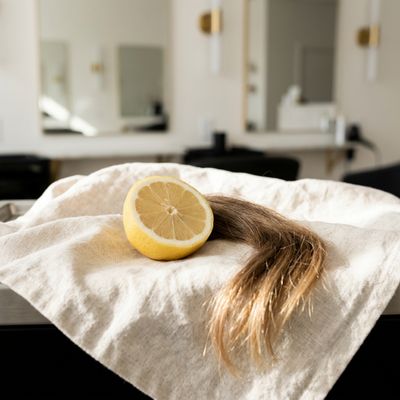
Same strand, two different stories: the root remembers less of the summer than the tip does.
Why doesn’t your June photo work as a reference anymore?
It doesn’t work because that photo describes hair that, technically, no longer exists. It captured one uniform state, and now you have three. Bringing it in and saying “this is what I want back” assumes your whole head started from the same place in September — when it actually started from three.
Think of Daniel, who came back from the coast convinced his ash blonde “just needed a root touch-up.” The problem was his mid-lengths had spent three months in the shared pool at his building, with copper from the water settling into a fiber the chlorine had made more porous. His roots — freshly grown — had none of that. Treating all three zones the same would have left an uneven result: perfect roots, mid-lengths shifting toward a tone that was never in the photo.
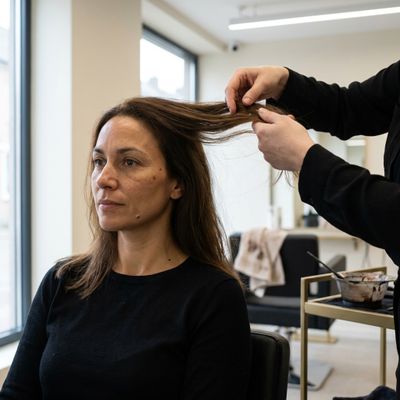
That’s why a real diagnosis isn’t done by comparing to an image — it’s done by looking at wet hair, strand by strand, zone by zone. That process is covered in technical depth in sun and chlorine damage: reading hair before coloring, written for whoever has to decide the formula. What matters here, as the person wearing the color, is knowing that diagnosis exists — and that it’s what keeps your September result from being a guess.
And if you’d rather arrive with fewer surprises next summer, the preventive side — what to do before you leave, not after you’re back — is in locking in your color before summer.
| Zone | What happened this summer | What you’ll notice |
|---|---|---|
| Roots | New growth, grew during summer itself | Barely changed — can look close to how it did in June |
| Mid-lengths | Direct, continuous sun for months | Duller reflect, tone reads less defined |
| Ends | Accumulated sun plus salt, chlorine, and towel friction | The zone that shows the biggest difference in touch and color |
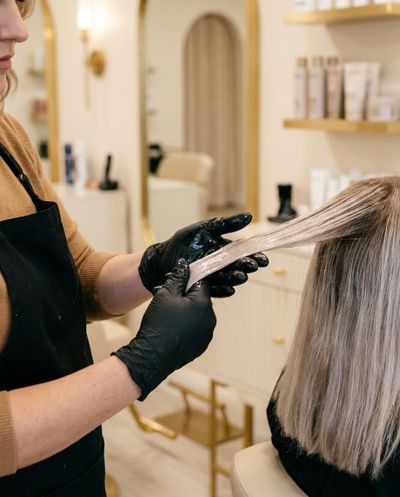
This table isn’t a recipe to fix at home — it’s the map of what your colorist will check before deciding anything. It’s never a DIY process: reading hair by zone means checking it wet, under neutral light, and that happens at an appointment, not from a tutorial.
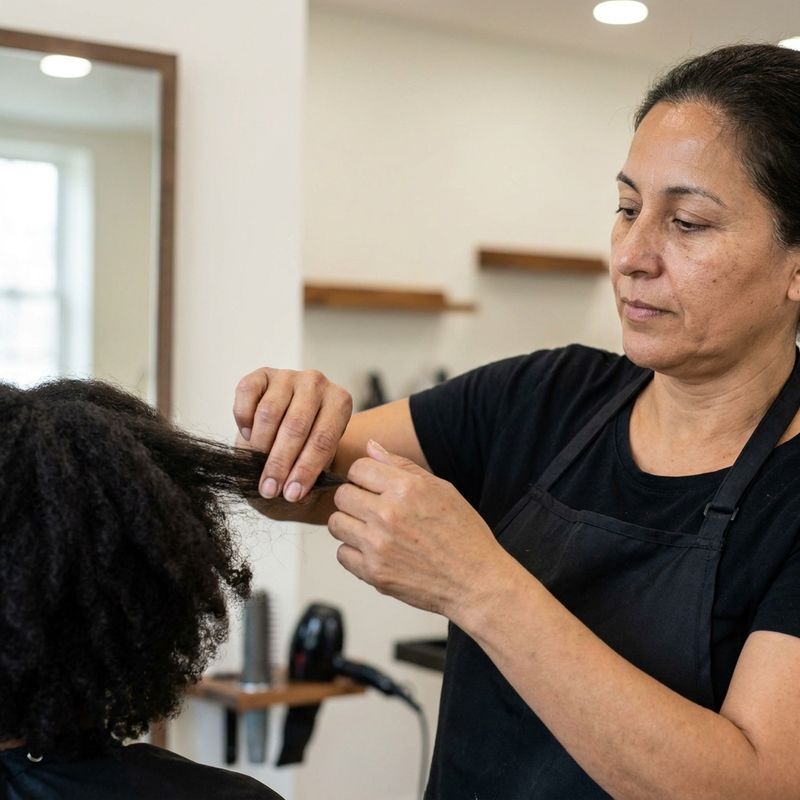
The diagnosis isn’t improvised — it’s read zone by zone, with the hair in hand.
Your starting point isn’t what it was in June
This is worth repeating, because it’s what changes the conversation in the chair: you’re not walking into September with “your usual color, a bit worn.” You’re walking in with three starting points on the same head, and that’s information, not a problem. Whoever colors you needs to know that before touching anything — the same way they need to know what you’ve been using at home or whether you’ve lightened your hair before. That full history, and why the order it’s told in matters, is laid out in what to tell your colorist before coloring.
What you can actually do before your appointment: don’t rely only on the June photo as your argument. Bring the story of what your hair actually lived through this summer instead — how many pool days, how much time in the sea, whether you wore a hat, whether your part always falls in the same place. With that, and with a wet strand in hand, the diagnosis stops being a guess.
Frequently asked questions
Why does my hair look lighter in summer but the color doesn’t last as long?
Because the sun can lighten pigment slightly while also opening the cuticle. With an open cuticle, any color applied afterward goes in faster — and leaves faster too. The initial result can look even more vibrant, and within a few weeks it’s noticeably duller than it was before vacation.
Do roots and ends need the same treatment?
No, and that’s exactly why the diagnosis happens by zone. Roots, being new growth, usually don’t need the same prep work as ends that have accumulated months of sun, salt, and chlorine. Treating all three zones identically is precisely what produces uneven results.
How long does it take hair to “forget” summer?
It doesn’t forget on its own — what changes is that as new hair grows in and the most damaged ends get trimmed, the proportion of damaged fiber goes down over time. A post-summer trim isn’t just cosmetic; it reduces the share of your hair carrying the most wear.
Can I still bring a photo to my appointment?
Yes, and it’s useful for explaining where you want to end up. The nuance is not presenting it as “this is what I need back,” since it describes one state and your hair is arriving with three. Use it for the destination, not the starting point.
In summary
- Summer doesn’t leave you with one color — it leaves you with three. Roots, mid-lengths, and ends aged at different speeds on the same head.
- Roots changed the least because they’re the newest hair, not because they were somehow “protected” from the sun.
- Mid-lengths and ends were exposed continuously, and ends carry the extra load of salt, chlorine, and towel friction.
- Your June photo no longer describes your hair today. A real diagnosis happens strand by strand, zone by zone, on wet hair — not by comparing to a picture.
Diagnoses that aren’t improvised
Whoever formulates your color after summer needs to see your hair by zone, not guess from a photo. Blendsor is the tool colorists use to calculate that formula from a real, zone-by-zone diagnosis — not from a memory of what your hair looked like in June.
And if you’re the one formulating? Blendsor runs the zone-by-zone calculation — porosity, grey coverage, base, colour history — from the diagnosis in front of you.
How long does it usually take your hair to feel like “itself” again after summer?
What happens if you don't recover hair color after summer?
In the app, we ask you a question like this one, but about your own client.
Up for this week’s case? → More on global color →Related articles
Practice with our colorimetry tools
Calculators, neutralization wheel, AI consultation...
The Blendsor newsletter
Color techniques and trends for professionals. No spam.
A client in the chair right now?
The Blendsor advisor gives you the precise formula for this technique with your salon's brands — and saves it to your client's card.
Ask about your caseWritten by the Blendsor team
Professional hair colorimetry experts with experience in AI-assisted formulation. We combine color science, salon practice and technology to help colorists formulate with precision.