Toner for Brassy Hair: Complete Pro Guide
The best toner for brassy hair depends on the type of brass. Learn which toner family works for orange, yellow-orange, warm yellow, and gold tones.
Blendsor
Blendsor Team
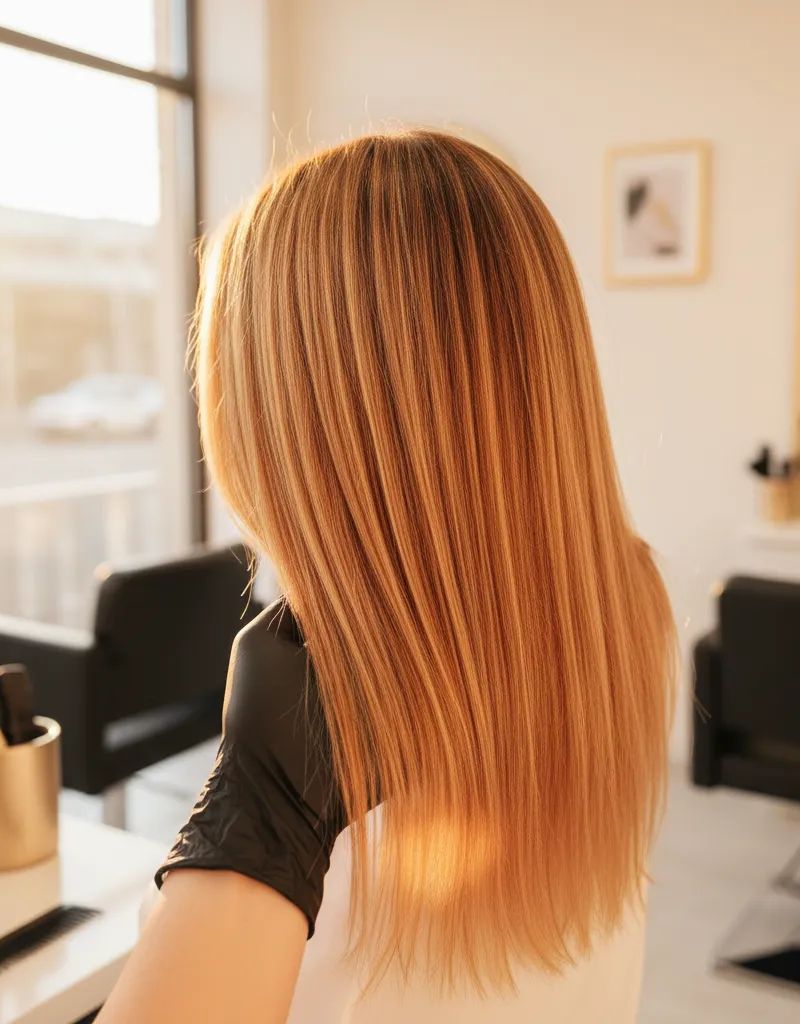
There is no single best toner for brassy hair. There are four different types of brassiness, each requiring a different toner family. Using the wrong one either does nothing or makes the situation worse.
The short answer: match your toner family to your brassiness level. Orange at levels 5-6 needs ash (blue-based). Yellow-orange at level 7 needs ash-violet. Warm yellow at levels 8-9 needs violet. Gold at levels 9-10 needs violet-pearl. For the full color theory behind this, see our colorimetry basics guide.
This guide breaks down exactly how to identify which type of brassiness you’re dealing with and what to use for each one.
The four types of brassiness — and why they matter
The Society of Cosmetic Chemists explains that brassiness is the visible expression of pheomelanin — the warm pigment that remains in the hair shaft after lightening. How much remains, and in what ratio, determines the exact tone you see.
In practice, there are four distinct scenarios.
Intense orange (levels 5-6)
The classic “naranjazo.” A saturated pumpkin or copper tone. This happens when lightening stopped too early on a dark base, leaving behind a heavy pigment load.
It’s the most visible and the most demanding to neutralize.
Neutralizer family: Blue (ash). Reflect code .1, high concentration.
Yellow-orange (level 7)
This is the most deceptive type. It’s not clearly orange and it’s not cleanly yellow. It looks like a dull, muddy blonde — the kind where you can tell something is off but can’t quite name it.
Neutralizer family: Ash-violet. Reflect code .01 or .12.
Warm yellow (levels 8-9)
Orange is largely gone at this level. What remains is a warm golden yellow — often from sun exposure or natural pigment oxidation. Common in balayage that has faded warm, or in natural blondes looking to go cool.
Neutralizer family: Violet. Reflect code .2.
Soft gold (levels 9-10)
The subtlest form of brassiness. A gentle warmth on very light blondes. Often the difference between a natural blonde and a cool or platinum blonde.
Neutralizer family: Violet-pearl. Reflect code .21 or .12.
Quick reference table
| Brassiness type | Level range | Root cause | Toner family |
|---|---|---|---|
| Intense orange | 5-6 | Insufficient lightening | Ash (.1) |
| Yellow-orange | 7 | Mixed warm pigment | Ash-violet (.01 / .12) |
| Warm yellow | 8-9 | Pheomelanin + oxidation | Violet (.2) |
| Soft gold | 9-10 | Natural warmth / sun | Violet-pearl (.21 / .12) |
Before selecting your toner, use the Blendsor Toner Selector to confirm the right family based on the underlying pigment you’re seeing.
The right toner formula for each brassiness type
Intense orange: ash family
Violet toner does not neutralize intense orange. Only blue does. If you try to use a violet-based toner on a level 5-6 orange, the result will be muddy or unchanged.
Formula for level 6 orange:
- 7.1 (40g) + 7.01 (15g) + developer 10 vol (1:1)
- Timing: 30-35 minutes
The 7.01 softens the result so it doesn’t read as grey or greenish. Pure ash with no buffer can produce that effect on dark backgrounds.
Professional tip: If the orange is very saturated, ask yourself whether a second gentle bleach (20 vol) would be more efficient than trying to neutralize it all with toner. Toner has coverage limits on intense underlying pigment.
Yellow-orange: ash-violet (.01 / .12)
This level is where most toning errors happen. The orange isn’t intense enough to need pure ash, but there’s too much warmth for violet alone to handle. Either route alone gives an unbalanced result.
Reflect .01 (ash-pearl) combines blue and violet in a balanced ratio. The .12 (ash-iridescent, depending on brand) achieves something similar.
Formula for level 7 yellow-orange:
- 8.01 (35g) + 8.1 (15g) + 8 (10g)
- Developer 10 vol (1:1.5)
- Timing: 25-30 minutes
The natural base (8) prevents the result from going flat.
Warm yellow: violet (.2)
At levels 8-9, orange is no longer the problem. Yellow is. Violet is the correct corrector here.
Formula for level 8 warm yellow:
- 9.2 (40g) + 9.21 (20g)
- Developer 10 vol (1:2)
- Timing: 15-20 minutes — watch it
Violet on light hair shifts fast. Leaving it too long creates grey or mauve tones. If you’re unsure, do a strand test and rinse at the 10-minute mark.
For more on why underlying pigment determines the outcome at every level, read our guide on cool blonde without orange.
Soft gold: violet-pearl (.21 / .12)
For very light blondes with a gentle warmth, violet-pearl gives a more luminous result than pure violet. The pearl (silver-iridescent) pigment adds cool brightness without dulling the hair.
Formula for level 9-10 gold:
- 10.21 (40g) + 10.01 (20g)
- Developer 10 vol (1:1.5)
- Timing: 15 minutes maximum
Brand recommendations
Wella Color Touch (ash series)
The professional standard for neutralizing brassiness. The 7/1, 8/1, and 8/81 (ash-pearl blonde) are the most used in salon for levels 6-8. Standard ratio is 1:2 with 4% developer. Results are predictable and controllable.
Check the Wella Color Touch shade chart for the exact level equivalent you need.
Redken Shades EQ
The gel formula gives better control on short timing, making it ideal for precise toning on lighter hair. Key tones: 09V (violet), 08T (titanium ash), and 07AB (ash blue). Covers all four brassiness types across the range.
Reference the Redken Shades EQ shade chart to find your level match.
Schwarzkopf Igora Vibrance
High pigment saturation makes this line effective when brassiness is persistent or intense. The 8-1 (ash light) and 9.5-1 (extra light ash) handle levels 8-9 reliably. Use for soft gold: 9.5-2 or 9.5-21 with short timing.
Find equivalents in the Igora Vibrance shade chart.
Not sure which tone to choose across brands? The Blendsor Toner Selector gives you a recommendation in seconds based on level and brassiness type — no brand preference required.
At-home vs. professional: where the line is
One of the most common questions is whether a client can maintain toning between appointments. The honest answer depends on the brassiness type.
| Situation | At home sufficient | Needs salon |
|---|---|---|
| Intense orange (level 5-6) | No | Always |
| Yellow-orange (level 7) | Possibly (blue shampoo) | Yes if persistent |
| Warm yellow (level 8-9) | Yes (purple shampoo 1-2x/week) | If precision matters |
| Soft gold (level 9-10) | Yes (toning shampoo) | Optional |
Why blue shampoo doesn’t fix intense brassiness
Blue shampoo deposits pigment on the surface of the cuticle. It works as a maintenance tool after a professional toning — or for very light brassiness. On a level 5-6 orange, the pigment load in any shampoo is simply too low to neutralize it. The client can use it between appointments to slow the brassiness returning, but not to eliminate it.
When to recommend purple vs. blue shampoo
- Purple shampoo: warm yellow at levels 8-9
- Blue shampoo: yellow-orange at level 7, or maintenance after toning a level 6 orange
For more on the toning correction toolkit, see our guide on neutralizing unwanted hair tones.
Why brassiness comes back — and how to slow it
Even after a precise toning, warmth returns. Three factors drive this consistently.
Hard water minerals
Calcium and magnesium ions in hard water oxidize the toner pigment and pull warmth back into the hair. A final rinse with filtered water or a chelating shampoo once a week can noticeably extend the life of a cool toning.
UV exposure
Sunlight degrades artificial pigment and accelerates pheomelanin oxidation. Any cool blonde without UV protection will warm faster, regardless of toner quality. UV-protective hair products are non-negotiable in spring and summer.
Sulfate shampoos
High-sulfate shampoos strip toner pigment significantly faster than sulfate-free alternatives. This is not a marketing claim — it’s basic chemistry. For clients who want their toning to last, sulfate-free shampoo for the non-treatment washes is a practical recommendation.
Maintenance protocol to share with clients:
- Blue or purple shampoo: 1-2 times per week, matched to their brassiness type
- UV hair protection: Essential in warm months
- Sulfate-free shampoo: For all other washes
- Chelating treatment or filtered final rinse: If local water is very hard
For the complete professional toning system, visit our professional toning guide.
Frequently asked questions
Why did my toner turn my hair green?
Green happens when there is excess blue pigment (ash) over a background that still has yellow. Blue + yellow = green. This is the most common over-toning error at levels 8-9. To fix it, add a small amount of gold or copper in the next application to rebalance the tone. To prevent it, reduce either the ash concentration or the processing time. Use the Blendsor Toner Selector to check pigment proportions before applying.
How often should I tone brassy hair?
It depends on the brassiness type and at-home maintenance. For an intense level 6 orange, professional toning typically lasts 4-6 weeks. For a level 7-8 yellow-orange with good maintenance (blue/purple shampoo, UV protection, sulfate-free wash), results can hold 6-8 weeks. The more consistent the at-home care, the longer the interval between appointments.
Does toner damage hair?
Toner applied correctly — with 10 vol developer or as a demi-permanent — has minimal impact on the hair structure. Damage happens with high-volume developers (20-30 vol) or excessive processing time. For hair already sensitized by bleaching, demi-permanents and deposit-only toners are the safest choice.
Can I use purple shampoo on intense orange hair?
No. Purple shampoo neutralizes yellow, not orange. On a level 5-6 orange, purple shampoo will have no visible corrective effect. You need blue pigment — either in a blue shampoo (for light maintenance) or in a professional ash toner (.1 reflect) for actual neutralization.
What happens if I apply ash toner over very brassy hair?
The result depends on how saturated the orange is and how concentrated the toner is. On a very saturated orange, a weak ash toner may produce a muddy brown rather than a cool neutral. A strong ash concentration may partially neutralize but leave uneven patches. For intense orange (levels 5-6), assess honestly whether a second bleach is needed before toning. Trying to neutralize too much orange with toner alone rarely gives a clean, even result.
Is there one universal toner that works for all brassiness?
No — and that is the core point of this article. An ash toner that works perfectly for level 6 orange may turn level 9 hair green. A violet toner ideal for level 8-9 does nothing on intense orange. The diagnosis always comes before the product choice. Start with the level and the type of brassiness, then select the toner family. The Blendsor Toner Selector and the neutralization wheel both help you do this systematically.
In summary
- Brassiness is not one problem — it’s four, each with a different toner family
- Intense orange (5-6): ash (.1), high blue concentration
- Yellow-orange (7): ash-violet (.01 / .12), balanced mix
- Warm yellow (8-9): violet (.2), short controlled timing
- Soft gold (9-10): violet-pearl (.21 / .12), light pigment
- Blue shampoo maintains but cannot correct intense brassiness
- Sun, hard water, and sulfates all accelerate brassiness return
Want the exact toner and proportions for your client’s specific situation? Use the Blendsor Toner Selector and get a recommendation in seconds.
Which type of brassiness do you find hardest to correct consistently — the level 7 yellow-orange or the saturated level 5-6 orange?
Related articles
Practice with our free tools
Calculators, neutralization wheel, AI consultation...
Apply this theory with precision
Blendsor analyzes 70+ variables and generates exact formulas based on real colorimetry. Try our free color consultation or download the app.
Download free