Bronde Hair: What It Is and How to Pin Down the Request
What is bronde: a brown base with lighter strands close to it and no hard stripes. How it differs from balayage and blonde, and how to pin down the request.
Blendsor
Blendsor Team
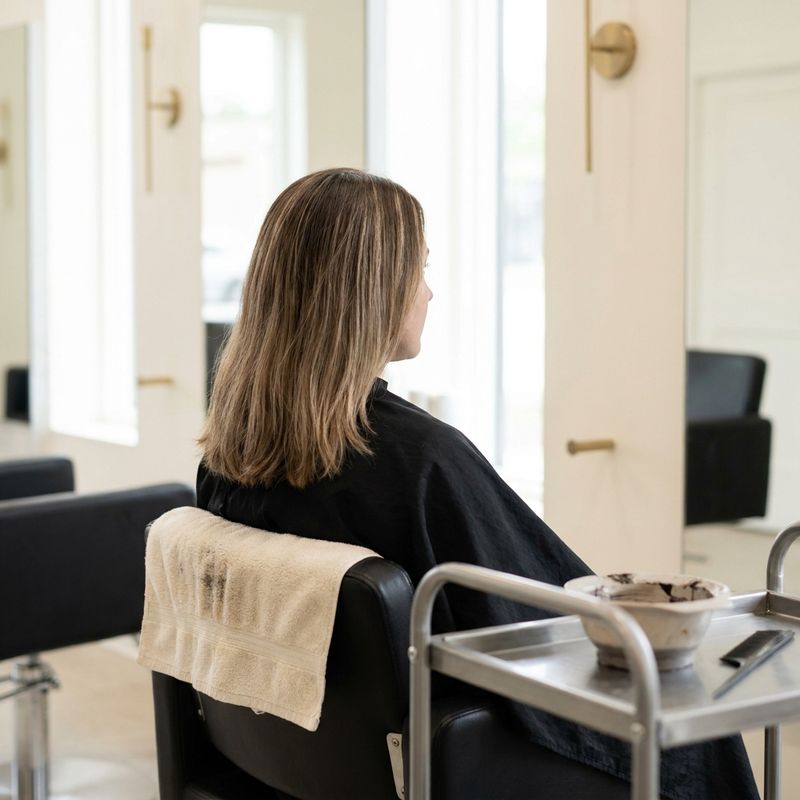
What exactly is someone asking for when they show you a photo of brown hair with some light running through it and say “I want bronde”?
If you formulate color, the word reaches the consultation with more than one meaning: for one person it is a brown with a touch of light, for another a dark blonde. Before you pick up the brush it pays to name what is in the photo. This guide gives you that vocabulary: what bronde is, how it differs from what looks like it, and which questions organize the request. It is part of our guide to hair color trends.
Quick summary: Bronde (from brown and blonde) is usually described as a brown base with lighter strands close to it and no hard stripes. It is named by the result and reached with fine highlights, balayage or other routes. What defines it is the small distance between the brown and the light.
What is bronde?
Bronde is a brightened brown: the base stays brown and lighter strands are added close to it, melting into it without hard stripes. The name joins brown and blonde, and Wella uses it in the sense of brown-blonde on the blog of its US store.
Two traits describe it. The base is still brown and the light sits close to it in depth, only a little lighter than that brown. That is why the result reads as a luminous brown rather than a blonde with dark roots.
There is a creamy variant, cashmere bronde, which already has its own section in the cashmere blonde article, so we don’t repeat it here.
How is it different from balayage, highlights and blonde?
Balayage and highlights are ways of applying; bronde is a result. You can reach it by more than one route, and the reference photo says more than the name of the technique.
| Term | What it names | What to look at in the photo |
|---|---|---|
| Bronde | A result: brown with lighter strands close to it | That the light melts into the brown |
| Balayage | A freehand technique, no foils, that gives natural gradients | Where it was painted: the technique doesn’t fix the distance to the brown |
| Foil highlights | A foil technique with defined contrast | Whether the contrast with the brown is strong |
| Lowlights | Darker strands that add dimension | That what is added is darker than the base |
To compare the techniques in depth, see balayage vs highlights and the guide to professional blonde balayage. For what darker strands add, the article on lowlights.
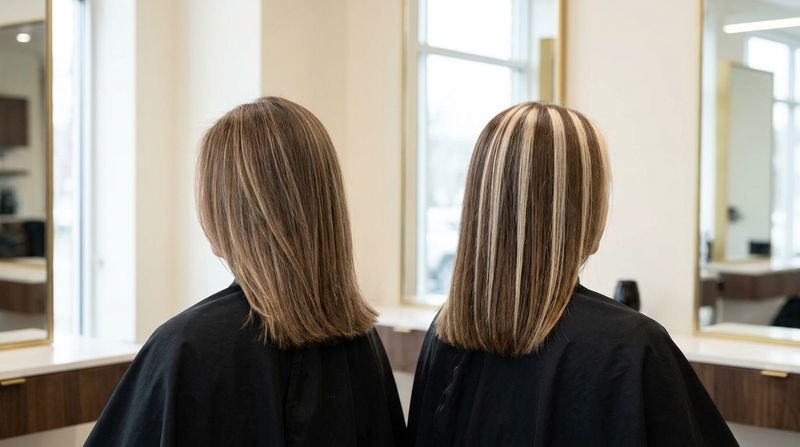
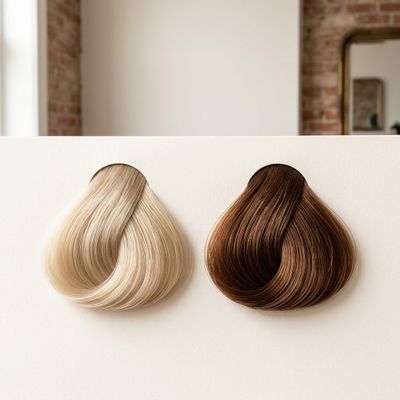
Concept illustration, not a real result. On the left the light melts into the brown; on the right it stands out. That difference decides whether a photo reads as bronde or as high-contrast highlights.
What changes depending on the starting point?
From a brown, the light stays close to the brown. From a blonde, the route runs the other way: you go darker.
From a brown
The strands lift less, and their underlying tone ends up warmer than in a light blonde. If that warmth is not what the person wants, a toner can cool it; how it is distributed in that version, and what you gain in return, is covered in the cashmere bronde section of the cashmere blonde article.
From a blonde
Someone who arrives blonde and asks for bronde is asking to go darker. One way is to darken in strands and leave light close to the brown, with a strand test first. The light you leave can’t sit far from the brown, or stripes appear.
Re-darkening a lightened base also has a step before it that changes the result, putting the underlying tone back, and the guide to pre-pigmenting when going darker from blonde explains it. If you’re not sure whether a filler is needed, do two strands, one with it and one without, and compare them dry.
How do you pin down a bronde request?
With the photo in front of you and four questions that you answer by looking, none of them with a number.
- Where is the light? Near the root, spread through the lengths or concentrated at the ends. The photo shows it better than the word does.
- How much lighter than the brown is it? Ask the person to point to the lightest strand and compare it with their base. That distance is the brief.
- Warm or neutral? The underlying tone of a brown with light comes out warm; whether the person wants it golden or more neutral changes how you tone.
- What upkeep is acceptable? With the light close to the brown, regrowth shows with less contrast. If what they want is very visible light, the request is a different one.
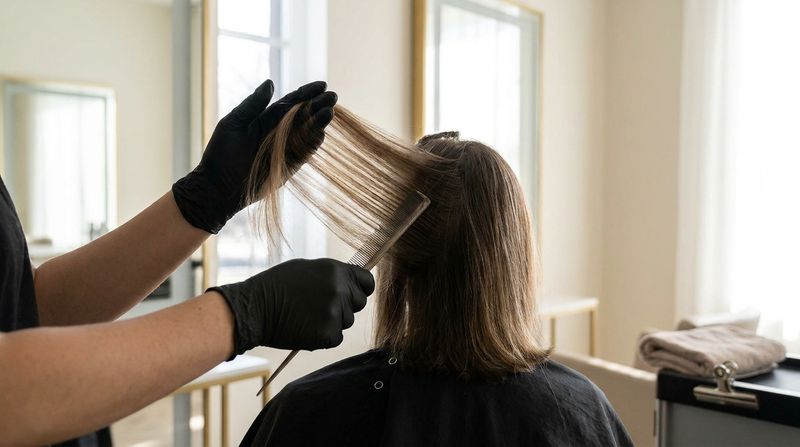
Pro tip: When someone says bronde, ask what they see in the photo before proposing anything. The word can cover a brown with light and a dark blonde, and each needs a different route.
Which tests come first?
The usual ones, done before you touch the whole head, not after.
- Allergy test: with the lead time the color manufacturer asks for; if your brand publishes none, not on the same day as the color appointment.
- Strand and elasticity test: on a hidden strand, test the same thing you will do on the head (the lightening if you start from brown; the filler and the color if you start from blonde). Stretch it wet: if it lengthens and doesn’t recover, the fiber is not ready for another process today.
Frequently asked questions
What does bronde mean?
It’s a blend of brown and blonde, and it is usually described as a brown base with lighter strands close to it and no hard stripes.
Is bronde a technique?
It is named by the result, not by the technique. It can come from fine highlights, balayage or other routes, depending on the starting point and what the photo shows. To choose between them, review balayage vs highlights.
Are bronde and cashmere bronde the same?
Cashmere bronde is a brightened brown with a creamy finish. It shares the definition of bronde and adds how it is toned; it is explained in the matching section of cashmere blonde.
Does bronde work for someone starting from blonde?
It does, although then what is being asked for is to go darker, and one way is to darken in strands and leave light close to the brown, with a strand test first. The step of putting the underlying tone back is in the guide to pre-pigmenting.
In short
- Bronde = brightened brown: a brown base with lighter strands close to it and no hard stripes.
- It is a result: you reach it with fine highlights, balayage or other routes; what counts is the distance between the brown and the light.
- Four questions: where the light is, how much lighter it is, warm or neutral, and what upkeep is acceptable.
- Tests first: allergy test with the manufacturer’s lead time (if none is published, not on the same day as the color appointment), strand and elasticity.
Calculate professional formulas with AI
Want to generate personalized formulas for a brightened brown based on the starting level and each person’s chemical history?
What do people ask you for more when they say bronde: more brown or more light?
Manufacturer sources
Manufacturer documents consulted for this article. A copy of each one is kept, and the passages noted from it are checked against that copy.
Note each one's country: the same line's instructions can differ from one market to another, so follow the directions for the product you use.
Related articles
The Blendsor newsletter
Color techniques and trends for professionals. No spam.
You know the theory. What about today's case?
Send a photo to the Blendsor advisor and get an answer grounded in colour theory: toner, developer and timing, with the brands on your shelf.
Ask about your caseWritten by the Blendsor team
Professional hair colorimetry experts with experience in AI-assisted formulation. We combine color science, salon practice and technology to help colorists formulate with precision.