Can You Use a High-Lift Tint on Gray Hair?
A high-lift tint doesn't cover gray the way a standard color does. What L'Oréal publishes as the ceiling for Majirel High Lift, and what to do when your client goes over it.
Blendsor
Blendsor Team
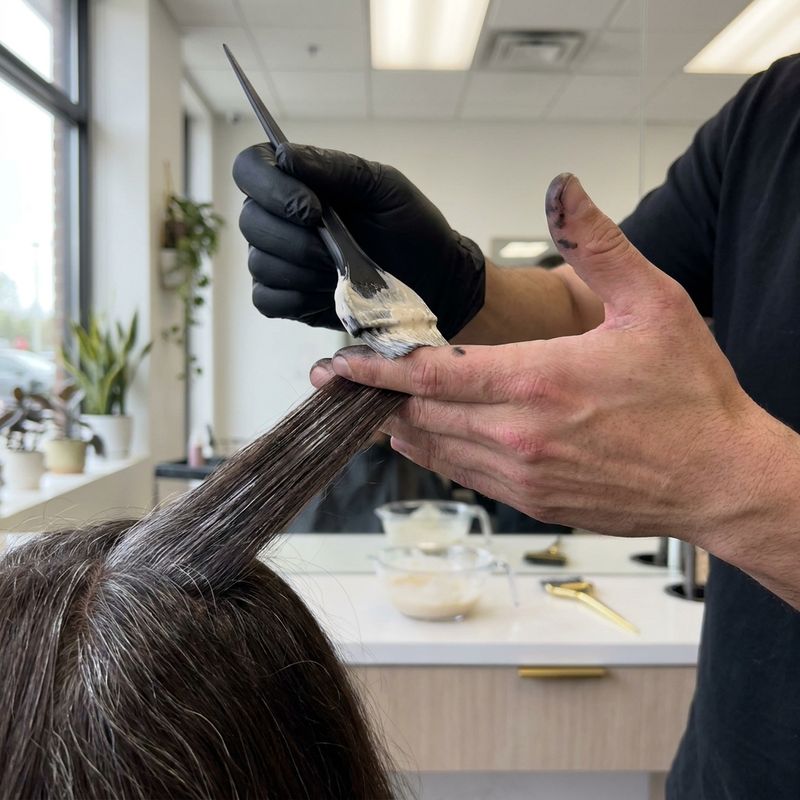
Have you promised a client a one-step blonde with a high-lift tint, only to watch the result come out sheer exactly where the gray was thickest?
That’s not an application error. The product is doing exactly what the manufacturer publishes it does, and also what it doesn’t publish it does: a high-lift tint is built to lift several levels in one step, and gray coverage isn’t part of that promise by default. Bring gray into the mix and that difference shows up in the mirror.
Let’s look at the coverage ceiling one manufacturer actually publishes for a specific high-lift tint, why that ceiling exists, and what to do when your client is past it.
How much gray does a high-lift tint cover?
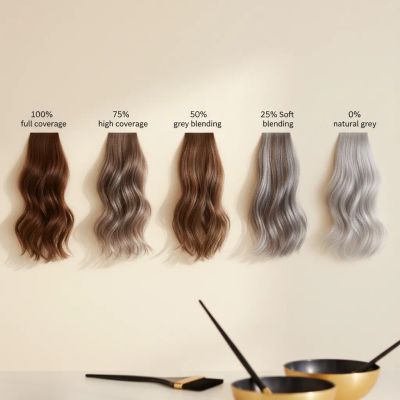
L’Oréal Professionnel publishes for Majirel High Lift, its high-lift line, that it can cover up to 30% of white hair and that it does not cover 100% gray hair. The product page doesn’t specify whether that 30% is the share of gray across the whole head or the opacity achieved on gray that’s already covered, so this article takes the more conservative reading: don’t push the product past 30% gray coverage of the head.
It’s a data point tied to one brand and one product, not a category-wide number. Every manufacturer sets its own ceiling, and if you work a different line, its threshold may be different.
Manufacturer data: Majirel High Lift mixes at a 1:2 ratio with a 30 or 40 volume developer. L’Oréal’s product page doesn’t publish a gray-coverage protocol for this line, only lift guidance by natural base. That matters for what comes next.
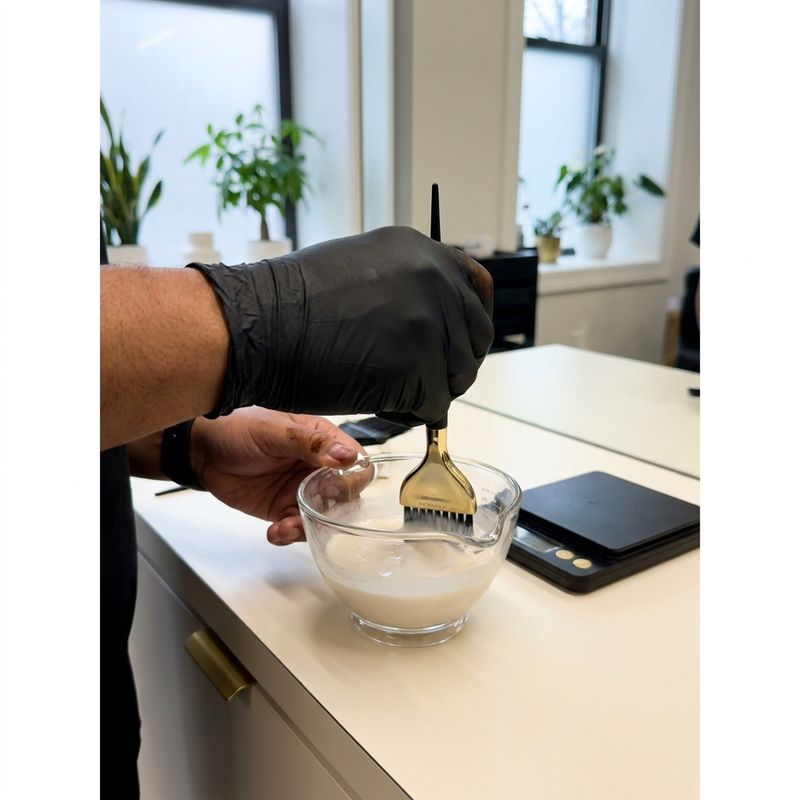
1:2, not 1:1: the ratio that activates the lightening powder.
Why does a high-lift tint cover less gray than a standard color?
The reason isn’t just “more developer, less deposit.” That’s true, but it’s the third cause, not the first.
First, the product’s design. L’Oréal publishes explicit gray-coverage protocols for Majirel standard and for Cool Cover. On standard Majirel, above 50% gray, the brand prescribes half the target shade plus half a same-level shade, and which second shade depends on the goal: gold for a warm result, natural for a cool one. Cool Cover follows a different rule: at levels 3 to 5, the target shade is applied unmixed, and only from level 6 up does the half-and-half blend appear, reserved for opaque coverage. For Majirel High Lift, the same usage chart L’Oréal publishes for the whole Majirel range carries no equivalent instruction: its row only lists lift tips. A high-lift tint exists to take hair several levels up in one step, and that missing gray protocol lines up with that purpose.
Second, gray has no melanin left to lift. A high-lift tint works by breaking down existing natural pigment. Gray hair, by definition, no longer has that pigment. So the product’s mechanism doesn’t find the same substrate to act on that it finds in pigmented hair. This is basic colorimetry reasoning, not a manufacturer claim: it may explain why the result reads sheerer on gray than on the rest of the strand, not why coverage runs low overall.
Third, high-volume developer doesn’t favor deposit. Blendsor already covers this when discussing developer strength: the higher the peroxide concentration, the more lift and the less deposit, because the balance shifts toward lifting pigment rather than leaving it. In a high-lift tint, that high volume (30-40 vol) isn’t something you can dial down to improve coverage. It’s fixed by the product’s own mixing instructions. Lower it, and you no longer have a high-lift tint.
What do you do when your client is past that limit?
This is where it pays to be precise about what the manufacturer says, and what it doesn’t.
L’Oréal publishes its rescue mix for gray coverage on standard Majirel and on Cool Cover, with the split described above. On the usage chart for the Majirel range, the High Lift row carries no equivalent mix: we didn’t find one on the product page, on that usage chart, or in the line’s formulation guide. It’s a consistent absence across every piece of documentation the manufacturer publishes for this product, and it means there’s no brand recipe for “stretching” a high-lift tint’s coverage by blending in a natural base. Eyeballing it changes a ratio no chart accounts for.
The practical takeaway: once your client’s gray percentage clears the published ceiling, anything you do with the high-lift tint beyond that point has no chart backing it up. The two moves with real backing are:
- Diagnose the gray percentage before you promise the result, and check more than one zone. Gray tends to show up first at the temples and hairline before the nape, as our professional gray-coverage guide notes when it describes moderate gray as “concentrated at the temples.” Compare temples, hairline, crown, and nape under neutral light, and estimate the ratio of white to pigmented strand in each. If the total clears the ceiling your brand publishes for the high-lift tint, say so before you apply, not after.
- Reserve the high-lift tint for the pigmented hair and cover the gray with the standard line. When gray is grouped in one zone (root, temples), you can zone the service: high-lift tint on pigmented hair, standard line with its own percentage-based mixing protocol on the gray zone. When gray is threaded evenly through the length, zoning isn’t possible: the same strand you want to lift several levels is the strand that needs coverage, and there the high-lift tint alone isn’t the right tool, no matter how far under the percentage ceiling you are. Our gray-coverage guide lays out the natural-base ratios the standard line uses by percentage bracket for those cases.
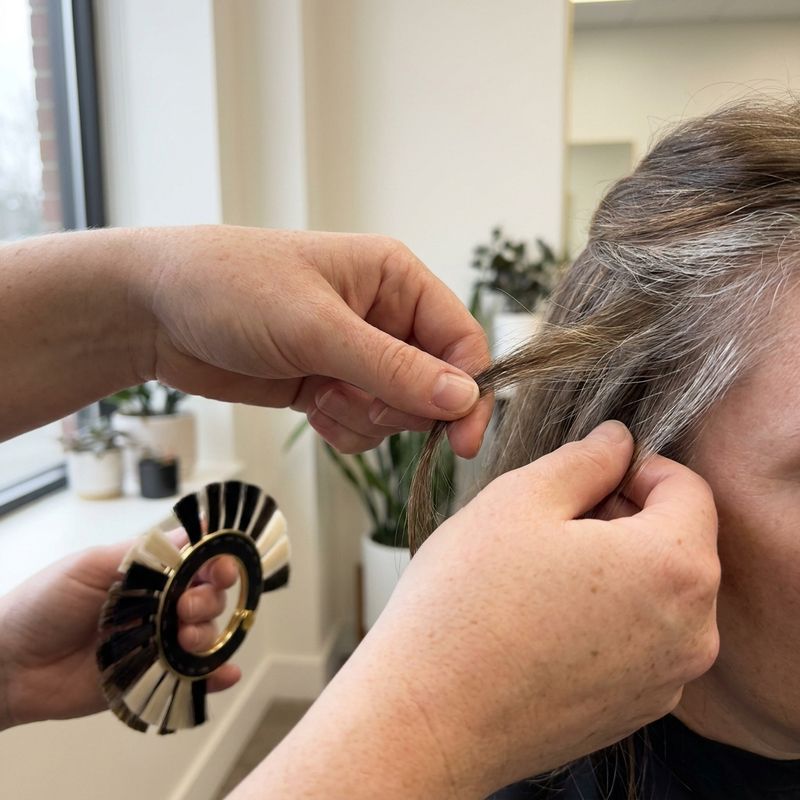
The nape isn’t the only zone worth checking.
That’s the same standard already applied before any decolorizing service: diagnose before you apply, and pick the product based on what the manufacturer confirms it does, not what you assume it should do.
Pro tip: If your diagnosis shows more gray than your high-lift line covers, say it at consultation, not at the backbar. Whoever knows upfront that the gray needs a separate formula walks in with the right expectations; whoever finds out in the mirror doesn’t.
When can you trust the high-lift tint alone?
When the gray diagnosis comes in under the ceiling your brand publishes (for Majirel High Lift, the 30% L’Oréal confirms) and the natural base falls within the range the product page allows: on lighter bases, the page itself calls for a 30-volume cream developer.
Outside that base range, or above the published gray ceiling, go back to the previous section: diagnose across multiple zones, and reserve the standard line for the strand that needs guaranteed coverage.
FAQ
Does a high-lift tint cover 100% gray?
No. L’Oréal publishes this outright for Majirel High Lift: it can cover up to 30% of white hair, not 100%. That’s a single product’s data point, so if you work a different brand, confirm its own product page before applying the same rule.
What developer volume do you use with a high-lift tint?
Whatever the product’s own chart calls for, not what you’d reach for on standard gray coverage. Majirel High Lift mixes 1:2 with 30 or 40 volume developer depending on natural base. There’s no room to dial it down without losing what makes it a high-lift tint.
Can I blend the high-lift tint with a natural base to cover more gray?
We haven’t found manufacturer backing for that on this line. L’Oréal does publish that blend (half target shade, half same-level shade) for its standard line and for Cool Cover, but not for High Lift. Blending it on your own changes a ratio no chart covers.
What happens at the next appointment if it wasn’t diagnosed right the first time?
The gray percentage itself won’t shift noticeably in six weeks, but at the retouch you’re no longer reading it against already-colored length: you’re reading it at the new root, at the temples, at the hairline. If the first service came up short because the high-lift tint got pushed past its ceiling, the retouch inherits the same problem, now with a demarcation line on top. Our guides on breaking the gray demarcation line and on French blending for gray coverage cover how to fix it once it’s already happened. Diagnosing right the first time keeps you from getting there.
Key takeaways
- Gray coverage isn’t built into Majirel High Lift by default: it’s a lift-focused line, and L’Oréal’s documentation confirms that by what it leaves out (a gray protocol) compared with its own standard line
- L’Oréal publishes a concrete ceiling for Majirel High Lift: up to 30% of white hair, never 100%
- Three causes, in order: the product’s design with no coverage protocol, gray’s lack of melanin, and third, the high developer volume the mix requires
- Past the ceiling, there’s no manufacturer rescue mix: diagnose across multiple zones and reserve the standard line for the strand that needs guaranteed coverage
- Today’s diagnosis shapes the retouch six weeks out: coverage pushed past its ceiling carries forward into the new root
Calculate professional formulas with AI
Want to generate lightening and gray-coverage formulas based on your client’s actual percentage and the line you work with, without memorizing which chart covers what?
Have you ever had to redo a service because you trusted a high-lift tint with more gray than it could handle?
How much gray hair does a high-lift tint actually cover?
In the app, we ask you a question like this one, but about your own client.
Related articles
Practice with our colorimetry tools
Calculators, neutralization wheel, AI consultation...
The Blendsor newsletter
Color techniques and trends for professionals. No spam.
You know the theory. What about today's case?
Send a photo to the Blendsor advisor and get an answer grounded in colour theory: toner, developer and timing, with the brands on your shelf.
Ask about your caseWritten by the Blendsor team
Professional hair colorimetry experts with experience in AI-assisted formulation. We combine color science, salon practice and technology to help colorists formulate with precision.