Champagne Blonde: Professional Formula for the Elegant 2026 Blonde
Cross-brand champagne blonde formula at levels 8-9 with exact codes for Wella, L'Oréal and Schwarzkopf. The low-maintenance blonde, explained step by step.
Blendsor
Blendsor Team
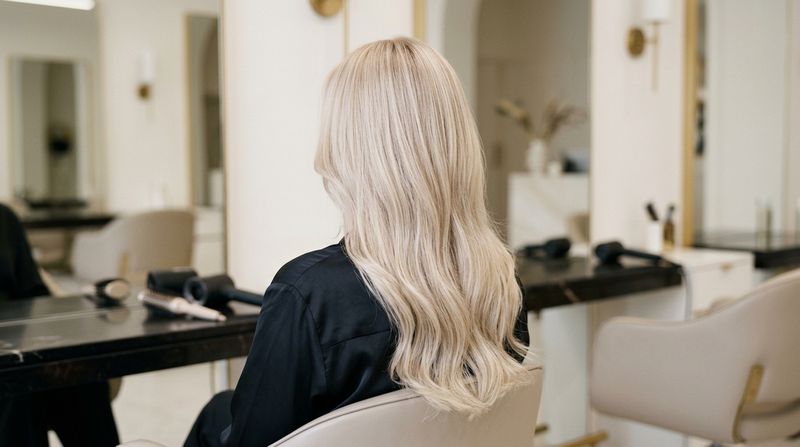
The blonde that looks expensive isn’t the lightest one. It’s the most controlled one.
That’s the logic behind champagne blonde: a level 8-9 blonde so precisely calibrated it looks like the hair was born that way. No strident shine. No harsh roots. No yellow. Just a soft, almost pearlescent luminosity that signals craftsmanship before anyone says a word.
It’s the blonde clients tend to ask for when they want the “quiet luxury” look. And it has a concrete formula logic.
Here it is in full: what technically separates champagne from golden or platinum, what starting base it needs, and which chart shades fit it in Wella, L’Oréal and Schwarzkopf.
Quick summary: Champagne blonde is a level 8-9 blonde with a very subtle golden tone and pearl or ash correction that neutralizes yellow without overcooling. It isn’t one box number: each brand builds it from its own shades. The volume depends on whether each zone needs deposit or lift. The key is restraint: less pigment than golden, more control than platinum.
What is champagne blonde and how does it differ from golden, butter, and platinum?
The confusion between neighboring blonde tones is one of the most common conversations in the salon. A client requests it by name and the professional needs to understand exactly what’s behind that name.
Here are the four differences that matter:
| Tone | Level | Dominant Reflection | Temperature | Maintenance |
|---|---|---|---|---|
| Champagne blonde | 8-9 | Pale gold + pearl or ash | Very subtly neutral-cool | Low |
| Golden blonde | 8-9 | Saturated gold | Pronounced warm | Medium |
| Butter blonde | 8-9 | Natural creamy yellow | Soft warm | Medium |
| Platinum blonde | 10+ | No reflection or pure ash | Cool or neutral | High |
Champagne blonde is not a cool blonde. It’s an almost-neutral blonde with barely-suggested warmth, like bubbles in a glass: present, but light. The difference from golden blonde is about saturation: golden has pronounced golden pigment; champagne has it in minimal doses, balanced with a pearl or gentle ash corrector.
That restraint is what makes it look expensive. And also what makes it technically demanding.
To understand the level structure where this tone lives, the hair color level guide maps every zone of the spectrum with lift stages.
What level and what number is champagne blonde?
Champagne isn’t a single number that works in any brand. It describes a result: a light blonde, usually at level 8 or 9, with a soft gold reflect and a touch of pearl or ash that takes the yellow out. Each brand builds it from its own shades and numbers them its own way: Wella writes the reflect after a slash (9/03), L’Oréal Majirel after a dot (9.3) and Schwarzkopf IGORA Royal after a dash (9-55). So when someone asks “what level is champagne blonde”, the answer is a level and a reflect. The code comes afterwards, from the chart you work with.
That also covers the “pale champagne blonde” and “champagne platinum” requests. Pale champagne sits at the light end (level 9, with more pearl than gold). Champagne platinum is a different service: it starts from a level 10 base, which means the lightening and maintenance of a platinum, with only a whisper of warmth on top.
Champagne or golden: where the difference lies
Gold is the reflect; champagne is the dose. In a golden blonde, the gold leads. In champagne, a pale gold is held back with pearl or ash: you sense the warmth, but it doesn’t read yellow. A simple check by the window: if the hair looks yellow, it’s golden; if it looks like luminous beige, it’s heading toward champagne.
Ideal starting base: why level 7-8 with a clean history is the entry point
Champagne blonde works best on a starting base between level 7 and 8 with a controlled chemical history. Here’s the reasoning:
Why not below level 7
Below level 7, the underlying lift stage still contains residual orange. The pearl or ash corrector in champagne doesn’t have enough strength to neutralize an intense orange-yellow undertone. The result: a tone that looks flat in mid-lengths and greenish at the ends.
Why not above level 9 without pre-work
On a level 9-10 base with no residual pigment, champagne can read as too cool or dull if the pearl corrector dominates. On very lightened bases, the corrector proportion needs adjustment or a minimal amount of gold needs to be added to restore warmth.
Why history matters so much
Champagne blonde demands homogeneous porosity. On hair with multiple previous processes, especially older partial bleaching or aging balayage, the more porous sections absorb the corrector unevenly. The result can have zones that read cooler and zones that read warmer with no harmony between them.
The solution before formulating: run the elasticity and porosity test to map the zones and adjust the protocol section by section.
Ideal base: level 7-8, virgin or recently evenly lightened, with no accumulated artificial pigment in the lengths.
Cross-brand formula with exact codes
This is the core section. Champagne blonde has a clear technical signature: very subtle gold + a light pearl or ash corrector. Below are the chart shades in each brand that fit that signature. No percentages: you decide the balance between the gold and the cool shade by looking at the test strand, because it depends on the underlying pigment in front of you.
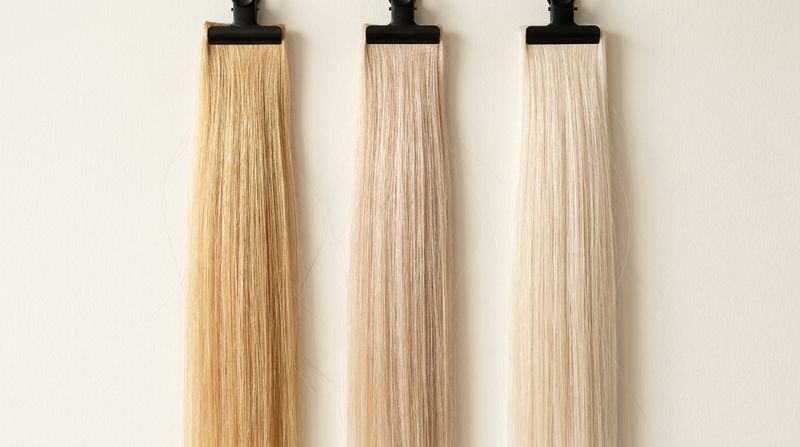
Wella Illumina Color
On Wella’s Illumina Color shade chart, level 9 has the two pieces champagne needs:
- 9/03 (Very Light Natural Gold Blonde): the soft warmth.
- 9/60 (Very Light Violet Natural Blonde): the cool shade that takes out yellow without dulling.
More 9/03 if the result falls flat; more 9/60 if yellow shows through. Mix and process it as the Illumina instructions for your market say.
Note: the current Illumina chart has 8/36 and 10/36, but no 9/36.
L’Oréal Majirel
Majirel separates level and reflect with a dot, and its shade list changes by market. On L’Oréal’s 2025 Majirel shade chart for the US, level 9 has 9.3/9G among the Golds and 9.1/9B among the Blues: champagne’s gold and cool sides. The same chart has shades that carry both in one tube: 9.31/9GB if you want the gold to lead, and 9.13/9BG if you want the cool side to lead. Check the chart for your own market before you order.
On mixing, L’Oréal’s Majirel How To Use sheet for the US lists Majirel at 1:1.5 with Majicrème Developer. Take the developer volume from the newest Majirel document for your market: which one you choose depends on whether you’re only depositing or also lifting the root a little.
Note: the US chart also has 9.03/9NG at level 9; the chart for Spain doesn’t.
Schwarzkopf IGORA Royal
IGORA separates level and reflect with a dash. At level 9, the IGORA ROYAL technical manual for the UK lists:
- 9-0 (Extra Light Blonde Natural): the neutral base.
- 9-55 (Extra Light Blonde Gold Extra): the gold. It’s intense, so it goes in small amounts.
- 9-1 (Extra Light Blonde Cendré): the cool shade that holds back yellow.
If you’re after “Schwarzkopf champagne blonde”, the logic is this: 9-0 as the body, a touch of 9-55 for warmth, and 9-1 only if the underlying pigment calls for it. Watch the names: on the US IGORA wall chart, -1 is Cendré and -2 is Ash, so “ash” in English is not IGORA’s -1. If you’re unsure which you need, the difference between Ash and Cendré in IGORA explains it shade by shade.
On the US IGORA wall chart, IGORA ROYAL mixes 1:1 with the IGORA ROYAL Oil Developer, and 6% (20 Vol.) is the one for tone-on-tone coloration and for lifting 1-2 levels.
Cross-brand summary table:
| Brand | Chart shades at level 9 | Mixing |
|---|---|---|
| Wella Illumina Color | 9/03 and 9/60 | As the Illumina instructions for your market say |
| L’Oréal Majirel | 9.3/9G and 9.1/9B, or one shade: 9.31/9GB or 9.13/9BG (US chart) | 1:1.5 with Majicrème Developer (US) |
| Schwarzkopf IGORA Royal | 9-0, 9-55 and 9-1 | 1:1 with the Oil Developer (US) |
Before you apply any of these mixes: they’re oxidative colors, so the allergy test goes first, on a different day from the color appointment. Wella’s Koleston Perfect leaflet says to always perform an allergy test 48 hours before any color service. Redness, burning or itching at the test site means the color is not applied, and the client gets medical advice before coloring again. And if the client has ever had an allergic reaction to hair color, you don’t color.
Developer and timing: which volume and why
With champagne, you pick the developer by what the mix has to do in each zone, within what your color line allows.
When you only need to deposit
When the base is already at the target level and you’re only correcting the reflect (tonal refresh, maintenance gloss), you want the volume the line gives for tone-on-tone work. For IGORA ROYAL, the US wall chart gives 6% (20 Vol.) for tone-on-tone coloration. For Majirel, L’Oréal’s newest US chart ties each developer volume to the lift you need, so take it from the chart for your market. If what you’re toning is mid-lengths and ends that were already lightened, look up your line’s guidance for depositing color on pre-lightened hair: it isn’t necessarily the same as the tone-on-tone one.
When the root needs to lift
If the natural root is darker than the champagne you’re after, the root needs lift and the lengths, already in range, don’t. That’s why it’s common to work with two mixes: one for the root, with the volume that lifts what’s missing, and one for mid-lengths and ends, with the deposit volume. For IGORA ROYAL, the same 6% (20 Vol.) lifts 1-2 levels per the US chart. If the root needs more than that, it’s no longer a tone-on-tone service and the plan should change. Timing for each zone follows each line’s instructions.
Because root and lengths take different amounts of product, use our hair dye amount calculator to get exact grams of color and developer for each zone before you mix.
Why not go up a volume “just in case”: more volume lifts the underlying pigment further and brings out more yellow, and champagne’s soft corrector isn’t built to cover it. The result stops being champagne and starts looking like butter or golden. Champagne is control, not power.
For more on the real behavior of each developer volume, the article why 30 volume developer delivers fewer levels than promised explains the technical logic with real data.
Low maintenance: what’s true about champagne blonde
Part of champagne blonde’s low-maintenance reputation has a technical explanation, not a marketing one.
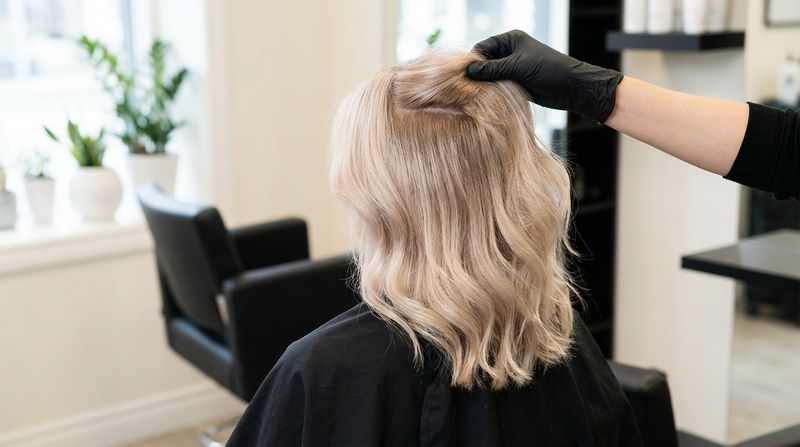
Why it asks for less maintenance
-
The root grows out with less contrast: champagne sits close to the natural level of many people who ask for it, and the tone itself isn’t extreme. When the root shows, it stands out less than on a platinum. How often the client needs to come back has no fixed number: it depends on how fast the hair grows, on the contrast between root and lengths, and on how much regrowth the client is happy to see.
-
Less bleaching: unlike platinum, champagne doesn’t require the base to reach level 10 or above. That reduces preliminary bleaching, the associated reconstruction treatments and the risk of structural damage.
-
Simpler at-home maintenance: a gentle toning shampoo, used only when yellow starts to show, keeps the tone fresh.
The right argument for the salon: offering champagne blonde isn’t selling fewer services. It’s selling higher-value technical services, with a result that grows out better. The professional input (diagnosis, formula calibration, a separate root and lengths mix) is what makes the difference between a result that looks like champagne and one that just looks pale.
Most common mistakes: over-toning and an orange base that wasn’t lifted
Two mistakes are behind many of the champagne blonde results that fall short.
Mistake 1: Over-toning
The pearl or ash corrector in champagne is delicate to dose. Go heavy on the cool side, or use a violet toning shampoo too often at home, and champagne turns into a flat, grey-looking blonde.
The warning sign: the result loses its shine and looks dull under artificial light. Champagne should reflect light; if it doesn’t, there’s too much corrector.
The correction: at the next visit, less cool shade in the mix and a little more of the level’s gold to bring back the luminosity. What an over-toned blonde looks like and how to fix one is covered in the most common toning mistakes. For the theory on how complementary colors neutralize, see how to neutralize unwanted tones.
Mistake 2: Toning an orange base instead of lifting it
Formulating champagne blonde on a base that still shows an orange underlying pigment is a costly structural error. The pearl or ash corrector in champagne doesn’t have enough neutralizing strength to compensate for a real orange undertone.
What happens: the result has correct champagne zones in the lengths and golden-orange zones at the root and mid-shaft where the underlying warmth competes with the corrector.
The correct protocol:
- Get the base to yellow first by lifting it, with a strand test in front of you: a toner deposits color and doesn’t raise the level, and an ash or blue over that orange dulls it at the same level instead of turning it yellow
- Then apply the champagne formula over that yellow base
This step adds time to the service but saves corrections later. Present that lift as part of the professional protocol, not as an extra charge.
The ideal client profile: expectations, frequency, and framing the tone
Champagne blonde doesn’t work for everyone, and part of the professional work is knowing who it’s going to deliver for.
Ideal base profile:
- Natural level 7-8 (natural medium to light blonde)
- No heavy accumulated dark artificial pigment in the history
- Neutral or cool skin undertone (also works with warm undertone if the gold component is calibrated)
- Looking for low maintenance and a “high-end salon” result
Expectations to manage:
- Champagne is not the lightest possible blonde: if the client wants platinum or white, this is not their tone
- The initial result can feel “subtle” compared to platinum or golden; that’s exactly the point
- The tone’s longevity depends on at-home maintenance: toning shampoo when the tone needs it, not daily
Realistic retouch frequency:
- First visit: full service (lifting first if the base still shows orange, then the champagne formula)
- Next visit, when root contrast or the tone calls for it: tonal refresh on mid-lengths and ends with the deposit volume, and the root with the lift volume if the regrowth is enough to show
- Later visits: assess whether partial bleaching is needed or whether a tonal refresh is enough
How to frame it in consultation:
“Champagne blonde is a blonde that asks little of you between visits. The root doesn’t stand out as much because the tone isn’t extreme. You keep it fresh at home with a gentle toning shampoo when you notice the yellow coming back. And maintenance visits are usually simpler than the first one.”
Frequently asked questions about champagne blonde
What’s the difference between champagne blonde and ash blonde?
Champagne blonde has a minimal presence of golden warmth that prevents the result from looking flat or grey. Pure ash blonde uses cool correctors without gold: it can read as dull on warm-toned skin or under artificial light. Champagne is the balance point: neither warm nor cool, with luminosity built in.
Can you formulate champagne blonde on previously dark colored hair?
Not directly. If the hair has accumulated dark artificial color (levels 4-6 with permanent pigment), a color remover or controlled bleaching is needed first to bring the hair to level 7-8 with a manageable yellow-orange undertone. Before that, a strand test tells you how far that hair lifts and how the fiber holds up. Attempting to formulate champagne directly on a dark base produces an unclear, unpredictable result.
How long does the champagne tone last between visits?
It depends on porosity, washing and sun. With gentle at-home maintenance (toning shampoo when yellow shows through, lukewarm water when rinsing), the tone stays fresh until the pearl reflect starts losing body and the residual gold drifts toward butter. The retouch visit can be tonal only (without root work) if regrowth is minimal.
Does champagne blonde work on dark hair?
Only with prior progressive lightening work. On natural dark hair at levels 3-5, reaching champagne can take several controlled bleaching sessions before you formulate the final tone. How many is decided by the strand test and the elasticity test, not by a number set in advance. The safety points for that process (scalp, developer volume and maximum time) are in the professional bleaching guide. It’s a process to plan and communicate clearly in the initial consultation.
What toning shampoo works best for maintaining champagne blonde?
Low-intensity violet toning shampoos are the safest for champagne (they avoid the over-toning risk of heavily pigmented ones). More than the brand, what matters is how it’s used: the time its instructions give, and only when yellow comes back. If the hair starts to look grey or dull, space it out.
Summary
- Champagne blonde is level 8-9 with minimal gold and pearl or ash corrector: more neutral than golden, warmer than platinum.
- The ideal base is level 7-8 with a clean history: a darker base, or one that still shows orange, needs lifting before toning.
- It isn’t one box number: at level 9, 9/03 and 9/60 in Illumina, 9.3/9G and 9.1/9B (or 9.31/9GB and 9.13/9BG) on Majirel’s US chart, and 9-0, 9-55 and 9-1 in IGORA Royal.
- Developer: the deposit volume where the base is already at level, and more volume only on a root that needs to lift. Going up “just in case” pulls yellow.
- The most common mistake: too much cool corrector. Champagne needs to reflect light; if it doesn’t, it’s over-toned.
- It asks for less maintenance than platinum: it grows out with less contrast and needs less bleaching.
Want to fit the corrector to your client’s base (actual level, porosity, chemical history) without guessing at the bowl? Blendsor generates the champagne blonde formula calibrated to each case, with the shades of your working brand.
Manufacturer sources
Manufacturer documents consulted for this article. A copy of each one is kept, and the passages noted from it are checked against that copy.
Note each one's country: the same line's instructions can differ from one market to another, so follow the directions for the product you use.
What's the difference between champagne blonde and a regular golden blonde?
In the app, we ask you a question like this one, but about your own client.
Up for this week’s case? → More on blondes and lightening →Related articles
Practice with our colorimetry tools
Calculators, neutralization wheel, AI consultation...
The Blendsor newsletter
Color techniques and trends for professionals. No spam.
You know the theory. What about today's case?
Send a photo to the Blendsor advisor and get an answer grounded in colour theory: toner, developer and timing, with the brands on your shelf.
Ask about your caseWritten by the Blendsor team
Professional hair colorimetry experts with experience in AI-assisted formulation. We combine color science, salon practice and technology to help colorists formulate with precision.